In full body vs split training for women, neither wins on results. A 12-week trial in women who were new to lifting found similar gains in strength and muscle from both, when weekly sets were matched. So choose by how many days you can train: full body suits 2 or 3 days a week, and a split suits 4 or more.
You start reading about training plans and everyone says something different. “Train full body three days a week.” “No, do an upper/lower split.” “Push/pull/legs is best.” It is easy to worry about picking the wrong one and wasting months.
I’m Will Duru, a personal trainer with over 10 years’ experience in London. I write both full-body and split programs. Neither is better in general. They suit different weeks and different lives.
This guide looks at what the research on women shows, then helps you choose with sample plans for each option.
Quick answer: which should you choose?
| Your situation | Best fit |
|---|---|
| 2 days a week | Full body, 2 days |
| 3 days a week | Full body, 3 days (or a 3-day push/pull/legs) |
| 4 days a week | Upper/lower split |
| 5 or 6 days a week | Push/pull/legs or upper/lower plus extra days |
| Unpredictable schedule | Full body, 2 or 3 days |
What the research says about full body vs split training
A trial in women new to lifting
A 2022 randomized trial by Pedersen and colleagues compared the two approaches in 50 women with no resistance training background, of whom 44 finished. Over 12 weeks:
- Full-body group: 2 sessions a week, doing all 10 exercises each time.
- Split group: 4 sessions a week, 2 upper body and 2 lower body.
- Both groups: 3 sets per exercise, the same weekly sets, and each muscle trained twice a week.
Both groups improved on every measure, with no significant difference between them:
| Measure | Full body | Split |
|---|---|---|
| Bench press 1RM | +25.5% | +30.0% |
| Lat pulldown 1RM | +27.2% | +26.0% |
| Leg press 1RM | +29.2% | +28.3% |
| Muscle mass | +1.9% | +1.7% |
1RM means one-rep max, the heaviest weight you can lift once with good form. The authors concluded that two full-body sessions or four upper/lower sessions gave similar results in these women when each muscle was trained twice a week.
The wider evidence
A 2024 meta-analysis pooled 14 studies with 392 participants. It found that split and full-body routines did not significantly change strength or muscle gains when volume was equated. The authors said people can choose based on personal preference.
Training frequency research points the same way. A 2016 meta-analysis found training each muscle at least twice a week beat once a week for muscle growth. A larger 2019 analysis found no significant difference by frequency when weekly sets were matched. In other words, total weekly work matters more than how you divide it.
Do women need different rules? A 2020 meta-analysis found women and men gain muscle at a similar rate. Women showed larger relative gains in upper-body strength. The same principles apply to you.
What this means: both approaches work. Choose based on your schedule, your experience and what you will stick with.
Full body training: what it is and who it suits
Full body training means working all your major muscle groups in each session. A typical session includes:
- A squat pattern (lower body push)
- A hinge, such as a deadlift or hip thrust (lower body pull)
- An upper body press, such as a bench press or overhead press
- An upper body pull, such as a row or lat pulldown
- Extra work for arms, shoulders or core
You do this 2 or 3 times a week on non-consecutive days, such as Monday, Wednesday and Friday. For a wider look at the benefits, see the benefits of full-body workouts.
Full body works best if you
- Train 2 or 3 days a week. Every session trains every major muscle, so nothing gets missed.
- Are new to lifting. You practice each main lift 2 or 3 times a week, which helps you learn technique.
- Have an unpredictable schedule. Miss a session and you have not skipped “leg day”. You just train everything next time.
- Like simple plans. “Get to the gym three times this week” is easy to remember.
Pros and cons of full body training
| Pros | Cons |
|---|---|
| Only 2 or 3 sessions a week | Sessions can run 60 to 75 minutes |
| Each muscle trained 2 or 3 times a week | Squatting, pressing and rowing in one session is tiring |
| Missing a session does not leave a muscle untrained | Fewer sets per muscle in each session |
| Fewer workouts to plan and remember | Harder to give one area, such as glutes, extra focus |
Sample full body programs
Full body, 2 days a week
Day 1
| Exercise | Sets | Reps |
|---|---|---|
| Squat | 3 | 8-10 |
| Bench press | 3 | 8-10 |
| Bent-over row | 3 | 10-12 |
| Romanian deadlift | 3 | 10-12 |
| Overhead press | 2 | 10-12 |
| Plank | 3 | 30-45 seconds |
Day 2
| Exercise | Sets | Reps |
|---|---|---|
| Deadlift | 3 | 6-8 |
| Bulgarian split squat | 3 | 10-12 each leg |
| Lat pulldown | 3 | 10-12 |
| Incline dumbbell press | 3 | 10-12 |
| Dumbbell row | 2 | 12-15 each arm |
| Biceps curl | 2 | 12-15 |
Video: Barbell full-body workout with 12REPS. Watch this to see how a full-body session moves from lower body to upper body lifts in one workout.
Full body, 3 days a week
Day 1 (Monday)
| Exercise | Sets | Reps |
|---|---|---|
| Squat | 4 | 8-10 |
| Bench press | 3 | 8-10 |
| Lat pulldown | 3 | 10-12 |
| Hip thrust | 3 | 12-15 |
| Lateral raise | 2 | 15 |
Day 2 (Wednesday)
| Exercise | Sets | Reps |
|---|---|---|
| Romanian deadlift | 3 | 10-12 |
| Overhead press | 3 | 8-10 |
| Cable row | 3 | 10-12 |
| Leg press | 3 | 12-15 |
| Triceps extension | 2 | 12-15 |
Day 3 (Friday)
| Exercise | Sets | Reps |
|---|---|---|
| Bulgarian split squat | 3 | 10-12 each leg |
| Incline dumbbell press | 3 | 10-12 |
| Barbell row | 3 | 8-10 |
| Walking lunges | 3 | 12 steps each leg |
| Biceps curl | 2 | 12-15 |
For a fully planned version, see our 12-week 2-day plan for women.
Split training: what it is and who it suits
A split divides your muscle groups across different days. The common options are:
- Upper/lower: Alternate upper body and lower body days, usually 4 days a week.
- Push/pull/legs: Push muscles (chest, shoulders, triceps), pull muscles (back, biceps) and legs on separate days, 3 to 6 days a week.
- Body part split: One or two muscle groups per session, such as a chest day or a back day.
A split works best if you
- Train 4 or more days a week. You can do more sets per muscle while keeping each session a reasonable length.
- Have trained consistently for a year or more. As you progress, adding volume often helps. A split spreads it out.
- Want to focus on one area. An upper/lower split with two lower body days gives you room for extra glute work.
- Prefer shorter sessions. Many split sessions take 45 to 60 minutes.
- Have stalled on full body. A split can make it easier to add volume.
For a side-by-side look at the two most common choices, read upper/lower vs full body for women.
Upper/lower split (4 days a week)
Best for: Women training 4 days a week who want balanced development.
- Monday: Upper body
- Tuesday: Lower body
- Thursday: Upper body
- Friday: Lower body
Each muscle is trained twice a week, sessions stay a reasonable length, and the plan is easy to follow.
Video: Dumbbell upper-body workout with 12REPS. Watch this for an example of an upper body day you can use in an upper/lower split.
Upper Day 1
| Exercise | Sets | Reps |
|---|---|---|
| Bench press | 4 | 8-10 |
| Bent-over row | 4 | 8-10 |
| Overhead press | 3 | 10-12 |
| Lat pulldown | 3 | 10-12 |
| Biceps curl | 2 | 12-15 |
| Triceps extension | 2 | 12-15 |
Lower Day 1
| Exercise | Sets | Reps |
|---|---|---|
| Squat | 4 | 8-10 |
| Romanian deadlift | 3 | 10-12 |
| Bulgarian split squat | 3 | 10-12 each leg |
| Hip thrust | 3 | 12-15 |
| Calf raise | 3 | 15-20 |
Upper Day 2
| Exercise | Sets | Reps |
|---|---|---|
| Incline dumbbell press | 4 | 10-12 |
| Cable row | 4 | 10-12 |
| Arnold press | 3 | 10-12 |
| Pull-ups or assisted pull-ups | 3 | 6-10 |
| Face pulls | 3 | 15 |
Lower Day 2
| Exercise | Sets | Reps |
|---|---|---|
| Deadlift | 4 | 6-8 |
| Leg press | 3 | 12-15 |
| Walking lunges | 3 | 12 steps each leg |
| Leg curl | 3 | 12-15 |
| Cable kickback | 2 | 15 each leg |
Push/pull/legs split (6 days a week)
Best for: Experienced lifters who can train 6 days a week and recover well.
- Monday: Push (chest, shoulders, triceps)
- Tuesday: Pull (back, biceps)
- Wednesday: Legs
- Thursday: Push
- Friday: Pull
- Saturday: Legs
Each muscle is trained twice a week with plenty of sets per session. The trade-off is the least flexible schedule and the highest recovery demand.
Push day
| Exercise | Sets | Reps |
|---|---|---|
| Bench press | 4 | 8-10 |
| Overhead press | 3 | 10-12 |
| Incline dumbbell press | 3 | 10-12 |
| Lateral raise | 3 | 12-15 |
| Overhead triceps extension | 3 | 12-15 |
| Cable flye | 2 | 15 |
Pull day
| Exercise | Sets | Reps |
|---|---|---|
| Deadlift | 4 | 6-8 |
| Bent-over row | 4 | 8-10 |
| Lat pulldown | 3 | 10-12 |
| Cable row | 3 | 12-15 |
| Face pull | 3 | 15 |
| Barbell curl | 3 | 10-12 |
Leg day
| Exercise | Sets | Reps |
|---|---|---|
| Squat | 4 | 8-10 |
| Romanian deadlift | 4 | 10-12 |
| Bulgarian split squat | 3 | 10-12 each leg |
| Hip thrust | 3 | 12-15 |
| Leg extension | 2 | 15 |
| Leg curl | 2 | 15 |
For 3, 4 and 5-day versions and a full A/B routine, read push/pull/legs for women.
Body part split (5 to 6 days a week)
Best for: Experienced lifters with very specific physique goals.
- Monday: Chest
- Tuesday: Back
- Wednesday: Legs
- Thursday: Shoulders
- Friday: Arms
Each session is focused, but each muscle is usually trained only once a week. That can work if your weekly sets are high enough. But most women find it easier to get enough work by training each muscle twice a week, and missing one day means a muscle goes untrained that week. For most women, upper/lower or push/pull/legs is a better use of the same days.
Pros and cons of split training
| Pros | Cons |
|---|---|
| Shorter sessions, often 45 to 60 minutes | Needs 4 to 6 training days a week |
| More sets per muscle in each session | Missing a session can leave a muscle untrained that week |
| Easier to give one area extra focus | More workouts to plan and remember |
| Less tiring per session than full body | Skipping or rushing certain days can create imbalances |
How to choose based on your week
If you train 2 days a week
Choose full body. A 2-day split (one upper, one lower) trains each muscle only once a week. Full body gives every muscle two sessions.
If you train 3 days a week
Full body is the classic choice. Each muscle is trained up to three times a week, the time commitment is manageable and the plan is simple. A 3-day push/pull/legs also works if each session has enough sets.
If you train 4 days a week
Choose an upper/lower split. Each muscle is trained twice a week, and sessions stay around 60 minutes. This is the split I recommend most often for women with 12 to 24 months of training behind them.
If you train 5 or 6 days a week
Choose push/pull/legs or an upper/lower split with extra days. This suits experienced lifters who recover well. Make sure you still take rest days. See rest days for women who strength train.
If your goal is fat loss
Either approach works. Fat loss depends mainly on your eating, so choose the routine you can repeat every week. A practical option is full body 3 days a week plus 2 days of moderate cardio. Read strength training for fat loss for the full picture.
If your goal is muscle growth
Total weekly sets matter most. Splits make it easier to add sets without very long sessions. Try upper/lower 4 or 5 days a week, or push/pull/legs 6 days a week once you are experienced.
Full body vs split: common questions
Can I train full body 4 or 5 days a week?
You can, but each session has to be shorter and lighter. Otherwise the same muscles never get time to recover. The Better Health Channel advises resting each muscle group for at least 48 hours before working it hard again. If you want to train 4 or 5 days, a split is usually easier to manage.
I've done full body for 6 months. When should I switch to a split?
Consider switching when:
- Your strength gains have slowed a lot.
- You cannot add more sets without sessions passing 90 minutes.
- You have time for 4 or more sessions a week.
- You want to give certain muscles more focus.
Around 9 to 12 months of training is a sensible time to consider it. But some women stay on full body for years and keep progressing.
Which split is best for glute growth?
An upper/lower split with two lower body days a week works well. Make one lower day squat-focused (squats, Bulgarian split squats, leg press) and the other hinge-focused (deadlifts, Romanian deadlifts, hip thrusts). Include direct glute work, such as hip thrusts and cable kickbacks, on both days. I aim for about 12 to 16 sets of glute-focused work a week. For more, read how often you should train glutes.
Can I do upper/lower on only 3 days a week?
Yes, by rotating: Upper, Lower, Upper one week, then Lower, Upper, Lower the next. Frequency becomes uneven from week to week, so full body is usually simpler on 3 days.
Is push/pull/legs better than upper/lower?
Not in general. Research shows similar results when weekly volume is matched. The practical difference is days: upper/lower fits 4 days, and the classic push/pull/legs uses 6.
Are body part splits best for muscle growth?
Not for most women. When weekly sets are matched, frequency makes little difference. But body part splits make it harder to fit enough weekly sets for each muscle, so a twice-a-week plan is usually the easier route.
Hybrid options
You do not have to choose pure full body or a pure split.
Upper/lower/full body (3 days)
- Monday: Upper body
- Wednesday: Lower body
- Friday: Full body (lighter weights, moderate volume)
You get focused upper and lower days while keeping a 3-day week.
Full body with emphasis days (3 days)
- Monday: Full body with extra lower body volume
- Wednesday: Full body, balanced
- Friday: Full body with extra upper body volume
This lets you prioritize an area while keeping the flexibility of full body.
A sensible progression path
- Months 0 to 6: Full body, 2 or 3 days a week. Learn the lifts, build base strength and make training a habit.
- Months 7 to 18: Full body 3 days, or upper/lower 4 days. Keep building strength, add volume gradually and refine technique.
- 18 months and beyond: Upper/lower 4 or 5 days, or push/pull/legs 6 days, if your goals and schedule call for it.
This is a guide, not a rule. Let your schedule, recovery and progress decide the timing. For a beginner-focused comparison of all three splits, read upper/lower vs push/pull/legs vs full body for beginners.
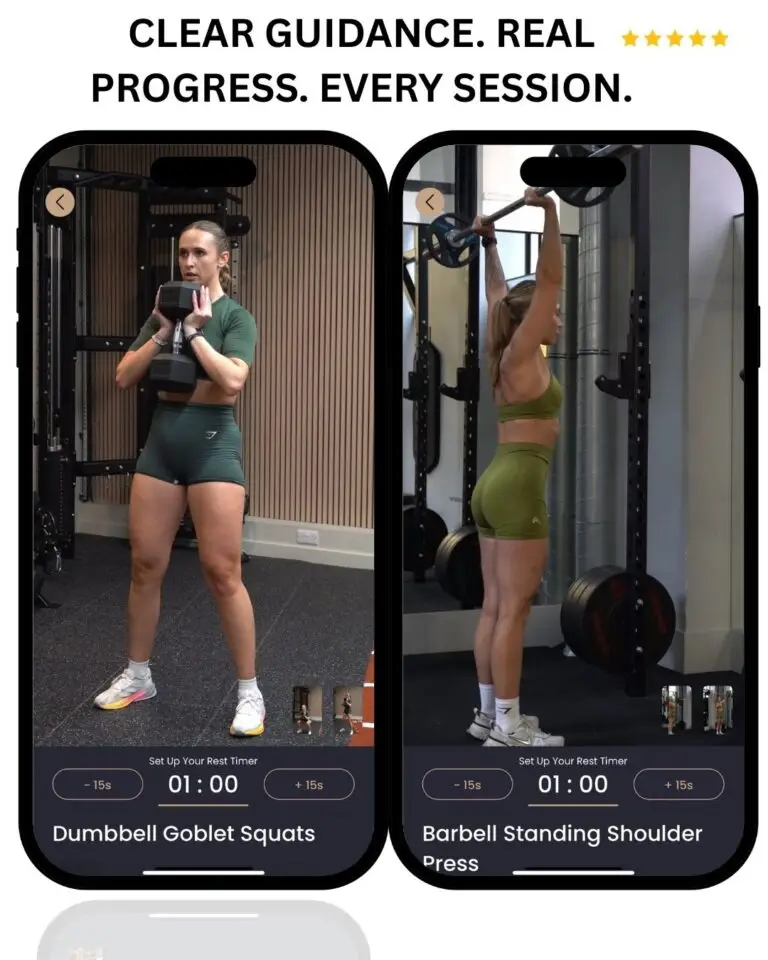
Whichever you pick, the hard part is following it week after week. 12REPS builds each session around your goal, your equipment and the time you have. Each exercise has a trainer demonstration, and the app remembers what you lifted so you know what to beat next time. See how the 12REPS app works.
The bottom line
Full body vs split is not about which is better. It is about which fits your week.
Choose full body if you:
- Train 2 or 3 days a week
- Are in your first year of lifting
- Have an unpredictable schedule
- Prefer simple plans
Choose a split if you:
- Train 4 or more days a week
- Have a year or more of training behind you
- Can keep a consistent schedule
- Want to give certain muscles extra focus
A trial in women and a wider meta-analysis both found similar results when weekly volume is matched. The best program is the one you will follow for months and years.
Sources
- A randomized trial on the efficacy of split-body versus full-body resistance training in non-resistance trained women. Pedersen H, Fimland MS, Schoenfeld BJ, Iversen VM, Cumming KT, Jensen S, Sæterbakken AH, Andersen V. BMC Sports Science, Medicine and Rehabilitation, 2022. https://bmcsportsscimedrehabil.biomedcentral.com/articles/10.1186/s13102-022-00481-7
- Efficacy of Split Versus Full-Body Resistance Training on Strength and Muscle Growth: A Systematic Review With Meta-Analysis. Ramos-Campo DJ, Benito-Peinado PJ, Andreu-Caravaca L, Rojo-Tirado MA, Rubio-Arias JÁ. Journal of Strength and Conditioning Research, 2024. https://doi.org/10.1519/JSC.0000000000004774
- Effects of Resistance Training Frequency on Measures of Muscle Hypertrophy: A Systematic Review and Meta-Analysis. Schoenfeld BJ, Ogborn D, Krieger JW. Sports Medicine, 2016. https://pubmed.ncbi.nlm.nih.gov/27102172/
- How many times per week should a muscle be trained to maximize muscle hypertrophy? A systematic review and meta-analysis of studies examining the effects of resistance training frequency. Schoenfeld BJ, Grgic J, Krieger J. Journal of Sports Sciences, 2019. https://pubmed.ncbi.nlm.nih.gov/30558493/
- Sex Differences in Resistance Training: A Systematic Review and Meta-Analysis. Roberts BM, Nuckols G, Krieger JW. Journal of Strength and Conditioning Research, 2020. https://pubmed.ncbi.nlm.nih.gov/32218059/
- Resistance training: health benefits. Better Health Channel, Victorian Department of Health, 2022. https://www.betterhealth.vic.gov.au/health/healthyliving/resistance-training-health-benefits