




By Will Duru, BSc (Hons) Sport and Exercise Science Award-winning Personal Trainer with over 10 years of experience in strength training and optimising recovery.
How many days a week should women strength train? Most women get good results from 2 to 4 days a week. Two full-body sessions meet the health minimum and build real strength. Three or four let you spread out more work per muscle. Research has not shown that women need a different number of days from men, so pick the number you can keep up.
Women who train often ask me whether they are doing too little, or too much. Some feel guilty for not training every day. Others worry that a fourth session will undo their progress. Most of the time, the answer is fewer, better sessions they can repeat for months.
This guide answers the question for women specifically. For a whole-week plan that includes cardio, read how many days a week should I work out. For frequency by goal, see how many times a week should I work out.

What the research says about strength training frequency
The World Health Organization (WHO) recommends muscle-strengthening activities for the major muscle groups on 2 or more days a week (WHO). That is the minimum for health.
For strength, the American College of Sports Medicine (ACSM) 2026 position stand advises training at least twice a week, working all major muscle groups. For muscle growth it points to about 10 or more sets per muscle group each week (ACSM, 2026).
How you spread those sets matters less than you might think. A meta-analysis found no meaningful difference in muscle growth between higher and lower frequencies when weekly sets were equal (Schoenfeld et al., 2019). Pick a schedule that fits your life.
Is the answer different for women?
Mostly, no. The ACSM 2026 position stand makes no separate frequency recommendations for women (ACSM, 2026). Here is what the research on women adds.
Women respond to training as well as men
A meta-analysis found women and men gained muscle and lower-body strength at similar rates. Women showed larger relative gains in upper-body strength (Roberts et al., 2020). The same weekly approach works for both.
Women often fatigue less during a session
A review found women are usually less fatigable than men at the same relative effort, at least in held contractions. The gap depends on the task, and it is often smaller in moving contractions like normal lifting (Hunter, 2014). It does not suggest women need more days off than men.
You do not need to plan around your cycle
A 2023 umbrella review concluded it is premature to say that menstrual cycle phase changes strength or training results (Colenso-Semple et al., 2023). You can keep the same weekly schedule all month. If you feel unwell on a given day, train lighter or rest, as anyone would. If you have painful or heavy periods, or a medical condition, check with your doctor.
Your week matters more than your sex
In practice, the biggest factor is time. Work, family and sleep decide how many sessions you can repeat every week. A plan you keep for a year beats a perfect plan you drop after a month.

How many days a week to strength train, by level
| Where you are | Days per week | Session type |
|---|---|---|
| Beginner | 2 to 3 | Full body |
| Intermediate | 3 to 4 | Full body, upper/lower or push/pull/legs |
| Advanced, with a specific goal | 4 to 5 | A split built around that goal |
| Short on time, maintaining | 2 to 3 | Full body, mostly compound exercises |
These are coaching starting points, not rules. Start at the low end and add a day only when you recover well between sessions.
Beginner: 2 to 3 full-body days
Your main jobs are learning the movements and building the habit. Two or three focused sessions do both, with plenty of time to recover.
Two-day week:
- Monday: full body
- Thursday: full body
Three-day week:
- Monday: lower body
- Wednesday: upper body
- Friday: full body
Video: Barbell full-body workout with the 12REPS app. Watch it to see how a full-body session covers your legs, back and pushing muscles in one workout.
For a ready-made plan, see our 2-day strength training split for women.
Intermediate: 3 to 4 days
Once the basics feel steady, more days let you add sets per muscle without making each session very long.
Upper/lower split, 4 days:
- Monday: upper body
- Tuesday: lower body
- Thursday: upper body
- Friday: lower body
Video: Dumbbell upper-body workout with the 12REPS app. This is the kind of session you would do on an upper-body day of this split.
Push/pull/legs, 3 days:
- Monday: push (chest, shoulders, triceps)
- Wednesday: pull (back, biceps)
- Friday: legs
Push/pull/legs over 3 days trains each muscle once a week, so each session needs enough sets. Compare the options in full body vs split training for women and push/pull/legs for women.
Advanced or short on time
Experienced lifters with a specific goal may train 4 to 5 days on a planned split. If life is busy, 2 to 3 well-planned full-body sessions can keep your strength and muscle ticking over.
An optional lighter day
Many women like to add one easy movement day, such as a walk, mobility work or a gentle yoga class. It keeps the habit going without adding hard training. It is optional, not a rule.
Quality beats quantity
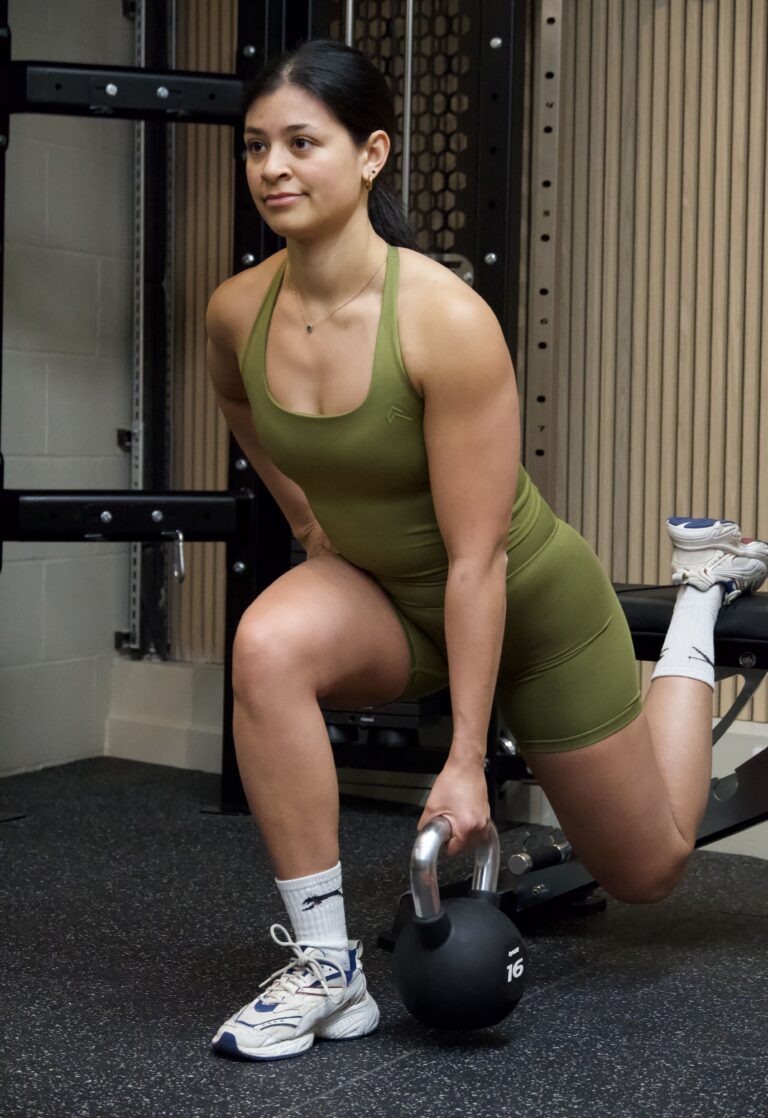
What you do in each session matters more than adding days. A focused session with challenging weights beats two unfocused ones.
- Work hard enough. Finish most sets with about 2 to 3 reps left. ACSM found going all the way to failure did not add gains (ACSM, 2026).
- Keep sessions a sensible length. See how long a woman’s workout should be.
- Protect your rest days. Read rest days for women who strength train for how to use them.
Listen to your body
Watch for these signs that you are training too often:
- Your weights and reps are stalling or going backward for a few weeks.
- You feel sore and flat going into most sessions.
- Your sleep, mood or motivation is slipping.
- You keep skipping sessions because the plan does not fit your week.
If two or more of these sound familiar, drop a day for a few weeks and see how you feel.
Pick your days and stick with them
- Count the sessions you could do every week, even in a busy week.
- Pick the matching schedule above.
- Run it for 8 to 12 weeks and log every session.
- Add a day only if you recover well and want more.
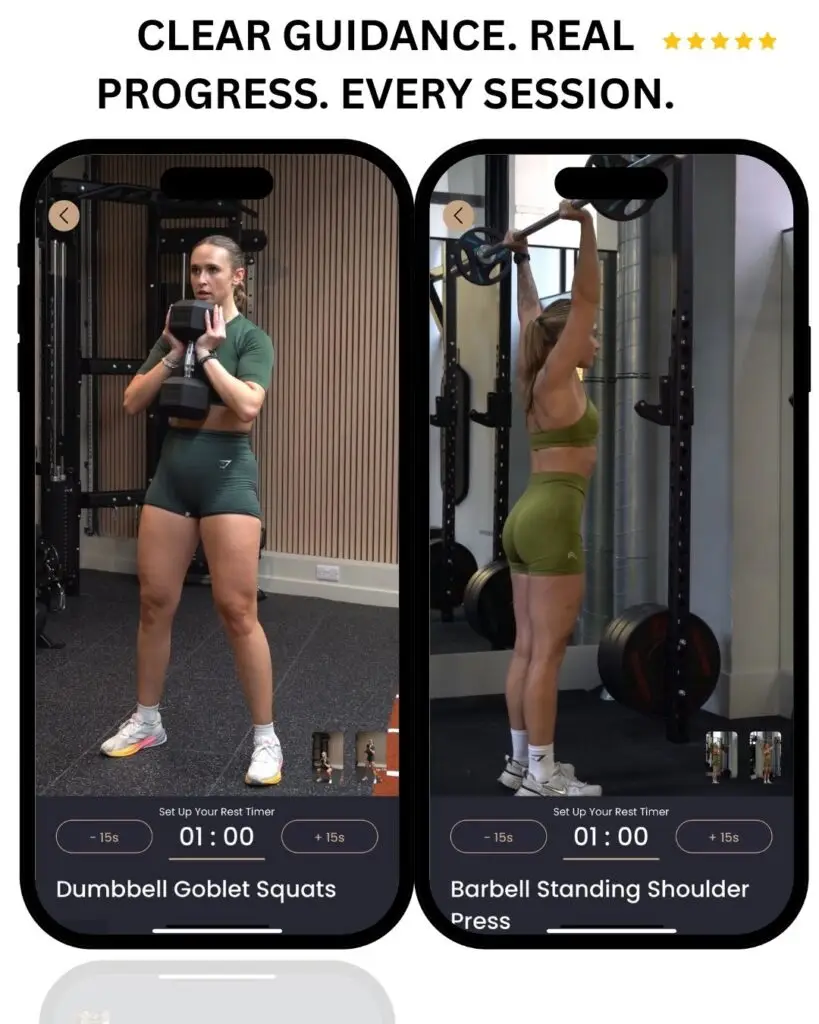
If you want your week planned for you, 12REPS builds each workout around your goal, your equipment and the time you have. It tracks your workouts, streaks and weekly goal, so you can see whether your schedule is working.
Training frequency FAQs
Is strength training twice a week enough for women?
Yes, for most goals. Two full-body sessions meet the WHO guideline and can build strength and muscle if the sets are hard enough.
Can women strength train every day?
You can, if you rotate muscle groups and keep the weekly workload sensible. Most women do not need to, and rest days make it easier to train hard on the days you lift.
Should I train fewer days during my period?
Not by default. Current evidence does not show that cycle phase changes your results. Adjust on any day you feel unwell.
Sources
- Physical activity. World Health Organization, n.d.. https://who.int/initiatives/behealthy/physical-activity
- Resistance training prescription for muscle function, hypertrophy, and physical performance in healthy adults: an overview of reviews (ACSM position stand). Currier BS et al., American College of Sports Medicine, Medicine & Science in Sports & Exercise, 2026. https://doi.org/10.1249/MSS.0000000000003897
- How many times per week should a muscle be trained to maximize muscle hypertrophy? A systematic review and meta-analysis of studies examining the effects of resistance training frequency. Schoenfeld BJ, Grgic J, Krieger J, Journal of Sports Sciences, 2019. https://doi.org/10.1080/02640414.2018.1555906
- Sex differences in resistance training: a systematic review and meta-analysis. Roberts BM, Nuckols G, Krieger JW, Journal of Strength and Conditioning Research, 2020. https://doi.org/10.1519/JSC.0000000000003521
- Sex differences in human fatigability: mechanisms and insight to physiological responses. Hunter SK, Acta Physiologica, 2014. https://pubmed.ncbi.nlm.nih.gov/24433272/
- Current evidence shows no influence of women’s menstrual cycle phase on acute strength performance or adaptations to resistance exercise training. Colenso-Semple LM, D’Souza AC, Elliott-Sale KJ, Phillips SM, Frontiers in Sports and Active Living, 2023. https://doi.org/10.3389/fspor.2023.1054542

