




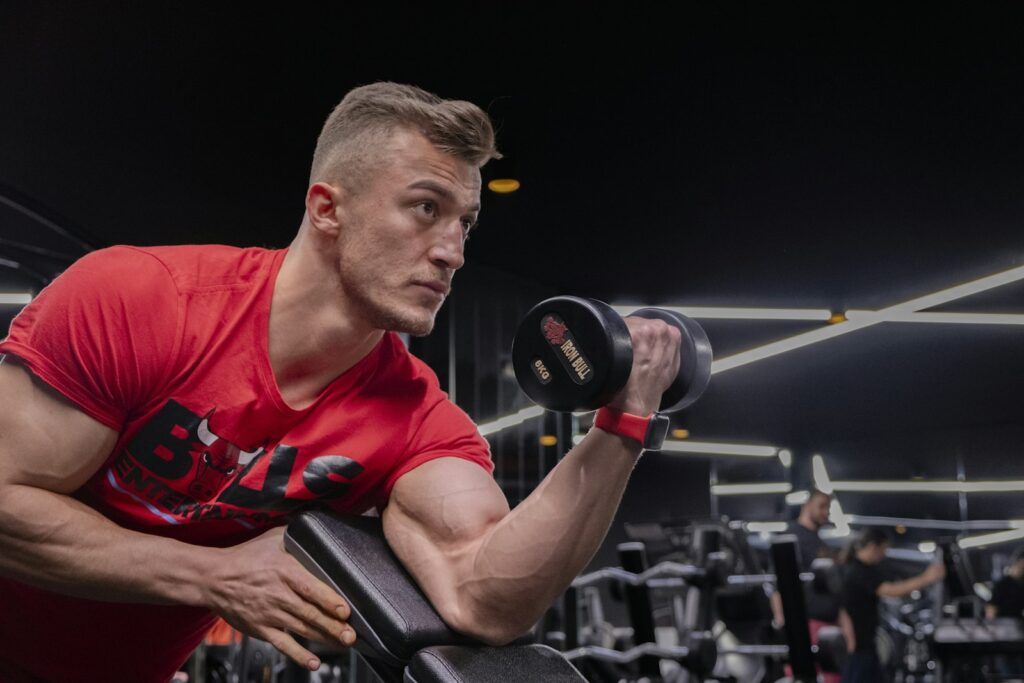
The short answer: both build bigger biceps, and the best choice is probably to use both. A 2025 study found that preacher curls grew the lower part of the arm (near the elbow) more, while incline curls grew the upper part (near the shoulder) more. The middle of the arm grew about the same with both. The preacher curl is hardest when your arm is nearly straight. The incline curl stretches your biceps at the shoulder. Doing one of each, or rotating them through your program, is a simple way to train your whole biceps.
This guide is for anyone who wants bigger, stronger arms and wonders which curl deserves a place in their program. I’ll cover how each curl works, what the research shows, how to do both, common mistakes and how to program them.
Preacher curl vs incline curl: the main differences
| Preacher curl | Incline curl | |
|---|---|---|
| Arm position | Upper arm resting on a pad, in front of your body | Arms hanging behind your body on an incline bench |
| Hardest part of the rep | Near the bottom, with your arm almost straight | More even, with the biceps stretched at the shoulder |
| Where it stretches the biceps | At the elbow | At the shoulder and elbow |
| Cheating | Hard to swing the weight | Easier to swing if you lift your shoulders |
| Growth bias in research | Lower biceps, near the elbow | Upper biceps, near the shoulder |
| Equipment | Preacher bench or machine | Adjustable bench and dumbbells |
What the research says
- Each curl grew a different region. In a 2025 study of 63 untrained young women, one group did preacher curls and the other did incline curls, twice a week for 8 weeks, with sets of 8–12 reps taken to failure. Both groups grew their elbow flexors and got stronger. Incline curls grew the upper measurement site more, preacher curls grew the lower site more, and the middle site grew about the same. Each group got stronger mostly at the curl it trained. The study measured the biceps and the brachialis together, so it can’t say which of the two muscles grew.
- The bottom of the preacher curl seems to matter most. In a 2023 study of 19 young women, each person trained one arm with only the bottom half of a dumbbell preacher curl (from a straight arm to about halfway up) and the other arm with only the top half, three times a week for 8 weeks. The bottom-half arm grew more at the lower measurement site and gained more strength on a full preacher curl. Overall growth across both sites was similar.
Both studies used untrained women and lasted 8 weeks, so the results may differ in experienced lifters. But they point the same way: the position and range you train in can shift where your biceps grow. The advice below comes from that research and my coaching experience.
How to do a preacher curl
- Adjust the seat so your armpits sit just over the top of the pad, with the backs of your upper arms flat on it.
- Hold the handle or dumbbells with your palms facing up and your arms almost straight.
- Curl the weight up until your forearms are close to vertical. Stop just before the pad stops loading your biceps.
- Squeeze, then lower slowly until your arms are nearly straight.
Coaching cues I use: “armpits on the pad,” “control the bottom” and “don’t let it bounce.” The bottom of the rep is where the preacher curl does its best work, so own it.
How to do an incline curl
- Set an adjustable bench to about 45–60° and sit back with a dumbbell in each hand.
- Let your arms hang straight down behind your body, palms facing forward.
- Keep your shoulders back against the bench and curl the dumbbells up without moving your elbows forward.
- Squeeze at the top, then lower slowly until your arms are fully straight and you feel a stretch in your biceps.
If you use a cable machine, the Bayesian curl trains the biceps in a similar stretched-shoulder position.

Common mistakes and how to fix them
| Mistake | Why it matters | Fix |
|---|---|---|
| Cutting the bottom of the preacher curl short | You miss the part of the rep that drove the most growth in research | Lower until your arms are almost straight |
| Dropping fast into the bottom of the preacher curl | Stresses the elbow at its most vulnerable point | Lower under control and don’t bounce |
| Lifting your shoulders off the incline bench | Takes away the stretch and lets you swing | Keep your shoulders and head back on the bench |
| Moving your elbows forward on incline curls | Turns it into a regular curl | Keep your upper arms hanging straight down |
| Going too heavy | You lose range and control | Choose a weight you can control for 8–12 reps |
How to program them
These are starting points I use with most lifters.
| Exercise | Sets | Reps | Rest |
|---|---|---|---|
| Preacher curl | 2–3 | 8–12 | 60–90 seconds |
| Incline curl | 2–3 | 8–12 | 60–90 seconds |
- Option 1: do both curls in the same session, one after the other.
- Option 2: do preacher curls on one arm day and incline curls on the other.
- Option 3: rotate between them every 4–8 weeks.
Whichever you choose, take most sets close to failure and add weight or reps over time. If you also do lots of rows and pull-ups, 4–6 direct biceps sets a week is a good starting point for most people.
Summary
- Preacher curls and incline curls both build bigger biceps.
- In a 2025 study, preacher curls grew the lower arm more and incline curls grew the upper arm more.
- The bottom of the preacher curl, with your arm nearly straight, may drive the most growth.
- Incline curls stretch the biceps at the shoulder. Keep your shoulders back to get the full benefit.
- Use both, either in the same week or in rotation, to train your whole biceps.
Build bigger arms with a clear plan
The right curls help, but steady progress over months is what builds your arms. That’s where 12REPS helps.
12REPS gives you trainer-built programs with two demo videos for every exercise, including the machine preacher curl and Bayesian cable curl. The gym log shows what you lifted last time, so you know when to add weight. Build Your Routine lets you add both curls to your own week, and the built-in timer keeps your rest periods on track. Every new account starts with a 7-day free trial.
Download 12REPS and see what you’ll get:
Sources
- Kassiano W, Costa B, Kunevaliki G, et al. Distinct muscle growth and strength adaptations after preacher and incline biceps curls. International Journal of Sports Medicine. 2025;46(5):334–343.
- Pedrosa GF, Simões MG, Figueiredo MOC, et al. Training in the initial range of motion promotes greater muscle adaptations than at final in the arm curl. Sports. 2023;11(2):39.
Related reading
- What Is a Bayesian Curl?
- How to Build Bigger Arms: Complete Biceps & Triceps Guide
- Toned Arms Without Bulk: A Woman’s Guide to Sculpted Arms
- Machine Preacher Curl: exercise demo
- Spider Biceps Curl: exercise demo
I’m Will Duru, a personal trainer and the founder of 12REPS. I hold a BSc (Hons) in Sport and Exercise Science and have more than a decade of experience coaching people in strength training.
