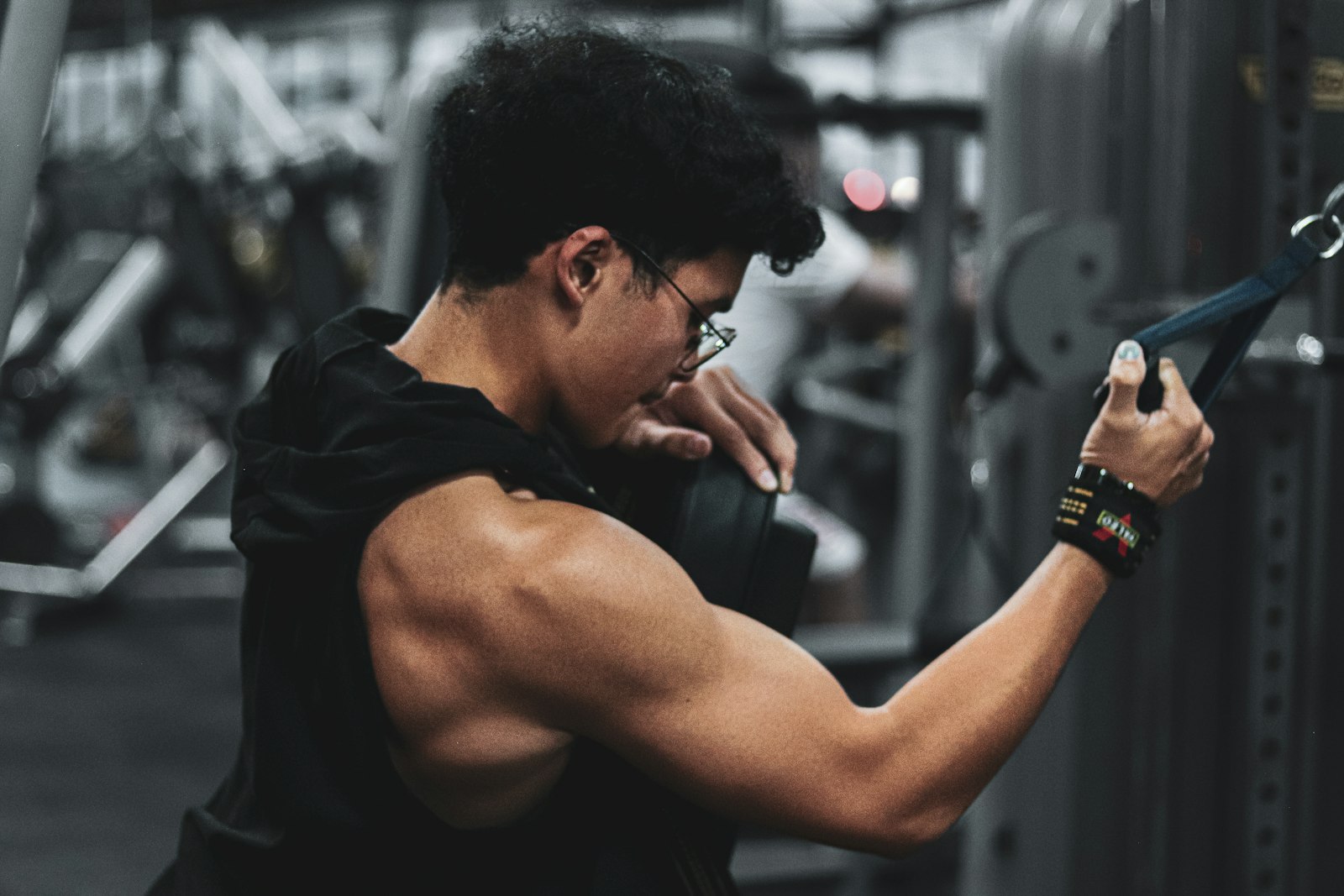


Quick answer: A Bayesian curl is a one-arm cable curl done facing away from a low cable, with your arm slightly behind your body. That position stretches your biceps at the start of every rep, and the cable keeps tension on the muscle where a dumbbell curl is easiest. Research shows that training your biceps in a stretched position builds more muscle than training them in a shortened position. No study has tested the Bayesian curl itself, but it puts that idea into practice. It’s a smart addition to your arm training, not a magic exercise.
This guide is for you if you’ve seen the Bayesian curl online and want to know whether it’s worth doing, how to set it up and how it compares with a regular curl.
Why is it called a Bayesian curl?
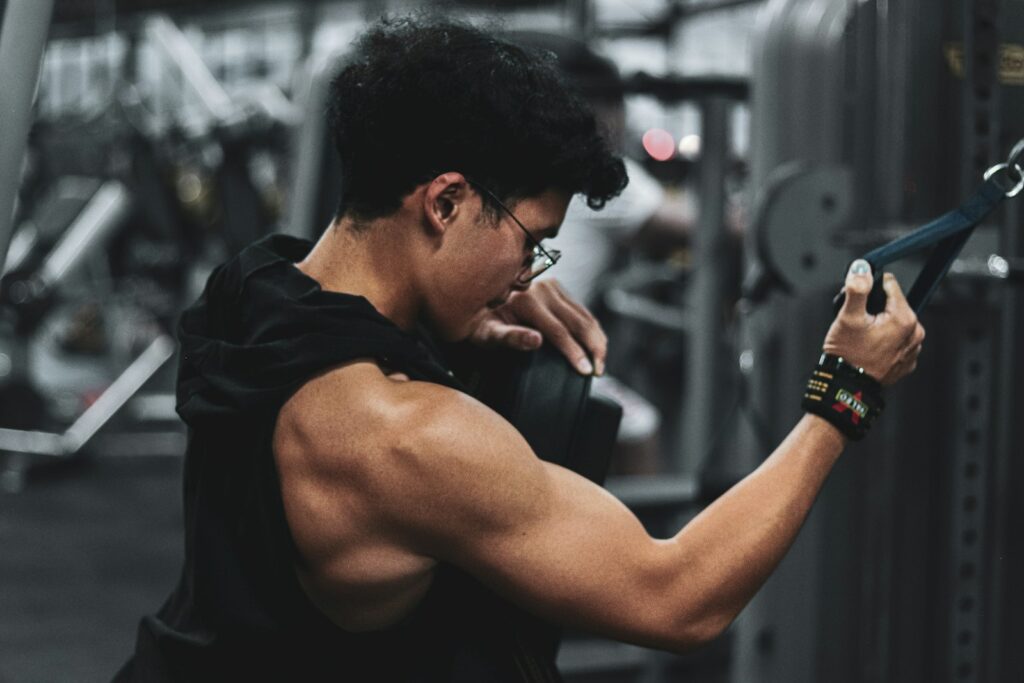
It was popularized by coach Menno Henselmans, whose coaching business is called Bayesian Bodybuilding, and the name stuck (Henselmans). It has nothing to do with statistics. It’s simply a cable curl done from behind your body.
Why it works: stretch and tension
Your biceps has two heads. The long head crosses both your elbow and your shoulder. When your arm is behind your body and your elbow is straight, the long head is stretched more than in a normal standing curl.
The cable adds a second advantage. With a dumbbell, gravity pulls straight down, so there’s very little resistance when your arm is straight at the bottom. A cable pulls from behind you, so your biceps works hard right from the start of the rep.
What the research says
- The stretched range builds more muscle. In a 5-week trial with 32 untrained adults, curling only in the bottom range (arm nearly straight) grew the elbow flexors by 8.9%. Curling only in the top range grew them by 3.4% (Sato et al., 2021).
- The same pattern in women. In an 8-week study, 19 young women trained one arm with preacher curls in the bottom half of the movement and the other arm in the top half. The bottom-half arm grew more at one of the measured spots and gained more strength (Pedrosa et al., 2023).
What hasn’t been tested: no published study has compared the Bayesian curl directly with a dumbbell or barbell curl. So we know the principle behind it works. We don’t know yet exactly how much more it builds than a regular curl.
How to do a Bayesian curl
Setup
- Set a cable pulley low, around knee height or a little lower, and attach a single handle.
- Hold the handle in one hand and turn so you face away from the machine.
- Step forward until there’s tension on the cable and your arm is pulled slightly behind your body.
- Take a staggered stance for balance, with your chest up and shoulders back.
The movement
- Start with your arm straight and slightly behind your torso. You should feel a stretch in the front of your arm.
- Curl the handle up toward your shoulder, keeping your elbow back. Don’t let it swing forward.
- Squeeze your biceps at the top for a second.
- Lower slowly, taking 2 to 3 seconds, until your arm is straight and stretched again.
Coaching cues: “Elbow stays back.” “Full stretch at the bottom.” “Slow on the way down.”
Step further forward for more stretch, or closer to the machine if the bottom position feels too much on the front of your shoulder.
Bayesian curl vs dumbbell curl
| Bayesian curl | Dumbbell curl | |
|---|---|---|
| Where it’s hardest | Bottom and middle of the rep | Middle of the rep |
| Stretch on the biceps | More, with your arm behind you | Less |
| Equipment | Cable machine | Dumbbells |
| Arms at a time | One | One or two |
| Best for | Extra work in the stretched position | Simple, heavy curling anywhere |
My advice: you don’t need to choose. Keep a regular curl in your program and add the Bayesian curl as a second biceps exercise. If you only have dumbbells, an incline dumbbell curl also puts your arm behind your body and stretches the biceps.
Common mistakes
- Elbow drifting forward. This takes away the stretch. Keep your elbow by your side or slightly behind it.
- Too much weight. You start swinging your body. Go lighter and control the rep.
- Cutting the bottom short. The stretched part is the point. Let your arm straighten fully each rep.
- Shoulders rolling forward. Keep your chest up and shoulders back.
- Cable set too high. A high cable changes the line of pull. Start low and adjust until it feels right.
If you feel pain in the front of your shoulder at the bottom, shorten the stretch by stepping closer to the machine. If it still hurts, choose another curl.
Sets and reps
| Your level | Sets and reps (per arm) | Where in your workout |
|---|---|---|
| Beginner | 2 sets of 10 to 12 | After your main curl or pulling exercise |
| Intermediate | 3 sets of 10 to 15 | As your second biceps exercise |
| Advanced | 3 to 4 sets of 8 to 15, close to failure | After heavier curls, 1 to 2 times a week |
Finish each set 1 to 2 reps short of failure. When you reach the top of your rep range on every set, add a little weight. That’s progressive overload.
Other curls to pair with it
- Cable rope biceps curl
- Cable straight bar biceps curl
- Machine preacher curl
- Spider biceps curl
- Resistance band biceps curl, if you train at home
Summary
- The Bayesian curl is a one-arm cable curl done facing away from a low cable, with your arm behind your body.
- It stretches your biceps and keeps tension where dumbbell curls are easiest.
- Research shows training your biceps in a stretched position builds more muscle.
- No study has compared it directly with a regular curl yet.
- Use it as a second biceps exercise, for 2 to 4 sets of 8 to 15 reps.
- Keep your elbow back and lower slowly into a full stretch.
Build bigger arms with a plan
Exercises like the Bayesian curl work best inside a program that adds weight and reps over time. 12REPS gives you trainer-built programs with two demo videos for every exercise, and a gym log that shows what you lifted last time. New users get a 7-day free trial.
Download 12REPS and see what you’ll get:
Sources
- Sato S et al. Elbow joint angles in elbow flexor unilateral resistance exercise training determine its effects on muscle strength and thickness. Front Physiol, 2021
- Pedrosa GF et al. Training in the initial range of motion promotes greater muscle adaptations than at final in the arm curl. Sports, 2023
- Henselmans M. Bayesian curls: the best biceps builder
Related reading
- How to build bigger arms: complete biceps and triceps guide
- Build bigger arms (women): biceps and triceps guide
- Training to failure: should you push every set?
- The beginner’s guide to progressive overload
I’m Will Duru, a personal trainer and the founder of 12REPS. I hold a BSc (Hons) in Sport and Exercise Science and have more than a decade of experience coaching people in strength training.