
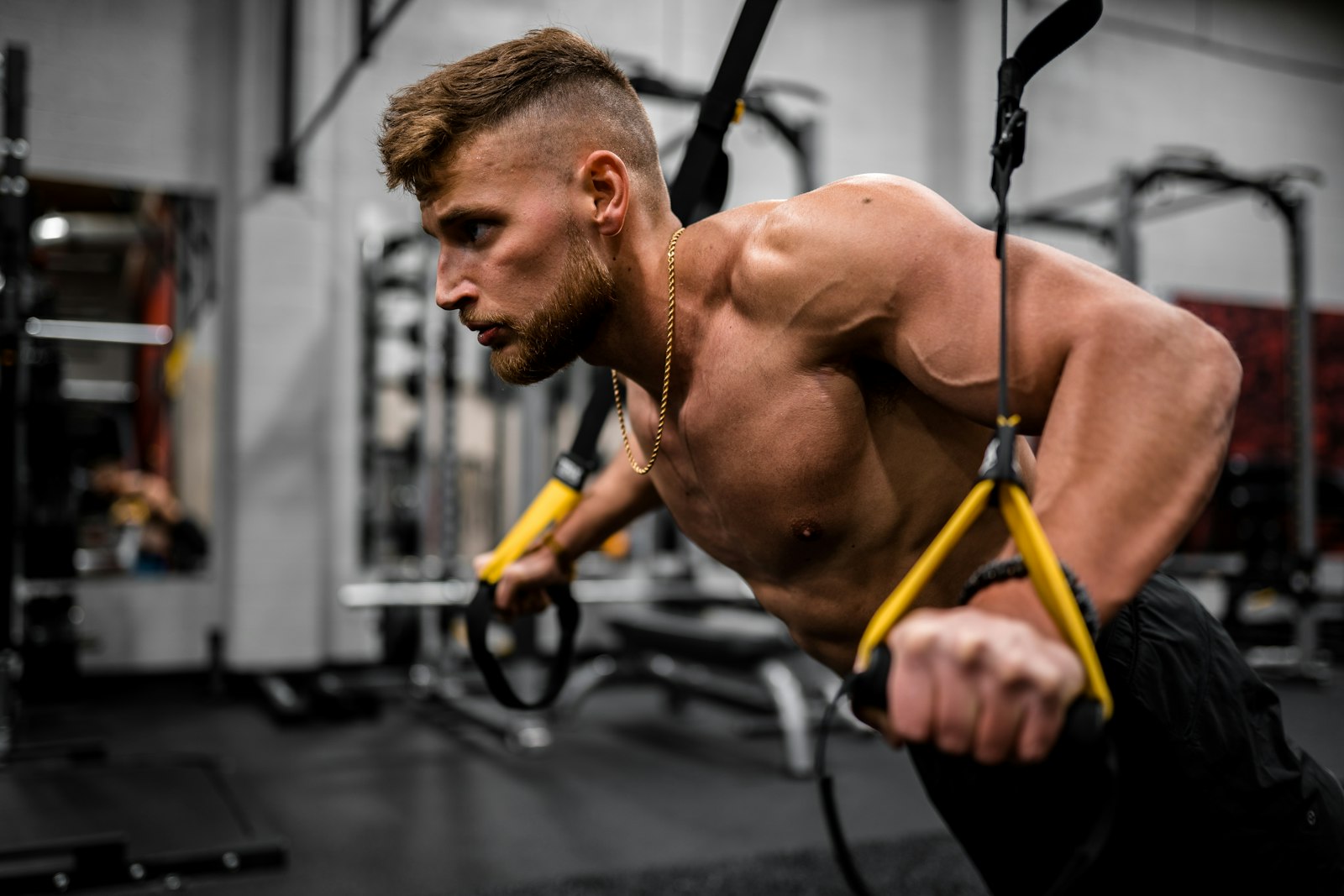



The short answer: the inverted row is a bodyweight row where you hang under a bar, rings or suspension straps and pull your chest up to your hands. It trains your lats, upper back, rear shoulders and biceps, and it’s one of the easiest ways to build pulling strength without weights. Research shows it produced the highest lat and upper back activity of three common rows while putting the least load on the lower back. Make it easier by standing more upright and harder by lowering your body toward horizontal or raising your feet.
This guide is for beginners building toward pull-ups, people training at home and anyone who wants a back exercise that’s kind to the lower back. I’ll cover what the inverted row works, what the research shows, how to do the main versions and how to progress.
What muscles does the inverted row work?
| Muscle | Role |
|---|---|
| Lats | Pull your upper arms down and back |
| Middle traps and rhomboids | Squeeze your shoulder blades together |
| Rear delts | Help pull your arms back |
| Biceps and forearms | Bend your elbows and hold the bar or handles |
| Core and glutes | Keep your body straight like a moving plank |
What the research says
- Strong back activity with low spinal load. A 2009 study of 7 healthy men compared the inverted row, the standing bent-over row and a standing one-arm cable row. The inverted row produced the highest lat, upper back and hip extensor activity of the three, with the lowest load on the lower back. The bent-over row produced the largest lower back load. The authors suggested the inverted row for people who want to spare their lower back.
- Straps and a fixed bar work the back about equally. A 2013 study of 15 adults compared an inverted row on a fixed bar with the same row on a suspension trainer. Lat, middle trap and rear delt activity were similar. Biceps activity was lower with the straps, at about 68% of maximum compared with 77% on the bar.
- Raising your feet makes it a real strength exercise. In a 2023 study of 12 male athletes, a suspension inverted row with the feet elevated worked at roughly 73% of their one-rep max on a lying barbell row, a load comparable to typical strength training.
These are small studies that measured muscle activity and load, not long-term growth. But they show that the inverted row is a serious back exercise, not just a beginner drill. The coaching advice below comes from my experience.
How to do a barbell inverted row
- Set a barbell in a rack or Smith machine at about hip height.
- Lie under the bar and grip it slightly wider than shoulder width, palms facing away.
- Straighten your legs and lift your hips so your body forms a straight line from your heels to your head.
- Pull your chest up to the bar, driving your elbows back and squeezing your shoulder blades together.
- Lower yourself under control until your arms are straight.
Coaching cues I use: “body like a plank,” “chest to the bar” and “elbows to your back pockets.” If your hips sag, bend your knees and plant your feet to make it easier.
How to do a TRX or ring row
- Hold the handles with your palms facing each other and walk your feet forward until you’re leaning back with straight arms.
- Brace your stomach and squeeze your glutes so your body stays straight.
- Pull your chest up between your hands, keeping your elbows close to your sides.
- Pause at the top, then lower slowly.
Straps and rings let your hands rotate, which many people find more comfortable on the elbows and shoulders. Here’s my ring row demo as well.
How to make inverted rows easier or harder
| Level | Change | Effect |
|---|---|---|
| Easiest | Stand more upright with the bar or straps higher | Less of your body weight to pull |
| Easier | Bend your knees and plant your feet | Shorter lever and more support |
| Standard | Body straight, feet on the floor | The main version |
| Harder | Lower the bar or walk your feet further forward until you’re nearly horizontal | More of your body weight to pull |
| Hardest | Elevate your feet on a bench, add a pause at the top or wear a weighted vest | Even more load and time under tension |
Common mistakes and how to fix them
| Mistake | Why it matters | Fix |
|---|---|---|
| Hips sagging | Shortens the range and takes your core out of it | Squeeze your glutes and keep a straight line |
| Pulling with your neck | Your chin reaches the bar but your chest doesn’t | Lead with your chest and keep your neck neutral |
| Shrugging up to your ears | Your upper traps take over | Keep your shoulders down and back |
| Half reps | Less muscle worked | Lower to straight arms and pull until your chest nearly touches |
| Dropping fast | You miss half the work | Take 2 seconds to lower |
Sets, reps and where they fit
These are starting points I use with most people.
| Goal | Sets | Reps | Rest |
|---|---|---|---|
| Building strength | 3–4 | 6–12 | 90 seconds |
| Working toward pull-ups | 3 | 8–15 | 60–90 seconds |
Pick a body angle that makes the target reps challenging. When you can do the top of your rep range with good form, move to a harder angle. If you’re working toward your first pull-up, inverted rows pair well with assisted pull-ups and slow negatives, as my first pull-up guide explains.
Summary
- The inverted row is a bodyweight row that trains your lats, upper back, rear shoulders and biceps.
- Research found it produced high lat and upper back activity with the lowest lower back load of three common rows.
- Suspension straps work the back about as well as a fixed bar, with slightly less biceps work.
- With your feet elevated, it can be as demanding as typical strength training.
- Adjust your body angle to make it easier or harder, and keep your body straight on every rep.
Build a stronger back with a plan
Whether you train at home or in the gym, progressing your rows over time is what builds your back. That’s where 12REPS helps.
12REPS gives you trainer-built programs with two demo videos for every exercise, including barbell inverted rows, TRX rows and ring rows. The gym log tracks your reps and progress, Build Your Routine lets you add rows to your own week, and the built-in timer keeps your rest periods on track. Every new account starts with a 7-day free trial.
Download 12REPS and see what you’ll get:
Sources
- Fenwick CMJ, Brown SHM, McGill SM. Comparison of different rowing exercises: trunk muscle activation and lumbar spine motion, load, and stiffness. Journal of Strength and Conditioning Research. 2009;23(2):350–358.
- Snarr RL, Esco MR. Comparison of electromyographic activity when performing an inverted row with and without a suspension device. Journal of Exercise Physiology Online. 2013;16(6):51–58.
- Vural F, Erman B, Ranisavljev I, et al. Can different variations of suspension exercises provide adequate loads and muscle activations for upper body training? PLoS ONE. 2023;18(9):e0291608.
Related reading
- How to Do Your First Pull Up: From Zero to 10 Reps
- TRX Workout for Beginners: 6 Moves for Full-Body Strength
- Home Workout Plan: Build Muscle Without a Gym
- How to Barbell Row: Complete Technique Guide for Women
I’m Will Duru, a personal trainer and the founder of 12REPS. I hold a BSc (Hons) in Sport and Exercise Science and have more than a decade of experience coaching people in strength training.
