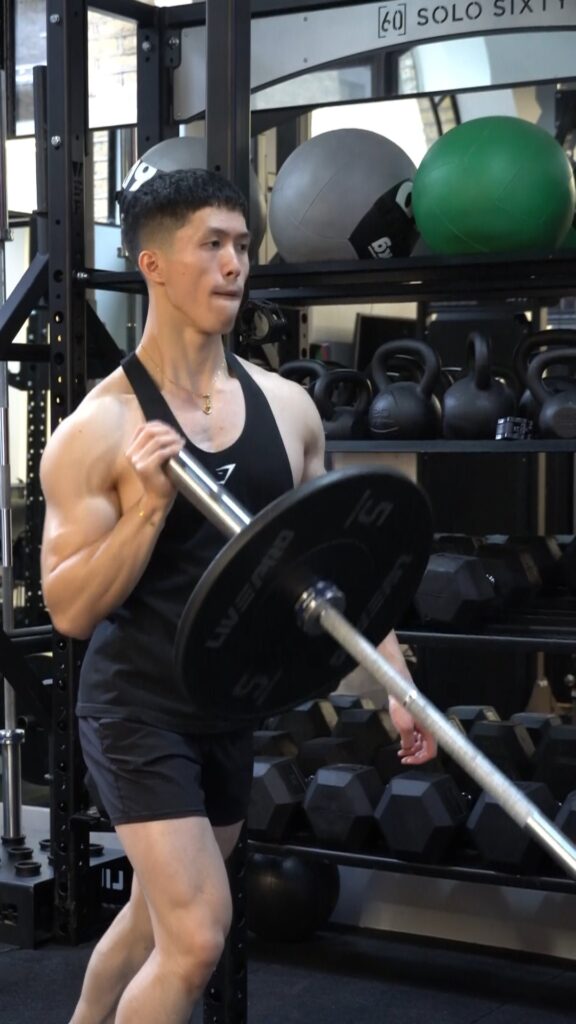
Short answer: The landmine press is a pressing exercise where you push one end of a barbell up and forward while the other end stays anchored to the floor. Because the bar moves in an arc at an angle, it sits somewhere between an incline press and an overhead press. It works your shoulders, upper chest and triceps, and the single-arm version also makes your core work to stop you twisting. It is a useful option if you want to train your shoulders without pressing straight overhead.
This guide is for anyone with access to a landmine attachment or a barbell and a safe corner. I cover how to set it up, how to do it, how it compares with the overhead press, what the research does and does not tell us, and the best variations.
What is the landmine press?
A landmine is a simple attachment that holds one end of a barbell to the floor and lets it pivot. You hold the other end and press it away from your body. The anchored end controls the path of the bar, so it moves up and forward in an arc rather than straight up.
If your gym does not have a landmine attachment, you can wedge the end of a barbell into a corner. Ask the staff first, protect the wall with a towel, and make sure the bar cannot slip out.
Muscles worked
- Front of the shoulders (anterior deltoids): the main muscles that drive the bar up.
- Upper chest: it helps because the press is angled forward, not straight overhead.
- Triceps: they straighten your elbow at the top.
- Upper back and shoulder blade muscles: they control your shoulder blade as your arm moves up and forward.
- Core and obliques: in the single-arm version, they stop your torso from twisting toward the side holding the bar.
How to do a landmine press
These steps are for the standing single-arm version, which is the one I use most.
- Load and lift the bar. Put a light plate on the free end. Pick up the end of the bar and bring it to the front of your shoulder.
- Set your stance. Stand facing the anchor point. Step the leg on the same side as the working arm back slightly, so your stance is staggered and stable.
- Set your grip and elbow. Hold the end of the bar in your palm, with your elbow tucked in front of your body rather than flared out to the side.
- Brace. Tighten your stomach and glutes, and keep your ribs down.
- Press. Push the bar up and forward until your arm is straight. Let your shoulder blade move forward and around your rib cage as you reach.
- Lower with control. Bring the bar back to the front of your shoulder over 2 to 3 seconds.
- Switch sides. Finish your reps, then repeat on the other arm.

Coaching cues I use
- “Reach, don’t just push.” Finish each rep by reaching the bar a little further forward, so your shoulder blade moves with your arm.
- “Ribs down.” Arching your lower back turns the press into a lean. Keep your ribs stacked over your hips.
- “Square to the bar.” Your hips and shoulders should face the anchor. If you twist toward the bar, the load is too heavy.
- “Control the way down.” The bar should come back to your shoulder, not crash into it.
Common landmine press mistakes
| Mistake | What it looks like | The fix |
|---|---|---|
| Leaning back | Your lower back arches to get the bar up | Brace your core and squeeze your glutes. Use a lighter weight. |
| Twisting the torso | Your shoulders rotate toward the bar during the press | Stay square to the anchor and slow down. The half-kneeling version can help. |
| Elbow flared out | Your elbow points straight out to the side at the bottom | Start with your elbow in front of your body, under the bar. |
| Stopping short | Your arm never fully straightens | Finish with a straight arm and a forward reach. |
| Standing too close or too far | The bar path feels too upright or too flat | Adjust your distance until the bar meets your shoulder comfortably at the bottom. |
| Using too much weight | You need a hip drive or a lean to finish reps | Drop the weight and keep reps strict. It is a smaller-load exercise than most presses. |
Landmine press vs overhead press
| Landmine press | Overhead press | |
|---|---|---|
| Bar path | Up and forward in a fixed arc | Straight up overhead |
| Pressing angle | Angled, between an incline and an overhead press | Vertical |
| Shoulder position at the top | Arm in front of the head | Arm next to or slightly behind the ear |
| Stability demand | Single-arm version challenges your core to resist twisting | Two-hand version challenges your core to resist leaning |
| Typical load | Lighter, often one arm at a time | Heavier with a barbell |
In my view, the landmine press is not a replacement for the overhead press. It is a different angle. I use it when someone cannot yet press overhead comfortably, when I want single-arm pressing for balance between sides, or as a second shoulder exercise after a heavier press. If your shoulders feel fine overhead, there is no reason to stop doing overhead pressing. My overhead press guide covers that lift step by step.
What the research says
I could not find any studies that measured muscle activity during the landmine press itself, so be wary of articles that quote exact numbers. The evidence below comes from related exercises and should be read as indirect.
- Pressing angle changes which muscles work most. In 30 trained adults, a study of bench press angles found the upper chest was most active at a 30° incline, while the front of the shoulders was most active at 60°. Angles above 45° shifted work toward the shoulders and away from the chest (Rodríguez-Ridao et al., 2020). The landmine press works at a steep angle too, so it is reasonable to expect both the shoulders and the upper chest to contribute, but this has not been measured directly.
- Less stable presses use more shoulder muscle but less load. In 15 healthy men, the standing dumbbell shoulder press, the least stable version tested, produced the highest deltoid activity but the lowest one-rep max (Saeterbakken and Fimland, 2013). A standing single-arm landmine press is also a less stable press, which may explain why it feels hard even with lighter weights.
My take: the landmine press is a sensible tool for shoulder and upper-body pressing, but its benefits are mostly based on coaching experience and on research from similar exercises. It is not proven to be safer or better than other presses.
Landmine press variations
| Variation | How it changes the move | Best for |
|---|---|---|
| Half-kneeling single-arm press | Kneel on the knee on the same side as the working arm | Learning the move, and reducing leaning and twisting |
| Standing single-arm press | The standard version described above | Most people |
| Close-grip two-hand press | Hold the end of the bar with both hands at chest height and press | Heavier loads and more chest and triceps work |
| Split-stance press | Take a longer staggered stance, as in a short lunge | More balance and core challenge |
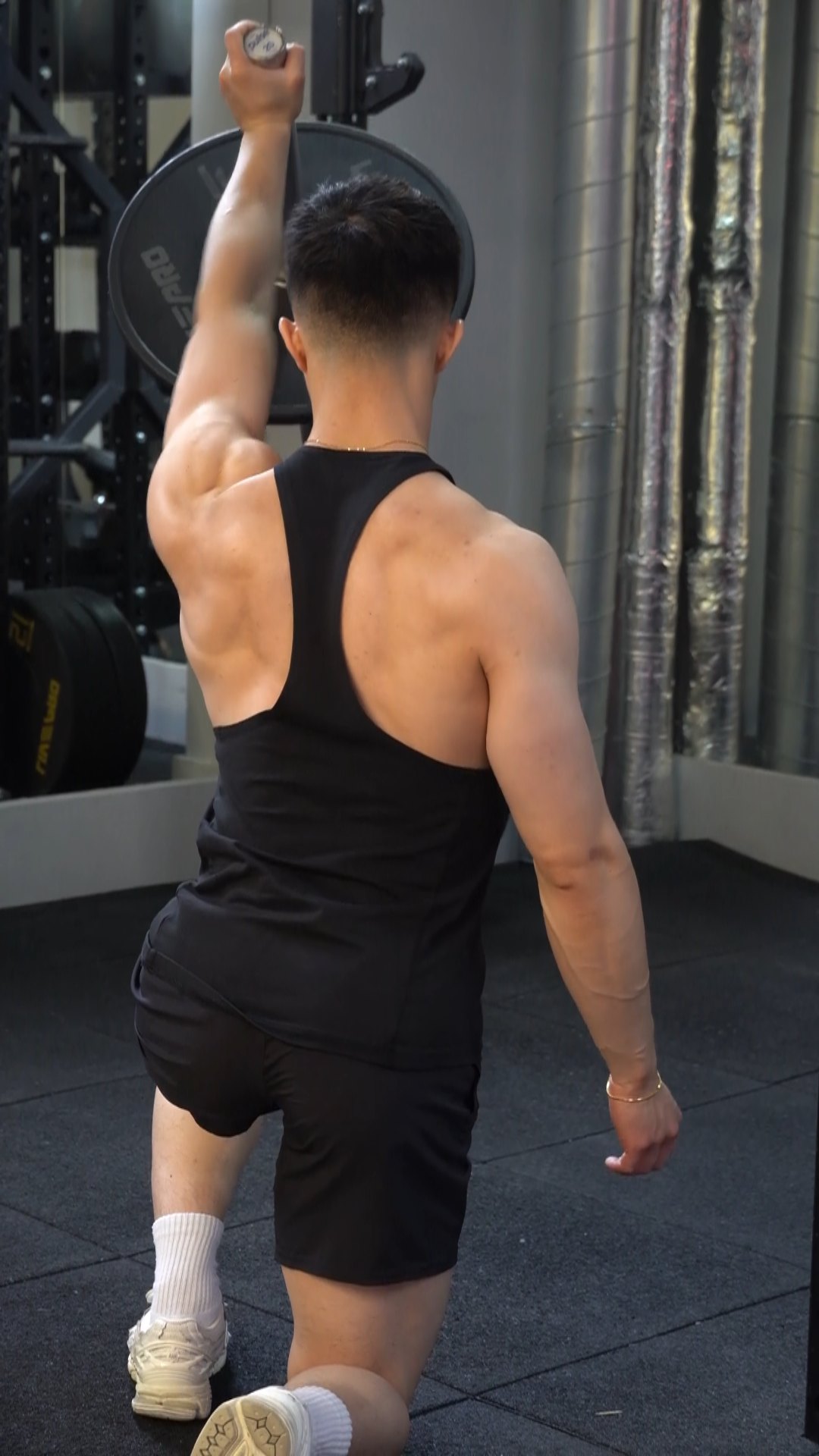
Half-kneeling landmine press
Kneeling takes your legs out of the movement and makes it harder to lean back. This is the version I would start with if you are new to the landmine.
Landmine close-grip press
Using both hands lets you lift more. It shifts some of the work toward your chest and triceps, so it is a good option on an upper-body or push day.
Sets, reps and where to use it
These are my coaching suggestions, not research-based targets:
| Goal | Sets and reps | Where in your workout |
|---|---|---|
| Building muscle | 3 sets of 8 to 12 reps per arm | After your main press, on an upper-body or push day |
| Strength | 3 to 4 sets of 6 to 8 reps per arm, or the two-hand version | Early in the session |
| Learning the move | 2 to 3 sets of 10 reps per arm, half-kneeling and light | Anywhere in the session |
Stop each set with 1 to 3 good reps left. To progress, add reps first, then a small amount of weight. Because the landmine changes the angle of the bar, a few pounds make a noticeable difference.
If you have a shoulder injury
If you have shoulder pain or a past shoulder injury, ask a doctor or physical therapist before you start. Use a light weight, stay in a range that feels comfortable and stop if the pain gets worse.
Summary
- The landmine press moves the bar up and forward in an arc, between an incline press and an overhead press.
- It works your shoulders, upper chest and triceps, and the single-arm version challenges your core.
- Keep your elbow tucked, your ribs down and your body square to the bar.
- Start with the half-kneeling single-arm version, then move to standing or two-hand versions.
- There is little direct research on the landmine press, so treat claims about it with care.
Fit the landmine press into your plan
The landmine press works best as part of a balanced upper-body routine, alongside your main presses and rows. The hard part is choosing the right exercises, sets and weights for your goal and the equipment you have.
That is what I built 12REPS to help with. You set your goal, your available time and your equipment, and the app builds your workouts. Every exercise comes with a trainer demonstration, and you can log your sets and reps to see your progress over time.
Download 12REPS and see what you’ll get:
Sources
- Rodríguez-Ridao D, Antequera-Vique JA, Martín-Fuentes I, Muyor JM. Effect of five bench inclinations on the electromyographic activity of the pectoralis major, anterior deltoid, and triceps brachii during the bench press exercise. Int J Environ Res Public Health. 2020;17(19):7339.
- Saeterbakken AH, Fimland MS. Effects of body position and loading modality on muscle activity and strength in shoulder presses. J Strength Cond Res. 2013;27(7):1824–1831.
Related reading
- Seated vs Standing Shoulder Press: Which Is Better?
- Push Press vs Strict Press: Differences, Form and Which to Do
- Best Incline Bench Angle for Upper Chest: What the Research Says
- T-Bar Row vs Landmine Row: Differences and How to Do Them
- How to Do Lateral Raises: Form, Weight and Common Mistakes
- Shoulder Workout
I’m Will Duru, a personal trainer and the founder of 12REPS. I hold a BSc (Hons) in Sport and Exercise Science and have more than a decade of experience coaching people in strength training.