
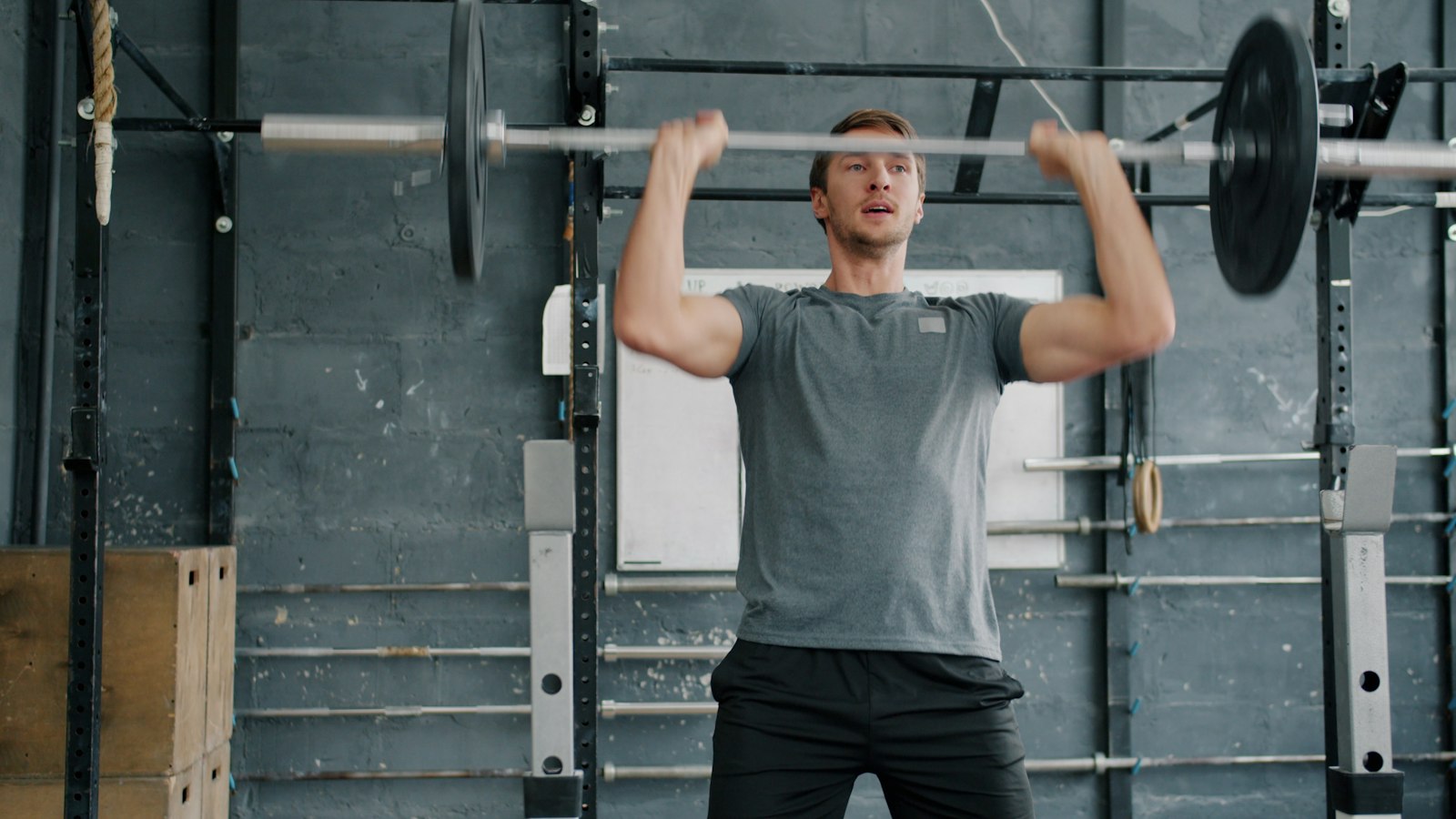



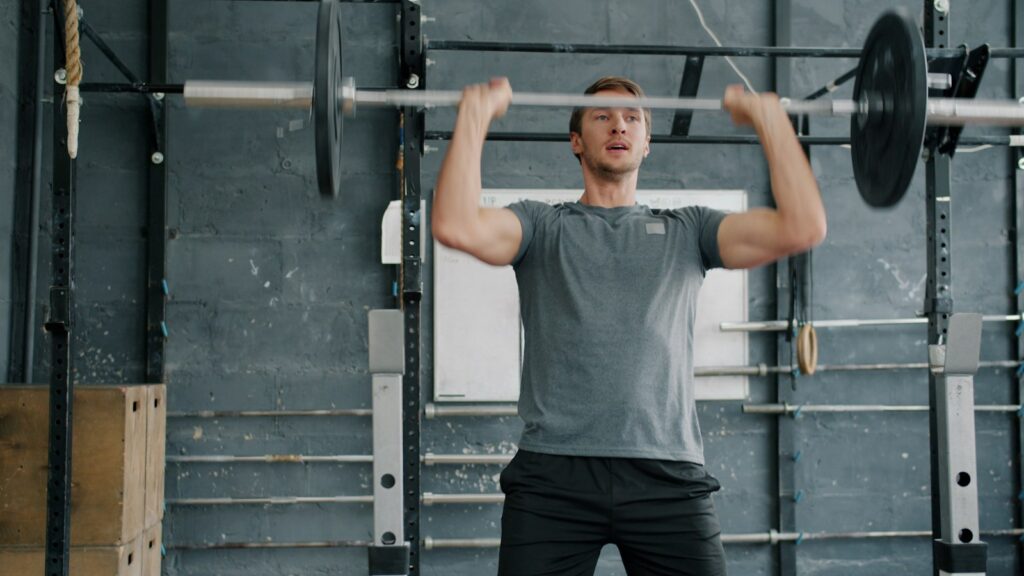
The short answer: the strict press uses only your shoulders, triceps and upper back to move the bar from your shoulders to overhead. Your legs stay locked. The push press adds a short knee bend and leg drive to launch the bar, then your arms finish the lift. That lets you handle more weight and move it faster. Use the strict press to build upper-body pressing strength and muscle. Use the push press to train power, overhead strength with heavier loads and the link between your legs and upper body.
This guide is for anyone who lifts a barbell overhead and wants to know which press belongs in their program. I’ll cover how the two lifts differ, what the research shows, how to do each one, the mistakes I see most and how to fit them into your week.
Push press vs strict press: the main differences
| Strict press | Push press | |
|---|---|---|
| What moves the bar | Shoulders, triceps and upper back only | Legs start the bar moving, then shoulders and triceps finish it |
| Leg action | None. Knees locked, glutes tight | Short dip (bend at the knees) and fast drive up |
| Load | Lighter | Heavier. Most lifters can push press more than they can strict press |
| Speed | Controlled, often slow near the sticking point | Fast and explosive |
| Main goal | Upper-body strength and muscle | Power and heavy overhead strength |
| Best rep range | Moderate, around 5 to 10 | Low, around 2 to 5 |
| Skill level | Beginner friendly | Learn after the strict press |
The strict press also goes by other names. You may see it called the overhead press, the military press or the standing barbell press. They all describe the same basic lift: bar on the front of your shoulders, legs straight, press overhead.
What the research says
There isn’t much research that compares these two lifts head to head. Most studies look at the push press as a power exercise, and the samples are small groups of trained men. Here’s what the evidence does show.
- The push press is a real power exercise. In a 2014 study of 17 resistance-trained men, peak power in the push press was highest at around 75% of each lifter’s one-rep max, and mean power was highest at around 65%. Going 10–20% lighter or heavier than those loads cut power by about 6–15%. Mean power in the push press was about 9.5% higher than in a jump squat.
- It produced peak power similar to a power clean. A 2016 study of 11 recreationally trained men compared the push press, the mid-thigh power clean and the squat jump. Peak power output didn’t differ significantly between them, and the authors suggested the exercises could be used interchangeably for that purpose. That matters if you want to train power but haven’t learned the Olympic lifts.
- Strict pressing changes with stability. A 2013 study of 15 healthy men compared seated and standing presses with a barbell and dumbbells. Standing dumbbell presses gave the highest front deltoid activity but the lowest one-rep max, about 7% below the standing barbell press. More stability demand meant less load but more muscle activity in the front of the shoulder.
So the research supports the push press as a way to train power with a lift most gym-goers can learn. It doesn’t show that one press builds bigger shoulders than the other. The advice on choosing between them below comes from my coaching experience, not from direct comparison studies.
How to do a strict press
This demo uses a Z-bar, but the setup and movement are the same with a straight barbell.
Setup
- Set the bar in a rack at about upper chest height.
- Grip the bar just outside shoulder width. Your forearms should be close to vertical when the bar sits on your shoulders.
- Step under, let the bar rest on the front of your shoulders and stand up. Take one or two steps back.
- Set your feet about hip width apart. Squeeze your glutes and brace your stomach as if you’re about to be poked in the gut.
The press
- Take a breath and hold it.
- Press the bar straight up. Move your head back slightly so the bar can pass your chin.
- Once the bar passes your forehead, push your head forward “through the window” so the bar finishes over your mid-foot.
- Lock your elbows at the top. Your ears should be roughly in line with your arms.
- Lower the bar under control back to your shoulders. Breathe out, reset and go again.
Coaching cues I use: “glutes tight,” “bar close to your face” and “head through at the top.” If your lower back arches hard to finish a rep, the weight is too heavy.

How to do a push press
The setup is the same as the strict press. The difference is in how you start the bar moving.
- Stand tall with the bar on the front of your shoulders and your feet about hip width apart. Brace your stomach.
- Dip: bend your knees a few inches, straight down. Keep your chest up and your weight across your whole foot. Don’t push your hips back as you would in a squat.
- Drive: without pausing at the bottom, push hard through your legs and stand up fast. The bar should leave your shoulders from that leg drive.
- Press: as the bar rises, press up hard and lock your elbows overhead. Finish with your head through, as in the strict press.
- Lower the bar to your shoulders. Bend your knees slightly as it lands to absorb the weight, then reset before the next rep.
Coaching cues I use: “short dip, fast drive,” “knees forward, chest up” and “legs then arms.” Think of the dip as a quick bounce, not a squat.
Common mistakes and how to fix them
| Mistake | Why it matters | Fix |
|---|---|---|
| Leaning back to finish a strict press | Shifts the work toward your lower back | Squeeze your glutes and use a lighter weight |
| Bar drifting forward | Makes the lift harder and pulls you off balance | Keep the bar close to your face and push your head through at the top |
| Elbows flared out wide at the start | Bar starts too far forward | Start with elbows slightly in front of the bar |
| Dip too deep in the push press | Turns it into a squat and loses leg drive | Bend only a few inches |
| Dipping with the hips back | Chest falls forward and the bar drifts | Bend at the knees and keep your torso upright |
| Pausing at the bottom of the dip | Loses the bounce that drives the bar | Dip and drive in one smooth movement |
| Pressing too early in the push press | Wastes the leg drive | Let your legs move the bar first, then press |
Which one should you do?
It depends on your goal and your experience. Here’s how I’d decide.
- You’re new to pressing overhead: start with the strict press. It teaches you to brace and press with good positions. The push press is easier to learn once you can strict press well.
- You want bigger, stronger shoulders: the strict press should be your main lift. It keeps the shoulders and triceps working through the whole range.
- You play a sport or train for power: add the push press. The research above shows it trains power at moderate-to-heavy loads.
- Your strict press has stalled: the push press lets you hold and lower heavier weights overhead. Some lifters find that helps their strict press.
- You do Hyrox, CrossFit or hybrid training: learn both. The push press shows up often in conditioning workouts, and the strict press builds the base strength behind it.
Shoulder pain or a past shoulder injury changes the picture. If pressing overhead hurts, check with a physical therapist or doctor before loading it.
How to program the push press and strict press
These are starting points that I use with most lifters, not fixed rules. Adjust them to your recovery and the rest of your program.
| Strict press | Push press | |
|---|---|---|
| Sets | 3–4 | 3–5 |
| Reps | 5–10 | 2–5 |
| Rest | 2–3 minutes | 2–3 minutes |
| Effort | Stop with 1–2 good reps left | Every rep fast. Stop when speed drops |
| Where in the session | Early, as a main lift | First, while you’re fresh |
If you want to do both, put them on different days. For example, push press on your power or lower-body day and strict press on your upper-body day. If you do them in the same session, push press first for low reps, then strict press for a few lighter sets.
To progress the strict press, add reps until you hit the top of your range, then add a small amount of weight. Small jumps work best overhead because the shoulders handle less load than the legs. For the push press, keep the reps low and only add weight when every rep stays fast and crisp.
Summary
- The strict press uses only your upper body. The push press adds a short leg drive.
- The push press lets you lift more weight and move it faster.
- Research shows the push press can train power, with peak power similar to the power clean and squat jump in one small study.
- Start with the strict press if you’re new. Add the push press once your strict press technique is solid.
- Use the strict press for strength and muscle at 5–10 reps. Use the push press for power at 2–5 fast reps.
Train both presses with a clear plan
Knowing the difference is the easy part. Knowing what to lift each week, how many sets to do and when to add weight is harder. That’s where 12REPS helps.
12REPS gives you trainer-built programs with two demo videos for every exercise, so you can check your form before you load the bar. The gym log shows what you lifted last time, so you know when it’s time to add weight. You can also use Build Your Routine to add the push press or strict press to your own week, and the built-in timer keeps your rest periods on track. Every new account starts with a 7-day free trial.
Download 12REPS and see what you’ll get:
Sources
- Lake JP, Mundy PD, Comfort P. Power and impulse applied during push press exercise. Journal of Strength and Conditioning Research. 2014;28(9):2552–2559.
- Comfort P, et al. Comparison of peak power output during exercises with similar lower limb kinematics. Journal of Trainology. 2016;5(1):1–5.
- Saeterbakken AH, Fimland MS. Effects of body position and loading modality on muscle activity and strength in shoulder presses. Journal of Strength and Conditioning Research. 2013;27(7):1824–1831.
Related reading
- How to Overhead Press Properly: The Complete Shoulder Guide for Women
- Building Broad Shoulders: The Complete Guide to Boulder Shoulders
- Barbell Military Press: exercise demo
- How to Get Stronger: The Complete Guide to Building Real Strength
- Best Exercises for Each Muscle Group
I’m Will Duru, a personal trainer and the founder of 12REPS. I hold a BSc (Hons) in Sport and Exercise Science and have more than a decade of experience coaching people in strength training.
