
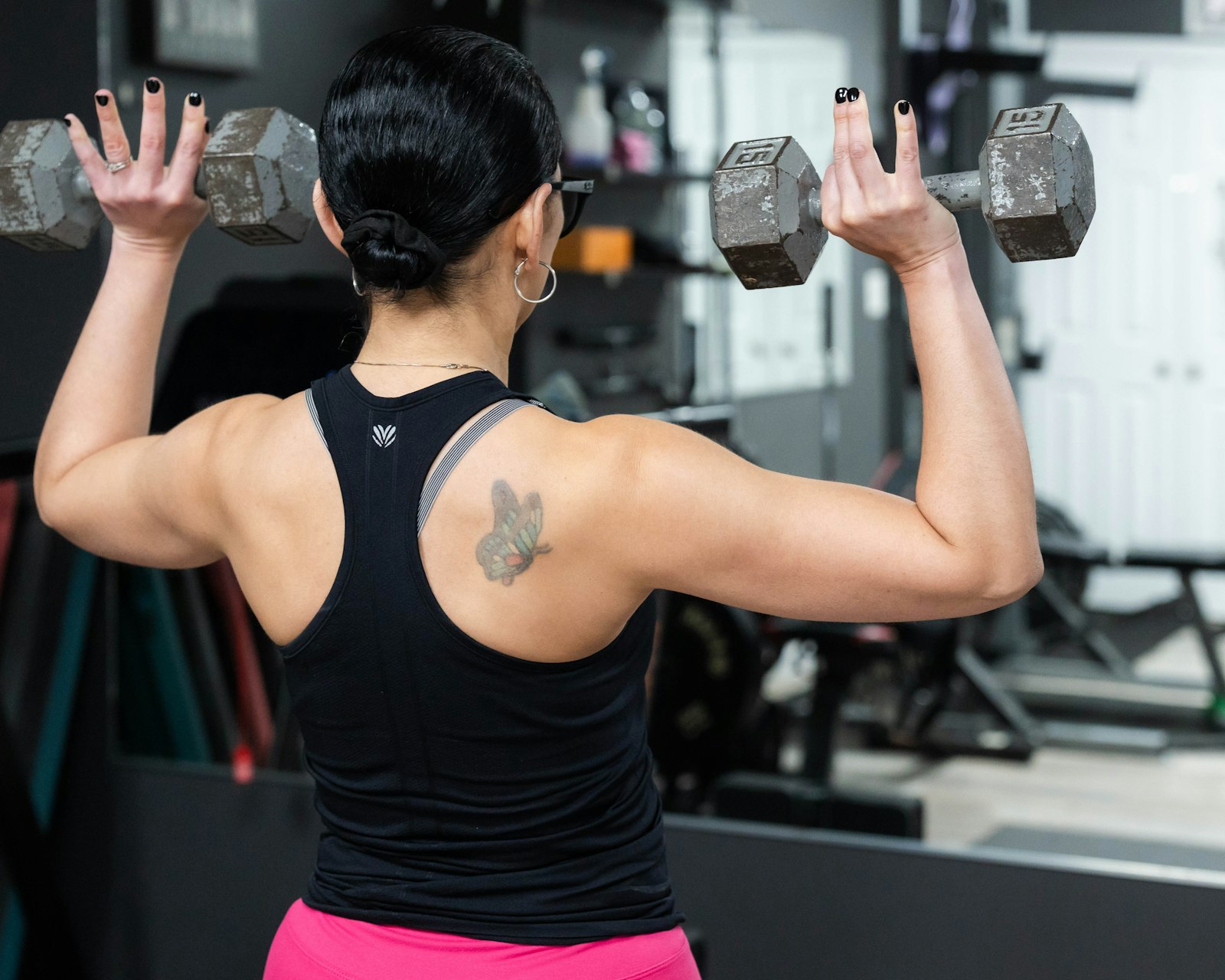



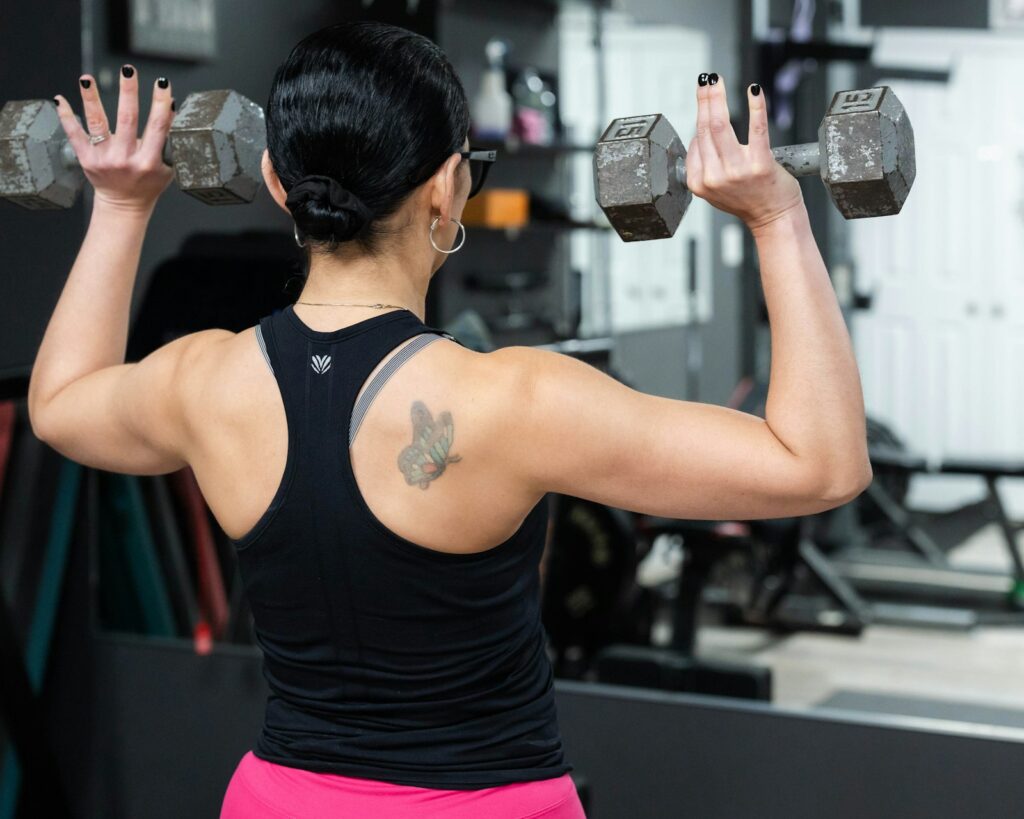
The short answer: both work. The standing shoulder press makes your core, glutes and legs work to keep you stable, and research shows it uses your abs and obliques far more than the seated version. The seated press gives you more support, so it’s easier to focus on your shoulders and usually lets you press more weight with dumbbells. Choose standing if you want a full-body strength lift. Choose seated if you want to isolate your shoulders, train around lower back or balance issues, or push more volume. Many people do well using both.
This guide is for anyone deciding how to set up their shoulder pressing. I’ll cover the differences, what the research shows, how to do each version, common mistakes and how to program them. For a full technique walkthrough of the overhead press, see my overhead press guide.
Seated vs standing shoulder press: the main differences
| Seated | Standing | |
|---|---|---|
| Support | Back pad or bench supports your torso | Your core and legs keep you upright |
| Core demand | Lower | Much higher |
| Load (with dumbbells) | Usually higher | Usually lower |
| Lower back | Easier to keep neutral with a back pad | Needs good bracing to avoid leaning back |
| Carryover | Shoulder strength and size | Full-body overhead strength for sports and daily life |
| Best for | Shoulder focus, higher reps, people with balance or back issues | Strength, athletic training, efficient full-body work |
What the research says
- Standing works your core much harder. A 2012 study of 15 healthy men measured core muscle activity during dumbbell shoulder presses at 80% of max. With two dumbbells, abdominal (rectus abdominis) activity was about 81% lower seated than standing, and oblique activity was about 58% lower. Lower back muscle activity was similar in both positions.
- The least stable version activates the front delts most but lifts the least. A 2013 study of the same research group with 15 healthy men compared seated and standing presses with a barbell and with dumbbells. The standing dumbbell press produced the highest front shoulder (anterior deltoid) activity, but lifters could press less weight with it than with any other version, about 7% less than the standing barbell press. Rear delt activity was generally lower when seated, and triceps activity was higher with a standing barbell than with standing dumbbells.
These studies measured muscle activity in single sessions, not growth over time. I couldn’t find a training study comparing seated and standing presses directly. Together they suggest that standing gives you more core work and the seated press makes it easier to load your shoulders. The advice below comes from my coaching experience.
How to do a standing shoulder press
- Set a barbell in a rack at upper chest height, or hold two dumbbells at shoulder height.
- Stand with your feet about hip width apart. Squeeze your glutes and brace your stomach.
- Press the weight straight up. With a barbell, move your head back slightly to clear your chin, then push your head through at the top.
- Lock your arms out overhead, with the weight over your mid-foot.
- Lower under control to your shoulders and repeat.
How to do a seated dumbbell shoulder press
- Set an adjustable bench upright, at or just below 90°.
- Sit with your back against the pad and your feet flat on the floor. Hold the dumbbells at shoulder height, palms facing forward or slightly in.
- Brace your stomach and keep your lower back against the pad.
- Press the dumbbells up until your arms are straight, bringing them slightly together at the top.
- Lower slowly until the dumbbells are around ear or shoulder height.
Coaching cues I use for both: “ribs down,” “squeeze your glutes” when standing and “back on the pad” when seated. If you lean back to finish a rep, the weight is too heavy.

Common mistakes and how to fix them
| Mistake | Why it matters | Fix |
|---|---|---|
| Leaning back when standing | Turns it into an incline press and loads your lower back | Squeeze your glutes, brace and use a lighter weight |
| Arching off the pad when seated | Same problem, and it shortens the range | Keep your lower back touching the pad |
| Bench set too far back | Becomes a steep incline chest press | Set the backrest at or just below 90° |
| Elbows flared straight out to the sides | Can irritate the shoulders | Keep your elbows slightly in front of your body |
| Cutting the range short | Less muscle worked | Lower to shoulder or ear height, then press to full lockout |
| Using leg drive on a strict press | Turns it into a push press | Keep your knees locked for a strict press |
If you do want to use your legs, that’s a different lift. My push press vs strict press guide explains when to use each.
Which should you do?
- You want full-body strength: make the standing press your main shoulder lift.
- You want bigger shoulders: both work. The seated press makes it easier to push hard sets without your core or balance giving out first.
- You have lower back discomfort when standing: try the seated press with your back against the pad.
- You’re short on time: standing presses train your core at the same time.
- You want both benefits: do a standing press as your heavy lift and a seated dumbbell press later in the week for more volume.
If you have shoulder pain or a past shoulder injury, start light and check with a physical therapist or doctor before loading overhead pressing.
Sets, reps and where they fit
These are starting points I use with most lifters.
| Version | Sets | Reps | Rest |
|---|---|---|---|
| Standing barbell press | 3–4 | 5–8 | 2–3 minutes |
| Seated dumbbell press | 3–4 | 8–12 | 90 seconds–2 minutes |
Add lateral raises for the side of your shoulders, as no pressing exercise works them fully on its own. My lateral raise guide shows how.
Summary
- Standing presses make your core, glutes and legs work. Seated presses give you more support.
- Research shows standing presses use the abs and obliques much more than seated presses.
- Standing dumbbell presses produced the highest front shoulder activity in one study, but the lowest weight lifted.
- Choose standing for full-body strength and seated for shoulder focus and higher volume.
- Brace, avoid leaning back and press to a full lockout in both versions.
Build stronger shoulders with a clear plan
Seated or standing, your shoulders grow when you train them consistently and add weight over time. That’s where 12REPS helps.
12REPS gives you trainer-built programs with two demo videos for every exercise, so you can check your pressing form. The gym log shows what you lifted last time, so you know when to add weight. Build Your Routine lets you add seated and standing presses to your own week, and the built-in timer keeps your rest periods on track. Every new account starts with a 7-day free trial.
Download 12REPS and see what you’ll get:
Sources
- Saeterbakken AH, Fimland MS. Muscle activity of the core during bilateral, unilateral, seated and standing resistance exercise. European Journal of Applied Physiology. 2012;112(5).
- Saeterbakken AH, Fimland MS. Effects of body position and loading modality on muscle activity and strength in shoulder presses. Journal of Strength and Conditioning Research. 2013;27(7):1824–1831.
Related reading
- How to Overhead Press Properly: The Complete Shoulder Guide for Women
- Push Press vs Strict Press: Differences, Form and Which to Do
- How to Do Lateral Raises: Form, Weight and Common Mistakes
- Building Broad Shoulders: The Complete Guide
- Barbell Military Press: exercise demo
I’m Will Duru, a personal trainer and the founder of 12REPS. I hold a BSc (Hons) in Sport and Exercise Science and have more than a decade of experience coaching people in strength training.
