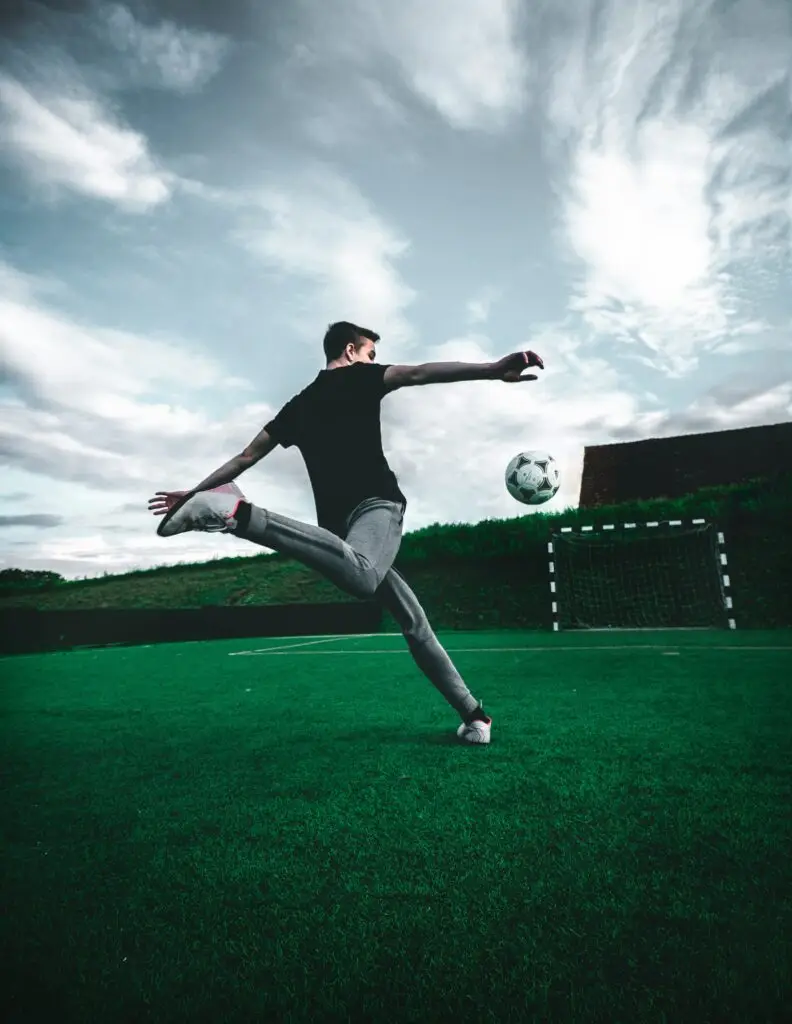



The best football pre-season exercises build strength, power and single-leg control. This session uses eight moves: split squats, trap bar deadlifts, box jumps, step-ups, band crab walks, single-leg glute bridges, press-ups with pull-ups, and farmer’s carries. Do it twice a week alongside your sprint, agility and football training.
Football (soccer) asks you to sprint, jump, change direction and hold off opponents for 90 minutes. Strength and conditioning is training that builds the strength, power and fitness your sport needs. Whatever sport you play, it means combining bodyweight exercises with free weights such as kettlebells, dumbbells and a trap bar.
This session was put together by personal trainer Will Duru, and most exercises below have a video demonstration. Warm up before you start. Our guide to warming up before lifting weights explains how.
The 8 Pre-Season Exercises

1. Kettlebell Split Squats
This single-leg exercise works your quads and glutes, with help from your hamstrings. It trains balance, hip stability and single-leg strength, which you use every time you sprint, cut or land on one leg.
Sets and reps: 4 sets of 12 reps (6 on each leg).
- Why it works: A 2022 meta-analysis found that single-leg (unilateral) training improved single-leg jump performance more than two-leg training. Effects on sprint speed were similar for both.
- Tip: Hold the kettlebell in the goblet position, close to your chest. This makes your core work and helps you stay upright when you are tired.
- Harder option: Raise your back foot on a bench to turn it into a Bulgarian split squat.
2. Trap Bar Deadlift
The trap bar (hex bar) deadlift works your glutes, hamstrings, quads and back. You stand inside the bar with the handles at your sides, so you can stay more upright than with a straight bar. Many people find it simpler to learn.
Sets and reps: 4 sets of 4 to 6 reps.
- Why it works: In a 2017 study of 11 men, lifters could lift about 6% more with a hex bar than a straight bar, and moved it faster. Mean power was about 28% higher with the hex bar.
- Tip: Push the floor away through your whole foot and stand up with intent to train lower-body power.
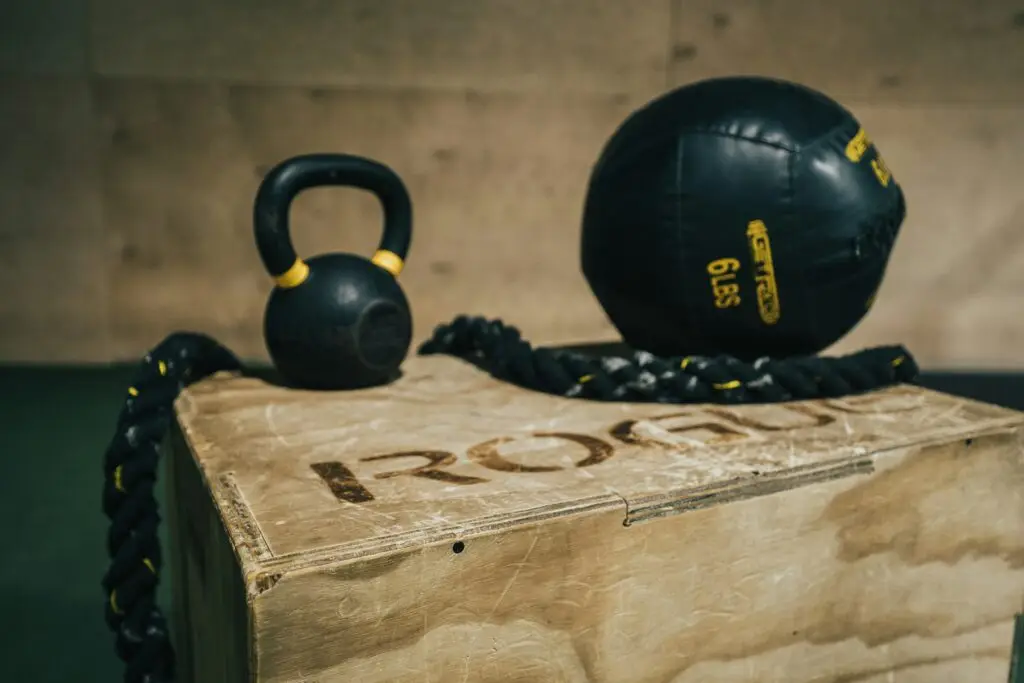
3. Box Jumps
Box jumps are a plyometric exercise. Plyometrics use jumps and landings to train your muscles to produce force fast. That matters for sprinting, jumping and reacting during play.
- Why it works: A 2010 review of plyometric training found it can improve lower-limb strength and power. It may also improve jumping, sprinting and agility.
- Tip: Step down and reset after each jump. Quality matters more than quantity. Land softly, with your knees in line with your toes.
Watch a 12REPS trainer demonstrate the box jump:
4. Kettlebell Box Step-Ups
Step-ups build single-leg strength and control. They work your quads and glutes in a pattern similar to running and pushing off.
Sets and reps: 4 sets of 12 reps (6 on each leg).
- Why it works: Your front leg does almost all the lifting. You train each leg on its own and can spot if one side is weaker.
- Tip: Push through your whole front foot and keep your torso upright. Avoid pushing off your back foot.
- Easier option: Start with a bodyweight step-up before adding a kettlebell.
5. Band Crab Walks
Crab walks train the muscles at the side of your hips, mainly the gluteus medius. These muscles help keep your pelvis level and your knees in line when you run, land and change direction.
Sets and distance: 4 sets of 20 meters.
- Why it works: Sideways band walks load your hips in a direction many gym exercises miss.
- Tip: Keep tension in the band the whole time. Take small steps and stay low.
See the mini band crab walk page for full technique.
6. Single-Leg Glute Bridge
This bodyweight exercise works your glutes and hamstrings. It also trains you to control your pelvis while one leg does the work.
Sets and reps: 4 sets of 20 reps (10 on each leg).
- Build up to it: Start with the two-leg banded glute bridge shown in the video below, as on our mini band glute bridge page. When that feels controlled, lift one foot and bridge on one leg.
- Tip: Keep your ribs down and squeeze your glutes at the top. Do not arch your lower back to get higher.
7. Press-Ups and Pull-Ups (or Assisted Pull-Ups)
These two exercises build upper-body pushing and pulling strength. You use that strength to shield the ball, win aerial duels and hold your position in contact.
Sets and reps: 4 sets of 4 to 8 reps of each.
- Why it works: Pairing a push with a pull trains the front and back of your upper body evenly.
- Tip: Use the full range of motion. If you cannot do pull-ups yet, use an assisted pull-up machine or a band. Our guide to doing your first pull-up shows how to progress.
Learn the technique on the bodyweight press-up page.
8. Kettlebell Farmer's Carry
Finish with a loaded carry. Pick up a heavy kettlebell in each hand, stand tall and walk.
Sets and distance: 4 sets of 40 meters.
- Why it works: Carries train your grip. Your trunk also has to work to keep you tall and steady while you walk under load.
- Tip: Keep your shoulders down and back, and take short, controlled steps.
Read our full guide to the farmer’s carry.
How to Use This Pre-Season Session
These eight exercises cover strength, power, balance and single-leg control. Run this session twice a week in pre-season. Combine it with sprint drills, agility work and football-specific conditioning.
- Warm up first: Start every session with a proper warm-up.
- Progress gradually: Add a little load or a few reps over the pre-season, as long as your form stays good. This is called progressive overload.
- Keep quality high: Stop a set if your technique breaks down, especially on box jumps.
If you play touch rugby, see our 8-week touch rugby strength and conditioning plan.
If you want your sessions set out for you, 12REPS builds workouts around your goal, your equipment and the time you have. Every exercise has a trainer demonstration, and the app remembers what you lifted so you have a number to beat.
Sources
- Liao KF, et al. Effects of unilateral vs. bilateral resistance training interventions on measures of strength, jump, linear and change of direction speed: a systematic review and meta-analysis. Biology of Sport, 2022. https://pmc.ncbi.nlm.nih.gov/articles/PMC9331349
- Lake J, Duncan F, Jackson M, Naworynsky D. Effect of a Hexagonal Barbell on the Mechanical Demand of Deadlift Performance. Sports (Basel), 2017. https://pmc.ncbi.nlm.nih.gov/articles/PMC5969032
- Markovic G, Mikulic P. Neuro-Musculoskeletal and Performance Adaptations to Lower-Extremity Plyometric Training. Sports Medicine, 2010. https://www.scilit.net/publications/d13e2fcbcbd735f07425a00648e92e01