


By Will Duru, BSc (Hons) Sport and Exercise Science, Award winning Personal Trainer with over 10 years of experience in strength training
To build glutes, train them two to three times a week. Use hip extension exercises such as hip thrusts and Romanian deadlifts, deep squats and lunges, and some side-of-hip work. Make your sets hard, add reps or weight over time, and eat enough protein. Muscle grows slowly, so think in months, not weeks.
Many women tell me they have squatted for years and their glutes look the same. The problem is rarely effort. It is usually the plan.
This guide covers the science: how your glute muscles work, what research says about squats versus hip thrusts, and how to put a plan together. For more detail on single topics, see how often to train glutes, barbell hip thrust form and how to split glute training between gym and home.
Understanding your glute muscles
Before you choose exercises, it helps to know what you are building. Your glutes are a group of three muscles.
Gluteus maximus is the largest of the three and gives your backside most of its shape. Its main jobs are to extend your hip (drive it forward, as at the top of a hip thrust) and to rotate your thigh outward (StatPearls).
Gluteus medius sits on the outer, upper part of your hip. It moves your leg out to the side, which is called hip abduction, and helps keep your pelvis level when you stand on one leg.
Gluteus minimus is the smallest. It lies under the gluteus medius and works with it.
Because the three muscles do different jobs, a good glute plan uses more than one movement pattern, not just squats.
Do squats build glutes? What the research says
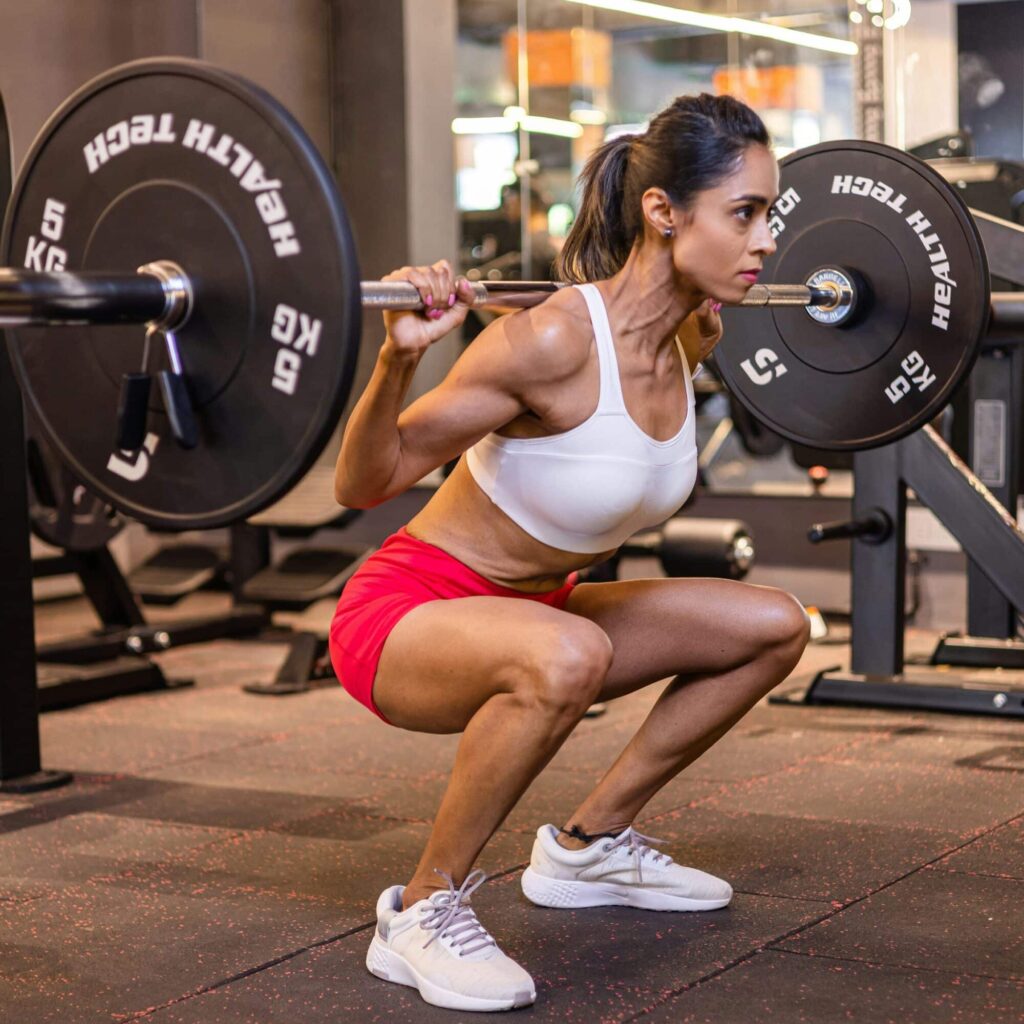
Squats do build glutes, especially deep ones. But they are not the only option, and they are not always the most glute-focused one.
- Muscle activity: a 2020 systematic review ranked exercises by how strongly the gluteus maximus was activated. Step-ups and their variations came out highest. Deadlifts, several hip thrust variations, lunges and split squats were also very high (Neto et al., 2020). Activation is measured with electrodes on the skin (EMG), and it does not directly show which exercise builds the most muscle.
- Hip thrust vs squat: in a 9-week study of 34 untrained young adults, most of them women, hip thrusts and back squats built similar glute size. The squat group also grew more in the front and inner thighs (Plotkin et al., 2023).
- Squat depth: in a 10-week study of 17 men, full squats increased gluteus maximus volume by 6.7%, compared with 2.2% for half squats (Kubo et al., 2019).
So the practical answer is to use both. Squat through a full range you can control. Then add hip thrusts or bridges, which load your glutes hard at the top, when your hips are fully extended.
The three movement patterns for glute training
To train all three glute muscles, include each of these patterns in your week.
1. Hip extension
These exercises drive your hips forward against resistance. They mainly work the gluteus maximus.
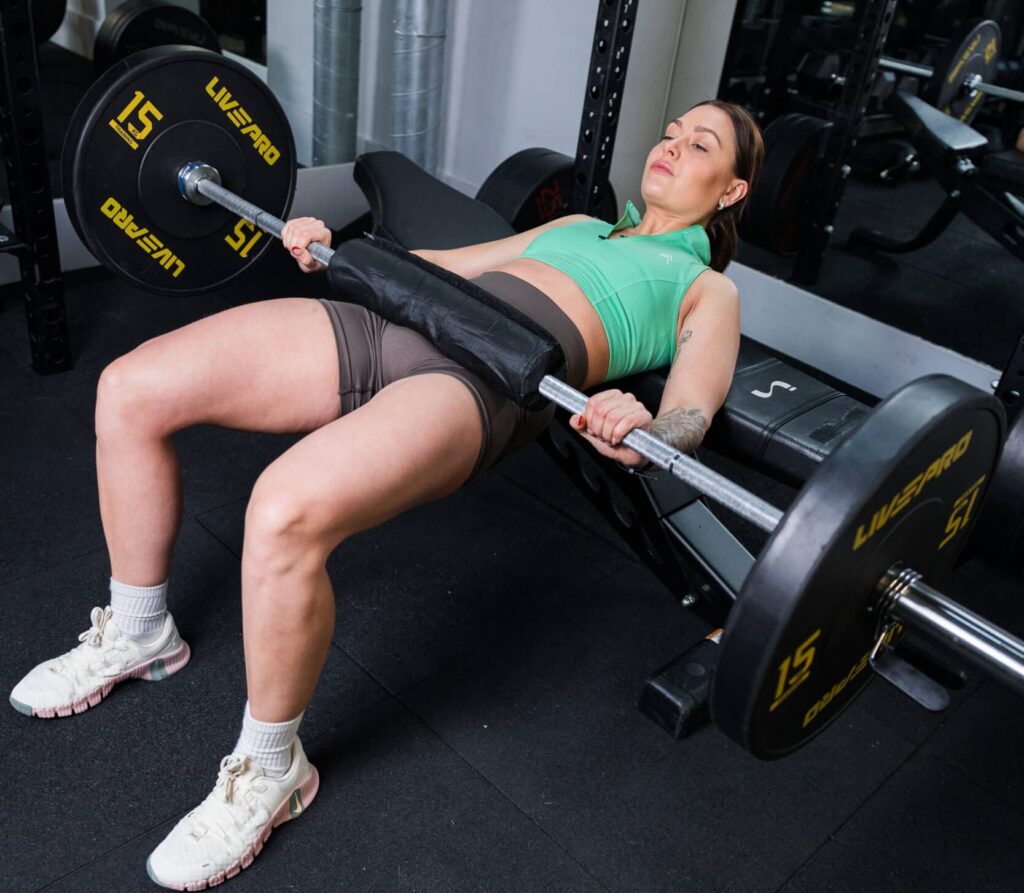
- Hip thrust (barbell, dumbbell or machine)
- Glute bridge (single-leg or both legs)
- Romanian deadlift
- Cable pull-through
- Kettlebell swing
Hip thrusts make a good foundation. Start with your body weight, as shown on the bodyweight hip thrust page, then add a dumbbell and later a barbell as you get stronger.
Video: How to do a barbell hip thrust. Watch this before you load a bar. It shows the bench position and how to finish each rep with your hips fully extended.
2. Hip abduction
These exercises move your leg out to the side. They mainly work the gluteus medius and minimus on the outer hip.
- Cable hip abduction
- Banded side walk, such as the mini band crab walk
- Side-lying leg raise
- Machine hip abduction
- Clamshell, such as the mini band clamshell
Many women skip this pattern. It only needs a few sets a week, often at the end of a session.
Video: Hip abductor machine. This is the machine version of hip abduction used in Workout B below. Watch it to check your seat position and range of motion.
3. Squats and lunges
These compound moves work your glutes together with your quads and inner thighs. They also build overall leg strength.
- Barbell back squat
- Bulgarian split squat, such as the bodyweight Bulgarian split squat
- Walking lunge
- Goblet squat
- Step-up
- Leg press with your feet higher on the platform
To get more from your glutes in these moves, go through a full range you can control. Push through your whole foot and squeeze your glutes as you stand up.

How often should you train glutes?
Most women do well training glutes two to three times a week on non-consecutive days. The NHS recommends strength training for all major muscle groups, including the hips, on at least 2 days a week (NHS).
Here is how I usually set it up:
- Beginner (0 to 6 months of training): two glute sessions a week, focused on learning good technique.
- Intermediate (6 months to 2 years): two to three sessions a week, with steady progression and more exercise variety.
- Advanced (2+ years): two to four sessions a week, depending on your goals and recovery.
Consistency over months beats a burst of training that burns you out. For the full answer, read how often should you train glutes.
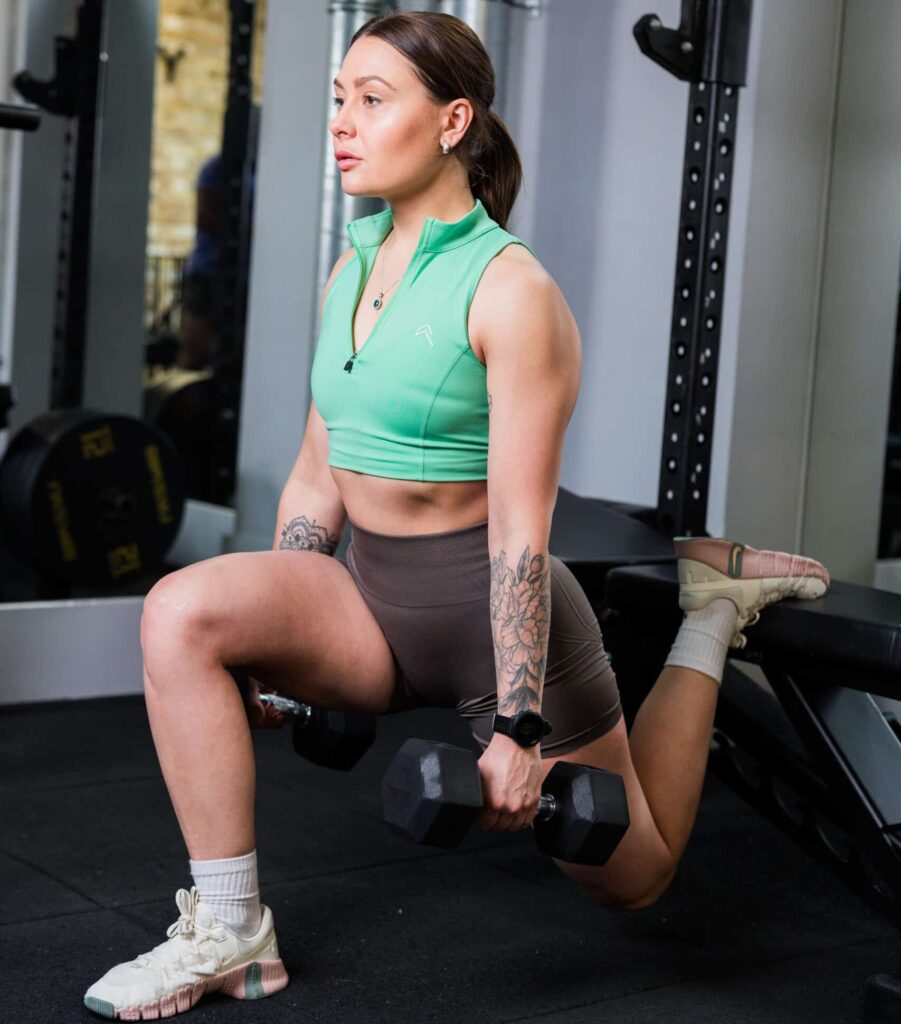
A sample glute workout plan
This plan covers all three movement patterns in two workouts. Do each workout once a week on non-consecutive days, for example Monday and Thursday.
Workout A: hip thrust focus
| Exercise | Sets x reps | Rest |
|---|---|---|
| Barbell hip thrust | 4 x 10-12 | 90 sec |
| Romanian deadlift | 3 x 10-12 | 90 sec |
| Bulgarian split squat | 3 x 10-12 each leg | 60 sec |
| Cable hip abduction | 3 x 15-20 each leg | 45 sec |
| Glute bridge hold | 3 x 30-second holds | 45 sec |
Workout B: squat and hinge focus
| Exercise | Sets x reps | Rest |
|---|---|---|
| Barbell back squat (or goblet squat) | 4 x 8-10 | 2 min |
| Single-leg Romanian deadlift | 3 x 10-12 each leg | 60 sec |
| Walking lunge | 3 x 12-16 steps in total | 90 sec |
| Machine hip abduction | 3 x 15-20 | 45 sec |
| Banded glute bridge | 3 x 15-20 | 45 sec |
That is 16 working sets per session and 32 a week. Start with weights you can control, and leave the last few reps of each set feeling hard.
Want a ready-made gym version? See the women’s glute workout at the gym.
Common mistakes that slow glute growth
I see the same mistakes again and again. Fix these and your training will work harder for you.
Mistake 1: sets that are too easy
Light weights are not the problem on their own. A 2021 network meta-analysis found that light, moderate and heavy loads built similar muscle when sets were taken to failure. Heavier loads built more strength (Lopez et al., 2021).
The real problem is stopping a set while it still feels easy. If you could do 10 more reps, the set was too easy to build much muscle. Your glutes are strong, so do not be afraid to load the hip thrust.
Mistake 2: not feeling your glutes work
If you mainly feel your thighs or lower back, check your technique. Pause and squeeze at the top of each hip thrust. In squats and lunges, push through your whole foot and drive your hips forward as you stand.
A few warm-up sets can help you find your glutes, for example the mini band glute bridge.
Mistake 3: no progressive overload
Doing the same workout with the same weight for months gives your muscles no reason to change. Progressive overload means making the work a little harder over time.
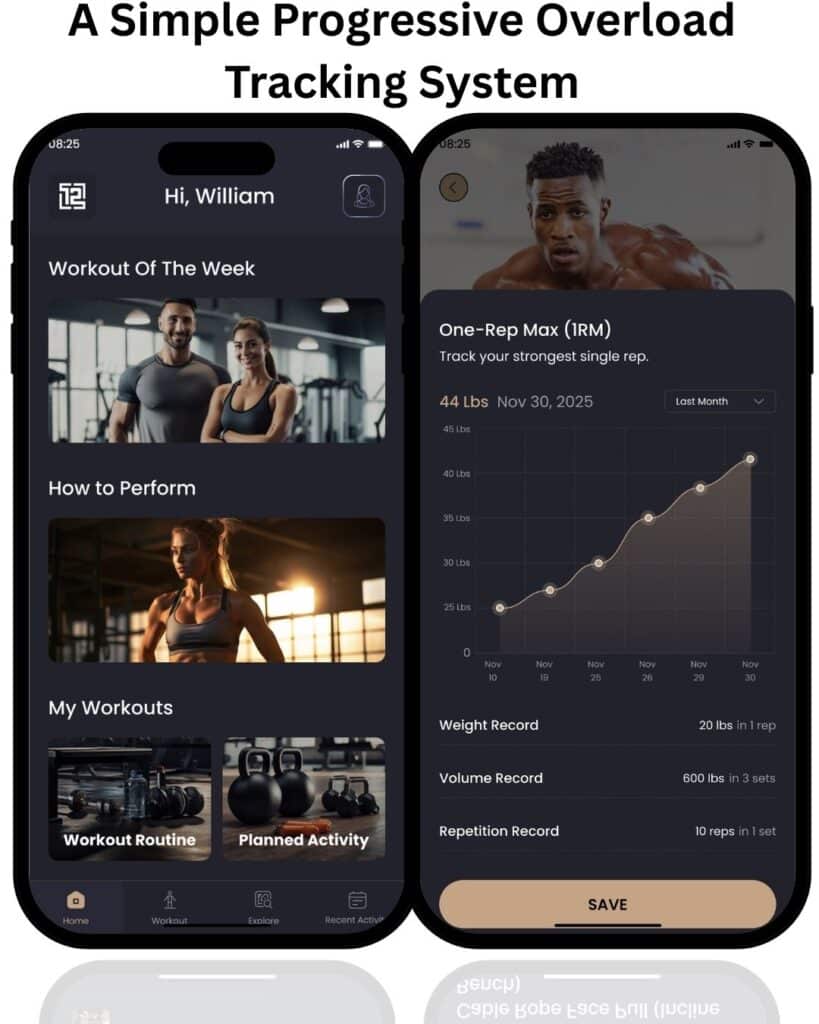
You can add weight or add reps. In an 8-week study of trained adults, both approaches built similar muscle (Plotkin et al., 2022). Write down what you lift each session so you know what to beat next time.
Mistake 4: training glutes when you are already tired
Some women add a few sets of hip thrusts at the end of a long session. If glutes are your priority, train them first while you are fresh.
Mistake 5: under-eating
Muscle needs enough protein and energy. In a meta-analysis, gains in muscle from training leveled off at about 1.6 g of protein per kg of body weight a day (Morton et al., 2018). For a 65 kg woman, that is about 105 g a day across your meals.
A big calorie deficit also holds back muscle growth. In another meta-analysis, a deficit of about 500 kcal a day was enough to stop gains in lean mass, although strength still improved (Murphy and Koehler, 2022). You do not have to gain weight, but avoid a large deficit while you build.
How long does it take to see results?
The glute growth studies above ran for 9 to 10 weeks and found measurable but modest changes on scans. Visible change usually takes longer than that. Plan on months of steady training, not weeks.
You may notice your glutes feel firmer and work harder in the first few weeks. That is a good sign, even before the mirror shows much. If you are new to glute training, you have the most room to grow in your first year.
How to get started
If you want sessions built around your goal, your equipment and the time you have, the 12REPS app sets them out for you. Every exercise has a trainer demonstration, and the app remembers what you lifted last time so you always have a number to beat. See how the 12REPS app works.
Final thoughts
Building glutes is not complicated, but it does take the right approach. Train hip extension, hip abduction, and squat and lunge patterns. Make your sets hard and add reps or weight over time. Eat enough, and stay consistent for months.
For lower-body sessions that train your whole legs, read lower body strength training for women.
Sources
- Anatomy, Bony Pelvis and Lower Limb, Gluteus Maximus Muscle. StatPearls Publishing, NCBI Bookshelf, accessed 2026. https://www.ncbi.nlm.nih.gov/books/NBK538193/
- Gluteus Maximus Activation during Common Strength and Hypertrophy Exercises: A Systematic Review. Neto WK, Soares EG, Vieira TL et al. Journal of Sports Science and Medicine, 2020. https://pubmed.ncbi.nlm.nih.gov/32132843/
- Hip thrust and back squat training elicit similar gluteus muscle hypertrophy and transfer similarly to the deadlift. Plotkin DL, Rodas MA, Vigotsky AD et al. Frontiers in Physiology, 2023. https://doi.org/10.3389/fphys.2023.1279170
- Effects of squat training with different depths on lower limb muscle volumes. Kubo K, Ikebukuro T, Yata H. European Journal of Applied Physiology, 2019. https://doi.org/10.1007/s00421-019-04181-y
- Physical activity guidelines for adults aged 19 to 64. NHS, accessed 2026. https://www.nhs.uk/live-well/exercise/physical-activity-guidelines-for-adults-aged-19-to-64/
- Resistance Training Load Effects on Muscle Hypertrophy and Strength Gain: Systematic Review and Network Meta-analysis. Lopez P, Radaelli R, Taaffe DR et al. Medicine and Science in Sports and Exercise, 2021. https://doi.org/10.1249/MSS.0000000000002585
- Progressive overload without progressing load? The effects of load or repetition progression on muscular adaptations. Plotkin D et al. PeerJ, 2022. https://doi.org/10.7717/peerj.14142
- A systematic review, meta-analysis and meta-regression of the effect of protein supplementation on resistance training-induced gains in muscle mass and strength in healthy adults. Morton RW, Murphy KT, McKellar SR et al. British Journal of Sports Medicine, 2018. https://doi.org/10.1136/bjsports-2017-097608
- Energy deficiency impairs resistance training gains in lean mass but not strength: A meta-analysis and meta-regression. Murphy C, Koehler K. Scandinavian Journal of Medicine and Science in Sports, 2022. https://doi.org/10.1111/sms.14075