




The short answer: push-ups and the bench press can build chest, shoulder and triceps muscle and strength about equally, as long as the effort and resistance are similar. Research shows that push-ups matched to bench press loads produce similar muscle growth and strength gains. The difference is practical. The bench press is easier to load heavily and progress in small steps. Push-ups need no equipment, train your core and shoulder blades at the same time, and can be made harder with bands, a weighted vest or elevated feet. Use the bench press if you want maximum strength and easy progression. Use push-ups when you train at home or want a joint-friendly option. Most people benefit from both.
This guide is for anyone deciding between push-ups and the bench press, or wondering if push-ups alone can build a strong chest. I’ll cover the differences, what the research shows, how much weight a push-up really is, and how to make push-ups hard enough to keep building muscle.
Push-ups vs bench press: the main differences
| Push-ups | Bench press | |
|---|---|---|
| Equipment | None | Bench, barbell or dumbbells, and ideally a rack |
| Load | A share of your body weight, changeable by position | Any weight you choose |
| Progression | Bands, vest, deficit, feet elevated, tempo | Add small plates |
| Shoulder blades | Move freely | Pinned to the bench |
| Core work | High, as in a moving plank | Low |
| Best for | Home training, beginners, conditioning, joint comfort | Maximum strength and heavy loading |
How much weight is a push-up?
A 2010 study of 23 recreationally fit young adults measured how much force people pushed through their hands in different push-up positions, as a share of body weight.
| Push-up variation | Share of body weight |
|---|---|
| Feet elevated on a 24-inch box | About 74% |
| Feet elevated on a 12-inch box | About 70% |
| Regular push-up | About 64% |
| Hands elevated on a 12-inch box | About 55% |
| From your knees | About 49% |
| Hands elevated on a 24-inch box | About 41% |
So for someone who weighs 180 lb, a regular push-up is roughly like pressing 115 lb. That makes push-ups a moderate load for most people, which is why they eventually need extra resistance to keep building strength.
What the research says
- Push-ups and the bench press built similar muscle. In an 8-week study of 18 young men, one group did the bench press at 40% of their max and the other did push-ups adjusted to the same load, twice a week. Both groups increased their chest and triceps thickness and their bench press 1RM. Bench press strength rose from about 60 to 65 kg in the bench group and 61 to 64 kg in the push-up group, with no significant difference between groups.
- Banded push-ups built similar strength. In a 5-week study of 30 trained students, one group did the bench press and another did push-ups with elastic bands, set so muscle activity was matched. Both trained 5 sets of 6 reps twice a week. Both groups improved their 6-rep max by about 20%. Their bench press 1RM also improved in both groups, by about 20% for the bench group and 14% for the push-up group.
Both studies were short and small, and the loads were matched carefully. In the real world, most people find it easier to keep the bench press challenging over months and years. But the research makes it clear that push-ups are a real strength exercise, not just a warm-up.
How to do a push-up
- Place your hands slightly wider than shoulder width, fingers pointing forward.
- Step your feet back so your body forms a straight line from your head to your heels.
- Brace your stomach and squeeze your glutes.
- Lower your chest toward the floor, keeping your elbows about 30–45° from your body.
- Touch your chest to the floor or a low target, then push back up to straight arms.
Coaching cues I use: “body like a plank,” “screw your hands into the floor” and “chest to the floor, not your chin.” If your hips sag, move to an easier variation.
How to make push-ups easier or harder
- Easier: put your hands on a bench or box. The higher your hands, the easier it gets. Here’s my bench push-up demo.
- Harder: elevate your feet, slow down the lowering phase, add a pause at the bottom, use a resistance band across your back or wear a weighted vest.
- More range: do deficit push-ups with your hands on low plates or handles so your chest can go lower.
Which should you do?
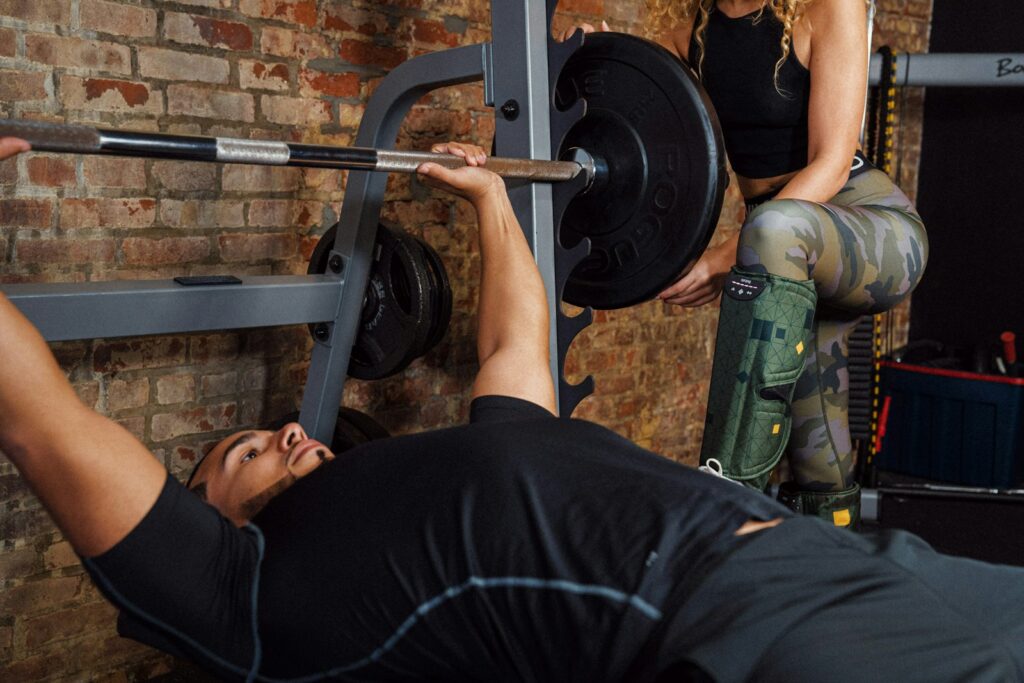
- You want maximum chest strength: make the bench press your main lift. It’s the easiest way to keep adding load.
- You train at home: push-ups can build a strong chest. Add bands, a vest or harder variations as you improve.
- You’re a beginner: start with push-ups, or incline push-ups, to learn to brace and press.
- Your shoulders feel beat up from benching: push-ups let your shoulder blades move freely, which many people find more comfortable.
- You want both: use the bench press for heavy sets and push-ups for higher-rep work or finishers.
Sets and reps
These are starting points I use with most people.
| Exercise | Sets | Reps | Notes |
|---|---|---|---|
| Bench press | 3–4 | 5–10 | Main chest lift |
| Push-ups (harder variation) | 3 | 6–15 | Choose a variation that makes 15 reps hard |
| Push-ups (finisher) | 1–2 | As many good reps as possible | Stop when your form breaks |
If you can do more than about 25–30 regular push-ups, they’re closer to endurance work than strength work. Make them harder to keep building muscle.
Summary
- A regular push-up is about 64% of your body weight.
- Research shows push-ups matched to bench press loads build similar muscle and strength.
- The bench press is easier to load heavy and progress over time.
- Push-ups need no equipment, train your core and let your shoulder blades move.
- Make push-ups harder with bands, a vest, elevated feet or deficits so they keep working.
Train your chest with a clear plan
Whether you press at home or in the gym, steady progress is what builds your chest. That’s where 12REPS helps.
12REPS gives you trainer-built programs with two demo videos for every exercise, including push-up variations and pressing movements. The gym log shows what you did last time, so you know when to make it harder. Build Your Routine lets you mix push-ups and presses in your own week, and the built-in timer keeps your rest periods on track. Every new account starts with a 7-day free trial.
Download 12REPS and see what you’ll get:
Sources
- Kikuchi N, Nakazato K. Low-load bench press and push-up induce similar muscle hypertrophy and strength gain. Journal of Exercise Science & Fitness. 2017;15(1):37–42.
- Calatayud J, Borreani S, Colado JC, Martin F, Tella V, Andersen LL. Bench press and push-up at comparable levels of muscle activity results in similar strength gains. Journal of Strength and Conditioning Research. 2015;29(1):246–253.
- Wurm B, VanderZanden T, Spadavecchia M, et al. Kinetic analysis of several variations of push-ups. ISBS Conference Proceedings. 2010.
Related reading
- Best Incline Bench Angle for Upper Chest
- Build a Stronger Chest: 4-Exercise Workout
- How to Increase Your Bench Press
- Home Workout for Dads: Build Muscle With Dumbbells
I’m Will Duru, a personal trainer and the founder of 12REPS. I hold a BSc (Hons) in Sport and Exercise Science and have more than a decade of experience coaching people in strength training.
