
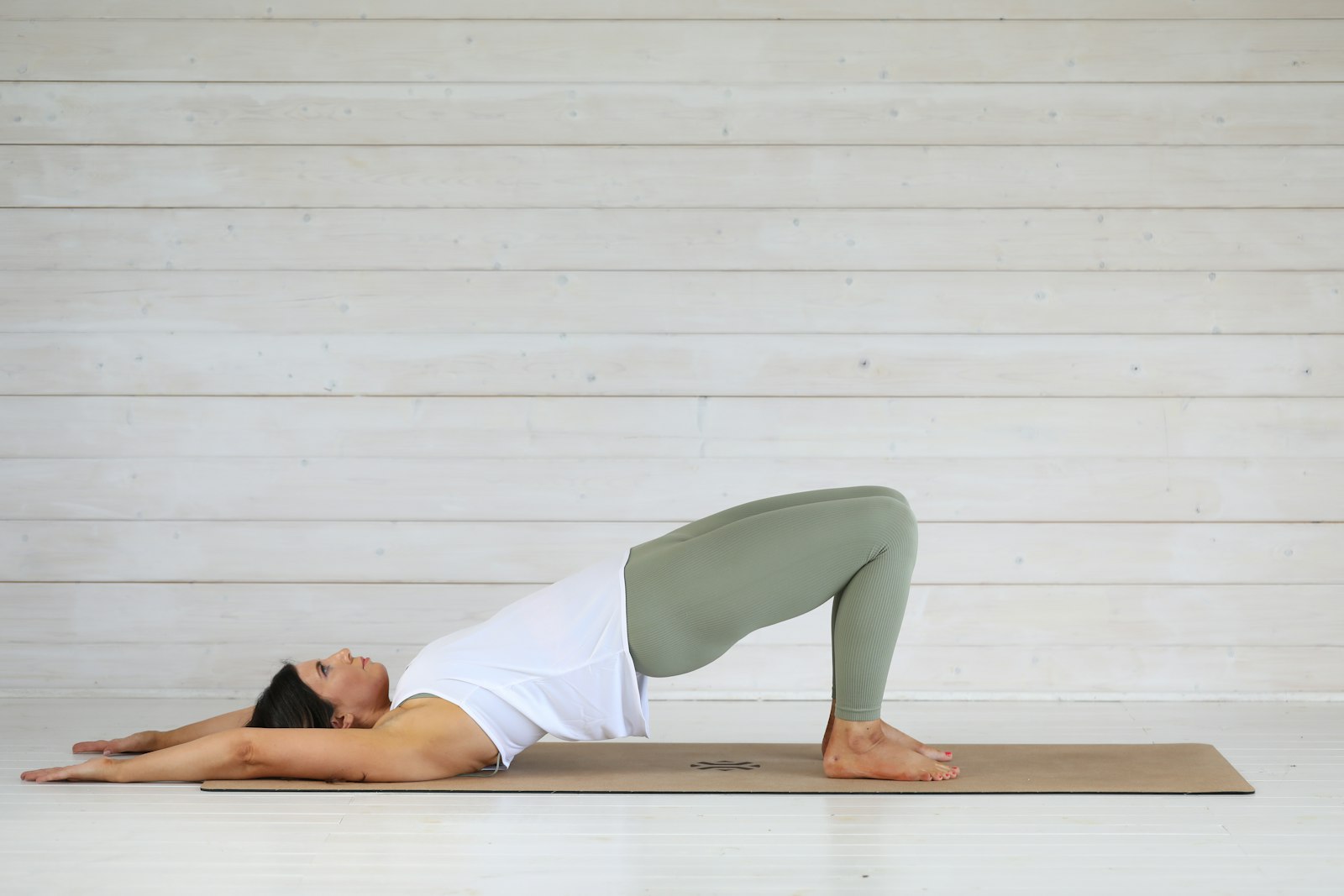



The short answer: the glute bridge and the hip thrust both train your glutes by driving your hips up. In a glute bridge, your upper back stays on the floor. In a hip thrust, your upper back rests on a bench, so your hips travel through a bigger range of motion. The bridge is easier to set up and a great place to start, especially at home. The hip thrust usually lets you lift more weight and keep progressing for longer, so it’s often the better main glute lift once you train in a gym. Both work, and most people benefit from using each one at different times.
This guide is for anyone deciding between the two, whether you’re new to glute training or you’ve been bridging for a while and want to know if it’s time to move to hip thrusts. I’ll cover the differences, what the research shows, how to do each one, common mistakes and how to program them.
Glute bridge vs hip thrust: the main differences
| Glute bridge | Hip thrust | |
|---|---|---|
| Upper back position | On the floor | On a bench, at about the bottom of your shoulder blades |
| Range of motion | Shorter | Longer. Your hips start lower and travel further |
| Equipment needed | Nothing. Add a dumbbell, band or barbell to progress | A bench plus a barbell, dumbbell or band |
| Setup | Quick and simple | Takes longer, especially with a barbell |
| Load potential | Moderate | High. Most people can load it heavily over time |
| Best for | Beginners, home workouts, warm-ups, higher reps | Building strength and muscle in the glutes in a gym |
| Hardest part of the rep | The top | A bigger range, with tension through more of the lift |
What the research says
There aren’t many studies that compare these two exercises directly. Here’s what the evidence shows so far.
- The hip thrust moves through a bigger range. A 2024 study of 10 resistance-trained people compared the two lifts at 80% of their hip thrust one-rep max. The bar traveled about 36 cm (14 inches) vertically in the hip thrust, compared with about 15 cm (6 inches) in the glute bridge. The hip thrust also produced more total force over each rep. The authors suggested the hip thrust suits training through a larger range, while the bridge focuses force near the top, close to full hip extension.
- Hip thrusts strongly activate the glutes. A 2020 systematic review of 16 studies classed several hip thrust variations as producing “very high” gluteus maximus activity, above 60% of maximum. The authors also warned that load, speed, fatigue and stability demands all affect these readings, so comparing activation across studies is tricky.
- High activation doesn’t guarantee more growth. In a 2023 study of 34 untrained young adults, 9 weeks of hip thrusts or back squats produced similar glute growth. Hip thrusts showed higher glute activity during a set, but that didn’t predict who grew more. Squats grew the quads and inner thighs more. Each group got stronger mostly at the exercise it trained, and both improved their deadlift by a similar amount.
So the hip thrust gives you a bigger range and more room to load, but it isn’t the only way to grow your glutes. The glute bridge still works them hard, especially near the top. The advice on choosing between them below comes from my coaching experience.
How to do a glute bridge
- Lie on your back with your knees bent and your feet flat on the floor, about hip width apart. Your heels should be close enough to your hips that you can just touch them with your fingertips.
- If you’re using a dumbbell, rest it across your hips and hold it in place with both hands.
- Brace your stomach and tuck your chin slightly.
- Push through your heels and squeeze your glutes to lift your hips until your body forms a straight line from your shoulders to your knees.
- Pause for one second at the top and squeeze your glutes hard.
- Lower your hips back to the floor under control.
Coaching cues I use: “push through your heels,” “ribs down” and “squeeze at the top.” If you feel it mostly in your hamstrings, bring your feet a little closer to your hips.
How to do a hip thrust
- Sit on the floor with the bottom edge of your shoulder blades against a stable bench.
- Roll a padded barbell over your legs until it sits in the crease of your hips. You can also use a dumbbell, as in the dumbbell hip thrust demo.
- Plant your feet flat, about hip width apart, so your shins will be close to vertical at the top.
- Brace your stomach, tuck your chin and look forward rather than up at the ceiling.
- Drive through your heels and lift your hips until your torso is parallel to the floor. Your upper back pivots on the bench.
- Squeeze your glutes at the top for one second, then lower under control until your hips are a few inches from the floor.
Coaching cues I use: “chin tucked, ribs down,” “shins vertical at the top” and “hips up, not back arched.” For more detail on setup and pads, see my full barbell hip thrust guide.
Common mistakes and how to fix them
| Mistake | Why it matters | Fix |
|---|---|---|
| Arching your lower back at the top | Your back takes over from your glutes | Tuck your chin, keep your ribs down and stop when your hips are level |
| Feet too far away | Shifts the work into your hamstrings | Move your feet closer so your shins are vertical at the top |
| Feet too close | Shifts more work to your quads and can push you onto your toes | Move your feet out until your heels stay down |
| Pushing through your toes | Takes power away from your glutes | Drive through your heels and mid-foot |
| Rushing the top | You miss the hardest part for your glutes | Pause and squeeze for one second on every rep |
| Bench too high or too low (hip thrust) | Makes the setup awkward and limits range | Use a bench roughly at knee height, about 16 inches |
| Knees caving in | Reduces stability and glute work | Push your knees out in line with your toes |
Which one should you do?
- You’re new to glute training: start with the glute bridge. It teaches you to drive with your hips and feel your glutes working without a complicated setup.
- You train at home: the glute bridge is the easy choice. Add a dumbbell, a band or single-leg reps to keep it challenging.
- You want to build glute strength and size in the gym: make the hip thrust your main glute lift. Its bigger range and higher load potential give you more room to progress.
- The bench bothers your back or neck: try a barbell glute bridge on the floor. It’s a good heavy option with a simpler setup.
- You want the best of both: use hip thrusts as your heavy lift and glute bridges for higher-rep work or as a warm-up.
How to program glute bridges and hip thrusts
These are starting points I use with most people. Adjust them to your goal and the rest of your program.
| Glute bridge | Hip thrust | |
|---|---|---|
| Sets | 2–4 | 3–4 |
| Reps | 10–20 | 6–12 |
| Rest | 60–90 seconds | 90 seconds–2 minutes |
| Effort | Stop with 1–2 good reps left | Stop with 1–2 good reps left |
| When in the session | Warm-up, finisher or main lift at home | Early, as a main lower-body lift |
Two or three glute-focused sessions a week is plenty for most people. My guide on how often to train glutes goes into more detail.
A simple progression path
- Bodyweight glute bridge
- Single-leg or banded glute bridge (try the mini band glute bridge)
- Dumbbell glute bridge
- Bodyweight hip thrust on a bench
- Dumbbell hip thrust
- Barbell hip thrust
Move to the next step once you can do 15–20 controlled reps with a strong pause at the top.
Do you need hip thrusts to grow your glutes?
No. The 2023 study above found that squats grew the glutes about as much as hip thrusts. Lunges, split squats, deadlifts and step-ups also train them well. I like hip thrusts because they let you load the glutes heavily with little strain on your lower back or knees. But a program built around squats, lunges and bridges can still grow your glutes if you train hard and progress over time.
Summary
- Both exercises train your glutes by driving your hips up.
- The glute bridge keeps your back on the floor and has a shorter range. The hip thrust uses a bench for a bigger range.
- Research shows the hip thrust moves through more than twice the range of the bridge and strongly activates the glutes.
- Hip thrusts and squats produced similar glute growth in one 9-week study, so no single exercise is essential.
- Start with glute bridges, then move to hip thrusts when you want to load heavier in the gym.
Train your glutes with a clear plan
Choosing the right exercise is the first step. Knowing how many sets to do, when to add weight and how it fits with the rest of your week is what drives results. That’s where 12REPS helps.
12REPS gives you trainer-built programs with two demo videos for every exercise, so you can check your bridge and hip thrust form before you start. The gym log shows what you lifted last time, so you know when to add weight. You can use Build Your Routine to put glute bridges or hip thrusts into your own week, and the built-in timer keeps your rest periods on track. Every new account starts with a 7-day free trial.
Download 12REPS and see what you’ll get:
Sources
- Zabaleta-Korta A, Fernández-Peña E. Biomechanical differences between hip thrust and glute bridge for hip extensors. Cultura, Ciencia y Deporte. 2024;19(59).
- Krause Neto W, Soares EG, Vieira TL, et al. Gluteus maximus activation during common strength and hypertrophy exercises: a systematic review. Journal of Sports Science and Medicine. 2020;19(1):195–203.
- Plotkin DL, Rodas MA, Vigotsky AD, et al. Hip thrust and back squat training elicit similar gluteus muscle hypertrophy and transfer similarly to the deadlift. Frontiers in Physiology. 2023;14:1279170.
Related reading
- How to Do Barbell Hip Thrusts Correctly
- How to Build Rounder Glutes: The Science of Glute Training for Women
- How Often Should You Train Glutes?
- Build Your Glutes: 4 Exercises From the 12REPS App
- How to Split Glute Training Between Gym and Home
I’m Will Duru, a personal trainer and the founder of 12REPS. I hold a BSc (Hons) in Sport and Exercise Science and have more than a decade of experience coaching people in strength training.
