


An early morning workout for dads works best as a short, pre-planned session before the kids wake up. Go to bed early enough to protect your sleep, lay everything out the night before, warm up well and lift for about 30 minutes. Research suggests you can build muscle and strength in the morning as well as in the evening.
Evening plans are easy to lose. Dinner runs late, bedtime drags on, and by 9pm the sofa wins. A 5:30am slot has fewer things competing for it, as long as you are not short on sleep.
This guide is about timing: how to make early sessions work and keep them going. For what to do in the gym, pair it with our 3-day workout split for busy dads or the home dumbbell workout for dads. If you want to train when the gym is quiet, see the best time to go to the gym.
Does morning training work as well as evening training?
For building muscle, the time of day does not seem to matter much. A 2019 meta-analysis found similar gains in muscle size whether people trained in the morning or the evening. Strength gains were also similar (Grgic and colleagues, 2019).
Most people are a little weaker first thing. The same review found that regular morning training may raise morning strength to similar levels. In other words, your body tends to adapt to the time you train.
Why mornings suit many dads
- Fewer clashes. Late meetings, traffic and bedtime battles cannot cancel a session that is already done.
- The house is quiet. You can train without stopping every few minutes.
- The day starts with a win. You do not carry the session around on your to-do list.
Mornings are not for everyone. If you have a baby who wakes at 5am, or you work late shifts, another slot may suit you better. The best time is the one you can repeat.

Protect your sleep first
An early alarm only works if you go to bed earlier. The NHS says most healthy adults need around 7 to 9 hours of sleep a night. Count back from your alarm. For a 5:15am alarm and 8 hours of sleep, lights out is about 9:15pm.
Cutting sleep to fit training in is a poor trade. A 2022 meta-analysis found that short-term sleep loss lowered exercise performance by about 7.6% on average. Strength fell less than most other types of performance (Craven and colleagues, 2022).
The same review found that tests done in the morning were mostly unaffected, while afternoon and evening tests dropped. A review on sleep and strength also suggests training before long periods awake when sleep is short (Knowles and colleagues, 2018). So on a rough night, a morning session can still be a sensible choice, if you feel safe to train.
If your nights are broken by a baby or young child, read our guide to training on little sleep. For how lifting may help your sleep, see strength training and sleep.
The night-before plan (5 minutes)
At 5:30am, every small decision feels big. Do the thinking the evening before so the morning runs on autopilot.
- Check tomorrow’s workout. Know the first exercise and the weight you will start with.
- Lay out your kit. Clothes, shoes, water bottle and gym bag by the door.
- Put a snack out if you want one. A banana or a slice of toast is enough.
- Put your alarm across the room. You have to stand up to turn it off.
- Make an if-then plan. For example: if it is Monday at 5:15am, then I get up and go straight to the gym.
If-then plans have a name in research: implementation intentions. A meta-analysis of 26 studies found they had a small to medium effect on how much people exercised (Bélanger-Gravel and colleagues, 2013).
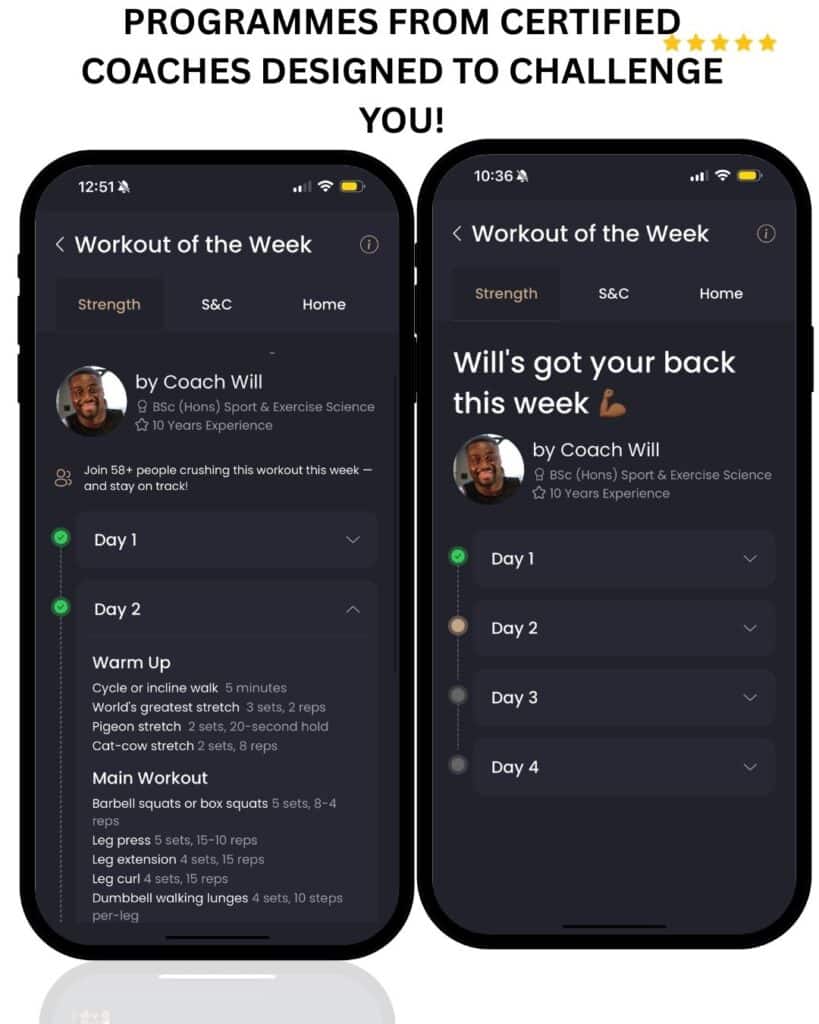
The 40-minute morning session
| Time | What you do |
|---|---|
| 5:30am | Get up, drink some water, put on your laid-out kit |
| 5:35am | Optional small snack and coffee if you like it |
| 5:40am | Warm up for about 10 minutes |
| 5:50am | Main workout, about 30 minutes |
| 6:20am | Done. Shower before the house wakes up |
Some people lift well on an empty stomach. Others feel weak or lightheaded. Try both and keep what works for you.
Warm up properly
Many people feel stiff first thing, so do not skip this. A systematic review found warming up improved performance in 79% of the measures studied (Fradkin and colleagues, 2010).
| Warm-up part | Time | Examples |
|---|---|---|
| Joint mobility | 2 min | Wrist circles, arm swings, hip circles |
| Light cardio | 3 min | Brisk walk, easy bike or rower |
| Moving stretches | 3 min | Leg swings, walking lunges, arm circles |
| Activation | 2 min | Bodyweight squats, push-ups, band pull-aparts |
Then do one or two light sets of your first exercise. A review on shorter workouts suggests exercise-specific warm-up sets matter most when time is tight (Iversen and colleagues, 2021). Our warm-up guide for strength training has more detail.
The main workout: 4 mornings a week
This upper/lower plan alternates upper body on Monday and Thursday with lower body on Tuesday and Friday. If four mornings is too many, use our 3-day split instead.
Upper body (Monday and Thursday)
| Exercise | Sets x reps |
|---|---|
| Bench press | 4 x 6-8 |
| Rows | 4 x 8-10 |
| Shoulder press | 3 x 8-10 |
| Biceps curls and triceps extensions | 3 x 10-12 each |
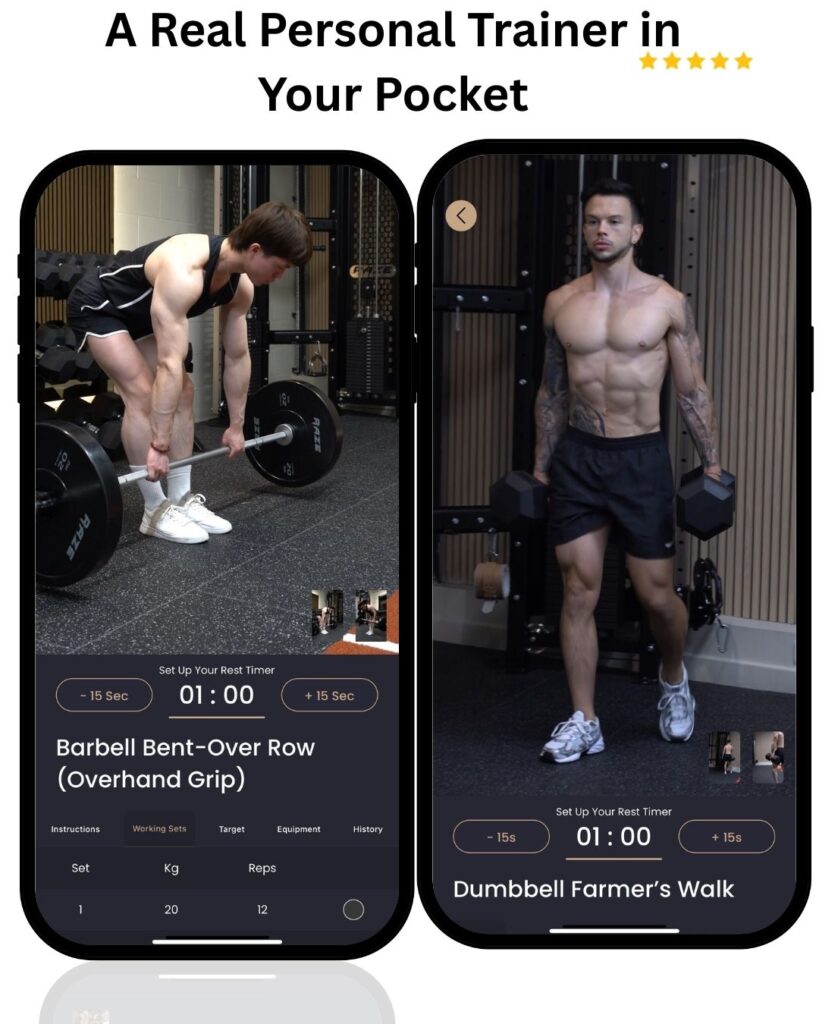
Video: Bench press. Watch this before your first upper-body morning. It shows the setup and bar path for the opening lift.
Common early morning mistakes
- No night-before prep. Fix: spend five minutes the evening before.
- Staying up late and getting up early. Fix: move your bedtime, not just your alarm.
- Rushing the warm-up. Fix: take the full 10 minutes, then do light sets of your first lift.
- Planning long sessions. Fix: keep the main workout to about 30 minutes so it fits before the house wakes.
- Training through a terrible night. Fix: if you slept very little or feel unwell, rest and go again tomorrow.
What to expect in the first 12 weeks
The first couple of weeks feel hard. You may hit snooze or miss a session. That is normal.
New habits take time. In a study of people building a daily health habit, the time for it to become automatic ranged from 18 to 254 days. Missing one day did not undo the habit (Lally and colleagues, 2010).
So judge the plan after a few months, not a few days. If motivation dips, our guide on how to stay motivated as a busy dad has a simple system.
Practical tips
- Keep weekends flexible. Sleep in when you can. Three or four weekday sessions are enough.
- Tell your family the plan. Your partner knows the gym slot, and the kids learn it too.
- Use your commute. A gym near home or work saves more time than a better gym further away.

Common questions
Is it bad to lift weights at 5:30am?
No. Research shows similar muscle and strength gains in the morning and evening. Warm up well, as you may feel stiffer early on.
Do I need to eat before a morning workout?
It depends on you. If you feel fine training without food, that is OK. If you feel weak, have something small like a banana.
What if I slept badly?
Train if you feel safe and well, but lighten the session. Do fewer sets and leave more reps in reserve. If you are exhausted or feel unwell, rest.
How do I fit this around a 12-week goal?
Use the morning slot for any plan. Our 12-week dad bod plan shows how to progress over three months.
Wake up to a workout that is ready
12REPS plans your training around your goal, your equipment and the time you have. Check tomorrow’s session the night before. In the morning, open the app, watch the trainer demonstration and log each set. It remembers what you lifted, so you know what to beat. See how the 12REPS app works.
Sources
- The effects of time of day-specific resistance training on adaptations in skeletal muscle hypertrophy and muscle strength: a systematic review and meta-analysis. Grgic J, Lazinica B, Garofolini A, Schoenfeld BJ, Saner NJ, Mikulic P. Chronobiology International, 2019. https://doi.org/10.1080/07420528.2019.1567524
- Sleep problems (Every Mind Matters). NHS, accessed 2026. https://www.nhs.uk/every-mind-matters/mental-health-issues/sleep/
- Effects of Acute Sleep Loss on Physical Performance: A Systematic and Meta-Analytical Review. Craven J, McCartney D, Desbrow B, et al. Sports Medicine, 2022. https://doi.org/10.1007/s40279-022-01706-y
- Inadequate sleep and muscle strength: implications for resistance training. Knowles OE, Drinkwater EJ, Urwin CS, Lamon S, Aisbett B. Journal of Science and Medicine in Sport, 2018. https://doi.org/10.1016/j.jsams.2018.01.012
- A meta-analytic review of the effect of implementation intentions on physical activity. Bélanger-Gravel A, Godin G, Amireault S. Health Psychology Review, 2013. https://doi.org/10.1080/17437199.2011.560095
- Effects of warming-up on physical performance: a systematic review with meta-analysis. Fradkin AJ, Zazryn TR, Smoliga JM. Journal of Strength and Conditioning Research, 2010. https://pubmed.ncbi.nlm.nih.gov/19996770/
- No Time to Lift? Designing Time-Efficient Training Programs for Strength and Hypertrophy: A Narrative Review. Iversen VM, Norum M, Schoenfeld BJ, Fimland MS. Sports Medicine, 2021. https://doi.org/10.1007/s40279-021-01490-1
- How are habits formed: Modelling habit formation in the real world. Lally P, van Jaarsveld CHM, Potts HWW, Wardle J. European Journal of Social Psychology, 2010. https://doi.org/10.1002/ejsp.674