




By Will Duru, personal trainer and founder of 12REPS.
What Is a Dumbbell Thruster?
A dumbbell thruster is a front squat that flows straight into an overhead press. You hold a dumbbell at each shoulder, squat down, then drive up and use that momentum to press the weights overhead in one smooth movement.
It works your legs, glutes, shoulders, arms and core together, so it is a useful exercise for full-body strength and for conditioning workouts. This guide shows you how to do it, what it works, the mistakes to avoid and how to add it to your training.

How to Do a Dumbbell Thruster
Setup
- Stand with your feet about shoulder width apart, toes turned out slightly.
- Hold a dumbbell at each shoulder, with your palms facing each other or facing forward. Rest the ends of the dumbbells lightly on your shoulders.
- Keep your elbows slightly in front of your body and your chest up.
- Brace your stomach as if you are about to be pushed.
Movement
- Sit your hips back and down into a squat. Keep your chest up and your elbows up.
- Squat until your thighs are about parallel to the floor, or as deep as you can with a flat back and your heels down.
- Drive hard through your whole foot to stand up.
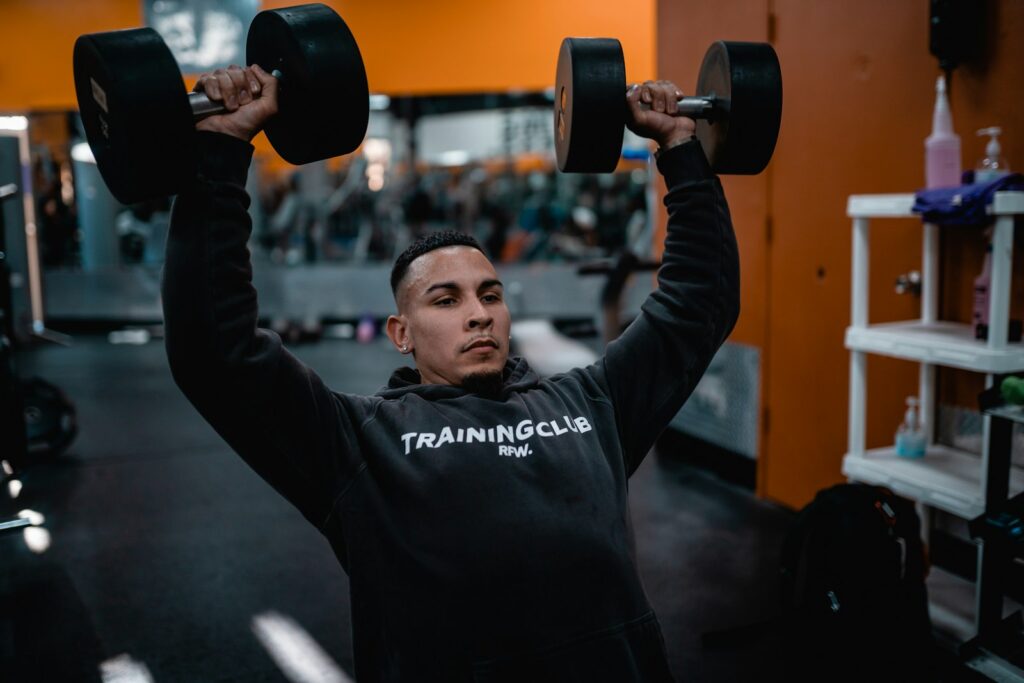
- As your hips straighten, keep the momentum going and press the dumbbells straight overhead.
- Finish with your arms straight, the dumbbells over your shoulders and your biceps near your ears.
- Bring the dumbbells back to your shoulders under control and go straight into the next squat.
Coaching cues
- “Elbows up in the squat.”
- “Stand fast, then press.”
- “One smooth movement, not a squat and then a press.”
- “Ribs down at the top.”
Muscles Worked
| Phase | Main muscles |
|---|---|
| Squat | Quadriceps (front of the thighs), glutes, adductors (inner thighs) |
| Press | Shoulders (deltoids), triceps, upper chest |
| Throughout | Core muscles, upper back and trapezius, which keep you upright and stable |
Because so many muscles work together, thrusters raise your heart rate quickly. That is why they are popular in circuit and conditioning workouts.
What the Research Says
There is very little research on the thruster itself, so I will be clear about what we know and what is my coaching view.
- The CDC physical activity guidelines recommend muscle-strengthening activity on at least two days a week, working all the major muscle groups. A thruster trains the legs, hips, shoulders, arms and core in one exercise, so it can help you cover a lot in a short session.
- A 2018 review by Feito and colleagues looked at high-intensity functional training, which uses varied full-body movements such as squats and push presses at a high effort. The review reported improvements in fitness and strength, and injury rates that appeared similar to or lower than running. The authors also noted that some popular workouts break sound training principles and that more research is needed.
My view is that thrusters are a good tool, not a magic exercise. The squat part is limited by how much you can press overhead, so the legs rarely get as much load as they would from a squat on its own. Use thrusters alongside dedicated squats and presses, not as a replacement for them.
Common Mistakes
- Pressing too early. Starting the press before your hips are straight puts the work on your shoulders. Let your legs drive the weight up first.
- Elbows dropping in the squat. This pulls your chest forward and can tip you onto your toes. Keep your elbows up and your chest proud.
- Heels lifting. Keep your whole foot on the floor. If your heels rise, squat only as deep as you can control.
- Arching your lower back overhead. Leaning back to finish the press stresses your lower back. Brace and keep your ribs down.
- Going too heavy. Pick dumbbells you can press overhead with control for every rep, not the weight you use for squats.
- Rushing the descent. Lower the dumbbells to your shoulders under control before you squat again.
Thruster vs Push Press vs Wall Ball
| Exercise | Leg drive | Load | Best for |
|---|---|---|---|
| Thruster | Full squat | Light to moderate | Full-body strength and conditioning |
| Push press | Short dip of the knees | Moderate to heavy | Overhead strength and power |
| Wall ball | Full squat, then throw | Light medicine ball | Conditioning and Hyrox practice |
Read more in my guides to the push press vs strict press and wall balls.
Easier and Harder Variations
- Easier: Do a goblet squat and a standing dumbbell press as two separate exercises until both feel solid. You can also use one dumbbell held at your chest and press it overhead with both hands.
- Single-arm thruster: Holding one dumbbell makes your core work harder to stop you leaning to the side.
- Kettlebell thruster: The same movement with kettlebells resting on the backs of your forearms.
- Barbell thruster: Lets you use more weight, but needs good mobility to hold the bar on your shoulders with high elbows.
How to Add Thrusters to Your Training
These are general starting points, not fixed rules. Adjust them to your level.
| Goal | Sets and reps | Rest | Where to use it |
|---|---|---|---|
| Strength | 3 to 4 sets of 6 to 8 reps | 90 to 120 seconds | Early in a full-body workout |
| Muscle and fitness | 3 sets of 10 to 12 reps | 60 to 90 seconds | Middle of a full-body workout |
| Conditioning | 3 to 5 rounds of 10 to 15 reps in a circuit | As needed between rounds | At the end of a session |
For a simple conditioning finisher, try 3 rounds of 10 dumbbell thrusters, 15 kettlebell swings and a 200-meter row, resting 90 seconds between rounds.
When you can do all your reps with good form, add a rep to each set or move up to slightly heavier dumbbells. The American College of Sports Medicine recommends progressing gradually like this.
A note on shoulders: if pressing overhead causes pain, stop and swap to a goblet squat and a pain-free press variation, then speak to a qualified professional.
Summary
- A dumbbell thruster is a front squat into an overhead press in one movement.
- It works your legs, glutes, shoulders, triceps and core together.
- Let your legs drive the weight up before you press.
- Choose a weight you can press with control, because the press limits the load.
- Use thrusters for full-body strength or conditioning, alongside regular squats and presses.
Train With a Plan, Not Guesswork
Not sure how to fit thrusters into your week? 12REPS builds a strength program around your goal, schedule and equipment, including dumbbell-only options for home.
Every exercise has a demo and a coach tutorial from me. Your log shows last session’s weights and reps, so you know exactly what to beat.
Download 12REPS and see what you’ll get:
Sources
- Centers for Disease Control and Prevention. Adult activity: an overview.
- Feito Y, Heinrich KM, Butcher SJ, Poston WSC. High-intensity functional training (HIFT): definition and research implications for improved fitness. Sports. 2018;6(3):76.
- American College of Sports Medicine. Progression models in resistance training for healthy adults. Med Sci Sports Exerc. 2009;41(3):687–708.
Related Reading
- How to do a goblet squat
- Push press vs strict press
- Wall balls: how to do them
- Kettlebell clean and press
- Seated vs standing shoulder press
I’m Will Duru, a personal trainer and the founder of 12REPS. I hold a BSc (Hons) in Sport and Exercise Science and have more than a decade of experience coaching people in strength training.
