




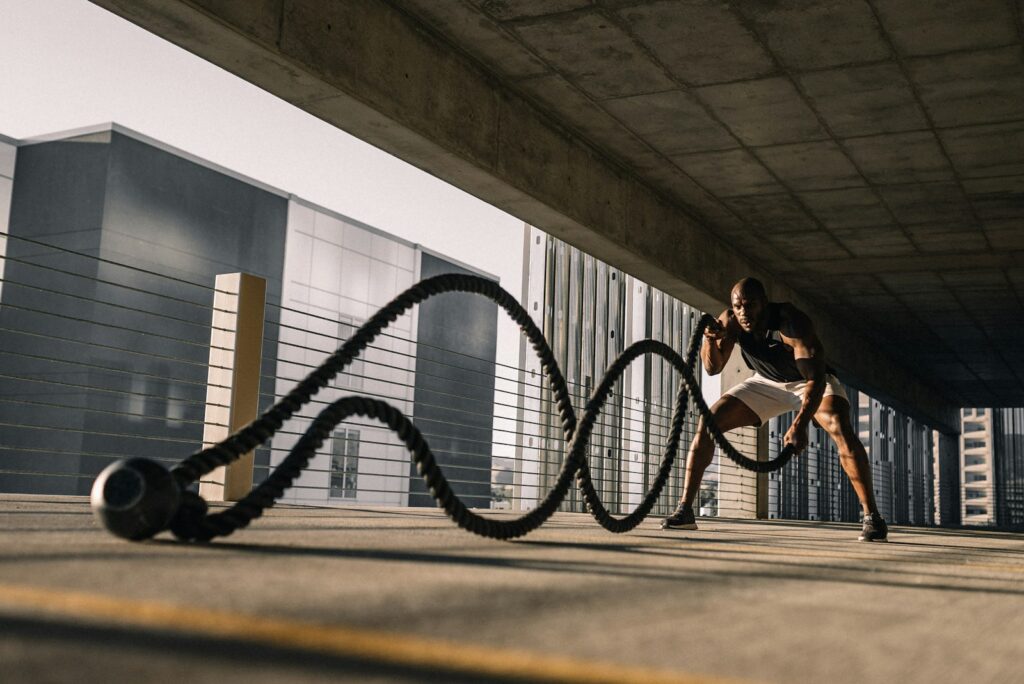
The short answer: yes, battle ropes are a good workout, especially for conditioning. Short, hard intervals push your heart rate into the vigorous range and work your shoulders, arms, grip, core and legs at the same time. They’re low impact, quick to learn and easy to fit at the end of a strength session. They’re less useful for building muscle or maximal strength, so treat them as a conditioning tool, not a replacement for lifting.
This guide is for anyone who has walked past the ropes at the gym and wondered what to do with them. I’ll cover what battle ropes train, what the research shows, how to hold and use them, the best exercises, common mistakes and a simple workout you can start this week.
What do battle ropes work?
Battle ropes are heavy ropes anchored at the middle. You hold one end in each hand and move them in waves, slams or circles. Every rep is a mix of arm work and full-body bracing.
| Area | What it does during battle ropes |
|---|---|
| Shoulders | Drive most of the up-and-down movement in waves and slams |
| Arms and forearms | Control the rope and keep your grip for the whole interval |
| Upper back | Keeps your shoulders stable and your posture steady |
| Core | Stops your torso from rocking as the rope pulls you around |
| Legs and glutes | Hold a half-squat stance and add power to slams |
| Heart and lungs | Work hard because many muscles are moving fast at once |
What the research says
Battle rope research is fairly small. Most studies use young, active adults and look at a single session or a few weeks of training. Still, the findings point the same way.
- Short intervals are vigorous exercise. In a 2015 study of 11 active adults, ten rounds of 15 seconds of double-arm waves with 45 seconds of rest (10 minutes total) produced an average heart rate of 163 beats per minute and a peak intensity of about 10 METs. A MET is a measure of how hard an activity is compared with sitting still. The authors classed the session as vigorous and enough to support better cardiovascular fitness.
- Shorter rest makes ropes harder. A 2015 study of 22 young adults compared eight 30-second rope sets with 1 minute or 2 minutes of rest. With 1 minute of rest, oxygen use averaged about 50–53% of each person’s maximum. With 2 minutes, it dropped to about 38–41%. Energy use and heart rate were also higher with the shorter rest.
- Ropes rank high for energy use. A 2015 study compared the metabolic cost of 13 common exercises, including resistance and bodyweight moves. A summary of that study reports that battle ropes had the highest energy use of the 13, at about 10 calories per minute.
- You can do them seated. A 2018 study of 40 adults found that a 10-round rope protocol (15 seconds on, 45 seconds off) reached about 68% of maximum oxygen use when standing and about 72% when seated. That makes seated rope work an option for people who can’t stand or use their legs for cardio.
- Rope training can improve fitness over time. In an 8-week study of 30 college basketball players, the group that did battle rope intervals three times a week improved aerobic fitness by 17.6%, upper-body power by 7.3% and core endurance by about 23–37%. A group doing shuttle runs with the same work and rest improved aerobic fitness by 12% but didn’t show the same gains in upper-body anaerobic power or core endurance.
So battle ropes are a proven way to raise your heart rate and train your upper body and core under fatigue. There isn’t good evidence that they build much muscle or strength on their own. My coaching advice below fills the gaps where the research stops.
How to hold and set up battle ropes
- Check the anchor. The rope should loop around a secure post or anchor at the middle so both ends are the same length.
- Grab the ends. Hold one end in each hand with a firm grip. Most people use a neutral grip, with palms facing each other. An overhand grip (palms down) works well for slams.
- Take up the slack. Step back until the rope is almost straight, then take one small step forward. You need a bit of slack for the waves to travel.
- Set your stance. Feet about shoulder width apart, knees bent, hips pushed back slightly, chest up. This is the same athletic position you’d use to guard someone in basketball.
- Brace. Tighten your stomach and keep your back flat. Breathe steadily through each interval.

The best battle rope exercises
Here’s the alternating wave, the main battle rope exercise and the best one to learn first.
- Alternating waves: move one arm up as the other moves down, fast and rhythmic. Keep the waves reaching the anchor. This is the easiest place to start.
- Double waves: move both arms up and down together. It’s harder on your shoulders and core than alternating waves.
- Slams: lift both ropes overhead, then slam them into the floor as hard as you can. Bend your knees and hips as you slam to use your legs. This is the most powerful variation.
- Outside circles: move both arms in circles away from your body so the ropes spiral. Then reverse direction with inside circles. Both work your shoulders from different angles.
- Side-to-side snakes: move both hands side to side close to the floor so the ropes slither like snakes. This adds more rotation through your core.
- Waves with squats or lunges: keep the waves going while you squat or lunge. This brings your legs into the work and raises the effort.
Common mistakes and how to fix them
| Mistake | Why it matters | Fix |
|---|---|---|
| Standing too upright | Your arms do all the work and your lower back takes the strain | Bend your knees and push your hips back |
| No slack in the rope | The waves die before they reach the anchor | Step forward until there is a small dip in the rope |
| Rounding your back on slams | Puts more stress on your spine | Keep your chest up and hinge at the hips |
| Going too long | Form breaks down and the waves get small | Keep work intervals short, around 15–30 seconds |
| Holding your breath | You tire faster and feel light-headed | Breathe in short, steady breaths through each set |
| Waves stop halfway down the rope | You lose most of the training effect | Make bigger movements and keep the rhythm fast |
A battle rope workout for beginners
These are starting points I’d use with most people, not fixed rules. Start with the beginner plan and move up when you can keep strong waves to the end of every interval.
| Level | Work | Rest | Rounds | Exercises |
|---|---|---|---|---|
| Beginner | 15–20 seconds | 40–45 seconds | 6–8 | Alternating waves, double waves, slams. Repeat in order |
| Intermediate | 30 seconds | 30–60 seconds | 8 | Alternate between waves and slams |
| Advanced | 30 seconds | 15–30 seconds | 8–10 | Mix waves, slams, circles and waves with squats |
To make the workout harder, change one thing at a time. Add rounds, add a few seconds of work or cut a few seconds of rest. As the 2015 rest interval study showed, shorter rest raises the effort.
How to fit battle ropes into your week
- As a finisher: 5–10 minutes of rope intervals after a strength session. This is how I use them most.
- On a conditioning day: pair ropes with a rower, bike or sled for a short circuit.
- As a low-impact option: ropes give your heart and lungs a hard session without the pounding of running or jumping.
- Once to three times a week is plenty for most people. Your shoulders and grip need time to recover, especially if you also press and pull in the gym.
Do your heavy lifting first and the ropes after. Tired shoulders and grip will hold back your presses, rows and pull-ups.
Are battle ropes good for fat loss?
Battle ropes use a lot of energy in a short time, so they can help you burn calories. Fat loss still depends on your overall eating and activity across the week. I’d treat ropes as one useful tool alongside strength training, daily steps and good nutrition, not the main driver.
If you have shoulder pain or a past shoulder injury, start with light, short intervals or check with a physical therapist or doctor first.
Summary
- Battle ropes are a strong conditioning tool that works your shoulders, arms, grip, core and legs.
- Research shows short rope intervals reach vigorous intensity, and shorter rest makes them harder.
- They’re low impact and can even be done seated.
- Start with 15–20 seconds of work and 40–45 seconds of rest for 6–8 rounds.
- Use them after your strength work, not instead of it.
Add battle ropes to a plan that builds strength too
Battle ropes work best as part of a full program. You still need strength work to build muscle and protect your joints. That’s where 12REPS helps.
12REPS gives you trainer-built programs with two demo videos for every exercise, so you know exactly how to move. The built-in timer handles your work and rest intervals, so you can focus on the rope instead of the clock. The gym log shows what you did last time, and Build Your Routine lets you add rope finishers to your own week. Every new account starts with a 7-day free trial.
Download 12REPS and see what you’ll get:
Sources
- Fountaine CJ, Schmidt BJ. Metabolic cost of rope training. Journal of Strength and Conditioning Research. 2015;29(4):889–893.
- Ratamess NA, Smith CR, Beller NA, Kang J, Faigenbaum AD, Bush JA. Effects of rest interval length on acute battling rope exercise metabolism. Journal of Strength and Conditioning Research. 2015.
- Ratamess NA, et al. Comparison of the acute metabolic responses to traditional resistance, body-weight, and battling rope exercises. Journal of Strength and Conditioning Research. 2015.
- Brewer W, Kovacs R, Hogan K, Felder D, Mitchell H. Metabolic responses to a battling rope protocol performed in the seated or stance positions. Journal of Strength and Conditioning Research. 2018;32(12):3319–3325.
- Chen WH, Wu HJ, Lo SL, et al. Eight-week battle rope training improves multiple physical fitness dimensions and shooting accuracy in collegiate basketball players. Journal of Strength and Conditioning Research. 2018;32(10):2715–2724.
Related reading
- The 3-Day Advanced HIIT Split: My 6-Week Plan to Build Strength and Burn Fat
- Cardio and Weights Same Day: Will It Kill Your Gains?
- What Is Zone 2 Cardio? Heart Rate, Benefits and How to Do It
- Hyrox Training: How to Adapt from Strength to Hybrid Fitness
I’m Will Duru, a personal trainer and the founder of 12REPS. I hold a BSc (Hons) in Sport and Exercise Science and have more than a decade of experience coaching people in strength training. This article is for general education and isn’t medical advice.
