




By Will Duru, BSc (Hons) Sport and Exercise Science, Award-winning Personal Trainer with over 10 years of experience in strength training and optimising recovery
Strength training can support male sex drive indirectly, through better fitness, mood, sleep and confidence. It is not a proven way to raise libido or testosterone. The strongest evidence for sexual health in men is for regular exercise overall, especially aerobic exercise, in men with erection problems.
A common question is whether lifting will “boost testosterone” or help in the bedroom. This article gives you the straight answer from the research, what helps most, and a 3-day push/pull/legs routine you can start this week.
Check with your doctor: low libido and erection problems can have medical causes, including high blood pressure, diabetes, high cholesterol, hormone problems, depression and some medicines. If erection problems keep happening, the NHS advises seeing a GP, as it can be a sign of a treatable condition. Exercise can support your general health, but it does not replace medical advice or treatment.

Does strength training increase male sex drive?
There is no strong evidence that lifting weights on its own raises sex drive. There is good evidence that being more active helps erectile function, which is one important part of sexual health.
- A meta-analysis of seven trials in men with erectile dysfunction (ED) found that exercise programs improved erectile function scores. The authors saw the clearest benefit from moderate to vigorous aerobic exercise.
- A systematic review of ten studies concluded that about 40 minutes of moderate to vigorous aerobic exercise, four times a week for six months, can reduce ED. This applied to men whose ED was linked to inactivity, obesity, high blood pressure, metabolic syndrome or heart disease.
- A 2024 meta-analysis found aerobic training gave the clearest benefit for erectile function. The small group of combined aerobic and resistance programs did not show a significant effect.
So, if sexual health is part of your reason to train, combine strength training with regular cardio. For the wider picture, including women’s research, mood and body image, see our general guide to strength training and libido.
Does lifting weights raise testosterone?
Only briefly, as far as research shows. A review of testosterone and resistance exercise found that testosterone generally rises for a short time after a heavy lifting session in men. The rise depends on the workout, your age and other factors.
A short rise after a workout is not the same as higher testosterone all day. The review did not measure libido, so these short rises tell us little about sex drive. The same review notes that resting testosterone in men tends to fall by about 1 to 3% a year from around age 35 to 40.
If you think you have low testosterone, see your doctor for a blood test rather than trying to train your way out of it.
Can too much training hurt your libido?
In a survey of 1,077 men, those doing the most intense and longest endurance training were more likely to report low libido. This shows a link, not cause and effect, and it looked at endurance rather than lifting. It is still a good reminder to plan rest days and not train hard every day.
Energy, mood and confidence
Stress and low mood are common reasons for low sex drive. A meta-analysis of 33 trials found that resistance training reduced depressive symptoms by a moderate amount. Many men also find that getting stronger, and seeing it in their training log, builds confidence.

A 3-day push/pull/legs routine for men
This routine works with a mix of barbells, dumbbells, kettlebells, a TRX and machines. Swap any exercise for a similar one if your gym does not have the equipment.
A push/pull/legs routine splits training by movement. Push day trains your chest, shoulders and triceps. Pull day trains your back and biceps. Legs and core day trains your lower body and midsection.
Train three days a week with a rest day between sessions, for example Monday, Wednesday and Friday. Choose a weight that is challenging for 10 to 12 reps with good form. Spend the first two weeks learning the exercises before you push the weights.
Push day
| Exercise | Equipment | Sets | Reps | Rest |
|---|---|---|---|---|
| Barbell bench press | Barbell | 4 | 10 to 12 | 2 to 3 minutes |
| Dumbbell shoulder press | Dumbbells | 4 | 10 to 12 | 2 to 3 minutes |
| Incline dumbbell press | Dumbbells | 4 | 10 to 12 | 2 to 3 minutes |
| TRX push-up | TRX | 4 | 10 to 12 | 90 seconds |
| Dumbbell lateral raise | Dumbbells | 4 | 10 to 12 | 90 seconds |
| Triceps dip | Machine or bench | 4 | 10 to 12 | 90 seconds |
| Kettlebell press | Kettlebell | 4 | 10 to 12 | 2 minutes |
| TRX triceps extension | TRX | 4 | 10 to 12 | 90 seconds |
Pull day
| Exercise | Equipment | Sets | Reps | Rest |
|---|---|---|---|---|
| Barbell bent-over row | Barbell | 4 | 10 to 12 | 2 to 3 minutes |
| Pull-ups or lat pulldowns | Bar or machine | 4 | 10 to 12 | 2 to 3 minutes |
| Dumbbell row | Dumbbells | 4 | 10 to 12 | 2 to 3 minutes |
| TRX row | TRX | 4 | 10 to 12 | 90 seconds |
| Kettlebell swing | Kettlebell | 4 | 10 to 12 | 2 minutes |
| Dumbbell biceps curl | Dumbbells | 4 | 10 to 12 | 90 seconds |
| TRX face pull | TRX | 4 | 10 to 12 | 90 seconds |
| Hammer curl | Dumbbells | 4 | 10 to 12 | 90 seconds |
Legs and core day
| Exercise | Equipment | Sets | Reps | Rest |
|---|---|---|---|---|
| Barbell back squat | Barbell | 4 | 10 to 12 | 2 to 3 minutes |
| Romanian deadlift | Barbell or dumbbells | 4 | 10 to 12 | 2 to 3 minutes |
| Dumbbell lunge | Dumbbells | 4 | 10 to 12 per leg | 2 minutes |
| TRX squat | TRX | 4 | 10 to 12 | 90 seconds |
| Kettlebell goblet squat | Kettlebell | 4 | 10 to 12 | 2 minutes |
| Leg press | Machine | 4 | 10 to 12 | 2 to 3 minutes |
| TRX pistol squat | TRX | 4 | 10 to 12 per leg | 2 minutes |
| Plank hold | Bodyweight | 4 | 30 to 60 seconds | 90 seconds |
| Russian twist | Kettlebell | 4 | 10 to 12 per side | 90 seconds |
Video: How to perform squats properly. Watch this before your first legs day to check your depth, foot position and bar path on the barbell back squat. Our barbell squat exercise guide has step-by-step cues too.
Video: How to do a barbell bent-over row. Watch this before pull day to see the hip hinge and where the bar should travel. You can also read the barbell bent-over row guide.
How 12REPS can help you follow this routine
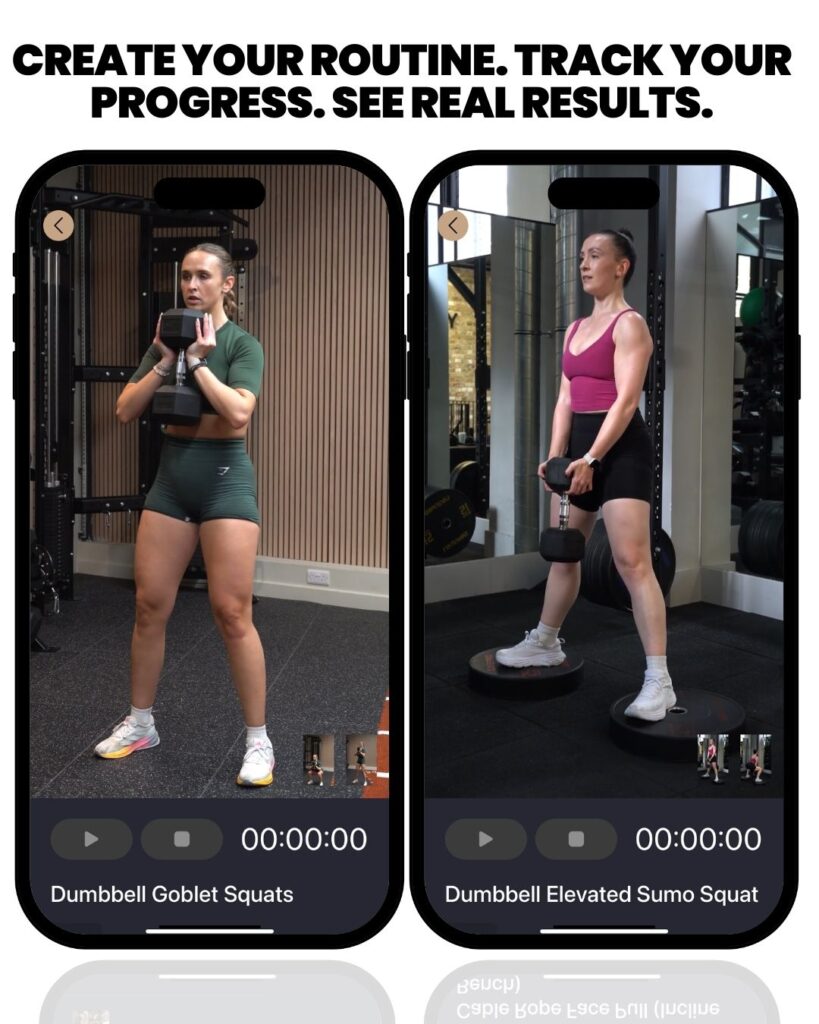
The routine above is a fixed plan. If you would rather have sessions built around your own week, 12REPS can help in a few ways.
- A plan for your setup: training built around your goal, the equipment you have and the time you have.
- Build your own: pick the muscle, equipment and time on the body map, and 12REPS builds the session for you to save and train.
- Trainer demonstrations: exercise demos and technique breakdowns from qualified personal trainers.
- A number to beat: you enter reps and weight for each set, and the app remembers what you lifted last time.
If you want a longer plan with the same structure, try our men’s 12-week push/pull/legs program.

Sleep, food and stress
Training is only part of the picture. These habits matter for energy and sexual health too.
Sleep
In a small study of 10 young men, a week of sleeping about five hours a night lowered testosterone by 10 to 15%. If you are short on sleep, fixing that is likely to do more for your energy than an extra workout. Our article on strength training and sleep has more detail.
Food
Eat enough protein to support muscle growth. A meta-analysis found that extra protein stopped adding to muscle gains at about 1.6 grams per kilogram of body weight a day. Our guide to muscle building foods turns that into meals.
Alcohol, smoking and weight
The NHS lists lifestyle changes that can help with erection problems. These include daily exercise, losing weight if you are overweight, stopping smoking and keeping alcohol within 14 units a week.
Stress
Stress and anxiety are common causes of both low libido and erection problems. Regular training can help you manage stress. Walks, time outdoors and talking to someone help too.

Progressive overload and long-term progress
Progressive overload means gradually increasing the demand on your muscles. Without it, your strength and muscle gains will stall.
- When you can complete all sets and reps with good form, add 2.5 to 5 pounds next session.
- The American College of Sports Medicine suggests a 2 to 10% load increase once you can do one or two reps beyond your target.
- Log every set so you know exactly what to beat next time.
Be patient. Strength often climbs in the first few months as you learn the lifts, but there is no fixed timeline for changes in energy or sex drive. Read our beginner’s guide to progressive overload for more ways to progress. If you are starting later in life, see strength training for men over 40.
Frequently asked questions
Can lifting weights fix erectile dysfunction?
No training plan can promise that. Exercise, mainly aerobic, has been shown to improve erectile function in some men with ED. ED can be a sign of a health problem, so see your doctor if it keeps happening.
Which exercises are best for male sex drive?
No specific exercise has been shown to raise sex drive. A balanced plan of strength training and regular cardio, with good sleep, is the most sensible approach.
Should I take testosterone boosters?
Talk to your doctor or pharmacist before taking any supplement, especially if you take medication. If you are worried about your hormone levels, ask your doctor about a blood test.
The bottom line
Strength training is good for your health, strength and confidence, and it can be part of looking after your sexual health. The research does not support claims that lifting alone raises testosterone or libido. For erectile function, the best evidence is for regular aerobic exercise, so combine both.
If you have ongoing low libido or erection problems, see your doctor. Then build a routine you can keep: three strength sessions a week, some cardio, enough sleep and enough protein.
If you want a plan built around your goal, equipment and time, 12REPS sets out each session with trainer demonstrations. It remembers what you lifted, so every workout gives you a number to beat.

Sources
- Physical activity and exercise for erectile dysfunction: systematic review and meta-analysis. Silva AB, Sousa N, Azevedo LF, Martins C. British Journal of Sports Medicine, 2017. https://bjsm.bmj.com/content/51/19/1419
- Physical Activity to Improve Erectile Function: A Systematic Review of Intervention Studies. Gerbild H, Larsen CM, Graugaard C, Areskoug Josefsson K. Sexual Medicine, 2018. https://pubmed.ncbi.nlm.nih.gov/29661646/
- Effect of different physical activities on erectile dysfunction in adult men not receiving phosphodiesterase-5 inhibitors therapy: A systematic review and meta-analysis. Chen Z, et al. Andrology, 2024. https://pubmed.ncbi.nlm.nih.gov/38937909/
- Testosterone physiology in resistance exercise and training: the up-stream regulatory elements. Vingren JL, et al. Sports Medicine, 2010. https://pubmed.ncbi.nlm.nih.gov/21058750/
- Endurance Exercise Training and Male Sexual Libido. Hackney AC, Lane AR, Register-Mihalik J, O’Leary CB. Medicine and Science in Sports and Exercise, 2017. https://pubmed.ncbi.nlm.nih.gov/28195945/
- Association of Efficacy of Resistance Exercise Training With Depressive Symptoms: Meta-analysis and Meta-regression Analysis of Randomized Clinical Trials. Gordon BR, et al. JAMA Psychiatry, 2018. https://doi.org/10.1001/jamapsychiatry.2018.0572
- Effect of 1 week of sleep restriction on testosterone levels in young healthy men. Leproult R, Van Cauter E. JAMA, 2011. https://pubmed.ncbi.nlm.nih.gov/21632481/
- A systematic review, meta-analysis and meta-regression of the effect of protein supplementation on resistance training-induced gains in muscle mass and strength in healthy adults. Morton RW, et al. British Journal of Sports Medicine, 2018. https://pubmed.ncbi.nlm.nih.gov/28698222/
- American College of Sports Medicine position stand. Progression models in resistance training for healthy adults. American College of Sports Medicine. Medicine and Science in Sports and Exercise, 2009. https://pubmed.ncbi.nlm.nih.gov/19204579/
- Erectile dysfunction (impotence). NHS, accessed 2026. https://www.nhs.uk/conditions/erection-problems-erectile-dysfunction/

