Written by Will Duru, BSc (Hons) Sport and Exercise Science, award-winning Personal Trainer with over 10 years of experience in strength training and optimising recovery .
Glute strength training for women at the gym works best with a few heavy compound lifts plus one or two targeted glute moves. This plan uses deadlifts, barbell hip thrusts, the leg press, barbell reverse lunges and the hip abduction machine. Below you’ll find the sets and reps, how to do each lift, and how to keep progressing.
Your glutes are some of the largest muscles in your body. They help you stand up, climb, lift and stay steady on one leg, so training them for strength pays off well beyond the gym.
If you are brand new to lower body training, read our beginner’s guide to women’s lower body strength training first.
Why Glute Strength Training Matters for Women
Strong glutes and legs are about health and everyday ability, not only appearance.
Bone health: the NHS explains that resistance exercise, where muscles pull on bones, helps strengthen them. It lists weightlifting and gym equipment as examples.
Daily life: carrying shopping, lifting children and moving furniture all need strong hips and legs. Training them makes those jobs feel easier.
Body composition: building muscle can raise your resting energy use a little. One review found resistance training increased resting metabolic rate by about 96 calories a day, though the studies had a high risk of bias. Your overall diet and activity still matter most for fat loss.
Confidence: lifting more weight or doing more reps is clear proof you are getting stronger. That feeling often carries over outside the gym.
The Glute-Focused Gym Workout
Here is the full lower body gym workout. It starts with the heaviest lift and finishes with a targeted glute exercise. Use progressive load: aim to lift a little more weight or do a few more reps over time. Rest long enough between sets to give each one your best effort.
| Exercise | Sets | Reps | Notes |
|---|---|---|---|
| Deadlift or sumo deadlift | 5 | 4 to 5 | Progressive load |
| Barbell hip thrust | 5 | 10 to 12 | Progressive load |
| Leg press | 5 | 10 to 12 | Progressive load |
| Barbell reverse lunges | 4 | 20 (10 per leg) | Progressive load |
| Hip abduction machine | 5 | 15 to 20 | Progressive load |

How to Do Each Exercise
Deadlift or Sumo Deadlift
The deadlift trains your glutes, hamstrings and back, and teaches you to lift heavy things from the floor. The sumo version uses a wide stance with your hands inside your knees. Choose the style that feels best for your body.
- Keep your back long and the bar close to your legs.
- Push the floor away with your legs, then drive your hips forward to stand tall.
- Lower the bar under control by pushing your hips back.
Read our full deadlift technique guide for women before you go heavy.
Barbell Hip Thrust
The hip thrust lets you load your glutes directly. Sit on the floor with your upper back against a bench and a padded barbell over your hips. Drive your hips up until your body is level from shoulders to knees, then squeeze your glutes at the top.
How does it compare with squats? In a 9-week study, hip thrusts and back squats grew the glutes by a similar amount. Squats also built more quad and inner-thigh muscle. This plan pairs the hip thrust with the leg press and reverse lunges, which add more work for your quads.
See the common errors in how to do barbell hip thrusts correctly.
Leg Press
The leg press trains your quads and glutes. The machine supports your back, so you can push hard with your legs. Place your whole foot on the platform and lower until your knees are well bent, without your lower back lifting off the pad.
Range of motion matters. In a squat study, full squats increased glute size more than half squats. Using a full, comfortable range on the leg press follows the same idea. Our guide to leg machines covers setup.
Barbell Reverse Lunges
Reverse lunges train one leg at a time, so each side gets equal work. They hit your glutes and quads hard.
- Rest the barbell across your upper back.
- Step one leg back and lower until both knees bend to about 90 degrees.
- Push through your front foot to return to standing.
- Do 10 reps on one leg, then switch.
If a barbell feels like too much, start with the plate reverse lunge or the bodyweight reverse lunge.
Hip Abduction Machine
This machine trains the muscles on the side of your hips: the gluteus medius and gluteus minimus. They help keep your pelvis steady when you stand on one leg. Sit tall and push your legs out against the pads, then return slowly.
Hip abduction is one of the most direct ways to work the gluteus medius. In one study, side-lying hip abduction produced the highest gluteus medius activity of the exercises tested. At home, you can use a band with the mini band seated abductor.
What Is Progressive Overload?
To keep getting stronger, you need to challenge your muscles a little more over time. This is called progressive overload. The American College of Sports Medicine lists several ways to do it:
- Lift more weight: the most common method. When the top of your rep range feels manageable, add a little weight next time.
- Do more reps: if you can’t add weight yet, aim for one or two more reps with the same load.
- Do more sets: add a set to an exercise.
- Adjust rest: shorter rest makes a session more demanding. For heavy lifts like deadlifts, keep longer rest so you can lift well.
Write down the weights and reps you do, so you know when to make things harder. Always keep your form solid before adding weight. Our complete guide to progressive overload goes deeper.

How Often to Train Your Glutes
Most women do well training glutes two times a week. A meta-analysis found that training a muscle twice a week built more muscle than once a week when total work was the same. Whether three times beats two is still unclear.
You could run this full workout once a week and add a lighter glute session later in the week. Leave at least one rest day between hard lower body days. For more detail, read how often you should train glutes.
Need to fit glute days around upper body training? Our strength training schedule for women shows sample weeks. No gym this week? Swap in these no-equipment lower body exercises or this dumbbell leg day workout.
Food for Growing Muscles
Your muscles need enough food to recover and grow. Think of food as both fuel for training and the building blocks for repair.
Protein matters most for muscle. A large review found that gains in muscle leveled off at around 1.6 g of protein per kg of body weight per day in people doing resistance training. Good sources include chicken, fish, eggs, Greek yogurt and lean meat. If you don’t eat meat, try lentils, beans, tofu or tempeh.
Spread your protein across your meals, including one after your workout.
The 12REPS App: Your Training Partner
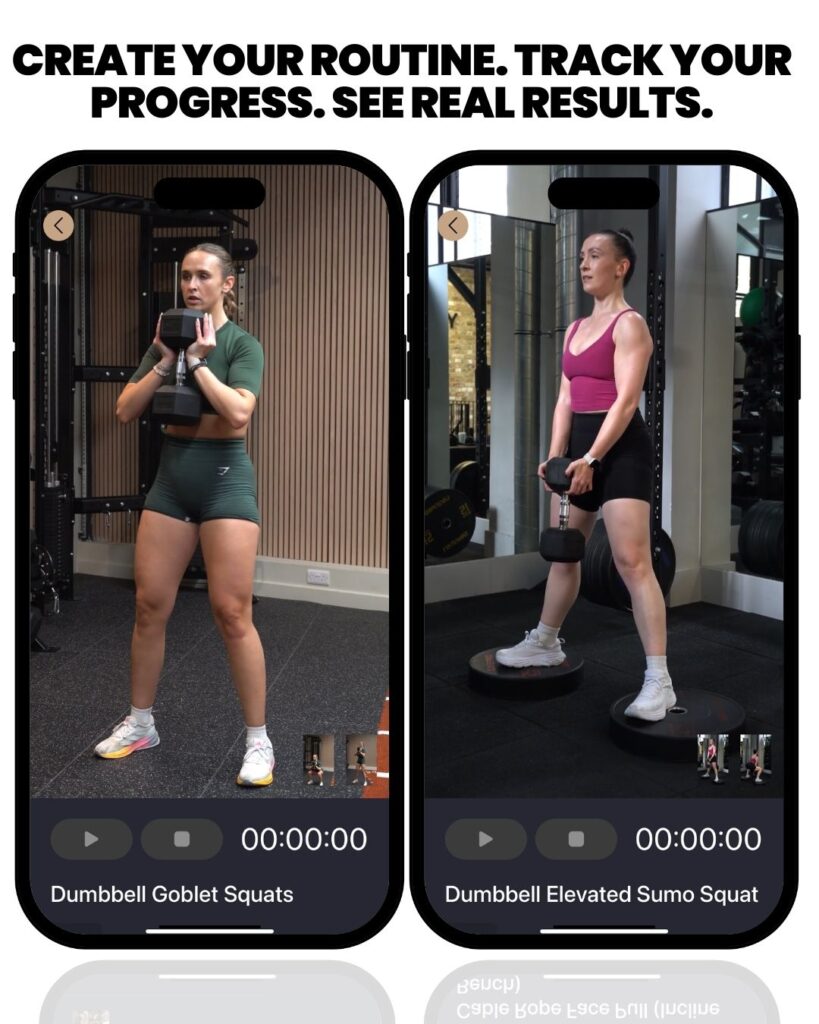
A gym plan works best when you know exactly what to do each session. 12REPS builds your training around your goal, your equipment and the time you have. You can also pick glutes on the body map, choose your equipment and time, and 12REPS builds the session for you.
Every exercise has a demo from a qualified personal trainer. You log your reps and weight for each set, and the app remembers what you lifted, so you have a number to beat next time.
To Finish Up
Building a strong lower body is one of the best things you can do for your health and daily life. This plan pairs heavy compound lifts with direct glute work and progressive overload. Eat enough protein, rest between hard sessions, and track your lifts so you can see your progress.

Sources
- Hip thrust and back squat training elicit similar gluteus muscle hypertrophy and transfer similarly to the deadlift (Plotkin et al.). Frontiers in Physiology, 2023. https://www.frontiersin.org/journals/physiology/articles/10.3389/fphys.2023.1279170/full
- Effects of squat training with different depths on lower limb muscle volumes (Kubo, Ikebukuro and Yata). European Journal of Applied Physiology, 2019. https://link.springer.com/doi/10.1007/s00421-019-04181-y
- Gluteal muscle activation during common therapeutic exercises (Distefano et al.). Journal of Orthopaedic & Sports Physical Therapy, 2009. https://read.qxmd.com/read/19574661/gluteal-muscle-activation-during-common-therapeutic-exercises
- American College of Sports Medicine position stand: Progression models in resistance training for healthy adults. Medicine & Science in Sports & Exercise, 2009. https://sfu.ca/~ryand/kin343/ACSMresistance.pdf
- Effects of resistance training frequency on measures of muscle hypertrophy: a systematic review and meta-analysis (Schoenfeld, Ogborn and Krieger). Sports Medicine, 2016. https://pubmed.ncbi.nlm.nih.gov/27102172/
- Osteoporosis: Prevention. NHS, accessed 2026. https://www.nhs.uk/conditions/osteoporosis/prevention/
- The effect of exercise interventions on resting metabolic rate: a systematic review and meta-analysis (MacKenzie-Shalders et al.). Journal of Sports Sciences, 2020. https://research.bond.edu.au/en/publications/the-effect-of-exercise-interventions-on-resting-metabolic-rate-a-/
- A systematic review, meta-analysis and meta-regression of the effect of protein supplementation on resistance training-induced gains in muscle mass and strength in healthy adults (Morton et al.). British Journal of Sports Medicine, 2018. https://bjsm.bmj.com/content/52/6/376.abstract