



Written by Will Duru, BSc (Hons) Sport and Exercise Science, award-winning Personal Trainer with over 10 years of experience in strength training and optimising recovery
Most runners don’t need to run more. They need a body strong enough to handle the running they already do.
I’m Will Duru, an award-winning strength and conditioning coach with over a decade of experience working with elite athletes, marathon runners, Hyrox competitors, and everyday runners. My background in sport science gave me the theory, but coaching real athletes taught me the truth: running performance is not just built on miles. It is built on strength, control, and resilience.
I learned this personally when I ran the Lake Garda Half Marathon at 115kg of lean muscle. At my size, people might assume distance running would lead to injuries. But strength training helped me build the joint control, muscular endurance, and impact tolerance to complete the race without breaking down. That experience confirmed something I already believed: strength training is not optional for runners. It is protection.
The research backs this up too. Runners who include structured strength training can improve running economy, increase power output, and reduce injury risk. But many runners still treat the gym like an extra task instead of part of the training plan. That is where they lose progress.
This 12-week push, pull, legs programme changes that. It does not treat strength work as separate from running. It uses functional movement patterns that support how your body actually moves when you run.
Whether you are preparing for your first 5K, building towards a marathon, or training for Hyrox, this programme gives you the strength foundation to perform better and stay in the game longer.
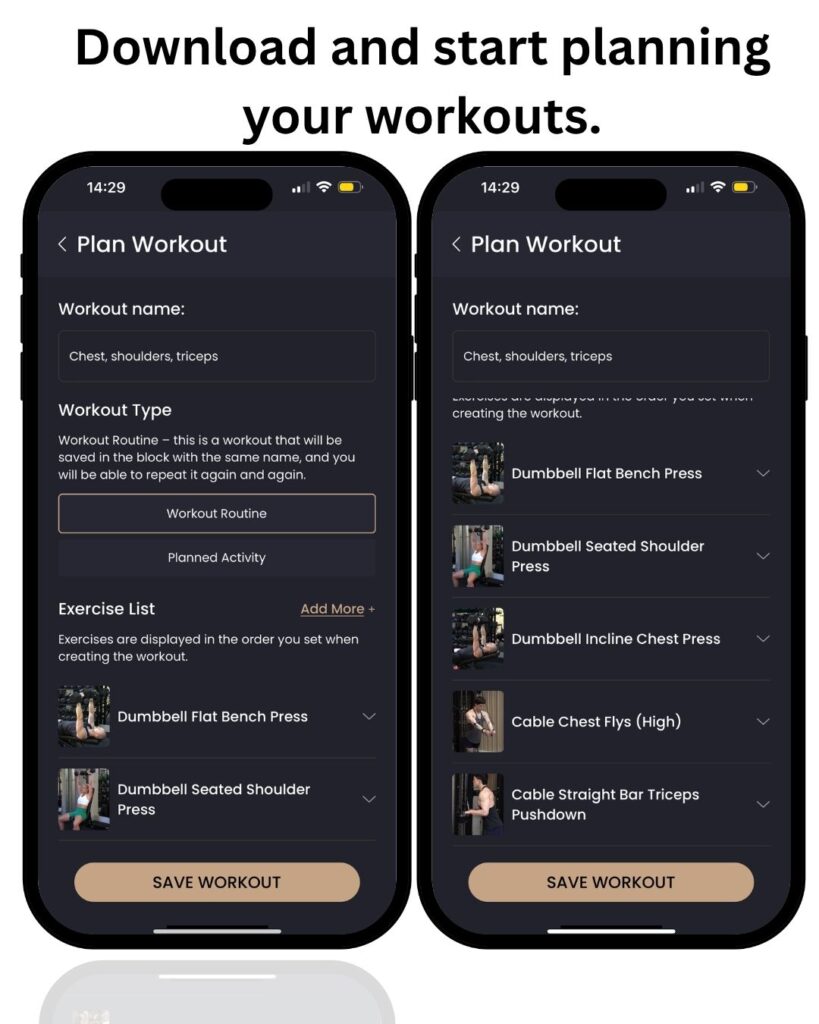
Join my strength training program on the 12reps app for free

Why Strength Training is the Mother of Performance
Running is not just a cardio sport. That is the mistake many runners make. They chase more miles, harder intervals, and longer runs, but the thing that often limits progress is not the lungs. It is the body’s ability to handle force.
Every time your foot hits the ground, your body has to absorb, control, and return force. That impact can reach around 2.5 to 3 times your body weight. Now repeat that thousands of times across a long run, half marathon, or marathon. That is the real demand of running. The question is not only, “Can you run for longer?” It is, “Can your body survive the amount of force your training creates?”
This is where strength training changes everything. A stronger runner wastes less energy. They do not collapse through the hips. They do not leak power through poor posture. They do not rely on compensation when fatigue hits. They move with more control, and that control helps them hold pace for longer.
Strength training can improve running economy, which means you use less oxygen at the same pace. Even a small gain matters over distance. A 2% to 8% improvement in efficiency can be the difference between holding pace and fading late in a race.
Most runners think strength training is about building bigger muscles. It is not. For runners, the goal is to build a better frame. Stronger glutes, more stable hips, stronger tendons, better foot and ankle control, and a core that holds position when the legs get tired.
This gives runners something many of them lack: a power reserve. That reserve matters when you climb hills, surge past someone, change pace, or finish fast. Endurance training teaches your body to keep going. Strength training teaches your body to keep form while going. That difference matters.
Injuries often appear when the body runs out of options. The hips stop doing their job. The knees take over. The calves tighten. The lower back starts to complain. A good strength programme gives your body more options by building the muscles and movement patterns that running alone often neglects.
That is why strength training is not an extra for runners. It is maintenance. It is insurance. It is performance work. It prepares the hips, glutes, hamstrings, calves, feet, and trunk to handle the repeated stress of running.
It also helps with body composition. More lean muscle can support a higher resting metabolic rate and improve how your body uses energy. For runners trying to lose weight, this can be useful because the goal is not just to get lighter. The goal is to become lighter without becoming weaker.
The best runners are not just fit. They are durable. They can tolerate training, repeat sessions, recover well, and hold technique when tired. So perhaps the better way to think about strength is this: running builds the engine, but strength training builds the frame that lets you use it.

Understanding Energy Systems for Runners
Most runners think endurance is built by staying in the aerobic zone for longer. That is only part of the story. Your body does not use one energy system at a time. It blends them. Even in a long run, your body shifts gears every time you climb a hill, overtake someone, hold pace into fatigue, or push near the end.
This is why hybrid training works so well for runners. It does not just train your engine. It teaches your body to change gears without breaking down. You have three main energy systems, and each one plays a different role in running performance.
The first is the phosphocreatine system. This gives you fast energy for short, explosive efforts. Think sprint starts, sharp accelerations, hill bursts, or the final push to the finish line. It does not last long, but when you need it, you really need it.
The second is the glycolytic system. This supports hard efforts that usually last from around 10 seconds to 2 minutes. This is the system you feel during tempo work, hard intervals, race surges, and those uncomfortable moments where your legs start to burn but you still need to hold pace.
The third is the oxidative system. This is your aerobic base. It supports longer efforts and helps you recover between harder bouts of work. Most runners already respect this system because it is the foundation of distance running.
The problem is that many runners only train the aerobic side. They become good at surviving at a steady pace, but poor at producing force, changing speed, or holding form when fatigue builds. That is where strength training fills the gap.
The 12-week programme targets all three systems. The higher rep ranges, short rest periods, and circuit-style structure challenge your muscles while your heart rate stays elevated. This develops strength endurance, which is the ability to keep producing force when your body is tired.
For runners, that matters. Late in a race, your fitness is not the only thing being tested. Your posture is being tested. Your hips are being tested. Your calves, feet, glutes, hamstrings, and trunk are all being asked one question: can you still do your job under fatigue?
Phase 1 builds the base. It focuses on bodyweight exercises, control, posture, and movement quality. This is where you teach the body to move well before asking it to move hard.
Phase 2 adds load. This is where the muscles, tendons, and joints start adapting to higher force. You build strength without losing running-specific control.
Phase 3 brings in more power. Explosive movements and heavier loads help you recruit fast-twitch fibres faster. This gives you more snap when you climb, surge, sprint, or finish strong.
This matters even more for runners who want to become hybrid athletes. You are not just trying to run further. You are trying to become more complete. You want endurance, strength, control, power, and the ability to recover between demands.
For female marathon runners, this approach can be especially useful. Many women are capable of meaningful strength gains when the programme progresses well. The key is not to copy bodybuilding training. The key is to build strength that supports running mechanics, protects the body, and improves force production.
Running performance is rarely limited by one system. A marathon still needs power. A 5K still needs endurance. A hill rep needs strength. A finishing kick needs speed. A tired runner needs stability.
That is why steady-state running alone can leave gaps. It builds one part of the athlete very well, but it does not always prepare the body for the full demand of racing.
The best runners are not just aerobically fit. They are metabolically flexible. They can cruise, surge, climb, recover, and push again. That is the real aim of this programme. Not just to make you fitter. To make you harder to break.

The 12-Week Push/Pull/Legs Program Overview
This athlete weightlifting programme uses a push, pull, legs structure, but it has been rebuilt for runners. The goal is not to train like a bodybuilder. The goal is to build a runner who can absorb force, hold posture, produce power, and stay strong when fatigue starts to change running form.
The programme splits training into three sessions per week. Push sessions train the chest, shoulders, and triceps. Pull sessions train the back, biceps, and rear delts. Leg sessions train the quads, glutes, hamstrings, calves, and the muscles that support hip, knee, ankle, and foot control. This structure gives each area enough stimulus to improve, while still allowing recovery between sessions.
The 12-week plan is divided into three 4-week phases. This matters because your body needs progression, not random workouts. Phase 1 builds control and movement quality. Phase 2 adds more load and strength. Phase 3 increases intensity and power. Each phase gives the body a new challenge without throwing too much at it too soon.
The strength of this system is its simplicity. You train three times per week. Each session takes around 45 to 60 minutes. You use free weights, bodyweight exercises, and simple equipment. That makes the programme easier to follow, which matters because the best plan is not the one that looks clever on paper. It is the one you can repeat.
You do not need a full gym setup. Dumbbells or adjustable weights are enough for most of the programme. A pull-up bar or resistance bands can cover the pulling movements. A bench, box, step, or stable surface can support bodyweight work. This means you can train at home, in a small gym, or in a basic training space without making excuses around equipment.
The three-day structure also works well alongside running. Strength training should support your running, not fight against it. The leg session needs smart placement, especially if you have intervals, tempo runs, hill work, or a long run in the same week. The aim is to build strength without leaving your legs flat for your most important runs.
Each workout follows a clear format. You start with a movement-specific warm-up, then complete 4 working sets of 12 to 15 reps with 45 seconds of rest between sets. This gives runners the kind of strength they actually need: the ability to keep producing force under fatigue.
That rep range is not random. Higher reps and short rest periods challenge muscular endurance and the glycolytic energy system. In simple terms, you teach your muscles to work hard while tired. That has direct value for running, especially late in races when your form starts to fade and every stride costs more.
This programme is not about chasing the heaviest lift possible. It is about building a body that can handle running better. Stronger hips. Better posture. More resilient legs. A more stable trunk. More control when fatigue arrives. That is what turns strength training from gym work into running performance.

Phase 1: Foundation (Weeks 1-4) - Bodyweight and Mobility Focus
Phase 1 Workout Tables
Push Day – Phase 1
Exercise | Warm-up Set | Working Sets | Reps | Rest | Progression Notes |
Push-ups (knee or full) | 1 x 8 | 4 x 12-15 | 12-15 | 45s | Progress from knee to full to elevated feet |
Pike Push-ups | 1 x 6 | 4 x 8-12 | 8-12 | 45s | Focus on shoulder strength |
Tricep Dips (chair/bench) | 1 x 8 | 4 x 10-15 | 10-15 | 45s | Elevate feet for progression |
Plank to Push-up | 1 x 5 | 3 x 8-12 | 8-12 | 45s | Builds core and push strength |
Wall Handstand Hold | 1 x 10s | 4 x 15-30s | 15-30s | 45s | Build shoulder stability |
Pull Day – Phase 1
Exercise | Warm-up Set | Working Sets | Reps | Rest | Progression Notes |
Inverted Rows (table/bar) | 1 x 8 | 4 x 10-15 | 10-15 | 45s | Adjust body angle for difficulty |
Pull-ups/Chin-ups (assisted) | 1 x 5 | 4 x 5-12 | 5-12 | 45s | Use resistance band if needed |
Superman | 1 x 10 | 4 x 12-15 | 12-15 | 45s | Focus on lower back strength |
Reverse Fly (lying) | 1 x 10 | 4 x 12-15 | 12-15 | 45s | Bodyweight rear delt work |
Dead Hang | 1 x 10s | 4 x 20-45s | 20-45s | 45s | Build grip strength |
Legs Day – Phase 1
Exercise | Warm-up Set | Working Sets | Reps | Rest | Progression Notes |
Bodyweight Squats | 1 x 10 | 4 x 15-20 | 15-20 | 45s | Focus on depth and control |
Single-leg Glute Bridges | 1 x 8 each | 4 x 12-15 each | 12-15 | 45s | Progress to single leg |
Lunges (alternating) | 1 x 6 each | 4 x 12-15 each | 12-15 | 45s | Add jump for power |
Calf Raises | 1 x 12 | 4 x 15-20 | 15-20 | 45s | Single leg progression |
Wall Sit | 1 x 20s | 4 x 30-60s | 30-60s | 45s | Increase time weekly |
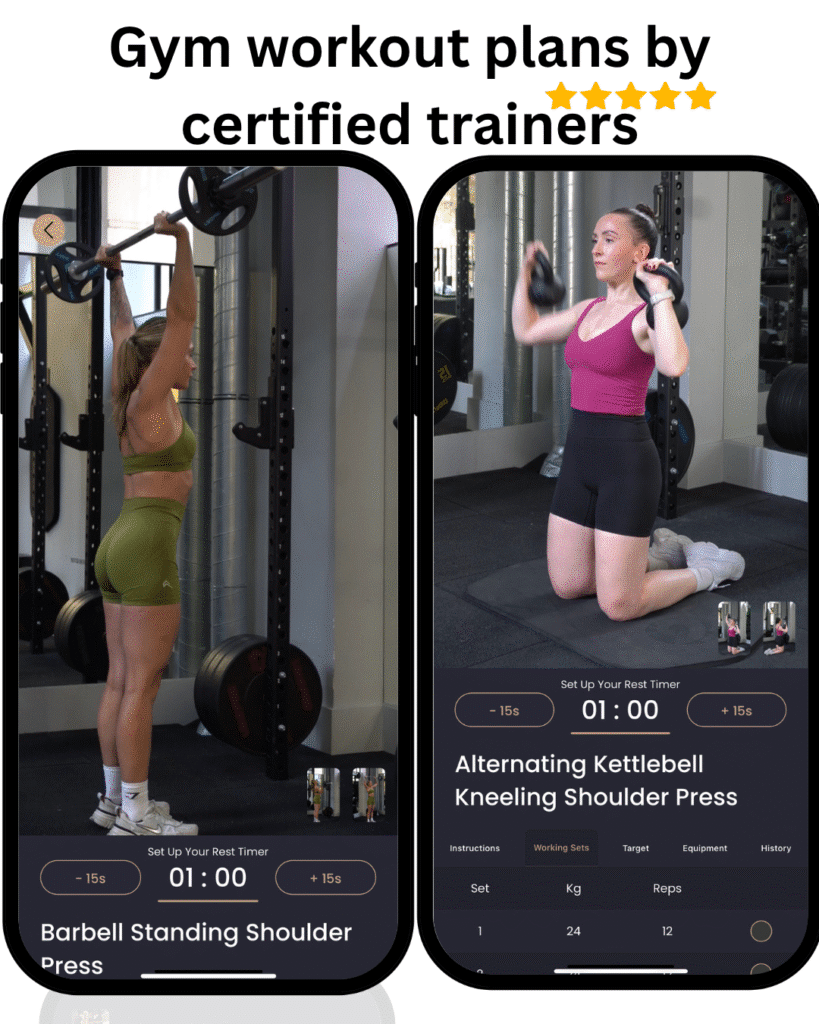
The progression strategy during Phase 1 focuses on movement quality and volume increases rather than external loading. Runners should master each movement pattern before advancing to more challenging variations. The bodyweight nature of this phase allows for daily practice of movement patterns, accelerating the learning process and building the foundation for subsequent phases. Download the 12reps app to see exercise demos.

Phase 2: Strength Development (Weeks 5-8) - Free Weights Introduction
Phase 2 Workout Tables
Push Day – Phase 2
Exercise | Warm-up Set | Working Sets | Reps | Rest | Progression Notes |
Dumbbell Chest Press | 1 x 10 light | 4 x 12-15 | 12-15 | 45s | Increase weight weekly |
Overhead Press (dumbbells) | 1 x 8 light | 4 x 10-12 | 10-12 | 45s | Focus on core stability |
Dumbbell Flyes | 1 x 10 light | 4 x 12-15 | 12-15 | 45s | Control the negative |
Close-grip Push-ups | 1 x 8 | 4 x 10-15 | 10-15 | 45s | Target triceps |
Lateral Raises | 1 x 10 light | 4 x 12-15 | 12-15 | 45s | Light weight, perfect form |
Pull Day – Phase 2
Exercise | Warm-up Set | Working Sets | Reps | Rest | Progression Notes |
Bent-over Dumbbell Rows | 1 x 10 light | 4 x 12-15 | 12-15 | 45s | Keep core tight |
Single-arm Dumbbell Rows | 1 x 8 each light | 4 x 12-15 each | 12-15 | 45s | Focus on lat engagement |
Reverse Flyes (dumbbells) | 1 x 10 light | 4 x 12-15 | 12-15 | 45s | Rear delt focus |
Bicep Curls | 1 x 10 light | 4 x 12-15 | 12-15 | 45s | Control the movement |
Face Pulls (resistance band) | 1 x 10 | 4 x 15-20 | 15-20 | 45s | External rotation focus |
Legs Day – Phase 2
Exercise | Warm-up Set | Working Sets | Reps | Rest | Progression Notes |
Goblet Squats | 1 x 10 light | 4 x 12-15 | 12-15 | 45s | Hold dumbbell at chest |
Romanian Deadlifts | 1 x 8 light | 4 x 10-12 | 10-12 | 45s | Focus on hip hinge |
Dumbbell Lunges | 1 x 6 each light | 4 x 12-15 each | 12-16 | 45s | Add weight gradually |
Single-leg Calf Raises | 1 x 10 each | 4 x 12-15 each | 12-16 | 45s | Hold dumbbell for load |
Farmer’s Walks | 1 x 20m light | 4 x 30-40m | 30-40m | 45s | Functional core strength |
Phase 3: Power and Performance (Weeks 9-12) - Advanced Movements
Phase 3 Workout Tables
Push Day – Phase 3
Exercise | Warm-up Set | Working Sets | Reps | Rest | Progression Notes |
Dumbbell Bench Press | 1 x 10 moderate | 4 x 10-12 | 10-12 | 45s | Heavier loads |
Push Press (dumbbells) | 1 x 8 light | 4 x 8-10 | 8-10 | 45s | Explosive movement |
Incline Dumbbell Press | 1 x 10 moderate | 4 x 10-12 | 10-12 | 45s | Upper chest focus |
Dumbbell Thrusters | 1 x 8 light | 4 x 10-12 | 10-12 | 45s | Full body power |
Plyo Push-ups | 1 x 5 | 3 x 6-10 | 6-10 | 45s | Explosive power |
Pull Day – Phase 3
Exercise | Warm-up Set | Working Sets | Reps | Rest | Progression Notes |
Weighted Pull-ups/Chin-ups | 1 x 5 bodyweight | 4 x 8-12 | 8-12 | 45s | Add weight if possible |
Renegade Rows | 1 x 6 light | 4 x 8-12 | 8-12 | 45s | Core and pull combined |
High Pulls (dumbbells) | 1 x 8 light | 4 x 8-10 | 8-10 | 45s | Explosive pulling |
Hammer Curls | 1 x 10 moderate | 4 x 10-12 | 10-12 | 45s | Grip strength focus |
Band Pull-aparts | 1 x 15 | 4 x 15-20 | 15-20 | 45s | Rear delt activation |
Legs Day – Phase 3
Exercise | Warm-up Set | Working Sets | Reps | Rest | Progression Notes |
Dumbbell Squats | 1 x 10 moderate | 4 x 10-12 | 10-12 | 45s | Heavier loads |
Single-leg Deadlifts | 1 x 6 each light | 4 x 8-12 each | 8-12 | 45s | Balance and strength |
Jump Squats | 1 x 8 bodyweight | 4 x 8-12 | 8-12 | 45s | Explosive power |
Bulgarian Split Squats | 1 x 8 each light | 4 x 10-12 each | 10-12 | 45s | Single leg strength |
Weighted Calf Raises | 1 x 12 moderate | 4 x 12-15 | 12-15 | 45s | Heavy load focus |
The progression strategy in Phase 3 emphasises movement velocity and power output rather than simply increasing load. Runners should focus on explosive execution of concentric movements whilst maintaining control during eccentric phases. The introduction of plyometric exercises requires careful attention to landing mechanics and progressive volume increases to prevent injury.
The metabolic demands of Phase 3 peak during this program, creating training stimuli that closely mirror competitive demands. The combination of heavy loads, explosive movements, and short rest periods develops the anaerobic power and recovery capacity essential for competitive running performance. This phase prepares runners for the physiological demands of racing whilst building the confidence that comes from feeling truly strong and powerful.
Conclusion
This 12-week push/pull/legs program represents a comprehensive approach to athletic strength training that addresses the specific needs of distance runners. Through systematic progression from bodyweight foundations to advanced power development, the program builds the strength qualities that enhance running performance whilst reducing injury risk.
The integration of multiple energy systems, functional movement patterns, and progressive overload creates adaptations that extend far beyond simple strength gains. Runners who complete this program will experience improved running economy, enhanced anaerobic capacity, better body composition, and the confidence that comes from feeling truly strong and resilient.
Whether you’re preparing for your first marathon, training for Hyrox training competitions, or simply seeking to become a more complete athlete, this program provides the foundation for long-term success. The principles and progressions outlined here can be adapted and repeated throughout your athletic career, ensuring continued development and injury prevention.
As an experienced strength and conditioning coach, I’ve seen countless runners transform their performance through systematic strength training. The program outlined here represents the distillation of years of experience working with athletes at all levels. Trust the process, focus on movement quality, and prepare to discover what you’re truly capable of achieving.
Remember, strength training isn’t just about becoming a better runner, it’s about becoming a more resilient, capable, and confident athlete in all aspects of life. The strength you build in the gym will serve you not just in races, but in every physical challenge you encounter.
Join my strength training program on the 12reps app for free
References
[1] Blagrove, R. C., Howatson, G., & Hayes, P. R. (2018). Effects of strength training on the physiological determinants of middle-and long-distance running performance: a systematic review. Sports Medicine, 48(5), 1117-1149. https://link.springer.com/article/10.1007/s40279-017-0835-7
[2] Cavanagh, P. R., & Lafortune, M. A. (1980). Ground reaction forces in distance running. Journal of Biomechanics, 13(5), 397-406.
[3] Yamamoto, L. M., Lopez, R. M., Klau, J. F., Casa, D. J., Kraemer, W. J., & Maresh, C. M. (2008). The effects of resistance training on endurance distance running performance among highly trained runners: a systematic review. Journal of Strength and Conditioning Research, 22(6), 2036-2044. https://journals.lww.com/nsca-jscr/fulltext/2008/11000/the_effects_of_resistance_training_on_endurance.43.aspx
[4] Jung, A. P. (2003). The impact of resistance training on distance running performance. Sports Medicine, 33(7), 539-552. https://link.springer.com/article/10.2165/00007256-200333070-00005
[5] Lauersen, J. B., Bertelsen, D. M., & Andersen, L. B. (2014). The effectiveness of exercise interventions to prevent sports injuries: a systematic review and meta-analysis of randomised controlled trials. British Journal of Sports Medicine, 48(11), 871-877.
[6] Brandt, T., Ebel, C., Lebahn, C., & Schmidt, A. (2025). Acute physiological responses and performance determinants in Hyrox© – a new running-focused high intensity functional fitness trend. Frontiers in Physiology. https://www.frontiersin.org/journals/physiology/articles/10.3389/fphys.2025.1519240/full
[7] Roelofs, E. J., Smith-Ryan, A. E., Melvin, M. N., Wingfield, H. L., Trexler, E. T., & Walker, N. (2015). Muscle size, quality, and body composition: characteristics of division I cross-country runners. Journal of Strength and Conditioning Research, 29(2), 290-296. https://journals.lww.com/nsca-jscr/FullText/2015/02000/Muscle_Size,_Quality,_and_Body_Composition_.2.aspx
[8] Aloia, J. F., Cohn, S. H., Babu, T., Abesamis, C., Kalici, N., & Ellis, K. (1978). Skeletal mass and body composition in marathon runners. Metabolism, 27(12), 1793-1796. https://www.sciencedirect.com/science/article/pii/0026049578902652
[9] Westcott, W. L. (2012). Resistance training is medicine: effects of strength training on health. Current Sports Medicine Reports, 11(4), 209-216.
[10] Kraemer, W. J., & Ratamess, N. A. (2005). Hormonal responses and adaptations to resistance exercise and training. Sports Medicine, 35(4), 339-361.
[11] Mikkola, J. S., Rusko, H. K., Nummela, A. T., Pollari, T., & Häkkinen, K. (2007). Concurrent endurance and explosive type strength training increases activation and fast force production of leg extensor muscles in endurance athletes. Journal of Strength and Conditioning Research, 21(2), 613-620. https://journals.lww.com/nsca-jscr/abstract/2007/05000/concurrent_endurance_and_explosive_type_strength.56.aspx
[12] Brooks, G. A., & Mercier, J. (1994). Balance of carbohydrate and lipid utilization during exercise: the “crossover” concept. Journal of Applied Physiology, 76(6), 2253-2261.
[13] Heinonen, A., Oja, P., Kannus, P., Sievänen, H., Mänttäri, A., & Vuori, I. (1993). Bone mineral density of female athletes in different sports. Bone and Mineral, 23(1), 1-14.