




Written by Will Duru, BSc (Hons) Sport and Exercise Science, award-winning Personal Trainer with over 10 years of experience in strength training and optimising recovery .
The best lower body exercises for women at home need no equipment at all: bodyweight squats, reverse lunges, butterfly glute bridges, fire hydrants and single-leg glute bridges. Together they train your glutes, quads and hamstrings in the space of a yoga mat. This guide shows you how to do each move, how many sets and reps to aim for, and how to make each one harder as you get stronger.
Life is busy, and getting to a gym is not always possible. Your bodyweight is enough to start building lower body strength, as long as you use good form and keep challenging yourself.
If you are brand new to leg training and want the bigger picture first, start with our beginner’s guide to women’s lower body strength training.

Why Home Lower Body Strength Training Works
Can you really get stronger without heavy weights? Yes, especially when you are new to training. A 2017 review found that muscle growth was similar across a wide range of loads, while heavier loads gave the biggest gains in maximal strength.
The practical takeaway is simple. Bodyweight moves can build muscle in your legs if each set is genuinely hard. Aim to finish each set with only a few good reps left in you.
Health guidelines count bodyweight exercise as muscle-strengthening activity. The NHS and the CDC both advise adults to work all major muscle groups, including the legs and hips, on at least two days a week.
Your lower body does a lot of daily work: walking, climbing stairs, carrying shopping and getting up from the floor. Strength training also loads your bones. The NHS explains that when muscles pull on your bones during resistance exercise, it helps strengthen them.
Worried about getting bulky? Building noticeable muscle takes months of steady, hard training. Read the truth about women and muscle growth if that concern is holding you back.

The 5 Essential Lower Body Exercises for Women at Home
Do the exercises in the order below. Each one includes the steps, the sets and reps, and a harder option for later.
1. Bodyweight Squat
The squat trains your quads (front of thighs), glutes and adductors (inner thighs). Your core works to keep your chest up.
- Stand with your feet a little wider than shoulder-width, toes turned out slightly.
- Keep your chest up and your back long.
- Push your hips back and bend your knees, as if sitting into a chair.
- Lower until your thighs are about parallel to the floor, or as low as you can with good form.
- Keep your knees in line with your toes and your whole foot on the floor.
- Push the floor away, squeeze your glutes and stand tall.
Sets and reps: 5 sets of 12 reps.
Make it harder: take three seconds to lower, or pause for two seconds at the bottom. For a full technique breakdown, read how to squat properly.
2. Bodyweight Reverse Lunge
The reverse lunge trains one leg at a time. It works your quads and glutes and challenges your balance. Many beginners find stepping back easier to control than stepping forward.
- Stand tall with your feet hip-width apart and your core braced.
- Step one leg back and land on the ball of your foot.
- Lower straight down until both knees bend to about 90 degrees.
- Keep your front knee over your ankle and your back knee just above the floor.
- Push through your front foot to return to standing, and squeeze your glutes at the top.
Sets and reps: 5 sets of 12 reps on each leg.
Watch the trainer demo on the Bodyweight Reverse Lunge exercise page. Make it harder: try the deficit reverse lunge, where your front foot stands on a low step.
3. Butterfly Glute Bridge
This bridge variation is also known as frog pumps. With the soles of your feet together and your knees open, many people feel it strongly in their glutes.
- Lie on your back. Bring the soles of your feet together and let your knees fall open.
- Pull your heels in close to your glutes. Rest your arms by your sides, palms down.
- Squeeze your glutes and lift your hips, pressing through your heels and the outer edges of your feet.
- At the top, aim for a straight line from your shoulders to your knees. Squeeze your glutes hard.
- Lower your hips slowly. Keep tension in your glutes for the whole set.
Sets and reps: 5 sets of 12 reps.
See the Frog Pumps exercise page for a demo of this movement.
4. Fire Hydrant
The fire hydrant lifts your bent leg out to the side. This movement is called hip abduction, and it mainly works the gluteus medius on the side of your hip. In one study, side-lying hip abduction produced the highest gluteus medius activity of the exercises tested. The fire hydrant was not tested in that study, but it uses the same outward hip movement from all fours.
- Start on all fours with your hands under your shoulders and your knees under your hips.
- Keep your back flat, your core tight and your gaze down at the floor.
- Keeping your knee bent at 90 degrees, lift one leg out to the side.
- Keep your hips level. Do not twist or lean onto your other side.
- Use your glutes to lift the leg, not momentum. Lower it slowly without letting it drop.
Sets and reps: 3 sets of 12 reps on each side.
Make it harder: add a loop band above your knees, as shown on the Mini Band Fire Hydrant exercise page.
5. Single-Leg Glute Bridge
Working one leg at a time makes each glute and hamstring do the job alone. It also shows you if one side is weaker.
- Lie on your back with your knees bent and your feet flat, hip-width apart.
- Straighten one leg, keeping both knees level. Rest your arms by your sides.
- Push through the heel of your planted foot, squeeze your glute and lift your hips.
- Aim for a straight line from your shoulders to the knee of your straight leg. Pause at the top.
- Lower slowly. Keep your hips level and do not let them drop.
Sets and reps: 3 sets of 12 reps on each leg.
Make it harder: rest your upper back on a sofa for a bodyweight hip thrust, or try a single-leg glute bridge on a BOSU ball if you have one.
How to Put the Workout Together
Here is how to turn the five moves into a simple home lower body session.
- How often: 2 to 3 sessions a week, with at least one rest day between them. For example, Monday, Wednesday and Friday. This fits the American College of Sports Medicine advice of 2 to 3 days a week for beginners.
- Warm-up: spend 5 to 10 minutes moving. March on the spot, then do leg swings, hip circles and a few easy squats.
- Order: do the exercises in the order listed. Finish all sets of one exercise before moving on. These are called straight sets.
- Rest: 60 to 90 seconds between sets, so you can keep good form on every set.
- Listen to your body: if something hurts, stop. It is fine to swap an exercise or take an extra rest day.
How to Keep Progressing
Progressive overload means making your training a little harder over time so your body keeps adapting. Without weights, you can progress in several ways:
- Add reps, up to about 20 per set.
- Slow down the lowering phase.
- Add a pause at the hardest point.
- Move to a harder variation, such as the single-leg options above.
- Add a set.
Change one thing at a time, and only when your form stays solid. Our beginner’s guide to progressive overload explains more.
Where to Go Next
- Got a pair of dumbbells? Try this women’s dumbbell leg day workout.
- Training at a gym? See our glute-focused lower body gym plan.
- Want to fit leg days into a full week? Read the strength training schedule for women.
Conclusion
These five exercises give you a complete home lower body workout: bodyweight squats, reverse lunges, butterfly glute bridges, fire hydrants and single-leg glute bridges. They need no equipment and very little space.
Consistency matters more than any single session. Train two or three times a week, keep your form tidy, and make the exercises a little harder as they start to feel comfortable.
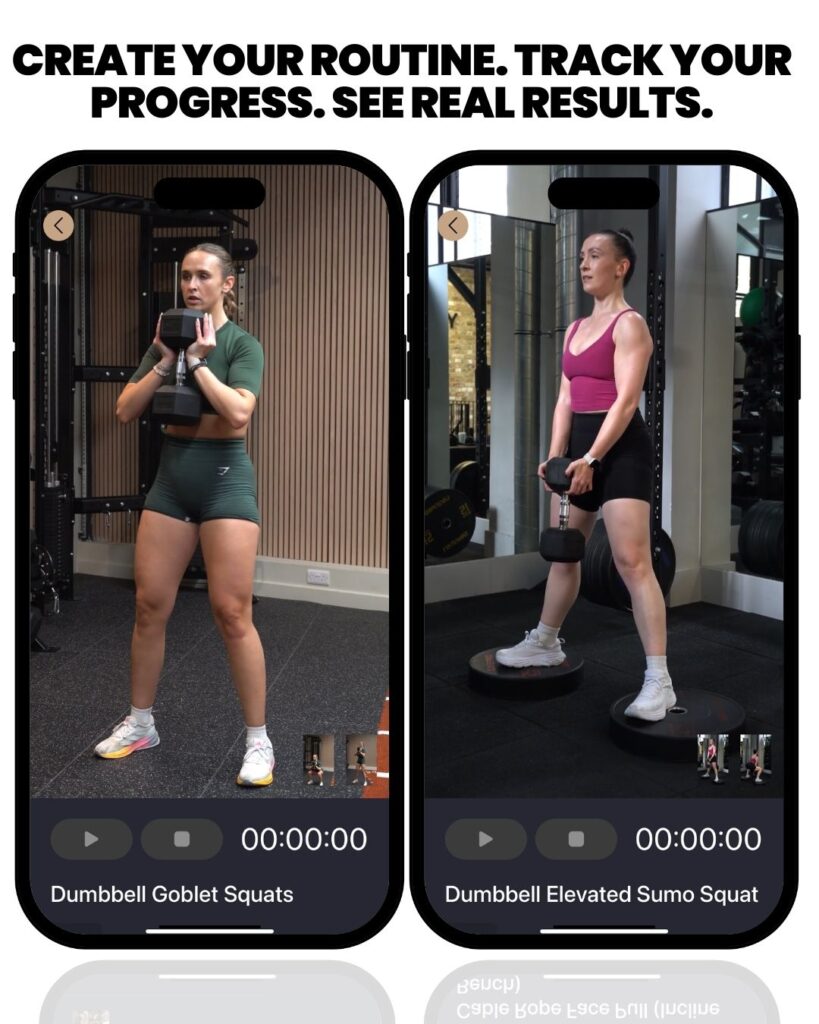
If you would like each session set out for you, 12REPS builds a plan around your goal, the equipment you have and the time you’ve got. Every exercise comes with a trainer demonstration, and the app remembers your reps so you always have a number to beat.

Sources
- Gluteal muscle activation during common therapeutic exercises (Distefano et al.). Journal of Orthopaedic & Sports Physical Therapy, 2009. https://read.qxmd.com/read/19574661/gluteal-muscle-activation-during-common-therapeutic-exercises
- American College of Sports Medicine position stand: Progression models in resistance training for healthy adults. Medicine & Science in Sports & Exercise, 2009. https://sfu.ca/~ryand/kin343/ACSMresistance.pdf
- Strength and hypertrophy adaptations between low- vs. high-load resistance training: a systematic review and meta-analysis (Schoenfeld, Grgic, Ogborn and Krieger). Journal of Strength and Conditioning Research, 2017. https://vuir.vu.edu.au/42281/
- Physical activity guidelines for adults aged 19 to 64. NHS, accessed 2026. https://www.nhs.uk/live-well/exercise/physical-activity-guidelines-for-adults-aged-19-to-64/
- Adult Activity: An Overview. Centers for Disease Control and Prevention (CDC), accessed 2026. https://www.cdc.gov/physical-activity-basics/guidelines/adults.html
- Osteoporosis: Prevention. NHS, accessed 2026. https://www.nhs.uk/conditions/osteoporosis/prevention/



