
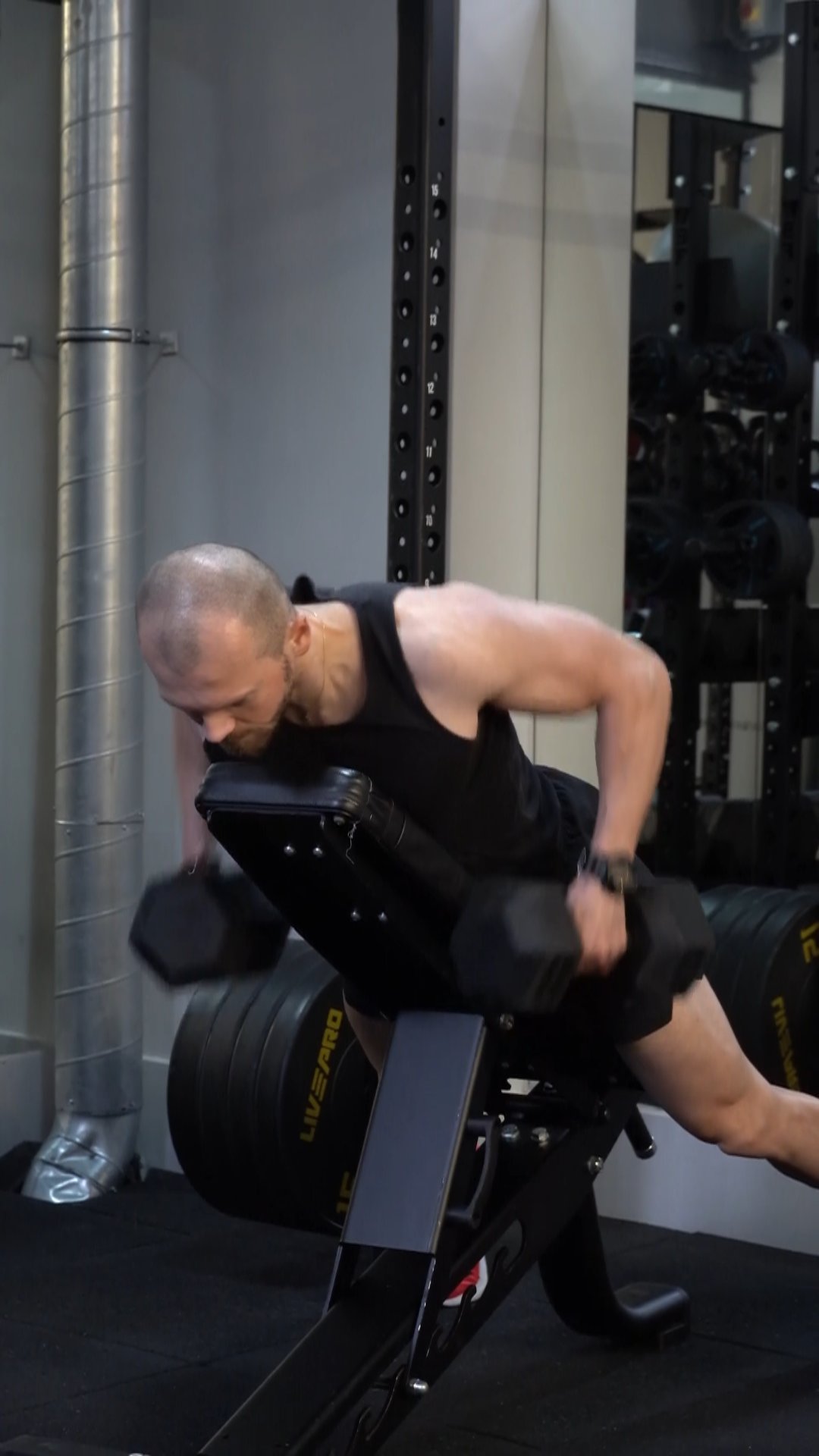



By Will Duru, personal trainer and founder of 12REPS.
The Short Answer
A chest-supported row is a row where you lie face down on an incline bench (or use a machine with a chest pad) and pull weights toward you. The bench holds your torso still, so you don’t need your lower back to support you.
That makes it one of the best rows for building your upper back and lats, especially if your lower back gets tired or sore during bent-over rows. Below I’ll show you how to do it, the best variations, and how it compares with other rows.
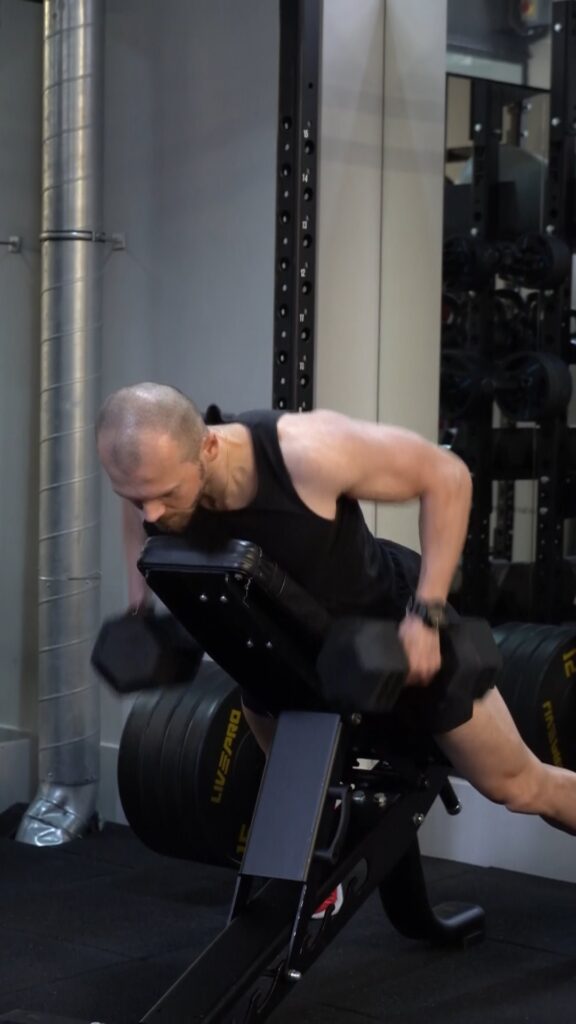
Why Choose a Chest-Supported Row?
- Less lower-back strain. The bench supports your torso, so your lower back doesn’t have to hold a bent-over position.
- Less cheating. It’s hard to swing the weight up when your chest is on a pad.
- Better focus on your back. With nothing else to think about, you can concentrate on pulling with your back muscles.
- Easy to learn. Beginners get the position right faster than with a barbell row.
What the Research Says
In a 2009 study by Fenwick, Brown and McGill, researchers compared three rows in seven healthy men. The standing bent-over barbell row put about 3,576 newtons of compression on the lower spine. The inverted row (about 2,339 N) and the standing one-arm cable row (about 2,457 N) put much less load on the lower back.
The bent-over row also needed more lower-back muscle activity. The authors suggested that people who want to spare their lower back could choose the inverted row.
That study didn’t test a chest-supported row, and it was very small. But the same logic applies: when a bench holds your torso, your lower back doesn’t have to hold a bent-over position. That’s my coaching reasoning, not a measured result.
How to Do a Chest-Supported Dumbbell Row
- Set an incline bench to about 30–45 degrees. See the best incline bench angle.
- Lie face down with your chest on the pad and your feet on the floor behind you.
- Let the dumbbells hang straight down, with your shoulder blades spread apart.
- Pull the dumbbells toward your hips, leading with your elbows.
- Squeeze your shoulder blades together at the top, then lower slowly until your arms are straight.
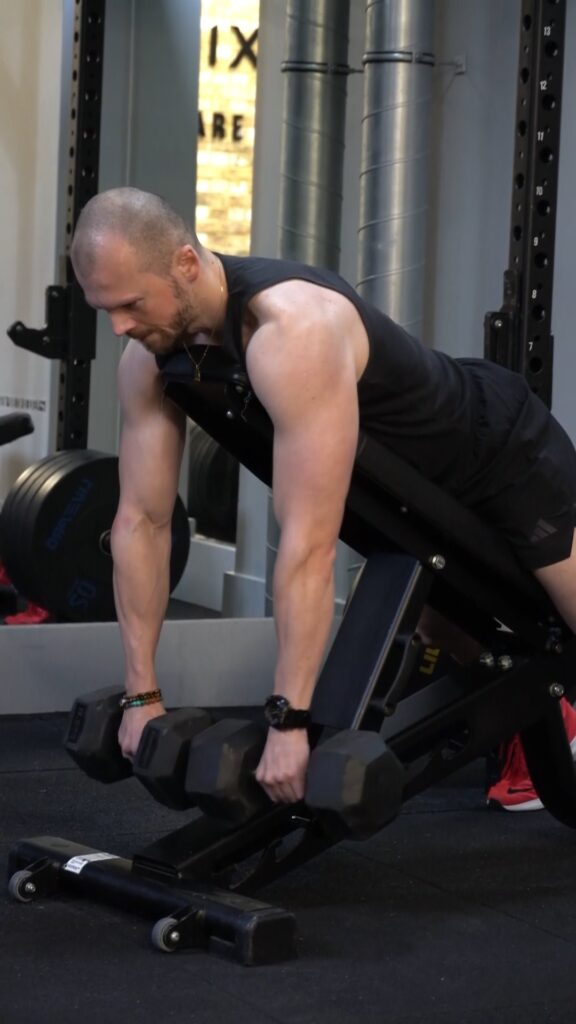
Coaching cues I use:
- “Keep your chest on the pad.” Lifting off means the weight is too heavy.
- “Pull your elbows toward your back pockets.” This targets your lats more.
- “Let the shoulder blades move.” Spread them at the bottom, squeeze them at the top.
Best Chest-Supported Row Variations
| Variation | Equipment | Best for |
|---|---|---|
| Dumbbell incline row | Incline bench and dumbbells | Most people, home or gym |
| Incline seated single-arm row | Incline bench and dumbbell | Working one side at a time |
| Cable incline seated row | Cable machine and bench | Constant tension through the rep |
| Cable single-arm row (incline bench) | Cable machine and bench | Single-arm work with a cable |
| Machine seated row | Row machine with chest pad | Simple setup and heavier loads |
Incline Seated Single-Arm Row
Working one arm at a time helps if one side is weaker. Keep your chest on the pad and don’t twist your torso.
Cable Incline Seated Row
The cable keeps tension on your back through the whole rep, including the stretched position at the bottom.
Cable Single-Arm Row (Incline Bench)
Machine Seated Row
Most gyms have a row machine with a chest pad. It’s the easiest way to load the movement heavily and safely.
Chest-Supported Row vs Other Rows
| Row | Lower-back demand | Main advantage |
|---|---|---|
| Chest-supported row | Low | Strict, back-focused reps |
| Seated cable row | Low to moderate | Constant cable tension |
| Bent-over barbell row | High | Heavy loads and trains your hips and back to hold position |
| Inverted row | Low to moderate | Bodyweight option |
You don’t have to pick just one. I often use chest-supported rows as the main row for clients with sensitive lower backs, and add seated cable rows or T-bar rows for variety.
Sets, Reps and Programming
These are my coaching recommendations, not rules from the research:
- Sets and reps: 3–4 sets of 8–12 reps.
- Rest: 90 seconds to 2 minutes.
- Frequency: 1–2 times a week as part of your back or pull day.
- Pair it with: A vertical pull such as a lat pulldown, and a rear-shoulder exercise such as face pulls or reverse flys.
Common Mistakes
- Lifting your chest off the pad. Lower the weight and keep the reps strict.
- Shrugging the weight up. Keep your shoulders away from your ears.
- Cutting the range short. Let your arms go straight at the bottom.
- Setting the bench too steep. If it’s too upright, the movement turns into a shrug. Start around 30–45 degrees.
- Craning your neck. Keep your head in line with your spine.
Summary
- A chest-supported row trains your upper back and lats with your torso supported.
- Research shows bent-over barbell rows load the lower back far more than some other rows.
- It’s a great choice if your lower back tires during rows or you want stricter reps.
- Use 3–4 sets of 8–12 reps, keep your chest on the pad and control every rep.
Build a Stronger Back With 12REPS
In 12REPS, pick your workout time and the equipment you have, and the app builds a back session that fits, with chest-supported rows when they suit you.
Every exercise has a demo and a coach tutorial from me, and your log shows what you lifted last time, so you know when to go heavier.
Download 12REPS and see what you’ll get:
Sources
Related Reading
- Seated cable row
- T-bar row vs landmine row
- Inverted row
- Dumbbell back workout
- Exercises for back pain
I’m Will Duru, a personal trainer and the founder of 12REPS. I hold a BSc (Hons) in Sport and Exercise Science and have more than a decade of experience coaching people in strength training.
