



By Will Duru, personal trainer and founder of 12REPS.
The Short Answer
Pyramid training means changing the weight and reps from set to set. In an ascending pyramid, the weight goes up and the reps go down each set. In a reverse (descending) pyramid, you start with your heaviest set and then lighten the weight.
Research shows pyramid sets build muscle and strength about as well as regular sets when the total amount of work is the same. They’re not magic, but they’re a useful way to train across different rep ranges and add variety.
Types of Pyramid Training
| Type | How it works | Example (dumbbell press, per dumbbell) |
|---|---|---|
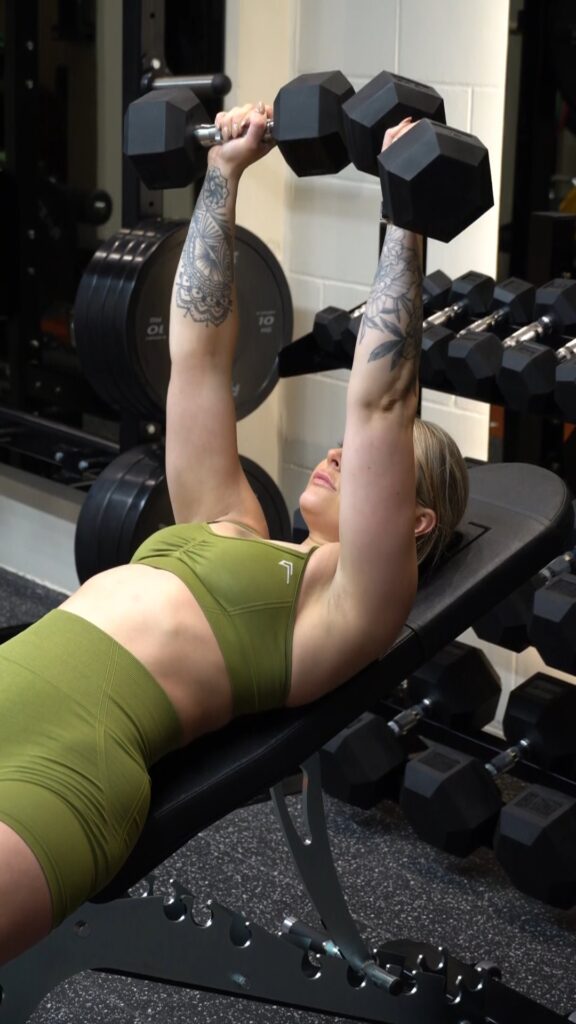
| Ascending pyramid | Weight goes up, reps go down | 40 lb x 12, 45 lb x 10, 50 lb x 8, 55 lb x 6 |
| Reverse (descending) pyramid | Heaviest first, then lighter with more reps | 55 lb x 6, 50 lb x 8, 45 lb x 10 |
| Triangle pyramid | Up, then back down | 40 lb x 12, 50 lb x 8, 55 lb x 6, 50 lb x 8, 40 lb x 12 |
The weights above are examples only. Choose loads that take each set close to your target reps with good form.
What the Research Says
In a 2017 study by Angleri and colleagues, 32 well-trained men trained their legs for 12 weeks on the leg press and leg extension. Each man trained one leg with traditional sets and the other with either an ascending (crescent) pyramid or drop sets. Total training volume was matched between legs.
- Muscle growth was the same: about 7.5% for both the traditional and pyramid legs.
- Strength gains were the same: about 26% on the leg press and 16% on the leg extension for both.
- Muscle structure changed equally across all three methods.
The authors concluded that pyramid and drop-set systems don’t produce greater gains than traditional training when volume is equal. In other words, total work matters more than the pattern of weights and reps.
Pros and Cons of Pyramid Training
| Pros | Cons |
|---|---|
| Trains several rep ranges in one exercise | No extra muscle or strength compared with regular sets |
| Ascending sets double as a gradual warm-up | Early sets of an ascending pyramid can be too easy to count much |
| Reverse pyramid puts your heaviest set first, when you’re fresh | Changing weights takes time, especially with barbells |
| Adds variety and can make training more engaging | Harder to track progress if the weights change each week |
Which Pyramid Should You Use?
- For strength: I prefer a reverse pyramid. You lift your heaviest set when you’re freshest, then add volume with lighter sets.
- For muscle growth: any pyramid works, as long as each set is reasonably close to failure. Total sets matter more than the pattern.
- For beginners: stick with straight sets (same weight each set) until you’ve learned good technique and how to judge effort.
These preferences are my coaching view. The research shows the outcomes are similar either way.
How to Do a Reverse Pyramid
- Warm up first with a few lighter sets that don’t count toward the pyramid. See the importance of warm-up sets.
- Set 1: your heaviest weight for 4 to 6 reps, leaving 1 to 2 reps in the tank.
- Set 2: reduce the weight by about 10% and do 6 to 8 reps.
- Set 3: reduce by another 10% and do 8 to 12 reps.
- Rest 2 to 3 minutes between sets so you can perform well on each one.
Common Mistakes
- Easy early sets in an ascending pyramid. Light sets far from failure add little. Make sure most sets are challenging.
- Going to failure on every set. You’ll struggle on later sets. Leave a rep or two in the tank, as explained in RPE vs RIR.
- Too many sets. A pyramid of six or seven sets is often more than you need on one exercise.
- Using it on every exercise. One or two pyramids per workout is plenty.
- Not tracking. Record every set so you can add weight or reps next time. See my guide to progressive overload.
Summary
- Pyramid training changes the weight and reps each set, either up, down or both.
- Research shows it builds muscle and strength about as well as regular sets when total work is the same.
- A reverse pyramid is a good choice for strength, because your heaviest set comes first.
- Keep most sets challenging, track your numbers and use it on one or two exercises per workout.
Track Every Set With 12REPS
Pyramid sets are easier when you know exactly what you lifted last time. In 12REPS, your log shows the weight and reps for every set, so you can beat them next session.
Pick your workout time and equipment, and the app builds your session, with a demo and a coach tutorial from me for every exercise.
Download 12REPS and see what you’ll get:
Sources
Related Reading
- Drop sets: do they build more muscle?
- Training to failure
- RPE vs RIR
- Progressive overload: the complete guide
- How to calculate your one-rep max
I’m Will Duru, a personal trainer and the founder of 12REPS. I hold a BSc (Hons) in Sport and Exercise Science and have more than a decade of experience coaching people in strength training.
