




By Will Duru, personal trainer and founder of 12REPS.
The Short Answer
Both squats build strong legs. The main difference is where the bar sits.
- Back squat: the bar rests across your upper back. You can usually lift more weight, and your hips and hamstrings do a bit more of the work.
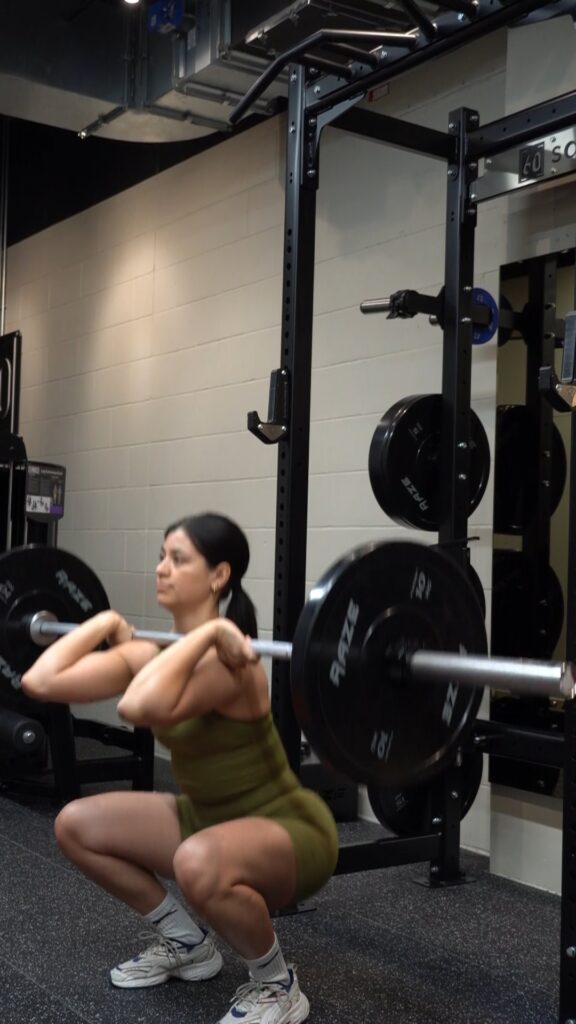
- Front squat: the bar rests on the front of your shoulders. You stay more upright, your quads do a bit more of the work, and your knees take less compressive force.
Choose the back squat if you want to lift the most weight. Choose the front squat if you want more quad focus, a more upright back, or a squat that may be easier on your knees. Many people do both.
Front Squat vs Back Squat at a Glance
| Front squat | Back squat | |
|---|---|---|
| Bar position | Front of your shoulders | Across your upper back |
| Torso angle | More upright | More forward lean |
| Extra emphasis | Quads | Hips and hamstrings |
| Weight lifted | Usually less | Usually more |
| Knee compressive force | Lower | Higher |
| Mobility needed | Wrists, shoulders, upper back and ankles | Shoulders and hips |
| Learning curve | Longer, mainly the rack position | Shorter |
What the Research Says
- Similar overall muscle work, less force on the knees. In a 2009 study by Gullett and colleagues, 15 healthy trained people did both squats. Overall muscle activity was similar. The back squat produced significantly higher compressive forces and extensor moments at the knee. The authors suggested the front squat may be useful for people with knee problems.
- More quad work and a more upright back in the front squat. In a 2015 study by Yavuz and colleagues, 12 young adults did both squats at their maximum loads. The front squat produced more activity in the vastus medialis, the inner quad muscle. The back squat produced more forward lean and more hamstring activity on the way up. Knee angles were similar.
Both studies were small. They suggest real differences, but both squats are effective leg exercises.
My view: if your back squat feels good, keep it as your main squat. Add front squats for variety and quad work, or use them as your main squat if you prefer an upright position.
How to Do a Front Squat
The front rack position

- Set the bar in a rack at about shoulder height.
- Step under the bar so it rests on the front of your shoulders, close to your neck.
- Hold the bar with your fingertips just outside your shoulders. You don’t need a full grip; the bar sits on your shoulders, not in your hands.
- Lift your elbows so your upper arms point forward.
If this position bothers your wrists, try crossing your arms over the bar, or loop lifting straps around the bar and hold those.
Movement
- Step back from the rack with your feet about shoulder width apart, toes turned out slightly.
- Brace your stomach and take a breath.
- Sit down between your heels, keeping your elbows up and your chest tall.
- Go as deep as you can while your heels stay down and your upper back stays upright.
- Drive up through your whole foot, leading with your elbows.
Coaching cues
- “Elbows up.”
- “Chest tall.”
- “Sit between your heels.”
- “Drive the floor away.”
For the back squat, see my guide to how to squat properly.
Prefer a kettlebell? Here is the kettlebell front squat from the 12REPS exercise library:
Common Front Squat Mistakes
- Elbows dropping. When your elbows fall, the bar rolls forward. Keep them up throughout.
- Gripping too hard. Let the bar rest on your shoulders, with a loose fingertip hold.
- Rounding your upper back. Keep your chest tall. Use a lighter weight if you lose your position.
- Heels lifting. Push through your whole foot. Small heel plates or lifting shoes can help if your ankles are stiff.
- Squatting too shallow. Read how deep should you squat.
And here is the barbell back squat for comparison:
Which Should You Choose?
- Choose the back squat if your goal is maximum strength or you are newer to barbell training.
- Choose the front squat if you want more quad work, find it easier to stay upright, or want a squat with lower knee compressive force.
- Use both for variety. For example, back squats early in the week and front squats later.
If you have a knee or back problem, speak to a doctor or physical therapist before changing your training. New to squatting? Start with the goblet squat, which uses a similar upright position.
Sets and Reps
These are general starting points, not fixed rules.
| Goal | Sets and reps | Rest |
|---|---|---|
| Leg muscle | 3 to 4 sets of 6 to 10 reps | 2 to 3 minutes |
| Strength | 3 to 5 sets of 3 to 6 reps | 2 to 4 minutes |
| Learning the front squat | 3 sets of 5 reps with a light bar | 2 minutes |
When you can do all your reps with good form, add a little weight. The American College of Sports Medicine recommends progressing gradually like this.
Summary
- Both squats build strong legs.
- The back squat lets you lift more and works your hips and hamstrings a bit more.
- The front squat keeps you more upright and works your quads a bit more.
- In one study, the back squat produced higher compressive forces at the knee.
- Keep your elbows up and chest tall in the front squat.
Get a Squat Plan That Fits You
Not sure which squat belongs in your program? 12REPS builds a strength program around your goal, schedule and equipment, with squat variations that suit your level.
Every exercise has a demo and a coach tutorial from me, and your log shows what you lifted last time, so you always know when to add weight.
Download 12REPS and see what you’ll get:
Sources
- Gullett JC, Tillman MD, Gutierrez GM, Chow JW. A biomechanical comparison of back and front squats in healthy trained individuals. J Strength Cond Res. 2009;23(1):284–292.
- Yavuz HU, Erdağ D, Amca AM, Aritan S. Kinematic and EMG activities during front and back squat variations in maximum loads. J Sports Sci. 2015;33(10):1058–1066.
- American College of Sports Medicine. Progression models in resistance training for healthy adults. Med Sci Sports Exerc. 2009;41(3):687–708.
Related Reading
- How to squat properly
- How deep should you squat?
- How to do a goblet squat
- Bulgarian split squats
- Why women should do barbell squats and deadlifts
I’m Will Duru, a personal trainer and the founder of 12REPS. I hold a BSc (Hons) in Sport and Exercise Science and have more than a decade of experience coaching people in strength training.
