

You eat loads. You train hard. But when you look in the mirror, nothing. The same skinny frame you’ve had for years. Arms that disappear in long sleeves. Chest that looks concave in t-shirts.
Meanwhile, you see other men building muscle seemingly effortlessly. Filling out shirts. Looking solid. You wonder: why does muscle building work for everyone else but not for you?
The truth: You’re not eating nearly as much as you think you are. Most skinny guys (hardgainers) drastically underestimate calorie intake whilst overestimating appetite. Combine insufficient calories with lack of progressive overload on key compound lifts, and muscle growth becomes impossible.
I’m Will Duru, a personal trainer with 10+ years’ experience in London. I’ve helped hundreds of skinny guys transform from 65kg and frail to 75 to 80kg and muscular.
What I’ve learned: Hardgainers need two things non-negotiably. First, genuine calorie surplus (typically 500 to 700 calories above maintenance, much higher than average). Second, systematic progressive overload on compound movements (squats, deadlifts, bench press, rows). Without both, muscle growth will not happen regardless of training frequency.
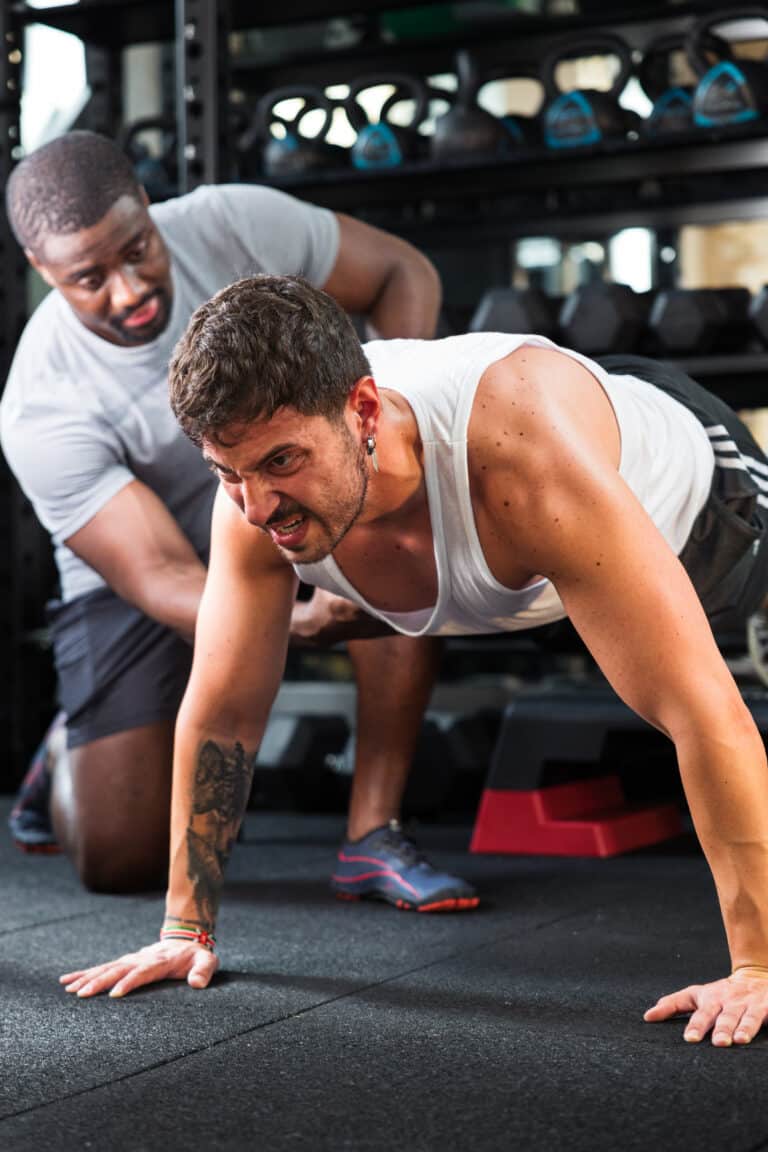
Why "Just Eat More" Advice Fails (The Real Problem)
The Hardgainer Metabolism Reality
What skinny guys experience: “I eat loads, I’m always eating, but I never gain weight.”
The scientific reality: Your maintenance calories are significantly higher than you think. A 70kg skinny guy might maintain weight at 2,800 to 3,200 calories daily (where 70kg average man maintains at 2,300 to 2,500 calories).
Why this happens: High non-exercise activity thermogenesis (NEAT). Your body unconsciously increases fidgeting, spontaneous movement, and heat production when you eat more. Research shows NEAT can vary by up to 700 calories daily between individuals.
What this means: You need to eat far more than generic calculators suggest. A 70kg hardgainer needing to bulk might require 3,500 to 3,800 calories daily where calculators predict 2,500 to 2,700.
Will’s hardgainer observation: “Client Alex insists he ‘eats loads, easily 3,000 calories.’ We track properly for 2 weeks: actually averaging 2,200 calories. Maintenance for his body is 2,700. He’s in 500 calorie deficit trying to bulk. We increase to genuine 3,200 calories daily. Eight months later: gained 9kg, mostly muscle.”
The Appetite and Satiety Problem
Why hardgainers struggle: Poor appetite (rarely feeling hungry), early satiety (feeling full quickly after eating), high stomach discomfort from large meals.
The genetic component: Smaller stomach capacity, faster gastric emptying, lower ghrelin (hunger hormone) production, higher leptin sensitivity (satiety hormone).
Why this makes bulking difficult: Forcing down 3,500 calories feels impossible when you’re full after 500 calorie meal. Most hardgainers give up because eating feels like a chore.
The solution: Calorie-dense foods (nuts, nut butters, oils, full-fat dairy, dried fruits), liquid calories (shakes, milk, smoothies), frequent smaller meals (6 to 7 times daily), appetite stimulation through training.
Will’s hardgainer feeding strategy: “Client struggles eating 3,000 calories in 3 meals. We split into 6 smaller meals of 500 to 600 calories each, add homemade mass gainer shake (milk, oats, banana, peanut butter, 800 calories). Suddenly 3,600 calories feels manageable. Weight starts climbing.
The Training Mistake (Random Workouts, No Progression)
What most skinny guys do: Go to gym, do random exercises, lift same weights month after month, wonder why muscle doesn’t grow.
Why this fails: No progressive overload equals no stimulus for growth. Your body has zero reason to build muscle if stimulus never increases.
What progressive overload means: Systematically increasing weight, reps, or sets over time. Week 1 you squat 60kg × 8 reps. Week 4 you squat 65kg × 8 reps. Week 8 you squat 70kg × 8 reps. This forces adaptation (muscle growth).
Will’s progressive overload rule: “Hardgainer client doing random exercises, same dumbbells for 6 months, zero muscle growth. We implement structured programme with progressive overload tracked every session. Twelve months: squat 40kg to 100kg, deadlift 60kg to 120kg, bench 40kg to 75kg, gained 11kg mostly muscle. Progression is everything.”
The Hardgainer Nutrition Formula
Step 1: Calculate Your TRUE Maintenance Calories
Standard formula: Bodyweight (kg) × 33 = maintenance calories
Hardgainer adjustment: Add 300 to 500 calories to this estimate.
Example for 70kg hardgainer:
- Standard estimate: 70kg × 33 = 2,310 calories
- Hardgainer reality: 2,310 + 400 = 2,710 calories actual maintenance
How to verify: Track weight and calories for 2 weeks. If weight stable eating 2,700 calories daily, that’s your maintenance. If weight dropping, maintenance is higher.
Will’s maintenance reality: “Most 70kg hardgainers maintain at 2,600 to 3,000 calories, not the 2,300 calculators predict. Client maintaining 72kg at 2,900 calories. We calculate surplus from there, not from generic formula.”
Step 2: Create Substantial Calorie Surplus
What hardgainers need: 500 to 700 calorie surplus daily (significantly more than average 300 to 400 surplus).
Why larger surplus: Your body is efficient at burning excess calories through increased NEAT. Modest 300 calorie surplus often gets completely negated by unconscious activity increases.
Target calories for 70kg hardgainer:
- Maintenance: 2,800 calories
- Bulk target: 2,800 + 600 = 3,400 calories daily
- Expected gain: 0.5 to 0.75kg weekly
Will’s surplus prescription: “Client creates 300 calorie surplus (2,900 to 3,200 daily), gains nothing in 4 weeks. We increase to 600 calorie surplus (3,400 daily), weight starts climbing 0.6kg weekly. Hardgainers need aggressive surplus.”
Step 3: Hit Protein Target Daily
What you need: 1.8 to 2.2g protein per kg bodyweight.
For 70kg hardgainer: 126 to 154g protein daily.
Protein sources: Chicken breast, turkey, lean beef, fish, eggs, Greek yoghurt, cottage cheese, protein powder.
Protein timing: 25 to 40g protein every 3 to 4 hours (5 to 6 meals daily).
Will’s protein requirement: “Every hardgainer needs minimum 1.8g per kg. Client eating 1.0g per kg gains fat, not muscle in surplus. Increase to 2.0g per kg, gains become predominantly muscle.”
Step 4: Emphasise Carbs for Energy and Growth
Carbohydrate needs: 4 to 6g per kg bodyweight (significantly higher than average).
For 70kg hardgainer: 280 to 420g carbs daily.
Why carbs matter: Fuel high-intensity training, replenish glycogen stores, spare protein for muscle building, easier to consume in large quantities than fat or protein.
Carb sources: Rice, pasta, potatoes, sweet potatoes, oats, bread, fruits, quinoa.
Will’s carb emphasis: “Hardgainers do well on high carb intake. Client eating 250g carbs at 3,400 calories, training energy poor. Increase to 400g carbs, training performance improves dramatically, progressive overload continues.”
Step 5: Use Calorie-Dense Foods and Liquid Calories
Calorie-dense foods: Nuts (600 calories per 100g), nut butters (600 calories per 100g), oils (900 calories per 100ml), full-fat dairy, dried fruits, dark chocolate.
Liquid calories: Homemade mass gainer shakes, whole milk, fruit smoothies, protein shakes with added carbs and fats.
Why this helps: Easier to consume 800 calorie shake than 800 calories solid food when appetite is poor.
Homemade mass gainer shake (850 calories):
- 500ml whole milk (330 calories)
- 80g oats (300 calories)
- 1 large banana (120 calories)
- 2 tablespoons peanut butter (190 calories)
- Blend, drink between meals
Will’s liquid calorie strategy: “Client struggles eating 3,500 calories solid food. We add two daily shakes (800 calories each). Total 3,600 calories becomes manageable. Weight climbs steadily 0.6kg weekly.”
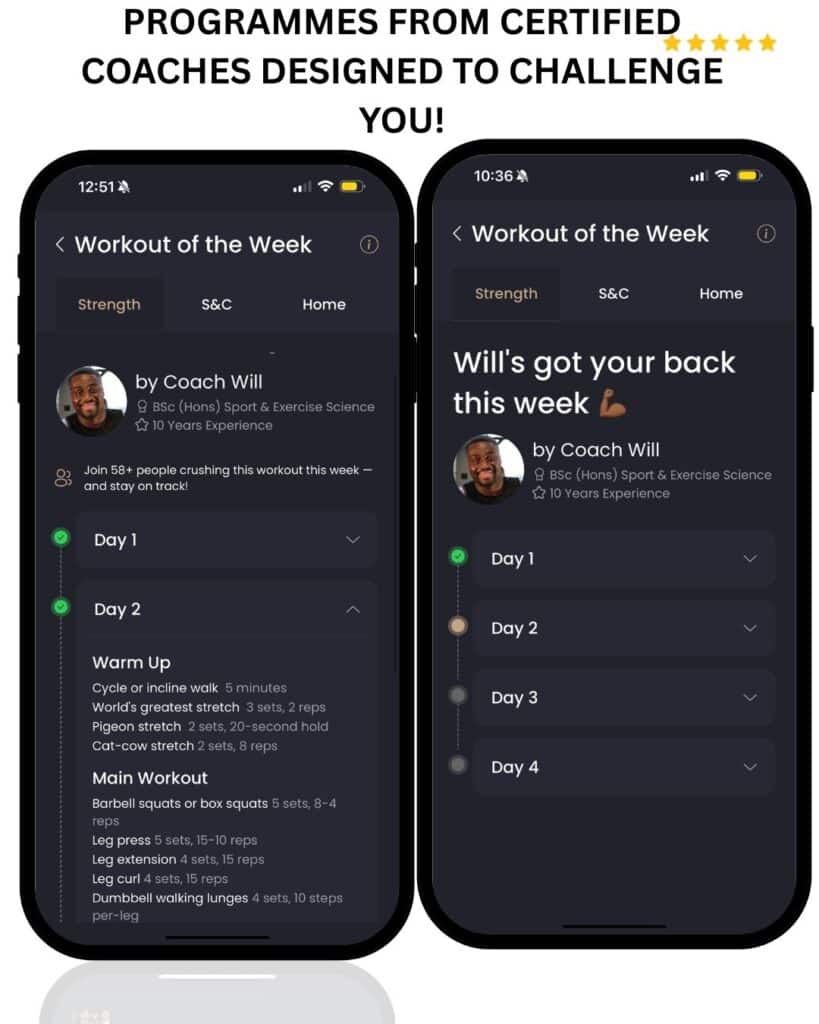
The Complete 3-Day Push/Pull/Legs Programme for Hardgainers
Programme Overview
Training frequency: 3 days weekly (Monday/Wednesday/Friday or Tuesday/Thursday/Saturday)
Why 3 days works: Adequate stimulus for growth, sufficient recovery between sessions, sustainable long term, perfect for beginners.
Rest days: Critical for muscle growth. Growth happens during recovery, not during training. Minimum 48 hours between sessions.
Progressive overload system: Increase weight when you hit top end of rep range for all sets. Example: If target is 8 to 10 reps, and you hit 10, 10, 10, increase weight 2.5 to 5kg next session.
COMPLETE 3-DAY PUSH/PULL/LEGS PROGRAMME
DAY 1: PUSH (Chest, Shoulders, Triceps)
| Exercise | Sets | Reps | Weight Progression | Rest Period |
|---|---|---|---|---|
| Barbell Bench Press | 4 | 6-8 | Start 50-60kg, add 2.5kg when hit 8,8,8,8 | 3 minutes |
| Incline Dumbbell Press | 3 | 8-10 | Start 16-20kg DBs, add 2kg per DB when hit 10,10,10 | 2.5 minutes |
| Machine/Dumbbell Shoulder Press | 3 | 8-10 | Start 12-16kg DBs or moderate machine weight | 2 minutes |
| TRX/Dip Station Dips | 3 | 6-12 | Bodyweight → add 5kg when hit 12,12,12 | 2 minutes |
| Kettlebell/Dumbbell Lateral Raises | 3 | 12-15 | Start 6-8kg, add 1-2kg when hit 15,15,15 | 90 seconds |
| Cable/Machine Tricep Extensions | 3 | 10-12 | Start light, add weight when hit 12,12,12 | 90 seconds |
Total: 19 sets
DAY 2: PULL (Back, Biceps, Rear Delts)
| Exercise | Sets | Reps | Weight Progression | Rest Period |
|---|---|---|---|---|
| Barbell/Trap Bar Deadlift | 4 | 5-8 | Start 60-80kg, add 2.5-5kg when hit 8,8,8,8 | 3-4 minutes |
| Barbell/Dumbbell Rows | 4 | 8-10 | Start 40-50kg BB or 16-20kg DBs, add 2.5kg | 2.5 minutes |
| Lat Pulldown/Pull-Ups | 3 | 8-10 | Start moderate weight or assisted pull-ups | 2 minutes |
| TRX/Cable Face Pulls | 3 | 12-15 | Bodyweight TRX or light cable weight | 90 seconds |
| Machine/Cable Straight-Arm Pulldown | 3 | 10-12 | Start light, focus on form | 90 seconds |
| Dumbbell/Barbell Bicep Curls | 3 | 10-12 | Start 10-12kg DBs, add 1-2kg when hit 12,12,12 | 90 seconds |
Total: 20 sets
DAY 3: LEGS (Quads, Glutes, Hamstrings, Calves)
| Exercise | Sets | Reps | Weight Progression | Rest Period |
|---|---|---|---|---|
| Barbell Back Squat/Leg Press | 4 | 6-10 | Start 40-60kg squat or moderate leg press | 3-4 minutes |
| Romanian Deadlift (BB/DB) | 3 | 8-10 | Start 40-50kg BB or 16-20kg DBs | 2.5 minutes |
| Dumbbell/Barbell Lunges | 3 | 10-12/leg | Start 12-16kg DBs or 20-30kg BB | 2 minutes |
| Leg Extension Machine | 3 | 12-15 | Start moderate, add weight when hit 15,15,15 | 90 seconds |
| Leg Curl Machine/KB Swings | 3 | 12-15 | Moderate machine or 12-16kg kettlebell | 90 seconds |
| Standing Calf Raises | 4 | 12-15 | Start bodyweight, progress to weighted | 60 seconds |
Total: 20 sets
Weekly Training Schedule Example
| Day | Workout | Rest Day |
|---|---|---|
| Monday | Push | |
| Tuesday | ✓ Rest | |
| Wednesday | Pull | |
| Thursday | ✓ Rest | |
| Friday | Legs | |
| Saturday | ✓ Rest | |
| Sunday | ✓ Rest |
Progressive Overload Tracking Example
Barbell Bench Press Progression (Weeks 1-12):
| Week | Weight | Reps (4 sets) | Action |
|---|---|---|---|
| 1 | 50kg | 8,7,6,6 | Continue same weight |
| 2 | 50kg | 8,8,7,7 | Continue same weight |
| 3 | 50kg | 8,8,8,8 | INCREASE WEIGHT |
| 4 | 52.5kg | 7,6,6,5 | Continue same weight |
| 5 | 52.5kg | 8,7,7,6 | Continue same weight |
| 6 | 52.5kg | 8,8,8,7 | Continue same weight |
| 7 | 52.5kg | 8,8,8,8 | INCREASE WEIGHT |
| 8 | 55kg | 7,7,6,6 | Continue same weight |
| 10 | 55kg | 8,8,8,8 | INCREASE WEIGHT |
| 12 | 57.5kg | 8,7,7,6 | Continue building |
This is progressive overload in action: 50kg → 57.5kg in 12 weeks whilst maintaining form and reps.
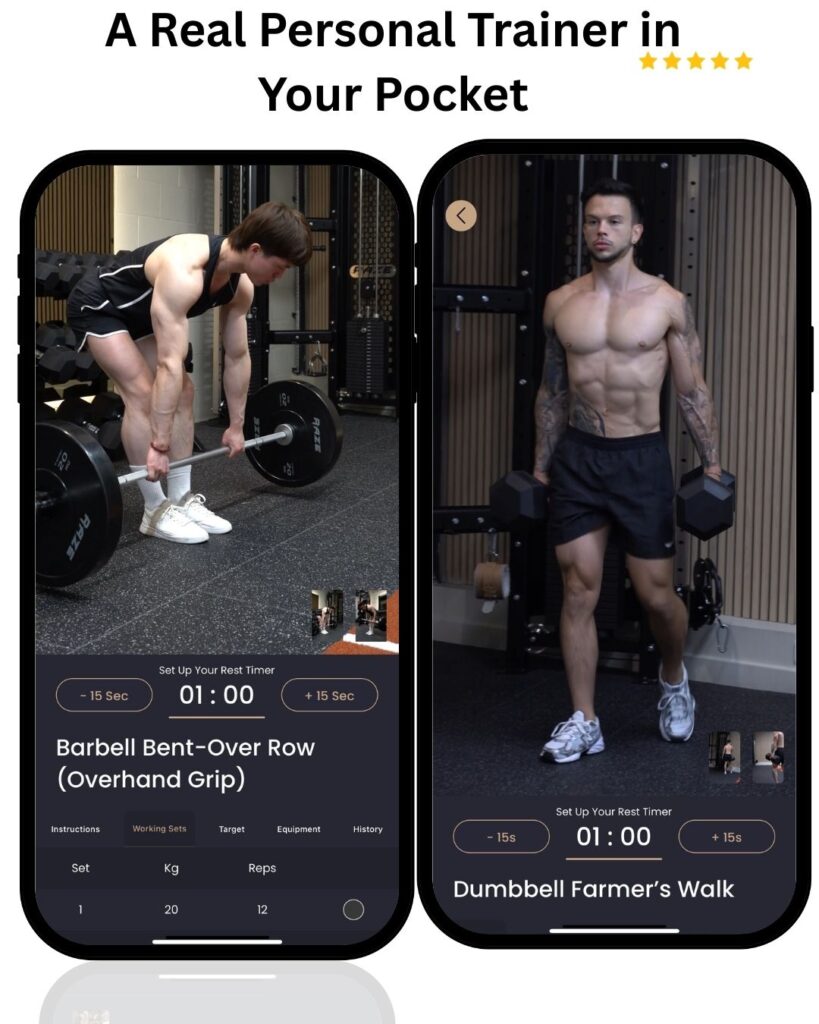
Workout 1: Push (Chest, Shoulders, Triceps)
1. Barbell Bench Press
- Sets: 4
- Reps: 6 to 8
- Rest: 3 minutes
- Equipment: Barbell, bench
- Progression: Increase 2.5kg when hitting 8, 8, 8, 8
Why first: Compound pressing movement, trains chest, shoulders, triceps simultaneously, allows heaviest weight, maximum muscle recruitment.
Will’s form cue: “Bar should touch lower chest (nipple line). Elbows at roughly 45 degrees from torso. Lower controlled (2 seconds), pause on chest, explosive press up. Progressive overload on bench builds massive upper body mass.”
2. Incline Dumbbell Press
- Sets: 3
- Reps: 8 to 10
- Rest: 2.5 minutes
- Equipment: Dumbbells, incline bench (30 to 40 degrees)
- Progression: Increase 2kg per dumbbell when hitting 10, 10, 10
Why second: Upper chest emphasis, dumbbells allow natural movement pattern, greater range of motion than barbell.
Will’s form cue: “Lower dumbbells until deep stretch in upper chest. Press up and slightly together at top. Don’t bang dumbbells together. Control throughout movement.”
3. Machine Shoulder Press or Dumbbell Shoulder Press
- Sets: 3
- Reps: 8 to 10
- Rest: 2 minutes
- Equipment: Machine or dumbbells
- Progression: Increase weight when hitting 10, 10, 10
Why third: Direct shoulder development, machine version safer for beginners, allows pushing to near failure without spotter.
Will’s form cue: “Press straight up, don’t lock elbows completely at top. Control negative slowly. Focus on shoulders doing work, not using leg drive excessively.”
4. TRX or Dip Station Dips (Chest Emphasis)
- Sets: 3
- Reps: 6 to 12 (bodyweight, progress to weighted)
- Rest: 2 minutes
- Equipment: TRX straps or dip bars
- Progression: Bodyweight × 12 reps → add 5kg weight belt
Why fourth: Lower chest emphasis, tricep development, bodyweight progression milestone.
Will’s form cue: “Lean forward 20 to 30 degrees (chest emphasis, not upright tricep emphasis). Lower until upper arms roughly parallel to floor. Explosive press up. When bodyweight becomes easy, add weight with belt or dumbbell between legs.”
5. Kettlebell or Dumbbell Lateral Raises
- Sets: 3
- Reps: 12 to 15
- Rest: 90 seconds
- Equipment: Kettlebells or dumbbells
- Progression: Increase 1 to 2kg when hitting 15, 15, 15
Why fifth: Isolation for side delts, creates width, high reps for metabolic stress.
Will’s form cue: “Slight bend in elbows, raise to shoulder height, lead with elbows not hands. Control negative slowly. This isn’t about heavy weight, it’s about feeling delts burn.”
6. Cable or Machine Tricep Extensions
- Sets: 3
- Reps: 10 to 12
- Rest: 90 seconds
- Equipment: Cable machine with rope or tricep extension machine
- Progression: Increase weight when hitting 12, 12, 12
Why last: Direct tricep work ensures complete arm development.
Will’s form cue: “Keep elbows stationary at sides. Extend fully at bottom, squeeze triceps. Slow controlled movement throughout.”
Total: 19 sets for push muscles
Workout 2: Pull (Back, Biceps, Rear Delts)
1. Barbell Deadlift or Trap Bar Deadlift
- Sets: 4
- Reps: 5 to 8
- Rest: 3 to 4 minutes
- Equipment: Barbell or trap bar
- Progression: Increase 2.5 to 5kg when hitting 8, 8, 8, 8
Why first: King of mass building exercises, trains entire posterior chain (back, glutes, hamstrings), releases most growth hormone and testosterone.
Will’s form cue: “Feet hip width, bar over midfoot. Hinge at hips, grip bar, chest up, shoulders over bar. Drive through floor, bar stays close to shins and thighs. Stand tall, squeeze glutes at top. Control negative. Deadlift builds more total muscle than any single exercise.”
2. Barbell or Dumbbell Rows
- Sets: 4
- Reps: 8 to 10
- Rest: 2.5 minutes
- Equipment: Barbell or dumbbells, bench (for dumbbell version)
- Progression: Increase 2.5kg when hitting 10, 10, 10, 10
Why second: Horizontal pulling, builds thickness in back, trains lats, traps, rhomboids.
Will’s form cue: “Barbell version: hinge forward 45 degrees, row to lower chest, elbows close to body. Dumbbell version: one knee on bench, row dumbbell to hip, elbow tight to body. Squeeze shoulder blades together at top.”
3. Lat Pulldown or Pull-Up Progression
- Sets: 3
- Reps: 8 to 10 (lat pulldown) or maximum reps (pull-ups)
- Rest: 2 minutes
- Equipment: Lat pulldown machine or pull-up bar
- Progression: Lat pulldown → increase weight. Pull-ups → bodyweight to weighted
Why third: Vertical pulling, builds width in lats, upper back development.
Will’s form cue: “Lat pulldown: pull bar to upper chest, elbows down and back, squeeze lats. Pull-ups: full range (chin over bar to arms fully extended), control negative. When you hit 10 bodyweight pull-ups, add weight.”
4. TRX or Cable Face Pulls
- Sets: 3
- Reps: 12 to 15
- Rest: 90 seconds
- Equipment: TRX straps or cable machine with rope
- Progression: TRX → harder angle. Cable → increase weight
Why fourth: Rear delt and upper back, shoulder health, posture improvement.
Will’s form cue: “TRX version: lean back, pull handles to face, elbows high. Cable version: rope to face, elbows flared out. Squeeze shoulder blades together.”
5. Machine or Cable Straight-Arm Pulldown
- Sets: 3
- Reps: 10 to 12
- Rest: 90 seconds
- Equipment: Cable machine or lat pulldown machine
- Progression: Increase weight when hitting 12, 12, 12
Why fifth: Lat isolation, helps learn to engage lats properly.
Will’s form cue: “Arms nearly straight, small elbow bend. Pull down to hips using lats, not arms. Control back up slowly. Feel lats stretch at top, squeeze at bottom.”
6. Dumbbell or Barbell Bicep Curls
- Sets: 3
- Reps: 10 to 12
- Rest: 90 seconds
- Equipment: Dumbbells or barbell
- Progression: Increase 1 to 2kg when hitting 12, 12, 12
Why last: Direct bicep work, arm development.
Will’s form cue: “Keep elbows stationary at sides. Curl weight up, squeeze biceps at top. Control negative (2 to 3 seconds). No swinging or momentum.”
Total: 20 sets for pull muscles
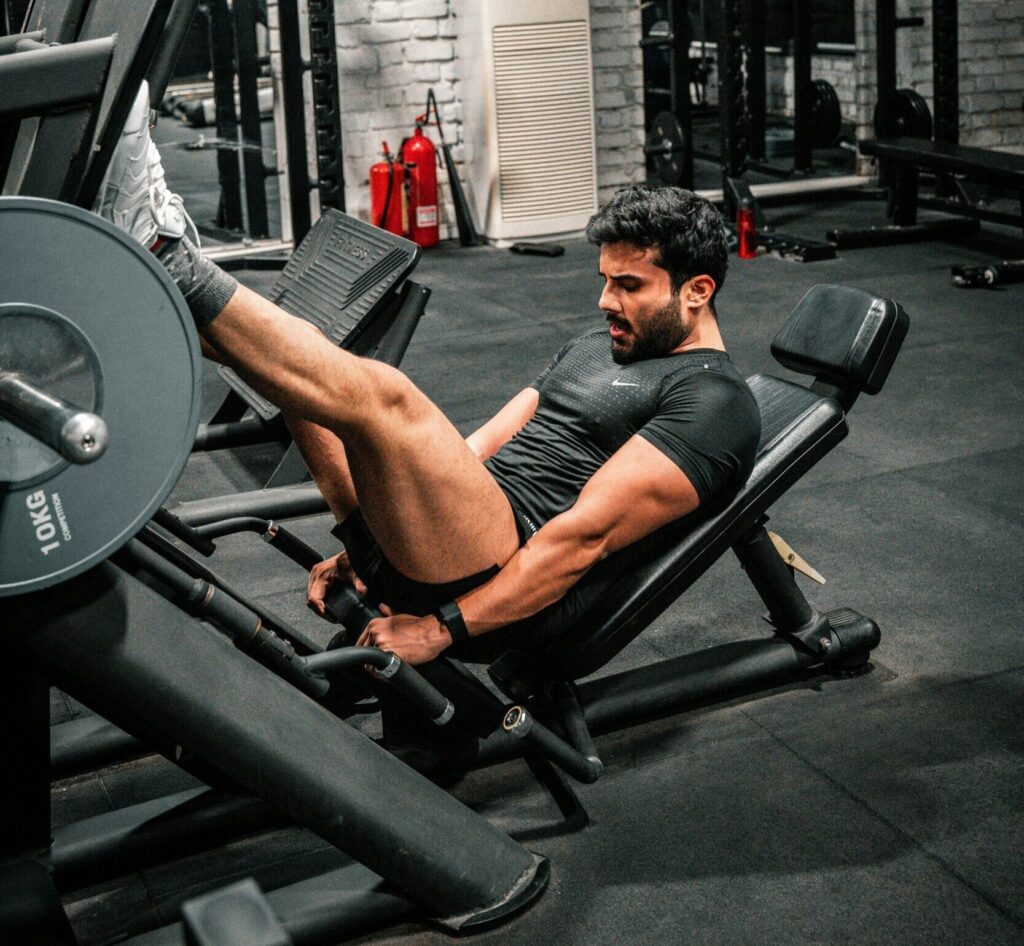
Workout 3: Legs (Quads, Glutes, Hamstrings, Calves)
1. Barbell Back Squat or Leg Press
- Sets: 4
- Reps: 6 to 10
- Rest: 3 to 4 minutes
- Equipment: Barbell, squat rack OR leg press machine
- Progression: Increase 5kg when hitting 10, 10, 10, 10
Why first: King of leg exercises, builds entire lower body, maximum muscle mass stimulus.
Will’s form cue: “Back squat: bar on upper traps, feet shoulder width, descend until thighs parallel to floor (or lower if mobility allows), drive up through heels. Leg press: feet shoulder width on platform, lower until knees at 90 degrees, press through midfoot. Squat progression builds massive legs.”
2. Romanian Deadlift (Barbell or Dumbbell)
- Sets: 3
- Reps: 8 to 10
- Rest: 2.5 minutes
- Equipment: Barbell or dumbbells
- Progression: Increase 2.5kg when hitting 10, 10, 10
Why second: Hamstring and glute emphasis, posterior chain development, complements squats.
Will’s form cue: “Slight knee bend, hinge at hips, lower weight down shins whilst keeping back flat. Feel hamstring stretch. Drive hips forward to stand, squeeze glutes at top. Don’t round lower back.”
3. Dumbbell or Barbell Lunges
- Sets: 3
- Reps: 10 to 12 per leg
- Rest: 2 minutes
- Equipment: Dumbbells or barbell
- Progression: Increase weight when hitting 12, 12, 12 each leg
Why third: Unilateral leg work, corrects imbalances, quad and glute development.
Will’s form cue: “Step forward into lunge, front thigh parallel to floor, back knee nearly touching floor. Push through front heel to return. Alternate legs. Keep torso upright throughout.”
4. Leg Extension Machine
- Sets: 3
- Reps: 12 to 15
- Rest: 90 seconds
- Equipment: Leg extension machine
- Progression: Increase weight when hitting 15, 15, 15
Why fourth: Quad isolation, safe way to push quads to failure without spine loading.
Will’s form cue: “Full range of motion, extend legs completely at top, squeeze quads. Control negative slowly (3 seconds). This is about quad pump, not ego lifting.”
5. Leg Curl Machine or Kettlebell Swings
- Sets: 3
- Reps: 12 to 15 (leg curl) or 15 to 20 (swings)
- Rest: 90 seconds
- Equipment: Leg curl machine OR kettlebell
- Progression: Increase weight (leg curl) or kettlebell weight (swings)
Why fifth: Hamstring isolation OR explosive posterior chain work.
Will’s form cue: “Leg curl: curl heels to glutes, squeeze hamstrings at top. Kettlebell swing: hinge at hips, swing kettlebell to shoulder height using hip thrust, not arms.”
6. Standing Calf Raises (Machine, Barbell, or Dumbbell)
- Sets: 4
- Reps: 12 to 15
- Rest: 60 seconds
- Equipment: Calf raise machine, barbell on shoulders, or dumbbells in hands
- Progression: Increase weight when hitting 15, 15, 15, 15
Why last: Calf development (often neglected), complete lower body training.
Will’s form cue: “Full range of motion: deep stretch at bottom, rise onto toes as high as possible, squeeze calves at top. Slow controlled movement.”
Total: 20 sets for leg muscles
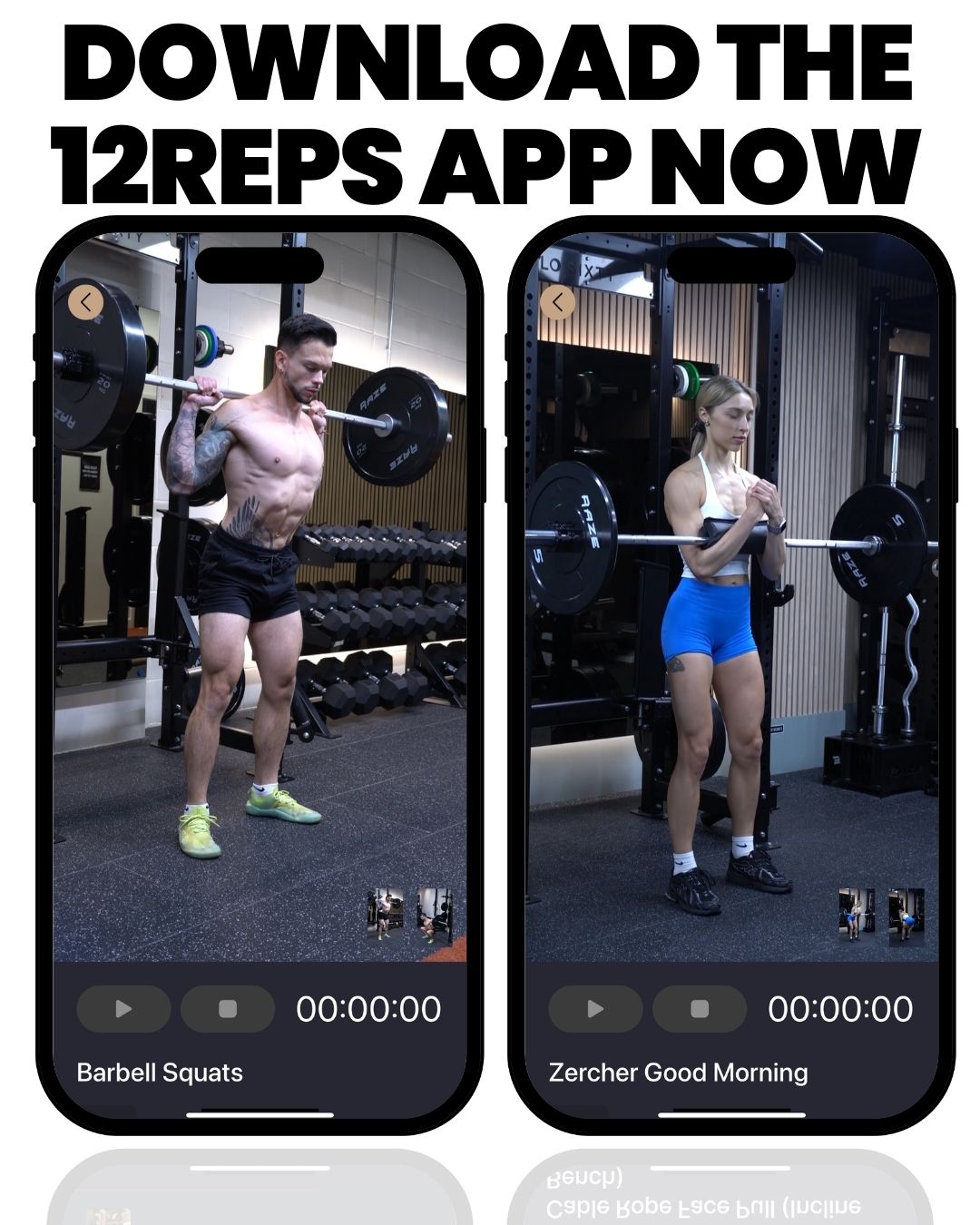
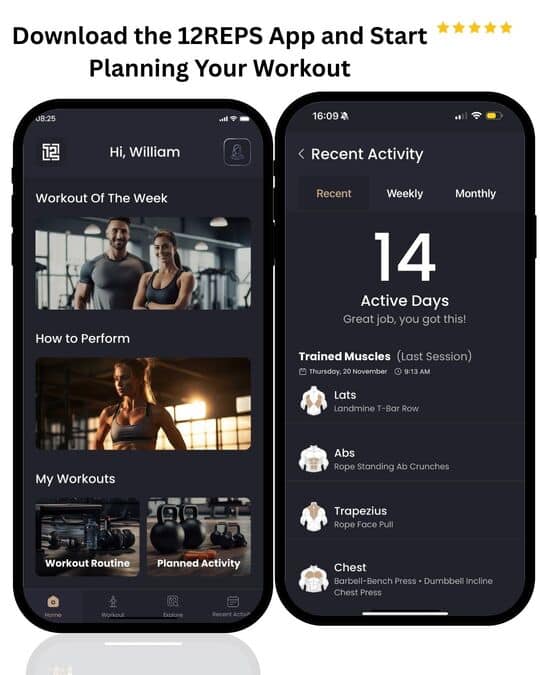
This Is Where 12REPS Solves The Execution Problem
The hardgainer challenge: executing structured training with consistent progressive overload.
Most skinny guys fail at muscle building because:
- They don’t have ready-to-execute workouts for gym equipment available
- They forget what weight they squatted or benched last session
- They have no system for when to increase weight
- They do random exercises without structure
12REPS eliminates every problem:
Solution 1: Instant Workout Generation for YOUR Equipment
What 12REPS does:
Answer questions (goal, equipment available), app generates complete push/pull/legs workouts instantly using YOUR available equipment.
How it works:
- Select “muscle building” goal
- Choose equipment: “Barbells, dumbbells, machines” OR “Dumbbells and bodyweight only” OR “Full gym access”
- Get instant workouts: Push day with bench press, incline dumbbell press, machine shoulder press, dips, lateral raises
If your gym has barbells and machines, app uses those. If you’re training at home with just dumbbells and kettlebells, app adapts all exercises to your equipment.
Will’s workout generation benefit: “Hardgainer client wastes time deciding exercises every session. 12REPS generates complete push/pull/legs programme. Barbell bench, incline dumbbell press, machine shoulder press. Execute it, track it, progress. No decision fatigue.”
Try 12REPS free for 7 days. Get instant push/pull/legs workouts generated for YOUR equipment. Stop wandering gym wondering what to do. Start structured training immediately.
Solution 2: Track Every Lift, Ensure Progressive Overload
What 12REPS provides:
Log every workout. App shows exactly what you lifted last session, what to aim for this session.
How tracking works:
- Last push session: Bench press 60kg × 8, 7, 6 reps
- Today’s target: Beat it (aim for 60kg × 8, 8, 7 or 8, 8, 8)
- Log actual: 60kg × 8, 8, 8 reps (progression achieved, increase to 62.5kg next session)
- App tracks everything: You see strength increasing weekly
Why tracking is critical for hardgainers: You cannot build muscle without progressive overload. Without tracking, you have no idea if you’re progressing. With 12REPS, you know exactly what to beat each session.
Will’s hardgainer tracking: “Client not tracking does random weights, bench stuck at 50kg for 5 months, zero muscle growth. We implement 12REPS tracking with systematic progression. Twelve months: bench 50kg to 85kg, squat 40kg to 100kg, gained 10kg mostly muscle. Tracking equals growth.”
Try 12REPS free for 7 days. Log bench press, squat, deadlift, rows. See your strength increasing weekly. Progressive overload guaranteed. This is how hardgainers build muscle.
Solution 3: 1,500+ Exercise Library With Perfect Form
What 12REPS provides:
Every exercise includes video demonstration. Bench press, squat, deadlift, rows, all with proper form shown.
Why form matters for hardgainers: Poor squat form builds no legs. Poor bench form builds no chest. Proper form on compound lifts maximises muscle stimulus.
Will’s form requirement: “Hardgainer client squatting with poor form (knees caving, not reaching depth), legs not growing. Watch 12REPS squat video, learn proper technique. Legs finally start developing.”
Your Hardgainer Muscle Building Timeline
Starting Point: 65kg Skinny Guy
Current state:
- Weight: 65kg
- Appearance: Very lean, minimal muscle, clothes hang off frame
- Strength: Bench 40kg, squat 50kg, deadlift 60kg
Target after 12 months: 75kg with visible muscle development
Nutrition requirements: 3,200 to 3,500 calories daily, 130 to 143g protein
Months 1 to 3: Foundation and Rapid Strength Gains
What’s happening:
- Learning to eat 3,200+ calories daily (feels impossible at first)
- Rapid strength gains (primarily neurological adaptation)
- Weight gain beginning (2 to 3kg gained)
Typical changes:
- Weight: 65kg to 68kg (3kg gain, roughly 2kg muscle + 1kg fat)
- Strength: Bench 40kg to 55kg, squat 50kg to 70kg, deadlift 60kg to 85kg
- Visual: Slightly less skinny, clothes fitting marginally better, no dramatic appearance change yet
Will’s months 1 to 3 reality: “Client Dan frustrated week 10: ‘Gained only 2kg, still look skinny.’ I explain nervous system adapting first, muscle growth accelerating soon. Strength up 30 to 40% already (bench 40kg to 55kg). Keep eating, keep training. Patience critical.”
Months 4 to 6: Visible Muscle Growth
What’s happening:
- Eating 3,200+ calories now habitual (no longer constant struggle)
- Actual muscle growth occurring (hypertrophy phase)
- Weight climbing steadily (3 to 4kg additional gain)
Typical changes:
- Weight: 68kg to 72kg (4kg gain, roughly 3kg muscle + 1kg fat)
- Strength: Bench 55kg to 70kg, squat 70kg to 90kg, deadlift 85kg to 110kg
- Visual: Colleagues notice. “You been working out?” Arms filling out shirts. Chest no longer concave. Still lean but visibly bigger.
Will’s months 4 to 6 transformation: “Same client Dan, month 6: 72kg from 65kg, arms went from 30cm to 33cm, chest from 90cm to 96cm. First time in life people comment he’s getting bigger. This is when hardgainers become believers.”
Months 7 to 12: Impressive Transformation
What’s happening:
- Total lifestyle habit (eating and training automatic)
- Continuous muscle growth
- Strength at impressive intermediate levels
Typical changes:
- Weight: 72kg to 76kg (4kg additional gain, roughly 3kg muscle + 1kg fat)
- Strength: Bench 70kg to 85kg, squat 90kg to 110kg, deadlift 110kg to 135kg
- Visual: Genuinely muscular appearance. Filled out t-shirts. 10kg gained from baseline, mostly muscle. People ask training routine.
Will’s year 1 hardgainer: “Client Dan, month 12: 76kg from 65kg. 11kg gained, roughly 8kg muscle and 3kg fat. Bench 40kg to 85kg, squat 50kg to 110kg, deadlift 60kg to 135kg. Complete transformation from skinny to muscular. Exactly what happens with proper nutrition and progressive overload.”
Common Hardgainer Mistakes (Avoid These)
Mistake 1: Not Actually Eating Enough
Why it’s the #1 problem: Hardgainers dramatically underestimate calorie intake. “I eat loads” usually means 2,000 to 2,500 calories when they need 3,200+.
The fix: Track everything for 2 weeks using MyFitnessPal. Weigh food, measure portions, include cooking oils. Actually verify you’re hitting 3,200+ calories daily.
Will’s tracking reality: “Nine out of ten hardgainer clients who ‘eat loads but can’t gain’ are eating 2,000 to 2,500 calories. We track properly, increase to genuine 3,200+, weight starts climbing immediately.”
Mistake 2: Doing Excessive Cardio
Why it’s terrible: Hardgainers burn calories easily already. Adding 4 to 5 cardio sessions weekly burns additional 1,500 to 2,000 calories, making surplus impossible to achieve.
The fix: Minimal cardio whilst bulking. Zero to two 20-minute sessions weekly maximum. Prioritise strength training, eat more to cover any cardio calories burned.
Will’s cardio prescription: “Hardgainer client doing 5 cardio sessions weekly, can’t gain weight despite eating 3,000 calories. Cardio burning 1,800 weekly, creating deficit. We eliminate cardio entirely during bulk. Weight starts climbing.”
Mistake 3: Not Following Progressive Overload
Why it fails: Lifting same weights month after month provides zero stimulus for muscle growth.
The fix: Track every workout with 12REPS. Systematically increase weight every 2 to 4 weeks. If bench press stuck at 60kg for 8 weeks, you’re doing it wrong.
Will’s progression requirement: “Hardgainer client benching 50kg for 6 months, wonders why no muscle growth. We implement systematic tracking and progression. Next 6 months: bench 50kg to 80kg, muscle growth obvious.”
Mistake 4: Doing Too Much Volume
Why it’s counterproductive: Hardgainers often have poor recovery capacity. Doing 6-day bodybuilder splits leads to overtraining, stalled progress, burnout.
The fix: Three full-body or push/pull/legs sessions weekly. Adequate rest between sessions. Growth happens during recovery.
Will’s volume guidance: “Client doing 6-day split, progress stalled, constantly fatigued. We reduce to 3-day push/pull/legs, adequate rest. Recovery improves, progressive overload continues, muscle growth resumes.”
The Bottom Line
Building muscle as hardgainer requires:
✅ Genuine calorie surplus (500 to 700 calories above TRUE maintenance, typically 3,200 to 3,800 calories for 70kg guy)
✅ High protein intake (1.8 to 2.2g per kg bodyweight daily)
✅ Emphasis on calorie-dense foods (nuts, nut butters, oils, liquid calories via shakes)
✅ Progressive overload on compound lifts (squat, deadlift, bench, rows increasing every 2 to 4 weeks)
✅ Structured 3-day programme (push/pull/legs with adequate rest)
✅ Minimal cardio (0 to 2 sessions weekly whilst bulking)
✅ Consistent tracking (nutrition via MyFitnessPal, training via 12REPS)
✅ Patience (realistic gain is 0.5 to 0.75kg weekly, 6 to 9kg muscle in year 1)
Will’s decade of hardgainer coaching:
✅ “Client Alex: tracked calories properly, actually eating 2,200 when thought 3,000. Increased to genuine 3,200, gained 9kg in 8 months mostly muscle”
✅ “Most 70kg hardgainers maintain at 2,600 to 3,000 calories, need 3,200 to 3,800 for growth. Much higher than calculators predict”
✅ “Client struggling eating 3,500 solid food. Added two daily shakes (800 calories each), total 3,600 manageable, weight climbed 0.6kg weekly”
✅ “Hardgainer needs 500 to 700 calorie surplus. Modest 300 surplus gets negated by increased NEAT. Be aggressive with surplus”
✅ “Client not tracking lifted random weights, bench stuck at 50kg for 5 months. Implemented 12REPS tracking, 6 months later bench 80kg, gained 10kg mostly muscle”
✅ “Client doing 5 cardio sessions weekly couldn’t gain despite eating 3,000 calories. Eliminated cardio, weight climbed immediately”
✅ “Client Dan year 1: 65kg to 76kg (11kg gained, 8kg muscle), bench 40kg to 85kg, squat 50kg to 110kg, deadlift 60kg to 135kg. Complete transformation”
✅ “Three-day push/pull/legs perfect for hardgainers. Adequate stimulus, sufficient recovery. Six-day splits cause overtraining”
Why 12REPS solves training execution:
✅ Instant push/pull/legs workouts (generated for YOUR equipment, no wandering gym)
✅ Track every lift (bench, squat, deadlift, rows), see strength increasing weekly
✅ Automatic progressive overload (app shows what to beat each session)
✅ 1,500+ exercise videos (perfect form on compound lifts)
✅ Equipment flexibility (barbells/dumbbells/kettlebells/machines/TRX)
Try 12REPS free for 7 days. Get structured push/pull/legs programme, track progressive overload on every compound lift, ensure systematic strength increases. Stop doing random workouts. Start building muscle with intelligent training.
For nutrition, use MyFitnessPal to track calories and verify you’re genuinely hitting 3,200+ daily. For training, use 12REPS to generate workouts and track progressive overload. Combine aggressive calorie surplus (nutrition) with systematic strength progression (training). Watch muscle growth happen over 12 months.
Stop saying “I eat loads but can’t gain.” Start tracking properly, verify actual intake, increase to genuine 3,200 to 3,800 calories daily. Execute push/pull/legs with progressive overload tracked via 12REPS. Gain 0.5 to 0.75kg weekly. Build 6 to 9kg muscle in year 1. Transform from skinny to muscular.
- Aragon, A.A., Schoenfeld, B.J., Wildman, R., et al. (2017). International Society of Sports Nutrition Position Stand: Diets and Body Composition. Journal of the International Society of Sports Nutrition, 14, 16. https://doi.org/10.1186/s12970-017-0174-y
- Morton, R.W., Murphy, K.T., McKellar, S.R., et al. (2018). A Systematic Review, Meta-Analysis and Meta-Regression of the Effect of Protein Supplementation on Resistance Training Induced Gains in Muscle Mass and Strength. British Journal of Sports Medicine, 52(6), 376-384. https://doi.org/10.1136/bjsports-2017-097608
- Schoenfeld, B.J., Grgic, J., Ogborn, D., et al. (2017). Strength and Hypertrophy Adaptations Between Low vs High Load Resistance Training. Journal of Strength and Conditioning Research, 31(12), 3508-3523. https://doi.org/10.1519/JSC.0000000000002200
- Rosenbaum, M., Leibel, R.L. (2010). Adaptive Thermogenesis in Humans. International Journal of Obesity, 34, S47-S55. https://doi.org/10.1038/ijo.2010.184