




By Will Duru, BSc (Hons) Sport and Exercise Science, Award-winning Personal Trainer with over 10 years of experience in strength training and optimising recovery
A 3-day strength training split for beginner men means three gym sessions a week: an upper body day, a lower body day and a full-body day. This 12-week plan runs in three 4-week phases. You learn the main lifts first, then add supersets and heavier weights as you get stronger.
As a personal trainer with over a decade of experience, I know the gym can feel confusing at first. A clear plan removes most of that. This one suits you if you are new to lifting and want to build muscle, lose some body fat, or both.
Below you will find why three days a week works, how to choose your starting weights, the full program and how to progress. Prefer to split your week by push, pull and legs instead? See our 3-day push pull legs program for men.

Why a 3-day split works for beginner men
Three sessions a week is enough to build real strength without taking over your life. The NHS recommends strengthening activities that work all the major muscle groups on at least 2 days a week. This plan gives you three.
The American College of Sports Medicine (ACSM) position stand suggests beginners train 2 to 3 days a week, with most sets in the 8 to 12 rep range. This plan sits inside that guidance.
Training on alternate days, for example Monday, Wednesday and Friday, also leaves a rest day after each session.
Upper, lower, full body: how the week works
The upper body day covers your chest, back, shoulders and arms. The lower body day covers your legs and glutes. The full-body day mixes both and adds core work. So most muscles get trained about twice a week.
How often you train a muscle matters less than many people think. A 2019 meta-analysis found that when total weekly sets were the same, training a muscle once or several times a week led to similar muscle growth. Pick the layout you can stick to. Our guide to upper/lower, push/pull/legs and full-body splits for beginners compares the options.
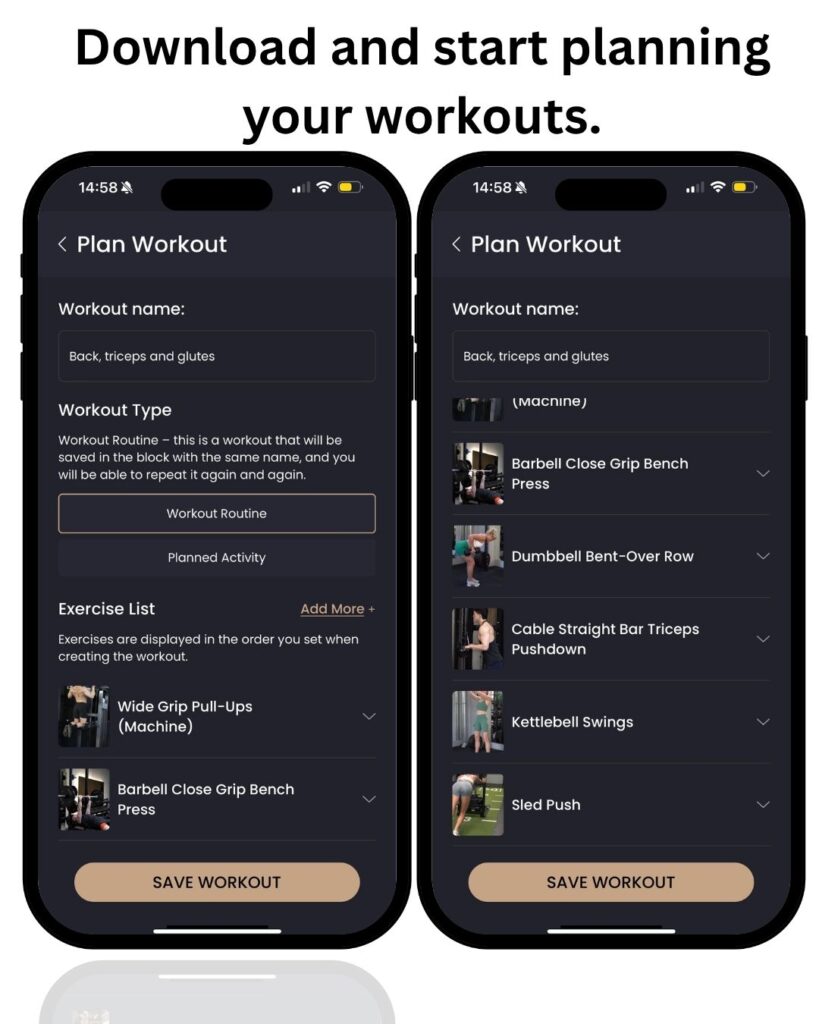
Your first weeks in the gym
The gym can feel intimidating when you are new. You see people lifting heavy weights, and it can feel like you do not belong. But every person in that gym started where you are now. Walk in with a plan and focus on your own session.
How to choose your starting weights
The ACSM suggests starting with moderate loads while you learn good form. In practice, pick a weight that lets you finish every working rep cleanly, with a couple of reps still in the tank.
- Warm-up set: light. It rehearses the movement before your working sets.
- Working sets: hard but controlled. The last two reps should feel like an effort.
- Form check: if your form breaks down, the weight is too heavy. Drop it and build back up.
The starting weights in the Phase 1 tables are a guide only. Start lighter if you need to.
Video: What every new gym beginner should know. Watch this before your first session. It covers the basics that make the first few weeks feel less overwhelming.
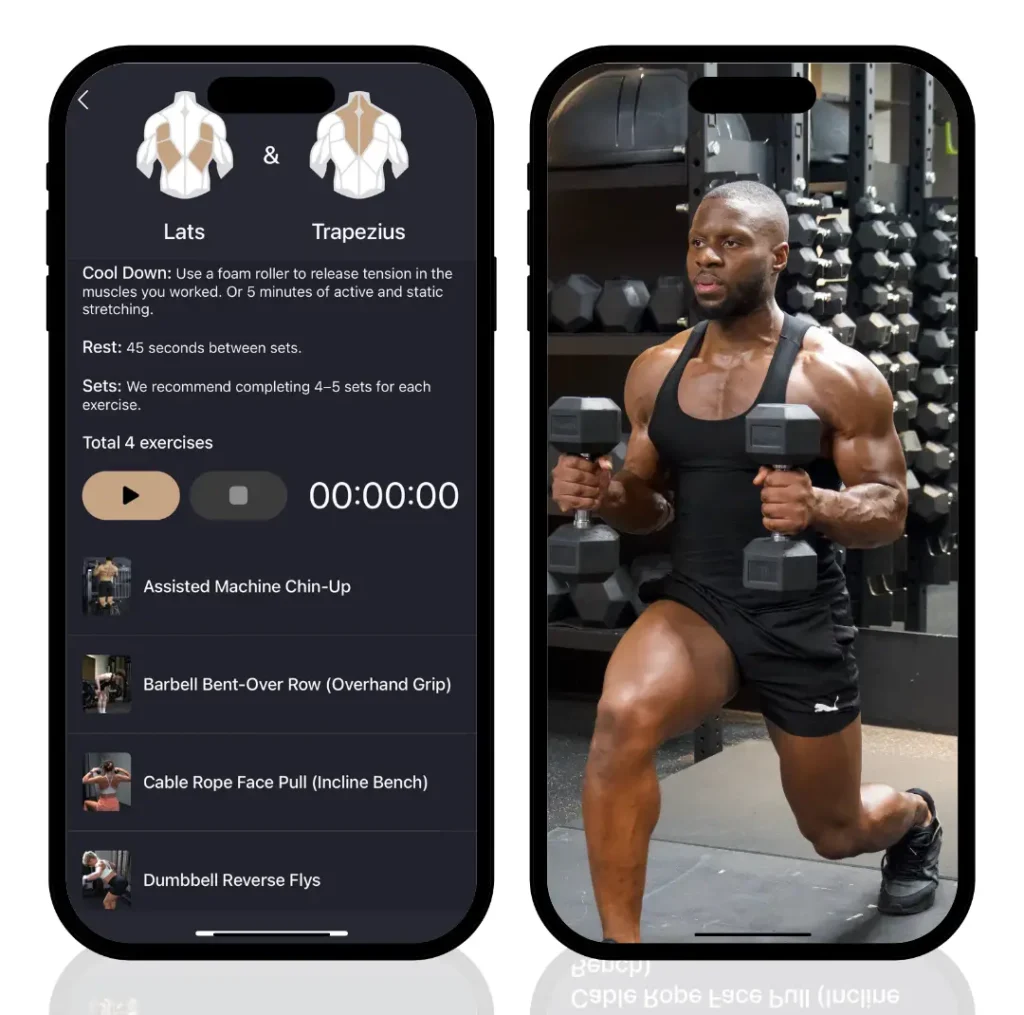
The 12-week 3-day split for beginner men
Train three days a week with at least one rest day after each session. Start every workout with a few minutes of light cardio, then do the warm-up set listed for each exercise.
How the 12 weeks are set out
- Phase 1, weeks 1 to 4 (foundation): 5 exercises per session. One warm-up set, then 4 working sets of each.
- Phase 2, weeks 5 to 8 (strength building): 4 main exercises plus two supersets. Working reps drop to 8 to 10 on most main lifts as the weights go up.
- Phase 3, weeks 9 to 12 (advanced strength and conditioning): heavier main lifts for 6 to 8 reps and harder supersets.
A superset means doing two exercises back to back with no rest between them. You rest after the second exercise. Supersets let you fit more work into the same session.
How to read the tables: “1 × 12-15” means one warm-up set of 12 to 15 reps. “4 × 10-12” means four working sets of 10 to 12 reps.
A sample training week
| Day | Session |
|---|---|
| Monday | Day 1: Upper body |
| Tuesday | Rest or a walk |
| Wednesday | Day 2: Lower body |
| Thursday | Rest or a walk |
| Friday | Day 3: Full body |
| Weekend | Rest |
Any three days work, as long as you leave a rest day after each session.
Phase 1: Foundation (weeks 1 to 4)
Phase 1 is about learning the lifts and building a routine. Each session has 5 exercises that cover all the major muscle groups.
Day 1: Upper body
| Exercise | Equipment | Warm-up set | Working sets | Weight | Rest |
|---|---|---|---|---|---|
| Smith Machine Bench Press | Smith Machine | 1 × 12-15 | 4 × 10-12 | Start with 30-40 kg | 90-120 seconds |
| Seated Cable Row | Machine | 1 × 12-15 | 4 × 10-12 | Light to moderate | 90-120 seconds |
| Dumbbell Shoulder Press | Dumbbells | 1 × 12-15 | 4 × 10-12 | Start with 8-12 kg | 60-90 seconds |
| Tricep Dips | Bodyweight | 1 × 8-10 | 4 × 8-12 | Bodyweight/Assisted | 60-90 seconds |
| Plank Hold | Bodyweight | 1 × 20-30 sec | 4 × 30-60 sec | Bodyweight | 60 seconds |
Day 2: Lower body
| Exercise | Equipment | Warm-up set | Working sets | Weight | Rest |
|---|---|---|---|---|---|
| Smith Machine Squat | Smith Machine | 1 × 12-15 | 4 × 10-12 | Start with 30-40 kg | 2-3 minutes |
| Romanian Deadlift | Dumbbells | 1 × 12-15 | 4 × 10-12 | Start with 12-16 kg | 2 minutes |
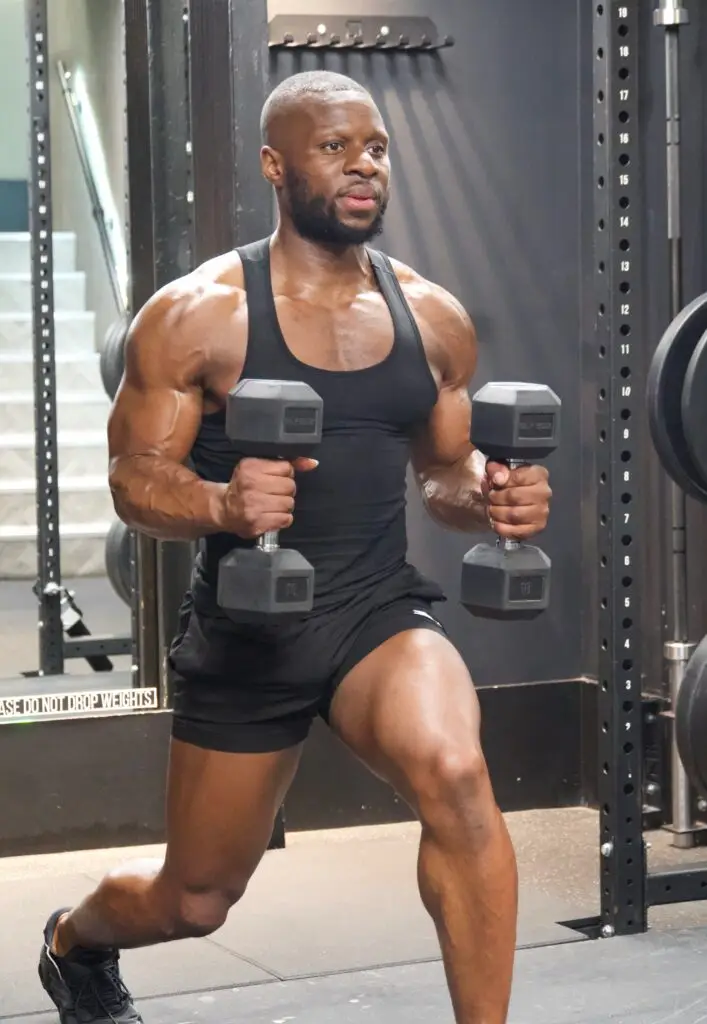
| Walking Lunges | Dumbbells | 1 × 8-10 each leg | 4 × 10 each leg | Start with 8-12 kg | 90 seconds |
| Hip Thrust | Bodyweight | 1 × 12-15 | 4 × 15-20 | Bodyweight | 60-90 seconds |
| Standing Calf Raises | Bodyweight | 1 × 12-15 | 4 × 15-20 | Bodyweight | 45-60 seconds |
Day 3: Full body
| Exercise | Equipment | Warm-up set | Working sets | Weight | Rest |
|---|---|---|---|---|---|
| Kettlebell Deadlift | Kettlebell | 1 × 12-15 | 4 × 10-12 | Start with 12-16 kg | 90-120 seconds |
| TRX Row | TRX | 1 × 8-10 | 4 × 10-12 | Bodyweight | 60-90 seconds |
| Dumbbell Squat to Press | Dumbbells | 1 × 10-12 | 4 × 10-12 | Start with 6-10 kg | 90 seconds |
| Push-ups | Bodyweight | 1 × 5-8 | 4 × 8-15 | Bodyweight/Modified | 60-90 seconds |
| Russian Twists | Bodyweight | 1 × 15-20 total | 4 × 20-30 total | Bodyweight | 60 seconds |
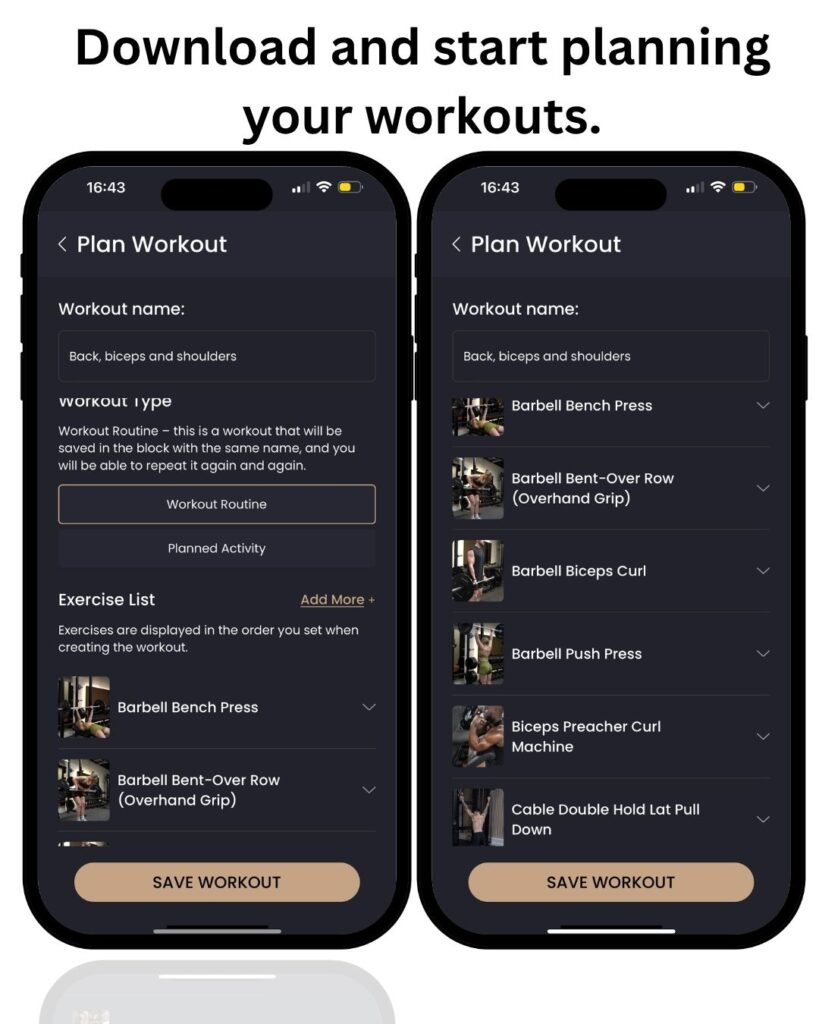
Learn the Smith machine squat first
The Smith machine squat is the main lower body lift in Phases 1 and 2. The bar runs on fixed rails, so you can focus on depth and control. Keep your whole foot on the floor and lower until your thighs are about parallel, or as deep as you can with a neutral back.
Video: Smith machine squats. See the foot position and how the bar travels before your first lower body day.
Phase 2: Strength building (weeks 5 to 8)
Phase 2 adds supersets. Each session has 4 main exercises followed by two supersets, so 8 exercises in total. Every exercise starts with one warm-up set. Weight increases are compared with what you used in Phase 1.
Day 1: Upper body
Main exercises
| Exercise | Equipment | Warm-up set | Working sets | Weight | Rest |
|---|---|---|---|---|---|
| Smith Machine Incline Press | Smith Machine | 1 × 10-12 | 4 × 8-10 | Increase by 5-10 kg | 2-3 minutes |
| Lat Pulldown | Machine | 1 × 10-12 | 4 × 8-10 | Progressive increase | 2 minutes |
| Dumbbell Shoulder Press | Dumbbells | 1 × 10-12 | 4 × 8-10 | Increase by 2-4 kg | 90 seconds |
| Assisted Pull-ups | Machine | 1 × 5-8 | 4 × 6-8 | Reduce assistance | 2 minutes |
Supersets
| Pair | Exercise | Equipment | Warm-up set | Working sets | Weight | Rest after |
|---|---|---|---|---|---|---|
| A1 | Dumbbell Flyes | Dumbbells | 1 × 12-15 | 3 × 12-15 | Moderate weight | No rest |
| A2 | Push-ups | Bodyweight | 1 × 8-10 | 3 × 10-15 | Bodyweight | 2 minutes |
| B1 | Lateral Raises | Dumbbells | 1 × 12-15 | 3 × 12-15 | Light-moderate weight | No rest |
| B2 | TRX Face Pulls | TRX | 1 × 10-12 | 3 × 12-15 | Bodyweight | 2 minutes |
Day 2: Lower body
Main exercises
| Exercise | Equipment | Warm-up set | Working sets | Weight | Rest |
|---|---|---|---|---|---|
| Smith Machine Squat | Smith Machine | 1 × 10-12 | 4 × 8-10 | Increase by 10-15 kg | 3 minutes |
| Romanian Deadlift | Dumbbells | 1 × 10-12 | 4 × 8-10 | Increase by 4-8 kg | 2-3 minutes |
| Bulgarian Split Squat | Dumbbells | 1 × 8-10 each leg | 4 × 8 each leg | Increase by 2-4 kg | 90 seconds |
| Hip Thrust with Weight | Dumbbell | 1 × 12-15 | 4 × 10-12 | Add 5-10 kg | 2 minutes |
Supersets
| Pair | Exercise | Equipment | Warm-up set | Working sets | Weight | Rest after |
|---|---|---|---|---|---|---|
| A1 | Jump Squats | Bodyweight | 1 × 8-10 | 3 × 10-12 | Bodyweight | No rest |
| A2 | Single Leg Glute Bridge | Bodyweight | 1 × 10-12 each leg | 3 × 12 each leg | Bodyweight | 2 minutes |
| B1 | Kettlebell Goblet Squat | Kettlebell | 1 × 12-15 | 3 × 15-20 | Moderate-heavy weight | No rest |
| B2 | Walking Calf Raises | Bodyweight | 1 × 15-20 | 3 × 20-25 | Bodyweight | 2 minutes |
Day 3: Full body
Main exercises
| Exercise | Equipment | Warm-up set | Working sets | Weight | Rest |
|---|---|---|---|---|---|
| Kettlebell Deadlift | Kettlebell | 1 × 10-12 | 4 × 8-10 | Increase by 4-8 kg | 3 minutes |
| Smith Machine Overhead Press | Smith Machine | 1 × 10-12 | 4 × 8-10 | Increase by 5-10 kg | 2-3 minutes |
| TRX Squat | TRX | 1 × 10-12 | 4 × 10-12 | Bodyweight | 90 seconds |
| Seated Cable Row | Machine | 1 × 10-12 | 4 × 8-10 | Increase weight | 2 minutes |
Supersets
| Pair | Exercise | Equipment | Warm-up set | Working sets | Weight | Rest after |
|---|---|---|---|---|---|---|
| A1 | Kettlebell Swing | Kettlebell | 1 × 15-20 | 3 × 20-25 | Moderate-heavy weight | No rest |
| A2 | Mountain Climbers | Bodyweight | 1 × 15-20 total | 3 × 20-30 total | Bodyweight | 2 minutes |
| B1 | Plank to Push-up | Bodyweight | 1 × 5-8 | 3 × 8-12 | Bodyweight | No rest |
| B2 | Bicycle Crunches | Bodyweight | 1 × 15-20 total | 3 × 20-30 total | Bodyweight | 2 minutes |
Phase 3: Advanced strength and conditioning (weeks 9 to 12)
The main lifts get heavier, with working sets of 6 to 8 reps on most of them. The supersets get harder too.
Some Phase 3 moves, such as pistol squats, man makers and Turkish get-ups, take practice. If one does not feel right yet, use the assisted version or keep the Phase 2 exercise in that slot for now.
Day 1: Upper body
Main exercises
| Exercise | Equipment | Warm-up set | Working sets | Weight | Rest |
|---|---|---|---|---|---|
| Smith Machine Bench Press | Smith Machine | 1 × 8-10 | 4 × 6-8 | Heavy load (75-80% effort) | 3 minutes |
| Wide-Grip Pull-ups | Bodyweight/Machine | 1 × 3-5 | 4 × 5-8 | Add weight if possible | 3 minutes |
| Smith Machine Overhead Press | Smith Machine | 1 × 8-10 | 4 × 6-8 | Heavy load | 2-3 minutes |
| T-Bar Row | Machine | 1 × 8-10 | 4 × 6-8 | Heavy load | 2-3 minutes |
Supersets
| Pair | Exercise | Equipment | Warm-up set | Working sets | Weight | Rest after |
|---|---|---|---|---|---|---|
| A1 | Diamond Push-ups | Bodyweight | 1 × 5-8 | 3 × 8-12 | Bodyweight | No rest |
| A2 | TRX Tricep Press | TRX | 1 × 8-10 | 3 × 10-12 | Bodyweight | 2-3 minutes |
| B1 | Dumbbell Pullovers | Dumbbells | 1 × 10-12 | 3 × 10-12 | Moderate-heavy weight | No rest |
| B2 | Pike Push-ups | Bodyweight | 1 × 5-8 | 3 × 8-12 | Bodyweight | 2-3 minutes |
Day 2: Lower body
Main exercises
| Exercise | Equipment | Warm-up set | Working sets | Weight | Rest |
|---|---|---|---|---|---|
| Smith Machine Front Squat | Smith Machine | 1 × 8-10 | 4 × 6-8 | Heavy load (75-80% effort) | 3 minutes |
| Sumo Deadlift | Dumbbells | 1 × 8-10 | 4 × 6-8 | Heavy load | 3 minutes |
| Single Leg RDL | Dumbbells | 1 × 8-10 each leg | 4 × 6 each leg | Moderate-heavy weight | 2 minutes |
| Hip Thrust with Weight | Dumbbell | 1 × 10-12 | 4 × 8-10 | Heavy load | 2-3 minutes |
Supersets
| Pair | Exercise | Equipment | Warm-up set | Working sets | Weight | Rest after |
|---|---|---|---|---|---|---|
| A1 | Pistol Squats | Bodyweight | 1 × 3-5 each leg | 3 × 5 each leg | Bodyweight/Assisted | No rest |
| A2 | Jump Lunges | Bodyweight | 1 × 10-12 total | 3 × 12-16 total | Bodyweight | 2-3 minutes |
| B1 | Kettlebell Swings | Kettlebell | 1 × 20-25 | 3 × 25-30 | Heavy weight | No rest |
| B2 | Single Leg Calf Raise | Bodyweight | 1 × 12-15 each leg | 3 × 15 each leg | Bodyweight | 2-3 minutes |
Day 3: Full body
Main exercises
| Exercise | Equipment | Warm-up set | Working sets | Weight | Rest |
|---|---|---|---|---|---|
| Thrusters | Dumbbells | 1 × 10-12 | 4 × 8-10 | Moderate-heavy load | 3 minutes |
| Man Makers | Dumbbells | 1 × 5-6 | 4 × 6-8 | Moderate weight | 3 minutes |
| TRX Pistol Squat | TRX | 1 × 5-8 each leg | 4 × 6 each leg | Bodyweight | 2-3 minutes |
| Renegade Rows | Dumbbells | 1 × 6-8 | 4 × 8-10 | Moderate-heavy weight | 2-3 minutes |
Supersets
| Pair | Exercise | Equipment | Warm-up set | Working sets | Weight | Rest after |
|---|---|---|---|---|---|---|
| A1 | Burpee Box Step-ups | Bodyweight | 1 × 8-10 total | 3 × 10-12 total | Bodyweight | No rest |
| A2 | Plank Jacks | Bodyweight | 1 × 15-20 total | 3 × 20-30 total | Bodyweight | 2-3 minutes |
| B1 | Turkish Get-up | Kettlebell | 1 × 2-3 each side | 3 × 3 each side | Moderate weight | No rest |
| B2 | Bear Crawl | Bodyweight | 1 × 15-20 steps | 3 × 20-30 steps | Bodyweight | 2-3 minutes |
How to progress week to week
Progressive overload means gradually asking more of your muscles over time. You can add weight, reps or sets. Change one thing at a time.
The ACSM position stand suggests raising the load by 2 to 10% once you can do 1 to 2 reps more than your target on two sessions in a row. Use the smaller jump for small-muscle lifts like lateral raises, and the bigger jump for squats and presses.
Write down every set so you know what to beat next time. Our beginner’s guide to progressive overload explains this in more detail.
Food and recovery basics
Protein supports the muscle you build in training. A 2018 meta-analysis found that extra protein stopped adding to training gains at about 1.6 g per kg of body weight a day. For an 80 kg man, that is about 130 g a day, spread across your meals.
You do not always have to choose between building muscle and losing fat. A 2020 review found that body recomposition, gaining muscle while losing fat, happens even in trained lifters, not only in beginners. Train hard, eat enough protein and keep calories sensible. Our guide to how many calories to eat to build muscle and lose fat helps you set a target.
Using 12REPS with this plan
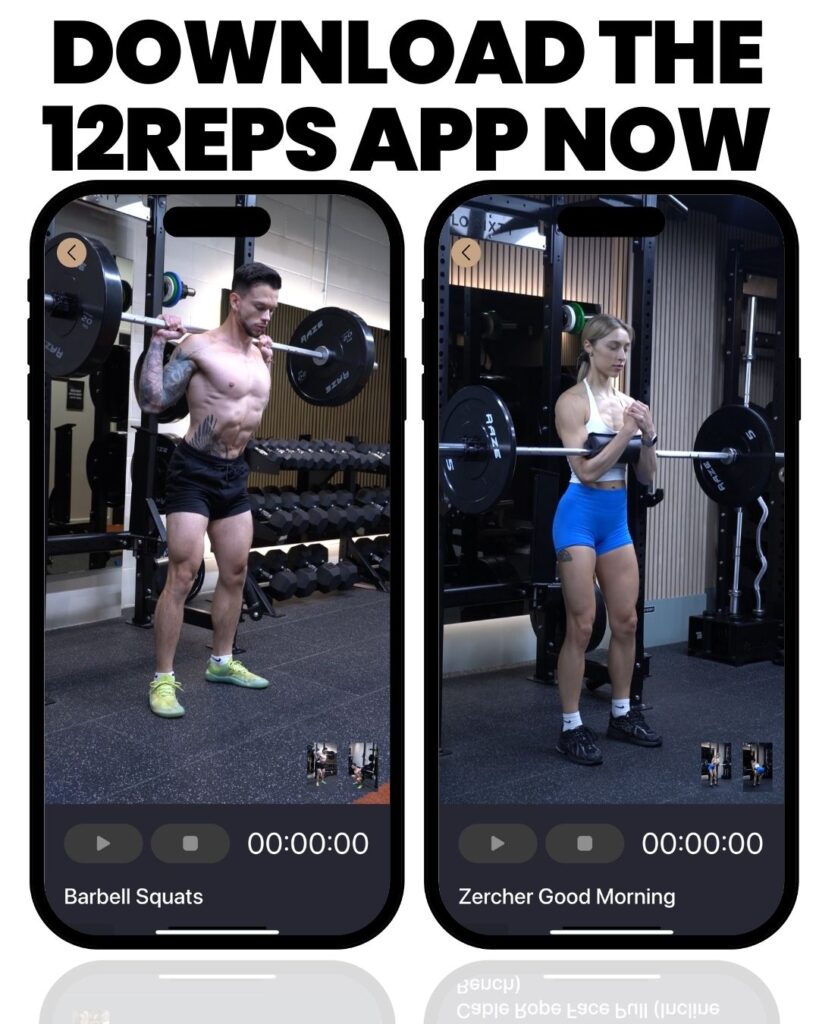
You can follow this plan with a notebook. An app makes logging faster. In the 12REPS app, you start your workout, watch a trainer demonstration, then enter your reps and weight for each set.
- Demonstrations: exercise demos and technique breakdowns from qualified personal trainers.
- Tracking: the app remembers what you lifted, so you always have a number to beat.
- Accountability: it tracks your workouts, streaks and weekly goal.
Form always comes before load, especially while you are building your foundation. If you are unsure about a lift, watch the demo again before your next set.
What to expect after 12 weeks
Expect the weights in your log to go up steadily, often fastest in Phase 1 while you learn the lifts. Changes in the mirror take longer. Judge your progress by your logbook first.
Every expert was once a beginner. The difference between people who make progress and people who do not is rarely talent. It is consistency and the willingness to start.
When you finish, you can repeat Phase 3 with heavier weights or move to a new split. Our comparison of 3-day and 5-day workout splits can help you decide what comes next.
Want a plan built around your goal, your equipment and your time? The 12REPS app sets out each session and shows a trainer demonstration for every exercise.
Sources
- Physical activity guidelines for adults aged 19 to 64. NHS, 2024. https://www.nhs.uk/live-well/exercise/physical-activity-guidelines-for-adults-aged-19-to-64/
- Progression models in resistance training for healthy adults (position stand). American College of Sports Medicine, Medicine & Science in Sports & Exercise, 2009. https://pubmed.ncbi.nlm.nih.gov/19204579/
- How many times per week should a muscle be trained to maximize muscle hypertrophy? A systematic review and meta-analysis. Schoenfeld BJ, Grgic J, Krieger J. Journal of Sports Sciences, 2019. https://doi.org/10.1080/02640414.2018.1555906
- A systematic review, meta-analysis and meta-regression of the effect of protein supplementation on resistance training-induced gains in muscle mass and strength in healthy adults. Morton RW et al. British Journal of Sports Medicine, 2018. https://pubmed.ncbi.nlm.nih.gov/28698222/
- Body recomposition: can trained individuals build muscle and lose fat at the same time?. Barakat C et al. Strength and Conditioning Journal, 2020. https://doi.org/10.1519/SSC.0000000000000584
