




By Will Duru, personal trainer and founder of 12REPS.
The Short Answer
Swiss balls (also called stability balls or exercise balls) are worth using for some exercises, but not for everything. They’re great for hamstring curls, core work and bodyweight glute exercises, especially at home.
For building strength and muscle with heavy weights, stable exercises on the floor or a bench are better. Research shows you produce much less force on an unstable surface, so you can’t lift as much.
What the Research Says About Stability Balls
- Less force on an unstable surface. In a 2004 study by Anderson and Behm, chest press force was about 60% lower on an unstable surface than on a stable one, even though muscle activity stayed similar. Earlier work from the same lab found leg extension force dropped by about 70% under very unstable conditions, as summarized in a later review presentation by Behm.
- More core activation. Unstable exercises increase activity in your core muscles compared with the same exercise on a stable surface.
- Free weights on the ground are better for strength. The Canadian Society for Exercise Physiology position stand (Behm and colleagues, 2010) recommends ground-based free-weight lifts, like squats and deadlifts, for strength and core training in athletes. It says instability devices are useful for rehabilitation, general fitness and people without access to free weights.
The CSEP summary sums it up well: instability training shouldn’t be the be-all and end-all, but it can be part of a balanced program.
When Swiss Ball Exercises Make Sense
| Good use | Less useful |
|---|---|
| Hamstring curls and glute bridges at home | Heavy chest presses or shoulder presses |
| Core exercises like planks and pike-ups | Standing on the ball (risky and not effective) |
| Beginners learning to squat (ball against a wall) | Replacing your main lifts when you have a gym |
| Rehab and gentle back exercises | Building maximum strength |
6 Swiss Ball Exercises Worth Doing
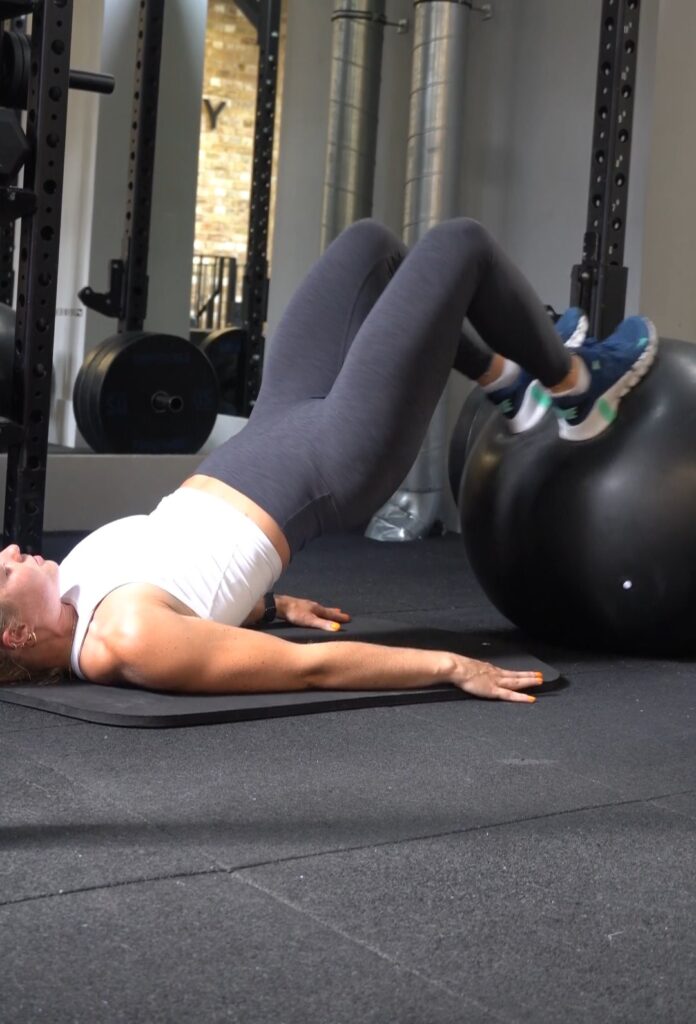
1. Swiss Ball Hamstring Curl
2–3 sets x 8–15 reps
- Lie on your back with your heels on the ball and your arms on the floor.
- Lift your hips so your body forms a straight line.
- Pull the ball toward you by bending your knees, keeping your hips up, then roll it back out slowly.
- See also seated vs lying leg curl and Nordic hamstring curls.
2. Swiss Ball Plank
3 sets x 20–45 seconds
- Rest your forearms on the ball with your feet on the floor behind you.
- Keep your body in a straight line and brace your midsection.
- For more challenge, make small circles with your forearms. See how to do a plank properly.
3. Swiss Ball Pike-Up
2–3 sets x 6–10 reps
- Start in a push-up position with your shins on the ball.
- Lift your hips toward the ceiling, rolling the ball toward your hands.
- Lower back to the start under control. This is an advanced move, so master the plank first.
4. Swiss Ball Hip Thrust
3 sets x 10–15 reps
- Rest your upper back on the ball with your feet flat on the floor.
- Lower your hips, then drive them up until your body is level from shoulders to knees.
- Squeeze your glutes at the top. See glute bridge vs hip thrust.
5. Swiss Ball Back Extension
2–3 sets x 10–15 reps
- Lie face down with the ball under your hips and your feet against a wall or wide apart.
- Lower your chest around the ball, then lift until your body is in a straight line.
- Don’t arch past straight.
6. Swiss Ball Wall Squat
3 sets x 10–15 reps
- Place the ball between your lower back and a wall, holding a dumbbell at your chest.
- Walk your feet slightly forward and squat down, letting the ball roll with you.
- Push through your feet to stand. The ball helps beginners learn depth and posture.

What About Pressing on a Swiss Ball?

You can do dumbbell chest presses with your upper back on a ball. It works your core and hips as you stay in position, but you’ll lift noticeably less weight than on a bench. I use it as a variation or for home workouts, not as a replacement for bench pressing when the goal is a bigger, stronger chest. See dumbbell vs barbell bench press.
Safety Tips
- Choose the right size. When you sit on the ball, your hips and knees should be at about 90 degrees.
- Inflate it properly and check it for damage. Use an anti-burst ball rated for your weight plus any dumbbells.
- Never stand on it. The risk of a fall outweighs any benefit.
- Keep heavy weights off the ball. Use moderate dumbbells you can control.
- Clear the space around you in case the ball rolls away.
Summary
- Swiss balls are best for hamstring curls, core work and bodyweight glute exercises.
- Research shows you produce much less force on an unstable surface, so they’re not ideal for heavy strength training.
- Ground-based free weights are better for building maximum strength.
- Use the ball as a useful extra, especially for home workouts or rehab.
Train at Home or in the Gym With 12REPS
Got a Swiss ball and a few dumbbells at home? In 12REPS, pick your workout time and the equipment you have, and the app builds a session that fits.
Every exercise has a demo and a coach tutorial from me, and your log shows what you did last time, so you know when to make each exercise harder.
Download 12REPS and see what you’ll get:
Sources
- Anderson KG, Behm DG. Maintenance of EMG activity and loss of force output with instability. J Strength Cond Res. 2004;18(3):637–640.
- Behm DG, Drinkwater EJ, Willardson JM, Cowley PM. Canadian Society for Exercise Physiology position stand: the use of instability to train the core in athletic and nonathletic conditioning. Appl Physiol Nutr Metab. 2010;35(1):109–112.
- Fowles JR. What I always wanted to know about instability training. Appl Physiol Nutr Metab. 2010;35:89–90.
- Behm DG. Instability resistance training (presentation, Rome 2012).
Related Reading
- Seated vs lying leg curl
- Glute bridge vs hip thrust
- How to do a plank properly
- Build a strong core: a beginner’s guide
- Home workout plan: build muscle without a gym
I’m Will Duru, a personal trainer and the founder of 12REPS. I hold a BSc (Hons) in Sport and Exercise Science and have more than a decade of experience coaching people in strength training.
