

By Will Duru, BSc (Hons) Sport and Exercise Science, Award-winning Personal Trainer with over 10 years of experience in strength training and optimising recovery
This home dumbbell upper body workout trains your chest, back, shoulders, biceps and triceps with five exercises and a pair of dumbbells. You do not need a gym or a bench, just some floor space. The workout should take under 40 minutes, depending on how long you rest.

Why dumbbells still work
You do not need a full gym to get stronger. A 2023 meta-analysis found no overall difference between free weights and machines for strength or muscle growth (Haugen and colleagues, 2023). The American College of Sports Medicine’s 2026 guidance says home routines can bring meaningful gains too (ACSM, 2026).
Dumbbells let each arm move on its own path, so you can work through a comfortable range of motion. At home you also skip the wait for equipment. All you need is your dumbbells, some floor space and a plan.

What if your dumbbells are light?
Many home lifters only have one or two pairs of dumbbells. That can still work. A meta-analysis found that muscle growth was similar across a wide range of loads, from light to heavy. Heavier loads were better for building maximal strength (Schoenfeld and colleagues, 2017).
So if your dumbbells feel light, take each set close to the point where you could not do another good rep. You can also slow down the lowering part of each rep to make it harder.
The NHS advises adults to do strengthening activities on at least 2 days a week that work all the major muscle groups (NHS). Pair this upper body session with a lower body or full home workout plan to cover the rest.
How 12REPS helps with this workout
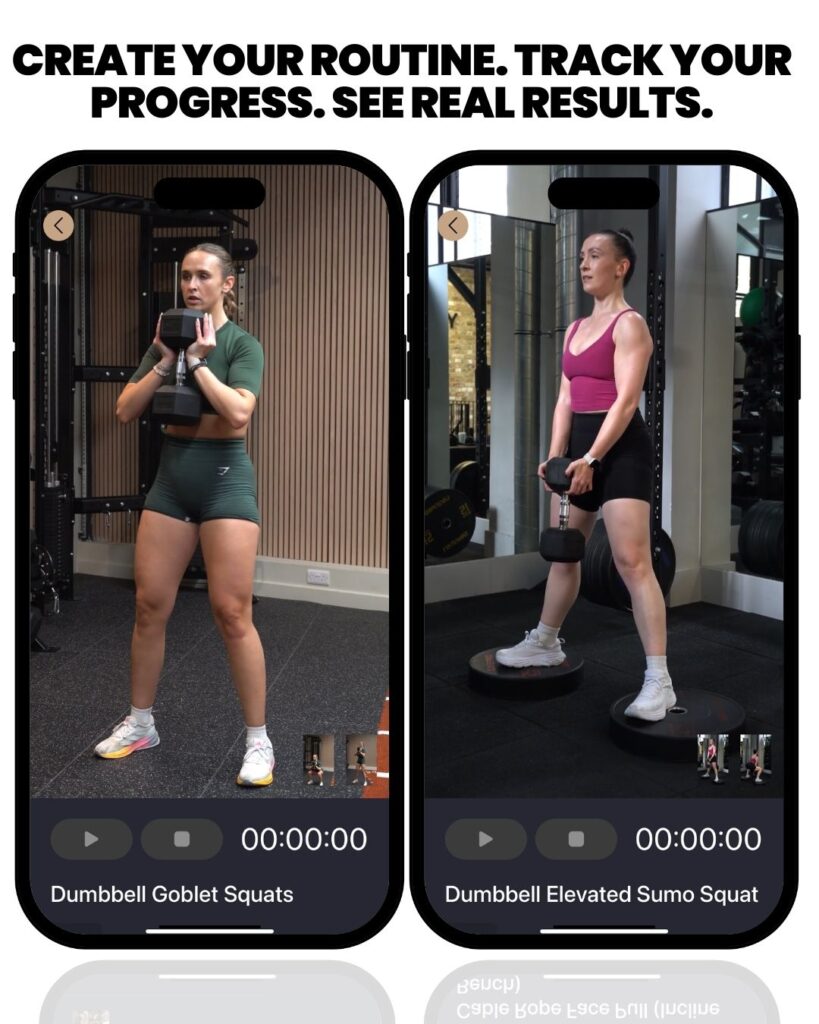
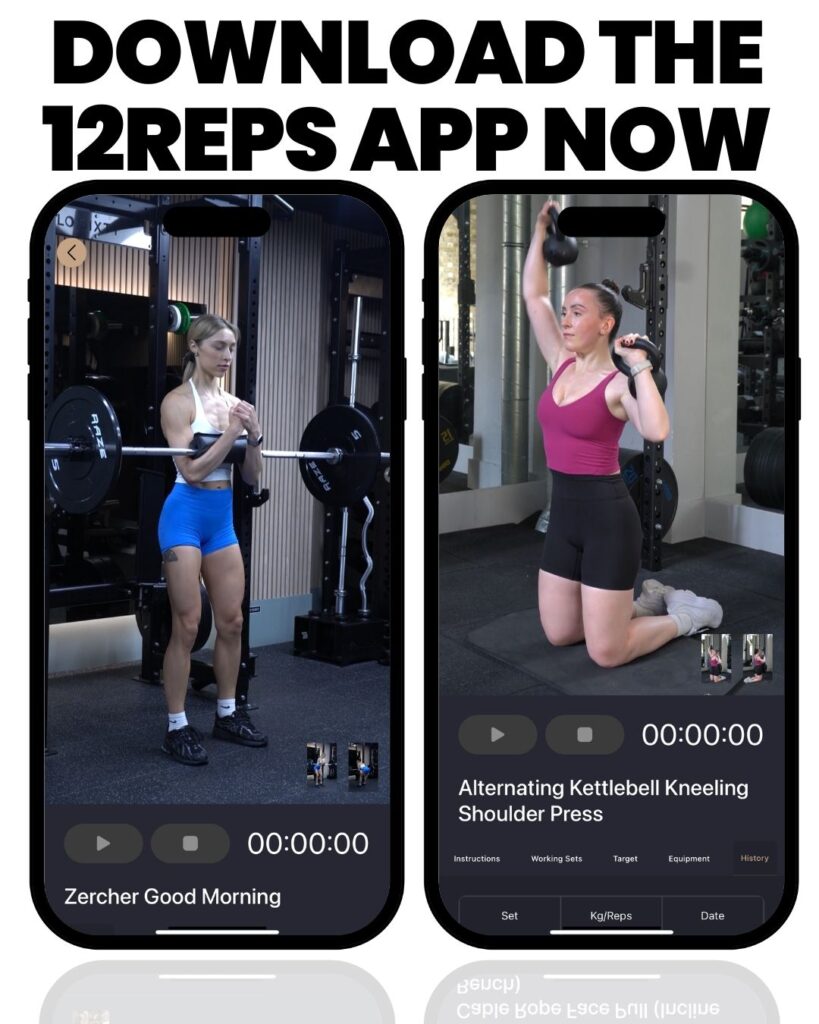
The 12REPS app takes the planning off your plate.
- You open the app and your workout is ready.
- You watch a trainer demonstration for each exercise.
- You enter your reps and weight for each set.
- The app remembers what you lifted, so next time you have a number to beat.
The at-home dumbbell upper body workout
Warm up for a few minutes before your first set. Our guide on how to warm up before strength training shows you how. The video below shows the full workout, and each exercise is explained underneath.
1. Dumbbell floor chest press
4 sets of 10 to 12 reps
Lie flat on the floor with a dumbbell in each hand and your knees bent. Press the weights up over your chest, then lower them under control until your upper arms touch the floor.
Why it works: it trains your chest, shoulders and triceps without a bench. The floor stops your elbows at the bottom, which shortens the range of motion.
2. Dumbbell single-arm row
4 sets of 20 reps (10 each side)
Lean one hand on your knee or a low surface, with your back flat. Row the dumbbell up toward your hip in a controlled motion, then lower it slowly. See the dumbbell single-arm row exercise page for a full breakdown.
Why it works: it trains your lats and upper back, one side at a time. Working each arm on its own also lets you see if one side is weaker.
3. Dumbbell push press
4 sets of 8 to 10 reps
Start with the dumbbells at your shoulders. Dip slightly at the knees, then drive the weights overhead using your legs and arms together. Lower them back to your shoulders under control.
Why it works: the leg drive helps you move a little more weight than a strict press. It works your shoulders and triceps, and your trunk has to keep you steady.
4. Single dumbbell biceps curl
5 sets of 10 reps
Hold one dumbbell with both hands. Curl it up under control and squeeze at the top. Lower it slowly.
Why it works: holding one dumbbell with both hands keeps the move strict, with no swinging.
5. Floor single dumbbell triceps press
4 sets of 12 reps
Lie flat on your back and hold one dumbbell above your chest with both hands. Bend your elbows to lower it behind your head, then straighten your arms again.
Why it works: it trains your triceps, the muscles at the back of your upper arm, with your arms overhead.
Keep it simple and stay consistent
You do not need to spend hours planning your split or copying someone who trains twice a day. Pick up your dumbbells, follow the session and log what you lift. The ACSM’s 2026 guidance says the best resistance training program is the one you will stick with (ACSM, 2026).
To keep getting stronger, add a rep or a little weight when every set feels controlled. This is progressive overload, and our beginner’s guide to progressive overload explains the options. Not sure how long to rest? See how long to rest between sets.
Want another option? Try this six-move dumbbell upper body workout, or finish your week with the 12REPS core workout.
Plan and track it with 12REPS
Would you rather open your phone and find your workout ready? 12REPS builds sessions around your goal, the equipment you have and your time. You watch a trainer demonstration, enter your reps and weight for each set, and the app remembers them so you have a number to beat. See how 12REPS works.
Sources
- Haugen ME, et al. Effect of free-weight vs. machine-based strength training on maximal strength, hypertrophy and jump performance: a systematic review and meta-analysis. BMC Sports Science, Medicine and Rehabilitation, 2023. https://doaj.org/article/a7282dba5e674176bde2a8239832d2f7
- ACSM Unveils Landmark 2026 Resistance Training Guidelines: First Update in 17 Years. American College of Sports Medicine via Newswise, 2026. https://www.newswise.com/articles/acsm-unveils-landmark-2026-resistance-training-guidelines-first-update-in-17-years
- Schoenfeld BJ, et al. Strength and hypertrophy adaptations between low- vs. high-load resistance training: a systematic review and meta-analysis. Journal of Strength and Conditioning Research, 2017. https://www.pubmed.gov/28834797/
- Physical activity guidelines for adults aged 19 to 64. NHS, 2024. https://www.nhs.uk/live-well/exercise/physical-activity-guidelines-for-adults-aged-19-to-64/