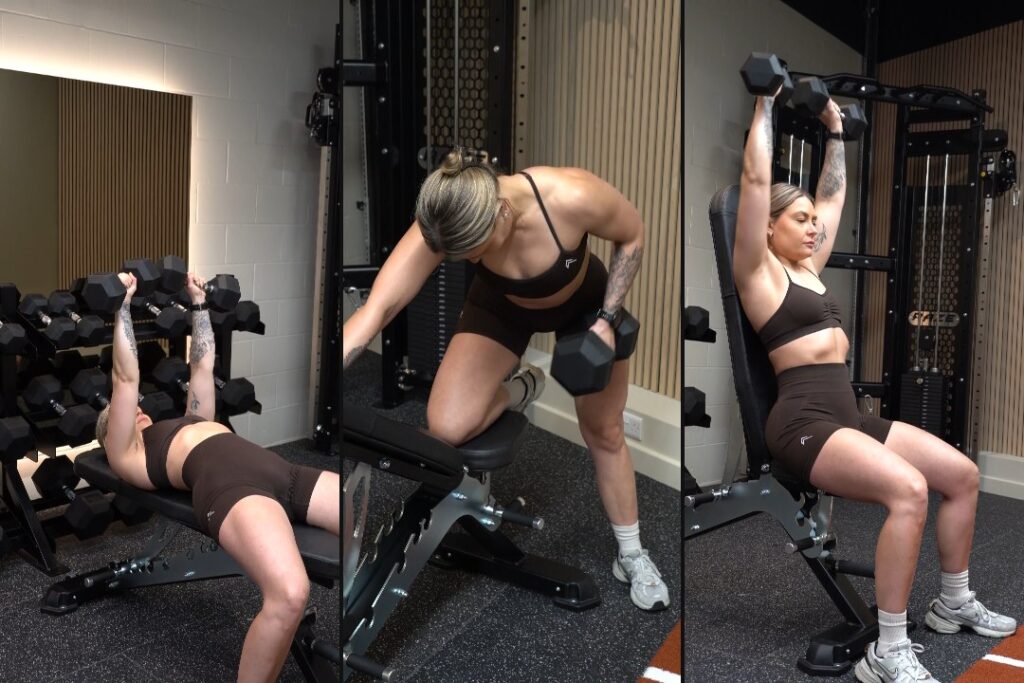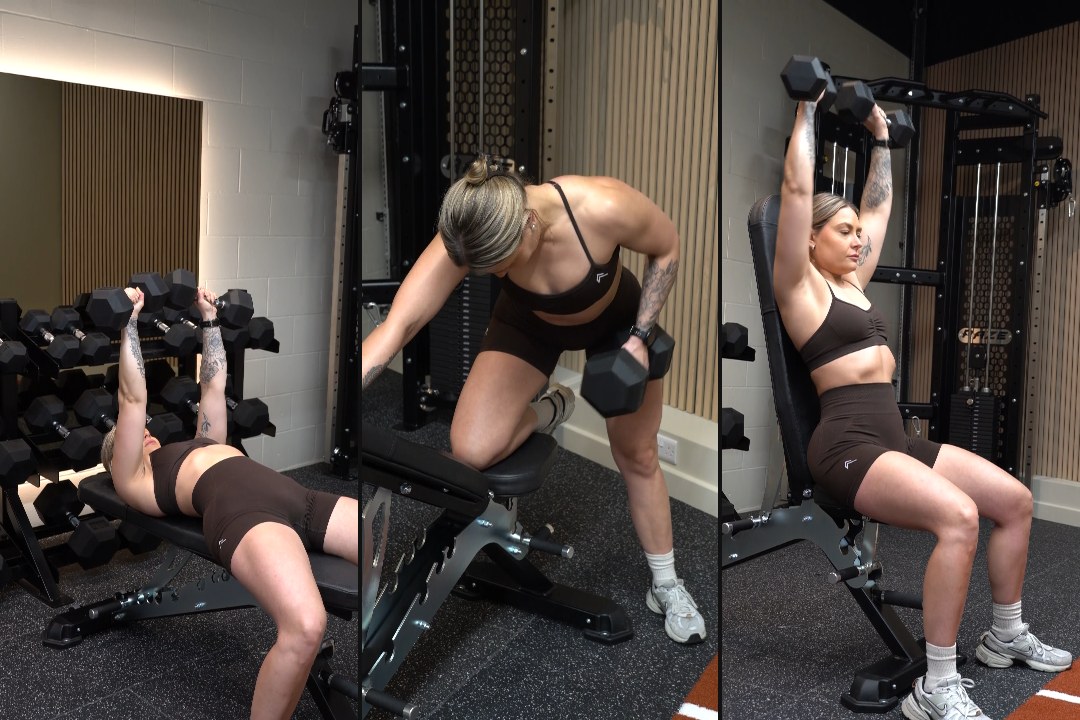



This dumbbell workout trains your chest, shoulders and back in about 40 minutes. You do six moves in three pairs, one push and one pull each time: chest press with single-arm row, shoulder press with incline row, then lateral raise with reverse fly. All you need is a pair of dumbbells and a bench.
Here’s the whole session at a glance:
| Pair | Exercise | Sets | Reps | Rest |
|---|---|---|---|---|
| A1 | Dumbbell chest press | 3 | 12, 10, 8 | None, go to A2 |
| A2 | Dumbbell single-arm row | 3 | 10 each side | 60 sec |
| B1 | Seated dumbbell shoulder press | 3 | 10 | None, go to B2 |
| B2 | Dumbbell incline row | 3 | 12 | 60 sec |
| C1 | Dumbbell lateral raise | 2 | 12 to 15 | None, go to C2 |
| C2 | Dumbbell reverse fly | 2 | 12 to 15 | 45 sec |
This workout is for you if:
- You train at home or in a busy gym with dumbbells.
- You want a stronger, more balanced upper body, front and back.
- You’re short on time and want a session that’s ready to go.
I’m Will Duru, a personal trainer and the founder of 12REPS. Below, I’ll explain why the session is built this way, how to warm up, how to do each move and how to progress.
Why train chest, shoulders and back together?
Most people train what they can see in the mirror: chest and the front of the shoulders. The back gets forgotten. Over time, that can leave your shoulders rounded forward. Pairing every push with a pull keeps the work balanced.
What the research says
- Dumbbells work your chest just as well. In 12 trained men, the dumbbell chest press produced the same chest and front-shoulder muscle activity as the barbell bench press, even though they lifted about 17% less weight. (Saeterbakken et al., 2011)
- Pairing exercises saves time. A study comparing normal sets with supersets (two exercises back to back) found supersets made training more time-efficient. They were also more tiring, so you may need a little more recovery. (Weakley et al., 2017)
- Twice a week works better than once. A review of 10 studies found training each muscle group twice a week led to more muscle growth than once a week, when the total work was the same. (Schoenfeld et al., 2016)
What the research doesn’t say
- These were small studies, mostly in young, trained men.
- The superset study used 14 trained men. If you’re new, take a little extra rest when you need it.
Why I built it this way
Dumbbells force each arm to work independently, so your weaker side can’t hide behind your stronger side. You also get a bigger range of motion than with a barbell.
I start with the chest press because your chest is a big muscle group and needs to be trained when you’re fresh. After a push, we do a pull. The smaller shoulder moves go last.
Warm-up (5 minutes)
| Exercise | Time or reps |
|---|---|
| Rowing machine or brisk walk, easy | 2 minutes |
| Arm circles | 30 seconds each direction |
| Band pull-aparts (or a light reverse fly) | 10 to 15 |
| Light set of dumbbell chest press | 10 reps with about half your working weight |
The goal is to get warm, not tired.
The workout: how to do each move
Do A1, then go straight into A2. Rest, then repeat until you’ve done all the sets for that pair. Then move on to B, then C.
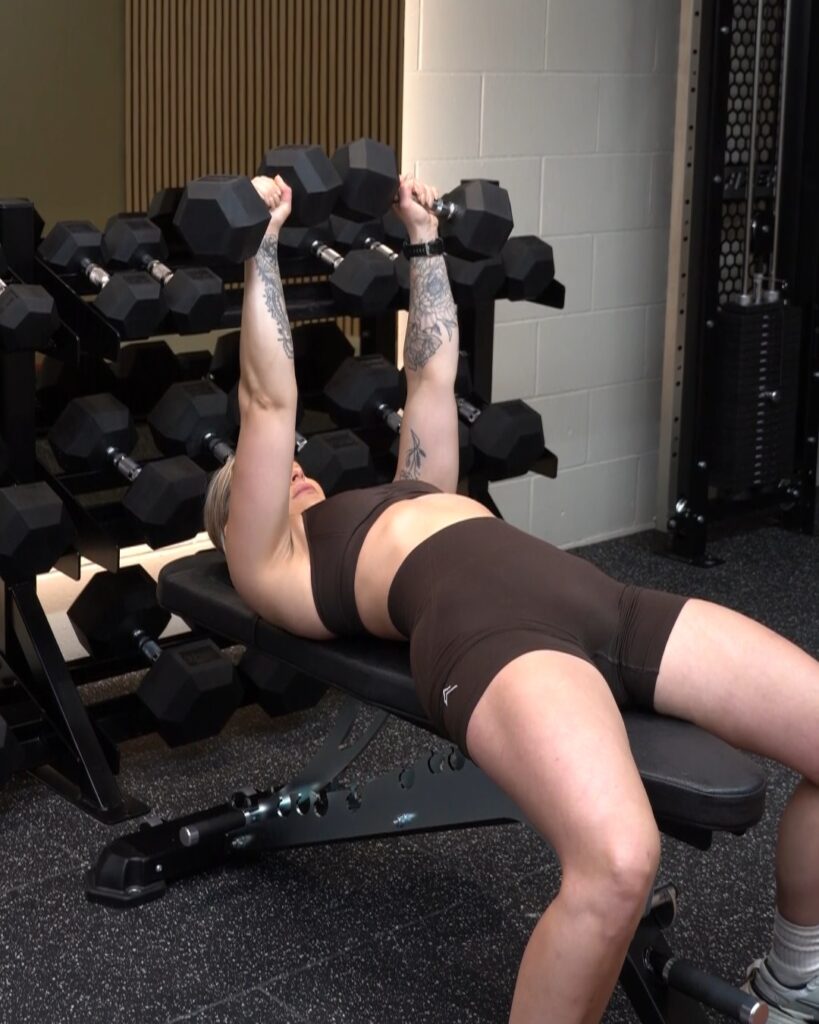
A1. Dumbbell chest press
Works: chest, front shoulders and triceps. Sets and reps: 3 sets of 12, 10, then 8, adding a little weight each set.
- Sit on a flat bench with a dumbbell on each thigh. Lie back and bring the dumbbells to the sides of your chest.
- Plant your feet firmly on the floor and pull your shoulder blades back into the bench.
- Press the dumbbells up until your arms are straight.
- Lower them slowly back to chest level.
Cue: “Lower to your chest, press and squeeze at the top.” Don’t bounce the weight.
A2. Dumbbell single-arm row
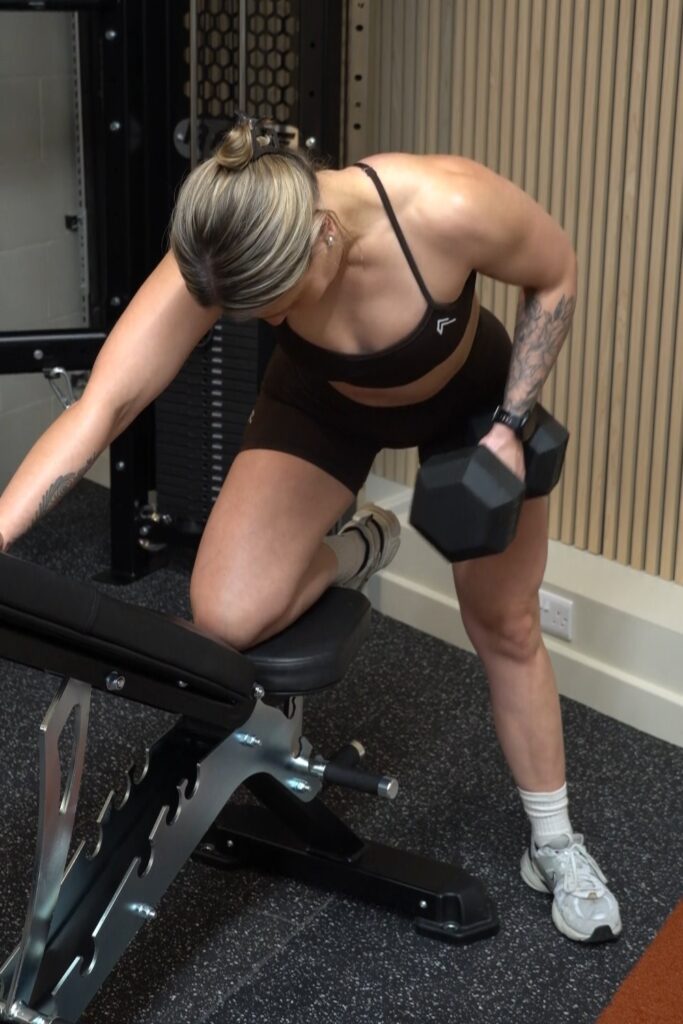
Works: lats, upper back and biceps. Sets and reps: 3 sets of 10 each side.
- Place one hand and one knee on a bench. Hold a dumbbell in the opposite hand.
- Keep your back flat and your core braced. Let the dumbbell hang below your shoulder.
- Pull your elbow toward your hip and squeeze your shoulder blade at the top.
- Lower under control. Finish your reps, then switch sides.
Cue: “Elbow to hip.” Don’t twist your body to lift the weight.
See the Dumbbell Single Arm Row demo.
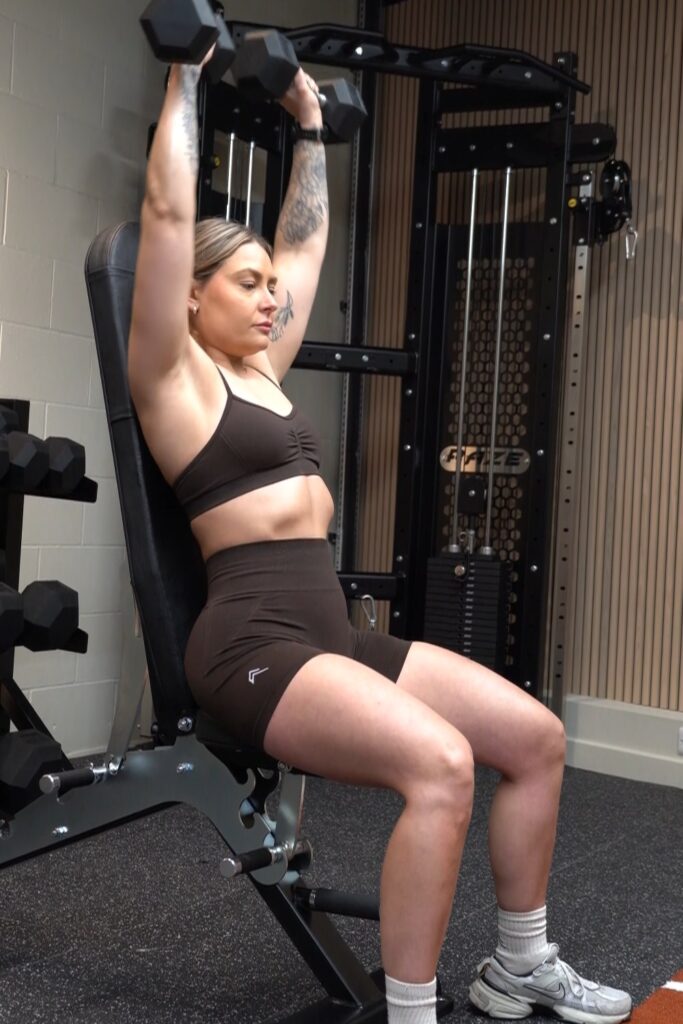
B1. Seated dumbbell shoulder press
Works: shoulders and triceps. Sets and reps: 3 sets of 10.
- Set a bench upright. Sit with your back against it and a dumbbell at each shoulder, palms facing forward.
- Brace your core and keep your feet flat.
- Press the dumbbells overhead until your arms are straight, without banging them together.
- Lower slowly back to shoulder height.
Cue: “Don’t flare your elbows.” Keep them slightly in front of your body, not straight out to the sides.
B2. Dumbbell incline row
Works: upper back, lats and rear shoulders. Sets and reps: 3 sets of 12.
- Set an adjustable bench to a 30 to 45-degree incline. Lie chest-down on it with a dumbbell in each hand.
- Let your arms hang straight below your shoulders. Keep your chest on the bench.
- Pull the dumbbells toward your lower ribs and squeeze your shoulder blades together.
- Lower under control.
Cue: “Chest stays on the bench.” The bench supports you, so your back does the work, not your lower back.
See the Dumbbell Incline Row demo.
C1. Dumbbell lateral raise
Works: side shoulders. Sets and reps: 2 sets of 12 to 15. Go light.
- Stand tall with a light dumbbell in each hand at your sides, elbows slightly bent.
- Raise your arms out to the sides until your hands reach shoulder height.
- Pause, then lower slowly.
Cue: “Lead with your elbows.” Don’t shrug or swing the weights up.
C2. Dumbbell reverse fly
Works: rear shoulders and upper back. Sets and reps: 2 sets of 12 to 15. Go light.
- Hold a light dumbbell in each hand. Hinge at your hips until your chest is close to parallel with the floor, back flat.
- Let the dumbbells hang below your chest, elbows slightly bent.
- Raise your arms out to the sides, squeezing your shoulder blades together.
- Lower slowly.
Cue: “Squeeze your shoulder blades, not your neck.”
What weight should you use?
Pick a weight that’s hard by the last two reps of each set, while your form stays the same as rep one. If you’re new, these are the starting weights I use, per dumbbell:
| Exercise | Beginner starting weight, each hand |
|---|---|
| Chest press and shoulder press | 5 to 8 kg (about 10 to 15 lb) |
| Single-arm row and incline row | 6 to 10 kg (about 12 to 20 lb) |
| Lateral raise and reverse fly | 2 to 4 kg (about 5 to 8 lb) |
Your first week isn’t about finding your maximum. It’s about learning the movements with weights you can control.
What “12, 10, 8” means
On the chest press, your first set is your lightest, at 12 reps. On each set after, add a small amount of weight and drop 2 reps, down to 8 on your final set. It’s a simple way to load your chest without overthinking your numbers.
How to progress
- If the last two reps feel easy, go slightly heavier next session.
- If you can’t add weight yet, add a rep to each set.
- Log every set, so you always know what to beat.
How often should you do this workout?
Twice a week, with at least one day off in between, works well for most people. Pair it with a lower-body day, like my Dumbbell Leg Day, for a simple four-day week:
| Monday | Tuesday | Thursday | Friday |
|---|---|---|---|
| Upper body (this workout) | Dumbbell leg day | Upper body (this workout) | Dumbbell leg day |
Common mistakes
| Mistake | Where you’ll see it | The fix |
|---|---|---|
| Bouncing the weight | Chest press | Lower to chest level under control, then press |
| Twisting to lift | Single-arm row | Keep your hips and shoulders square. Go lighter |
| Elbows flared wide | Shoulder press | Keep your elbows slightly in front of your body |
| Lifting your chest off the bench | Incline row | Keep your chest on the bench and let your back do the work |
| Shrugging and swinging | Lateral raise and reverse fly | Go lighter, lead with your elbows and slow down |
| Rushing the supersets | All pairs | Take an extra 30 seconds if your form starts to slip |
No bench? Training at home?
- Chest press: do a floor press, lying on the floor with your knees bent. Your elbows stop when they touch the floor.
- Single-arm row: brace one hand on a sturdy chair or the edge of a couch.
- Shoulder press: sit on a sturdy chair, or stand.
- Incline row: swap for a bent-over row. Hinge at your hips with a flat back and pull both dumbbells toward your ribs.
Summary
- Six dumbbell moves in three push-pull pairs: chest press with single-arm row, shoulder press with incline row, lateral raise with reverse fly.
- Do each pair back to back, then rest 45 to 60 seconds.
- Choose a weight that’s hard by the last two reps, with good form.
- Go heavier when the last two reps feel easy.
- Do it twice a week, alongside a leg day.
Build this workout in 12REPS
Walk into the gym with your session already planned.
- Open the 12REPS app and go to Build Your Routine.
- Add each exercise above, in order, and save it as your own session.
- Use the app’s built-in stopwatch to time your rest.
- Tap into any exercise before your set to watch the demo and the coach-led technique video.
Every set you log is saved, so next time you know exactly what to beat. Every program is written by a real personal trainer, so when you’re ready for more, there’s a full plan waiting.
Download 12REPS and see what you’ll get:
Sources
- Saeterbakken AH, van den Tillaar R, Fimland MS. A comparison of muscle activity and 1-RM strength of three chest-press exercises with different stability requirements. Journal of Sports Sciences. 2011;29(5):533–538.
- Weakley JJS, Till K, Read DB, et al. The effects of traditional, superset, and tri-set resistance training structures on perceived intensity and physiological responses. European Journal of Applied Physiology. 2017;117(9):1877–1889.
- Schoenfeld BJ, Ogborn D, Krieger JW. Effects of resistance training frequency on measures of muscle hypertrophy: a systematic review and meta-analysis. Sports Medicine. 2016;46(11):1689–1697.
Related reading
- Dumbbell Leg Day: 4 Simple Moves to Build Strong, Lean Legs
- Build a Stronger Chest: 4-Exercise Workout That Actually Works
- How to Do Face Pulls: Cable, Rope and Band Versions
- How Much Weight Should I Lift? Choosing the Right Weight
- Incline Dumbbell Chest Press demo
About the author: I’m Will Duru, a personal trainer and the founder of 12REPS. I hold a BSc (Hons) in Sport and Exercise Science and have more than a decade of experience coaching people in strength training.