




By Will Duru, BSc (Hons) Sport and Exercise Science, Award winning Personal Trainer with over 10 years of experience in strength training
David came to me at 43, frustrated and confused. He had been training consistently since his late twenties, but something had changed. The weights that once felt manageable now felt heavy. His joints ached in ways they never had before. Recovery took longer. Progress had stalled.
“I’m doing everything the same as I always did,” he told me. “But my body isn’t responding anymore. Am I just getting old?”
The answer was yes and no. Yes, his body had changed. No, that did not mean his training days were over. It meant he needed to train smarter, not just harder.
After working with hundreds of men in their forties over the past decade, I have learned that this decade is a turning point. The training strategies that worked in your twenties and thirties often stop working in your forties. But with the right adjustments, you can continue building muscle, gaining strength and feeling better than you have in years.
This guide explains exactly what changes in your forties and how to adapt your training to keep progressing.

What Actually Changes in Your 40s
Understanding the physiological changes happening in your body is the first step to training effectively. These changes are real, but they are not insurmountable.
Testosterone Decline
Testosterone, the primary hormone responsible for muscle growth in men, begins declining around age 30 at roughly 1% per year. By your mid forties, you may have 15 to 20% less testosterone than you did at your peak, according to research published in the Journal of Clinical Endocrinology and Metabolism.
Lower testosterone means slower muscle protein synthesis, reduced recovery capacity and a tendency to store more body fat, particularly around the midsection. It also affects energy levels, motivation and mood.
The good news is that strength training itself is one of the most effective natural ways to maintain testosterone levels. Studies from the European Journal of Applied Physiology show that resistance training can significantly boost testosterone production in middle aged men.
Reduced Recovery Capacity
In your twenties, you could train hard five or six days per week and bounce back quickly. By your forties, your body needs more time to repair and rebuild muscle tissue.
This happens for several reasons. Growth hormone production decreases with age. Sleep quality often declines, affecting the recovery that happens overnight. Accumulated stress from work and family responsibilities keeps cortisol levels elevated, which impairs muscle repair.
Research from Sports Medicine suggests that men over 40 may need 48 to 72 hours between training the same muscle group, compared to 24 to 48 hours for younger men.
Joint Wear and Accumulated Damage
Decades of movement, sport and training take their toll on your joints. Cartilage thins. Tendons lose elasticity. Old injuries that seemed healed start making themselves known again.
According to the British Journal of Sports Medicine, osteoarthritis affects approximately 10% of men in their forties, with the knees, hips and shoulders being the most commonly affected joints.
This does not mean you should stop training. In fact, the opposite is true. Strength training helps maintain joint health by building the muscles that support and protect your joints. But exercise selection and technique become more important than ever.
Decreased Muscle Mass (Sarcopenia)
Sarcopenia, the age related loss of muscle mass, begins in your thirties but accelerates in your forties and fifties. Research from Age and Ageing shows that without intervention, men lose 3 to 5% of their muscle mass per decade after age 30.
The loss accelerates as you age, with the most dramatic decline occurring after 60. But the good news is that strength training can completely halt and even reverse sarcopenia at any age. Studies consistently show that older adults who lift weights gain muscle at similar rates to younger people when they train consistently.
Metabolic Slowdown
Your basal metabolic rate, the number of calories you burn at rest, decreases by approximately 2 to 4% per decade after age 30. This is partly due to muscle loss, since muscle tissue burns more calories than fat tissue, and partly due to hormonal changes.
This metabolic slowdown explains why many men gain weight in their forties despite eating the same amount as before. The solution is building and maintaining muscle mass through strength training, which keeps your metabolism elevated.

How to Adapt Your Training
Now that you understand what is changing, let us look at how to adjust your training approach.
Principle 1: Prioritise Recovery
Recovery is no longer optional in your forties. It is where your progress happens. Without adequate recovery, you will break down faster than you build up.
Training frequency: Three to four sessions per week is optimal for most men in their forties. This allows adequate recovery between sessions while maintaining enough training stimulus for progress.
Sleep: Aim for seven to eight hours per night. Sleep is when growth hormone is released and muscle repair occurs. Poor sleep directly impairs muscle growth and recovery. The Sleep Foundation recommends maintaining consistent sleep and wake times to optimise sleep quality.
Deload weeks: Every four to six weeks, reduce your training volume and intensity by 40 to 50% for one week. This allows accumulated fatigue to dissipate and gives your joints and connective tissue time to repair.
Listen to your body: Sharp pain, unusual fatigue and persistent soreness are signals to back off. In your twenties, you could push through. In your forties, pushing through leads to injury.
Principle 2: Extend Your Warm Up
A proper warm up becomes essential in your forties. Cold muscles and stiff joints are more prone to injury, and it takes longer for your body to reach optimal training temperature.
Spend 10 to 15 minutes warming up before every session. This should include light cardiovascular activity to raise your body temperature, dynamic stretching to mobilise your joints and activation exercises for the muscles you are about to train.
For example, before a lower body session, you might spend five minutes on the bike, followed by leg swings, hip circles and bodyweight squats. Before an upper body session, arm circles, band pull aparts and light push ups prepare your shoulders and chest.
Never skip the warm up. The 10 minutes you save by skipping it will cost you weeks of recovery if you get injured.
Principle 3: Choose Joint Friendly Exercises
Some exercises that were fine in your twenties become problematic in your forties. This does not mean avoiding challenging movements altogether. It means being strategic about exercise selection.
Swaps to consider:
| Instead of | Try |
|---|---|
| Barbell back squat | Goblet squat, front squat or leg press |
| Flat barbell bench press | Incline dumbbell press or floor press |
| Conventional deadlift | Trap bar deadlift or Romanian deadlift |
| Behind the neck press | Dumbbell shoulder press |
| Upright rows | Face pulls or lateral raises |
These swaps reduce stress on vulnerable joints while still providing effective training stimulus. The trap bar deadlift, for example, is easier on the lower back while training the same movement pattern as a conventional deadlift.
That said, there is nothing inherently wrong with barbell squats, bench press or conventional deadlifts if you can perform them pain free with good technique. The key is paying attention to how your body responds and being willing to modify when needed.
Principle 4: Control the Weight
Ego lifting is dangerous at any age, but it becomes particularly risky in your forties. Lifting weights you cannot control puts enormous stress on joints and connective tissue that are less resilient than they used to be.
Use a controlled tempo on every rep. A good guideline is two to three seconds on the lowering phase, a brief pause at the bottom and one to two seconds on the lifting phase. This increases time under tension, which builds muscle effectively, while reducing the risk of injury from momentum and jerky movements.
If you cannot control a weight through the full range of motion, it is too heavy. Drop the weight and focus on quality reps.
Principle 5: Include Mobility Work
Flexibility and mobility tend to decrease with age, and tight muscles and restricted joints limit your training and increase injury risk.
Incorporate mobility work into your routine, either as part of your warm up, on rest days or as a dedicated session once per week. Focus particularly on areas that tend to tighten with age and desk work, including hips, thoracic spine and shoulders.
Yoga, dedicated stretching sessions or simply spending 10 minutes daily on mobility drills can make a significant difference in how you move and feel.

A Sample Training Week for Men in Their 40s
This three day programme is designed specifically for men in their forties who want to build muscle, maintain strength and protect their joints.
Day 1: Push (Chest, Shoulders, Triceps)
Warm up: 10 minutes (5 minutes cardio, 5 minutes dynamic stretching and activation)
| Exercise | Sets | Reps | Rest | Notes |
|---|---|---|---|---|
| Incline Dumbbell Press | 4 | 8 to 10 | 90 sec | Controlled tempo |
| Flat Dumbbell Press | 3 | 10 to 12 | 90 sec | Full range of motion |
| Seated Dumbbell Shoulder Press | 3 | 10 to 12 | 90 sec | Neutral grip option |
| Cable Flyes | 3 | 12 to 15 | 60 sec | Squeeze at contraction |
| Lateral Raises | 3 | 12 to 15 | 60 sec | Light weight, strict form |
| Tricep Pushdowns | 3 | 12 to 15 | 60 sec |
Cool down: 5 minutes stretching (chest, shoulders, triceps)
Day 2: Pull (Back, Biceps, Rear Delts)
Warm up: 10 minutes (5 minutes cardio, 5 minutes dynamic stretching and activation)
| Exercise | Sets | Reps | Rest | Notes |
|---|---|---|---|---|
| Lat Pulldown | 4 | 8 to 10 | 90 sec | Full stretch at top |
| Seated Cable Row | 4 | 10 to 12 | 90 sec | Squeeze shoulder blades |
| Single Arm Dumbbell Row | 3 | 10 to 12 each | 60 sec | Support with other hand |
| Face Pulls | 3 | 15 to 20 | 60 sec | External rotation at end |
| Dumbbell Bicep Curls | 3 | 10 to 12 | 60 sec | No swinging |
| Hammer Curls | 2 | 12 to 15 | 60 sec |
Cool down: 5 minutes stretching (lats, biceps, forearms)
Day 3: Legs and Core
Warm up: 10 minutes (5 minutes cardio, 5 minutes hip and ankle mobility)
| Exercise | Sets | Reps | Rest | Notes |
|---|---|---|---|---|
| Goblet Squat or Leg Press | 4 | 10 to 12 | 2 min | Full depth if possible |
| Romanian Deadlift | 4 | 10 to 12 | 90 sec | Feel hamstring stretch |
| Walking Lunges | 3 | 10 each leg | 90 sec | Controlled steps |
| Leg Curl | 3 | 12 to 15 | 60 sec | |
| Calf Raises | 3 | 15 to 20 | 60 sec | Full range of motion |
| Plank | 3 | 30 to 45 sec | 45 sec | Brace core tight |
| Dead Bug | 3 | 10 each side | 45 sec | Control movement |
Cool down: 5 minutes stretching (quads, hamstrings, hip flexors)
Weekly Schedule Example
| Day | Session |
|---|---|
| Monday | Push |
| Tuesday | Rest or light cardio |
| Wednesday | Pull |
| Thursday | Rest or mobility work |
| Friday | Legs and Core |
| Saturday | Active recovery (walking, swimming) |
| Sunday | Complete rest |

Nutrition Considerations for Your 40s
Your nutrition needs change along with your training requirements.
Protein becomes more important. Research from the Journal of the International Society of Sports Nutrition suggests that men over 40 may need more protein than younger men to achieve the same muscle building response. Aim for 1.6 to 2.2 grams per kilogram of body weight daily, spread across three to four meals.
Prioritise protein timing. Consuming 30 to 40 grams of protein within two hours after training maximises muscle protein synthesis. This becomes more important as you age because the anabolic response to protein is blunted in older adults.
Manage inflammation. Chronic inflammation increases with age and impairs recovery. Include anti inflammatory foods in your diet, such as oily fish, olive oil, berries and leafy greens. Consider omega 3 supplementation if you do not eat fish regularly.
Stay hydrated. Dehydration impairs performance and recovery. Your thirst mechanism becomes less reliable with age, so drink water consistently throughout the day rather than waiting until you feel thirsty.
Consider creatine. Creatine monohydrate is one of the most researched supplements available, with proven benefits for strength, muscle mass and recovery. Research from Nutrients shows particular benefits for older adults. A dose of 3 to 5 grams daily is effective.
Common Mistakes Men in Their 40s Make
Mistake 1: Training Like You Are Still 25
The biggest mistake I see is men refusing to adapt their training as they age. They keep doing the same exercises, same intensity and same volume that worked when they were younger, then wonder why they are getting injured and not progressing.
Your body has changed. Your training must change too.
Mistake 2: Ignoring Pain
In your twenties, you could train through minor aches and they would often resolve. In your forties, training through pain typically makes things worse. Sharp pain is always a signal to stop. Persistent dull aches indicate something needs attention.
Address issues early before they become serious injuries that sideline you for months.
Mistake 3: Skipping Warm Ups and Cool Downs
Time is precious in your forties. You have work, family and countless other responsibilities competing for your time. It is tempting to skip warm ups and cool downs to get in and out of the gym faster.
This false economy costs you in the long run. Proper warm ups prevent injuries that could sideline you for weeks. Cool downs and stretching maintain the mobility you need to train effectively.
Mistake 4: Neglecting Sleep
Sleep becomes harder to prioritise as responsibilities increase. But it is during sleep that your body repairs and builds muscle. Chronic sleep deprivation tanks your testosterone, increases cortisol and impairs recovery.
Treat sleep as non negotiable training recovery time, not something to sacrifice when life gets busy.
Mistake 5: Expecting Linear Progress
In your twenties, you could add weight to the bar almost every week. In your forties, progress is slower and less linear. You will have good weeks and bad weeks. Strength may fluctuate based on sleep, stress and recovery.
Focus on long term trends rather than week to week performance. If you are stronger now than you were six months ago, you are making progress.

Back to David
Remember David from the beginning? After implementing these principles, his experience in the gym transformed.
He reduced his training from five sessions to four per week, allowing better recovery between sessions. He swapped barbell back squats for goblet squats and trap bar deadlifts, which felt better on his knees and lower back. He extended his warm ups to 12 minutes and started doing dedicated mobility work twice per week.
Within three months, his joint pain had significantly reduced. Within six months, he was hitting personal bests on several lifts, something that had not happened in years. At 44, he was stronger and felt better than he had at 40.
“I wish I had made these changes sooner,” he told me. “I spent years fighting against my body instead of working with it. Once I accepted that I needed to train differently, everything clicked.”
How to Get Started
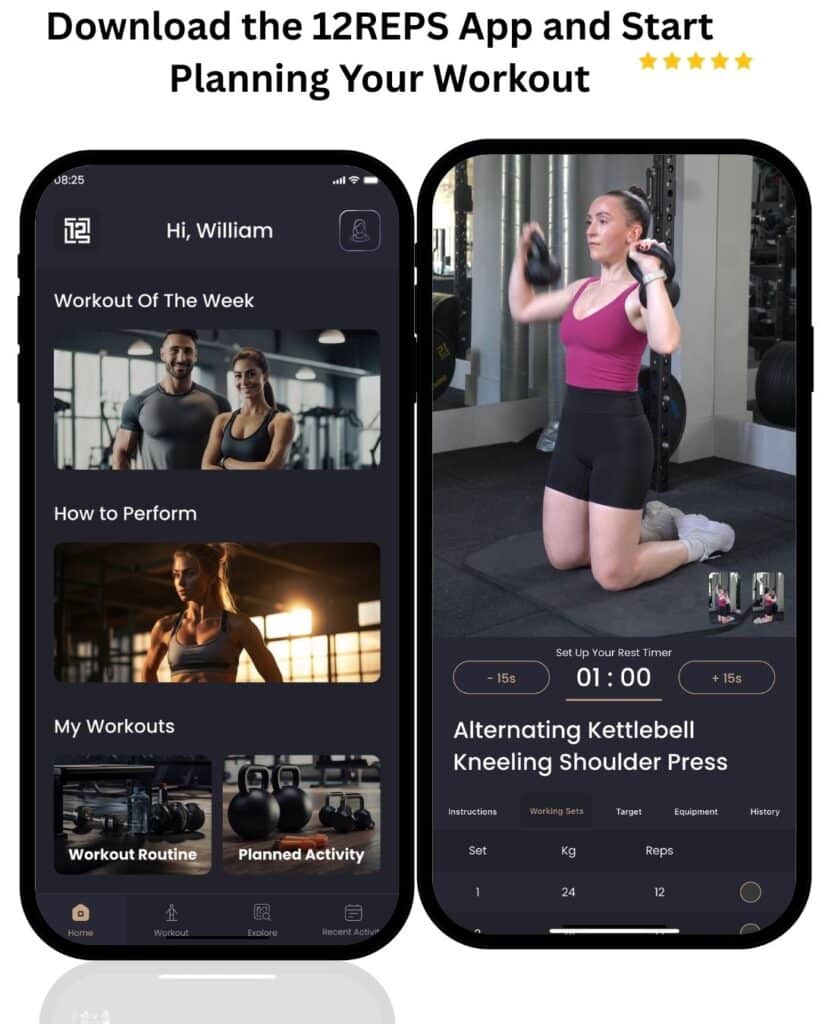
If you want to train effectively in your forties without guesswork, the 12REPS app can help you structure your workouts properly.
The app includes video demonstrations of over 1,500 exercises, so you can ensure your technique is correct. It tracks your progress automatically, showing you whether you are getting stronger over time. You can build custom routines based on the equipment you have available and your specific goals.
Whether you train at home or in a commercial gym, the app adapts to your situation. You can Download it and start your free trial at 12REPS.
Final Thoughts
Your forties are not the beginning of the end. They are the beginning of a new chapter that requires a different approach.
The men I know who are thriving in their forties, fifties and beyond are not the ones who trained the hardest. They are the ones who trained the smartest. They listened to their bodies. They prioritised recovery. They adapted their training to their changing physiology instead of fighting against it.
You can absolutely build muscle, gain strength and feel fantastic in your forties. You can even set personal records if you train intelligently. But you cannot do it by pretending you are still 25.
Accept where you are. Adapt your training accordingly. And enjoy the process of building a body that will serve you well for decades to come.
Related Articles on just12reps.com
| Article | Description | Link |
|---|---|---|
| 3 Day Strength Training Split for 40 Year Old Men | A complete 12 week programme designed specifically for men in their forties who are new to strength training. | Read Article |
| 4 Day Strength Split: How Alan Lost 10kg at 44 | See how Alan transformed his body at 44 using a push pull legs programme with smart nutrition. | Read Article |
| Strength Training for Men Over 50 | For those approaching or past 50, this guide covers the next phase of training adaptation. | Read Article |
| The Science Behind 12 Rep Training | Understand why moderate rep ranges work so well for muscle building, especially as you age. | Read Article |
| Complete Beginner’s Guide to Strength Training | New to strength training entirely? Start here for the fundamentals. | Read Article |
References
[1] Travison, T.G. et al. (2007). A Population Level Decline in Serum Testosterone Levels in American Men. Journal of Clinical Endocrinology and Metabolism. https://academic.oup.com/jcem
[2] Kraemer, W.J. and Ratamess, N.A. (2005). Hormonal Responses and Adaptations to Resistance Exercise and Training. Sports Medicine. https://link.springer.com/journal/40279
[3] Cruz-Jentoft, A.J. et al. (2019). Sarcopenia: revised European consensus on definition and diagnosis. Age and Ageing. https://academic.oup.com/ageing
[4] Damas, F. et al. (2015). A review of resistance training induced changes in skeletal muscle protein synthesis and their contribution to hypertrophy. Sports Medicine. https://link.springer.com/journal/40279
[5] Jäger, R. et al. (2017). International Society of Sports Nutrition Position Stand: protein and exercise. Journal of the International Society of Sports Nutrition. https://jissn.biomedcentral.com/
[6] Kreider, R.B. et al. (2017). International Society of Sports Nutrition position stand: safety and efficacy of creatine supplementation. Journal of the International Society of Sports Nutrition. https://jissn.biomedcentral.com/
About the Author: Will Duru holds a BSc (Hons) in Sport and Exercise Science and is an award winning personal trainer with over 10 years of experience specialising in strength training for men of all ages. He has helped hundreds of men in their forties and beyond build muscle, improve their health and train safely for long term results. Will is the creator of the 12REPS app, designed to make professional training guidance accessible to everyone.