

You’re about to start strength training. You’re reading programmes online. And everyone seems to recommend something different.
“Train full body 3 days per week.”
“No, do an upper/lower split 4 days.”
“Actually, Push/Pull/Legs is superior.”
You’re confused. You don’t know which approach will work. And you’re worried about choosing wrong and wasting months following the “inferior” programme.
Here’s what actually matters: research shows both approaches produce similar results when volume is matched. The “best” split is the one you’ll actually stick to.
I’m Will Duru, a personal trainer with over 10 years’ experience in London. I’ve programmed both full body and split routines for hundreds of women. Neither is inherently superior—they simply suit different circumstances.
This guide explains when full body training works best, when splits are more appropriate, and how to choose based on your actual life rather than theoretical ideals.
The Research: Full Body vs Splits
Before diving into practical recommendations, understand what the evidence shows.
A 2022 study published in BMC Sports Science, Medicine and Rehabilitation examined 50 untrained women over 12 weeks:
Group 1: Full body routine, 2 sessions weekly, training all major muscles each session
Group 2: Upper/lower split, 4 sessions weekly (2 upper, 2 lower)
Both groups performed identical exercises and weekly volume (total sets per muscle group).
Results after 12 weeks:
- Bench press strength: +25.5% (full body) vs +30.0% (split)
- Lat pulldown strength: +27.2% (full body) vs +26.0% (split)
- Leg press strength: Similar gains both groups
- Muscle mass: +1.7-1.9% both groups
No significant differences between groups.
A 2024 systematic review and meta-analysis of 14 studies (392 subjects) examining split vs full body training concluded: “When volume is equated, split or full body routines do not significantly impact strength gains or muscle hypertrophy. Individuals can confidently select based on personal preferences.”
What this means: Stop obsessing over which is “better.” Both work. Choose based on your schedule, preferences, and consistency capacity.

Full Body Training: Complete Overview
What It Is
Training all major muscle groups in each session. A typical full body workout includes:
- Lower body push (squat variation)
- Lower body pull (deadlift variation or hip thrust)
- Upper body push (bench press or overhead press)
- Upper body pull (row or lat pulldown)
- Accessory work (arms, abs, shoulders)
You perform this workout 2-3 times weekly on non-consecutive days (Monday/Wednesday/Friday, for example).
Who Should Use Full Body Training
Full body training works best if:
1. You train 2-3 days per week
If you can only commit to 2-3 training sessions weekly, full body ensures every muscle group receives adequate stimulus. Each session hits everything—you never “miss” a muscle group.
2. You’re a complete beginner (0-6 months training)
Learning movement patterns requires frequent practice. Training each movement 2-3 times weekly accelerates skill acquisition better than once weekly.
Research shows beginners benefit from higher training frequency per muscle group. Full body routines naturally provide this.
3. Your schedule is unpredictable
If you might miss a training session due to work, travel, or family commitments, full-body routines are forgiving. Miss a session? You haven’t skipped “leg day” or “upper body day”—you’ve just missed one complete session and all muscles were trained 2 days ago.
4. Your primary goal is fat loss whilst maintaining muscle
Full-body sessions are metabolically demanding. Training large muscle groups (legs, back, chest) in one session burns significant calories and creates favourable hormonal responses for fat loss.
5. You prefer shorter, more frequent training phases
Some women find it easier to commit to “just get to the gym 3 times this week” rather than organising 4-5 specific sessions. Full body fits this mindset.
Advantages of Full Body Training
✅ Time-efficient scheduling: 2-3 sessions weekly vs 4-6 for splits
✅ High training frequency per muscle: Each muscle trained 2-3x weekly promotes faster strength gains for beginners
✅ Flexible: Missing one session doesn’t create muscle group imbalances
✅ Metabolically demanding: Burns significant calories per session, supporting fat loss
✅ Simpler programming: Fewer workout variations to plan and remember
✅ Great for learning: Frequent practice of movement patterns accelerates skill development
Disadvantages of Full Body Training
❌ Longer individual sessions: Training everything takes 60-75 minutes. Splits allow 45-60 minute sessions.
❌ Potentially more fatiguing: Squatting, rowing, and pressing in one session is demanding. Some women find this exhausting.
❌ Limited volume per muscle group: You can’t do 10 sets for chest, 10 sets for back, 10 sets for legs in one session—that would take hours. Volume per muscle per session is necessarily lower (though weekly volume can match splits).
❌ Less specialisation: If you want to prioritise glute development whilst maintaining everything else, full body makes targeted emphasis harder.
❌ Recovery constraints: Training legs, back, and pressing all in one session then needing 48 hours recovery means you can’t train more than 3x weekly effectively.

Sample Full Body Programmes
Full Body – 2 Days Per Week
Day 1:
- Squat: 3 sets x 8-10 reps
- Bench Press: 3 sets x 8-10 reps
- Bent Over Row: 3 sets x 10-12 reps
- Romanian Deadlift: 3 sets x 10-12 reps
- Overhead Press: 2 sets x 10-12 reps
- Plank: 3 sets x 30-45 seconds
Day 2:
- Deadlift: 3 sets x 6-8 reps
- Bulgarian Split Squat: 3 sets x 10-12 reps each leg
- Lat Pulldown: 3 sets x 10-12 reps
- Incline Dumbbell Press: 3 sets x 10-12 reps
- Dumbbell Row: 2 sets x 12-15 reps each arm
- Bicep Curl: 2 sets x 12-15 reps
Full Body – 3 Days Per Week
Day 1 (Monday):
- Squat: 4 sets x 8-10 reps
- Bench Press: 3 sets x 8-10 reps
- Lat Pulldown: 3 sets x 10-12 reps
- Hip Thrust: 3 sets x 12-15 reps
- Lateral Raise: 2 sets x 15 reps
Day 2 (Wednesday):
- Romanian Deadlift: 3 sets x 10-12 reps
- Overhead Press: 3 sets x 8-10 reps
- Cable Row: 3 sets x 10-12 reps
- Leg Press: 3 sets x 12-15 reps
- Tricep Extension: 2 sets x 12-15 reps
Day 3 (Friday):
- Bulgarian Split Squat: 3 sets x 10-12 reps each
- Incline Dumbbell Press: 3 sets x 10-12 reps
- Barbell Row: 3 sets x 8-10 reps
- Walking Lunges: 3 sets x 12 steps each leg
- Bicep Curl: 2 sets x 12-15 reps
Split Training: Complete Overview
What It Is
Dividing your training so that different muscle groups are trained on different days. Common split approaches:
Upper/Lower Split: Alternate upper and lower body days (4 days weekly)
Push/Pull/Legs: Pushing muscles (chest, shoulders, triceps), pulling muscles (back, biceps), legs (6 days weekly or 3 days with less frequency)
Body Part Split: Dedicating entire sessions to specific muscles (chest day, back day, leg day, etc.)
Who Should Use Split Training
Split training works best if:
1. You train 4+ days per week
If you can commit to 4-6 training sessions weekly, splits allow higher volume per muscle group whilst keeping session duration reasonable.
2. You’re intermediate or advanced (12+ months consistent training)
After building a strong foundation, you need increased volume to continue progressing. Splits facilitate this without creating 90-minute sessions.
3. You have specific physique goals
Want to prioritise glute development? An upper/lower split with 2 lower-body days allows focused glute volume. Want bigger arms? A body part split can dedicate specific sessions to arms.
4. You prefer shorter, more focused sessions
Some women prefer 45-60-minute focused sessions over 75-minute full-body marathons. Splits provide this.
5. You’ve plateaued on full-body training
If strength gains have stalled on a 3-day full body programme, increased frequency and volume via a split might break the platea
Common Split Options
Upper/Lower Split (4 Days Per Week)
Best for: Women training 4 days weekly wanting balanced development
Structure:
- Monday: Upper Body
- Tuesday: Lower Body
- Thursday: Upper Body
- Friday: Lower Body
Advantages: Each muscle trained 2x weekly. Reasonable session length. Clear organization.
Sample Upper/Lower Split:
Upper Day 1:
- Bench Press: 4 sets x 8-10 reps
- Bent Over Row: 4 sets x 8-10 reps
- Overhead Press: 3 sets x 10-12 reps
- Lat Pulldown: 3 sets x 10-12 reps
- Bicep Curl: 2 sets x 12-15 reps
- Tricep Extension: 2 sets x 12-15 reps
Lower Day 1:
- Squat: 4 sets x 8-10 reps
- Romanian Deadlift: 3 sets x 10-12 reps
- Bulgarian Split Squat: 3 sets x 10-12 reps each
- Hip Thrust: 3 sets x 12-15 reps
- Calf Raise: 3 sets x 15-20 reps
Upper Day 2:
- Incline Dumbbell Press: 4 sets x 10-12 reps
- Cable Row: 4 sets x 10-12 reps
- Arnold Press: 3 sets x 10-12 reps
- Pull-Ups or Assisted: 3 sets x 6-10 reps
- Face Pulls: 3 sets x 15 reps
Lower Day 2:
- Deadlift: 4 sets x 6-8 reps
- Leg Press: 3 sets x 12-15 reps
- Walking Lunges: 3 sets x 12 steps each
- Leg Curl: 3 sets x 12-15 reps
- Cable Kickback: 2 sets x 15 reps each
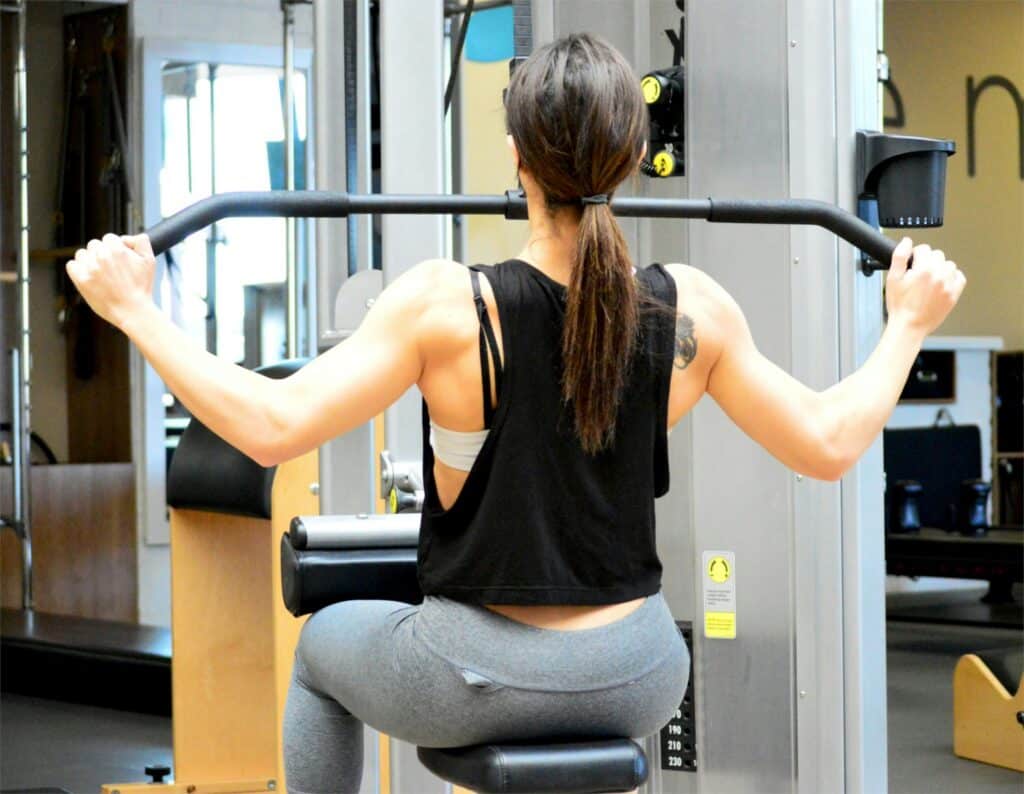
Push/Pull/Legs Split (6 Days Per Week)
Best for: Advanced trainees with time to train 6 days weekly
Structure:
- Monday: Push (chest, shoulders, triceps)
- Tuesday: Pull (back, biceps)
- Wednesday: Legs
- Thursday: Push
- Friday: Pull
- Saturday: Legs
Each muscle group trained 2x weekly with high volume per session.
Advantages: Maximum volume capacity. Very focused sessions. Popular amongst bodybuilders.
Disadvantages: Requires 6 training days weekly. Least flexible schedule. Demanding recovery requirements.
Sample Push/Pull/Legs:
Push Day:
- Bench Press: 4 sets x 8-10 reps
- Overhead Press: 3 sets x 10-12 reps
- Incline Dumbbell Press: 3 sets x 10-12 reps
- Lateral Raise: 3 sets x 12-15 reps
- Overhead Tricep Extension: 3 sets x 12-15 reps
- Cable Flye: 2 sets x 15 reps
- Deadlift: 4 sets x 6-8 reps
- Bent Over Row: 4 sets x 8-10 reps
- Lat Pulldown: 3 sets x 10-12 reps
- Cable Row: 3 sets x 12-15 reps
- Face Pull: 3 sets x 15 reps
- Barbell Curl: 3 sets x 10-12 reps
Leg Day:
- Squat: 4 sets x 8-10 reps
- Romanian Deadlift: 4 sets x 10-12 reps
- Bulgarian Split Squat: 3 sets x 10-12 reps each
- Hip Thrust: 3 sets x 12-15 reps
- Leg Extension: 2 sets x 15 reps
- Leg Curl: 2 sets x 15 reps

Body Part Split (5-6 Days Per Week)
Best for: Advanced bodybuilders with specific physique goals
Structure example:
- Monday: Chest
- Tuesday: Back
- Wednesday: Legs
- Thursday: Shoulders
- Friday: Arms
Advantages: Maximum volume per muscle group. Very focused sessions.
Disadvantages: Each muscle trained only 1x weekly (suboptimal for most). Requires 5-6 training days. Easy to create imbalances.
Not recommended for most women. Research consistently shows training muscles 2x weekly produces superior results to once weekly for both beginners and intermediates.
Advantages of Split Training
✅ Shorter session duration: 45-60 minutes vs 75+ minutes for full body
✅ Higher volume per muscle per session: Can perform 12-16 sets for a muscle group in one session
✅ More focused training: Dedicate mental energy to specific muscles
✅ Better for advanced trainees: Facilitates the high volume needed for continued progress
✅ Specialisation opportunity: Can emphasise specific muscle groups
✅ Less fatiguing per session: Training only upper or only lower is less demanding than full body
Disadvantages of Split Training
❌ More training days required: 4-6 days weekly vs 2-3 for full body
❌ Less flexible: Missing a session means a muscle group isn’t trained that week
❌ Requires more planning: Need to organise and remember multiple different workouts
❌ Can create imbalances: If you consistently skip or half-effort certain days
❌ Lower frequency per muscle: Most splits train each muscle 1-2x weekly vs 2-3x with full body

Choosing Based on Your Circumstances
If You Train 2 Days Per Week
Recommendation: Full body, 2 days weekly
Training only 2 days weekly with a split (one upper, one lower) means each muscle group is hit once per week—suboptimal frequency.
Full body ensures adequate stimulus across all muscles with limited weekly sessions.
If You Train 3 Days Per Week
Recommendation: Full body, 3 days weekly
This is the classic beginner recommendation for good reason. Three full body sessions provide:
- Each muscle trained 3x weekly (optimal frequency for beginners)
- Manageable time commitment
- Simple programming
- Flexible scheduling
Perfect for women with 6-12 months training experience.
If You Train 4 Days Per Week
Recommendation: Upper/Lower split
Four days allows you to train each muscle group 2x weekly via an upper/lower split whilst keeping sessions reasonable length (60 minutes).
This is my most commonly recommended split for intermediate trainees (12-24 months experience).
If You Train 5-6 Days Per Week
Recommendation: Push/Pull/Legs or modified upper/lower
If you have time and recovery capacity for 5-6 weekly sessions, Push/Pull/Legs provides high volume whilst maintaining 2x weekly frequency per muscle.
Only appropriate for advanced trainees (24+ months) who have developed training tolerance and recovery capacity.
If Your Schedule Is Unpredictable
Recommendation: Full body, 2-3 days weekly
Unpredictable schedules require flexible programming. Full-body routines tolerate missed sessions better than split routines.
Can’t train Thursday? No problem—all muscles were trained Monday and will be trained again Saturday.
If Your Primary Goal Is Fat Loss
Recommendation: Full body, 3 days weekly + 2 days cardio/conditioning
Full body sessions are metabolically demanding, burn significant calories, and maintain muscle mass during caloric deficit.
Combine with 2 days of moderate-intensity cardio or conditioning for optimal fat loss.
If Your Primary Goal Is Muscle Growth
Recommendation: Upper/lower split, 4-5 days weekly (intermediate) OR Push/Pull/Legs, 6 days weekly (advanced)
Muscle growth requires volume. Splits facilitate higher weekly volume per muscle group whilst maintaining trainable session durations.
Common Questions
“Can I train full body 4-5 days per week?”
Technically yes, practically no.
Training all major muscle groups 4-5x weekly provides insufficient recovery between sessions. You’d be training legs Monday, Tuesday, Wednesday—each session would be compromised by incomplete recovery.
If you want to train 4-5 days weekly, use a split.
“I’ve been doing full body for 6 months. When should I switch to a split?”
Indicators you’re ready for a split:
- Strength gains have slowed significantly
- You can’t increase volume without sessions exceeding 90 minutes
- You have time for 4+ weekly sessions
- You want to emphasize specific muscle groups
Typically 9-12 months into training is appropriate to consider transitioning from full body to upper/lower split.
“Which split is best for glute growth?”
Upper/lower split with 2 lower body days per week.
This allows:
- 2 lower body sessions weekly
- 12-16 sets of glute-specific work per week
- Adequate recovery between lower days
Structure lower days as:
- Lower Day 1: Squat-dominant (squat, Bulgarian split squat, leg press)
- Lower Day 2: Hip-hinge dominant (deadlift, RDL, hip thrust)
Both days include direct glute work (hip thrusts, cable kickbacks).
“Can I do upper/lower but only 3 days per week?”
Yes, but it’s suboptimal.
Three days weekly would be:
- Week 1: Upper, Lower, Upper
- Week 2: Lower, Upper, Lower
This creates uneven frequency (some weeks upper body trained 2x, other weeks only 1x).
If limited to 3 days, full body is more consistent.
“Is Push/Pull/Legs better than upper/lower?”
Not inherently.
Research shows similar results when volume is matched. The practical difference:
- PPL requires 6 days weekly
- Upper/lower requires 4 days weekly
Choose based on available training days, not theoretical superiority.
“I keep reading that body part splits (chest day, back day, etc.) are best for muscle growth. Is this true?”
No, this is outdated information from 1990s bodybuilding magazines.
Research from the past 15 years consistently shows training muscles 2x weekly produces superior results to 1x weekly for most people.
Body part splits (training each muscle once weekly) were popularized by enhanced bodybuilders whose recovery capacity far exceeds natural trainees. For most women, they’re suboptimal.
Hybrid Approaches
You’re not limited to pure full body or pure splits.
Upper/Lower/Full Body (3 Days)
Structure:
- Monday: Upper Body
- Wednesday: Lower Body
- Friday: Full Body (lighter weights, moderate volume)
Provides targeted volume via upper/lower days whilst maintaining 3-day-per-week schedule.
Full Body with Emphasis Days (3 Days)
Structure:
- Monday: Full body with lower body emphasis (more leg volume)
- Wednesday: Full body balanced
- Friday: Full body with upper body emphasis (more upper volume)
Allows prioritization whilst maintaining full body benefits.
Progression Recommendation
Here’s a sensible progression path for most women:
Months 0-6: Full body, 2-3 days weekly
- Learn movements
- Build base strength
- Establish consistency
Months 7-18: Full body, 3 days weekly OR Upper/lower, 4 days weekly
- Continue strength development
- Increase volume gradually
- Refine technique
Months 18+: Upper/lower, 4-5 days weekly OR Push/Pull/Legs, 6 days weekly
- Advanced programming
- High volume capacity
- Specific physique goals
This isn’t rigid. Some women stay on full body for years and make excellent progress. Others transition earlier. Let your schedule, recovery, and progress dictate timing.
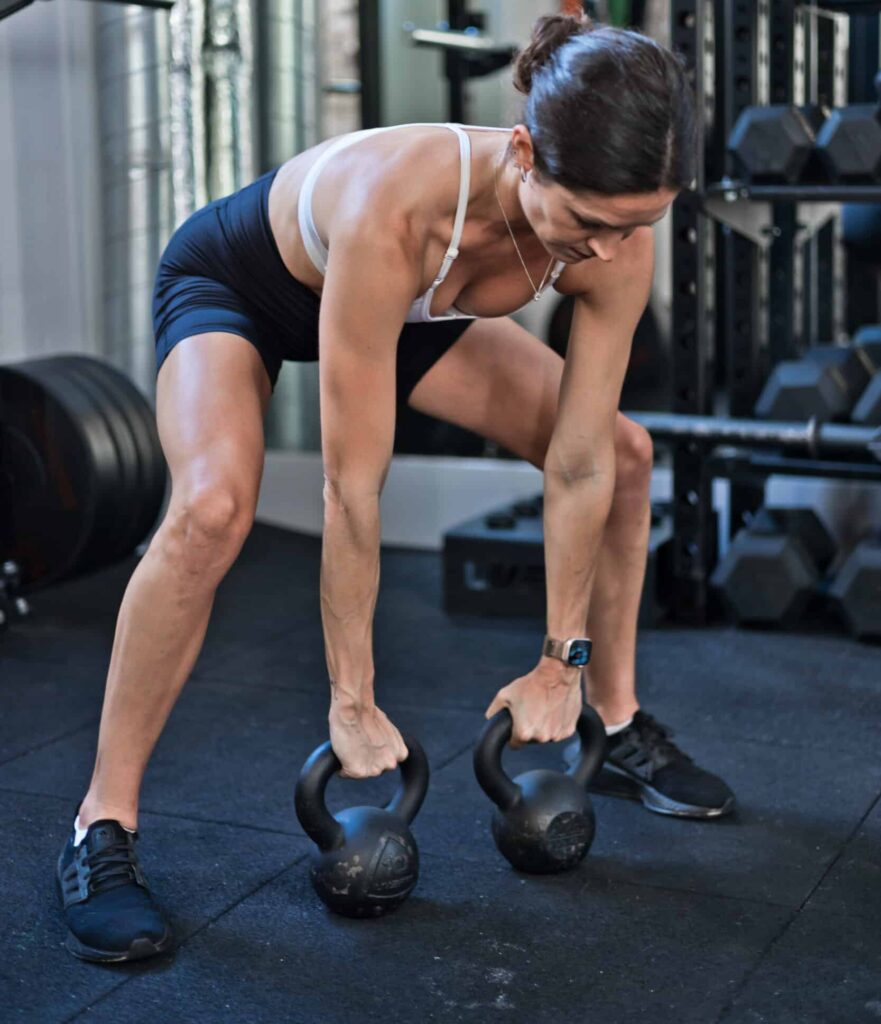
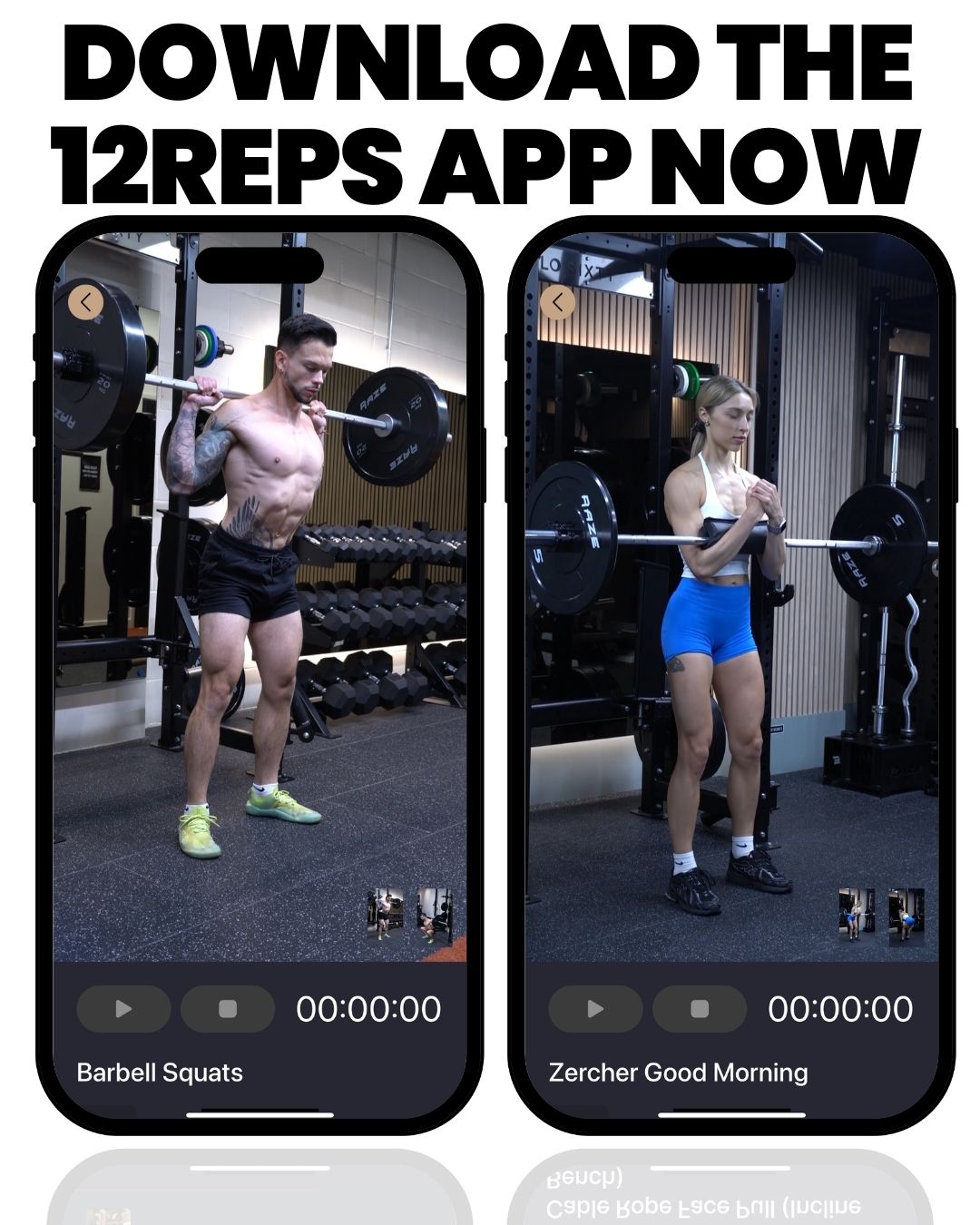
12REPS eliminates this problem entirely.
The biggest challenge with choosing between full body and split training isn’t understanding the theory—it’s actually implementing the programme consistently.
You’ve decided on an upper/lower split. Great. Now what? Which exercises? How many sets? What weight? When do you progress? How do you adjust if you miss a session?
This is where most people fail. They have the framework but lack the specific implementation.
What 12REPS Does
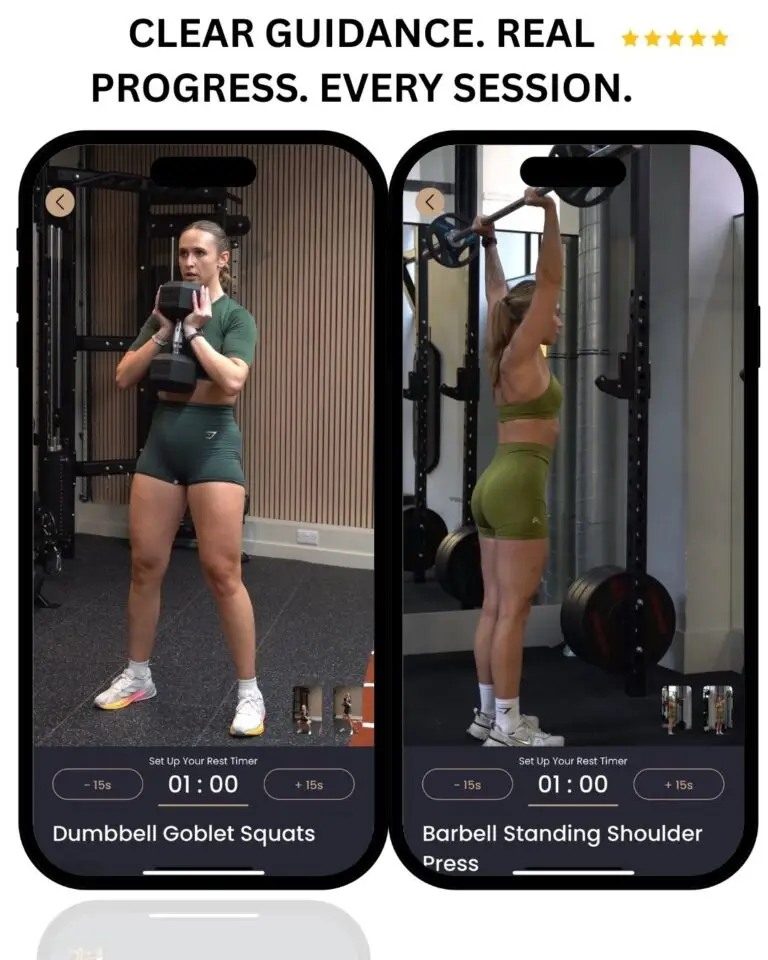
12REPS is a strength training app that builds your complete programme based on your specific circumstances:
1. Choose your training frequency
Tell the app how many days per week you can train (2, 3, 4, 5, or 6 days). The app automatically structures your programme accordingly:
- 2-3 days → Full body programme
- 4 days → Upper/lower split
- 5-6 days → Push/Pull/Legs split
No guessing which split suits your schedule. The app handles it.
2. Select your available equipment
Training at a fully-equipped gym? Home gym with limited equipment? Only have dumbbells? The app adjusts your entire programme based on what you actually have access to.
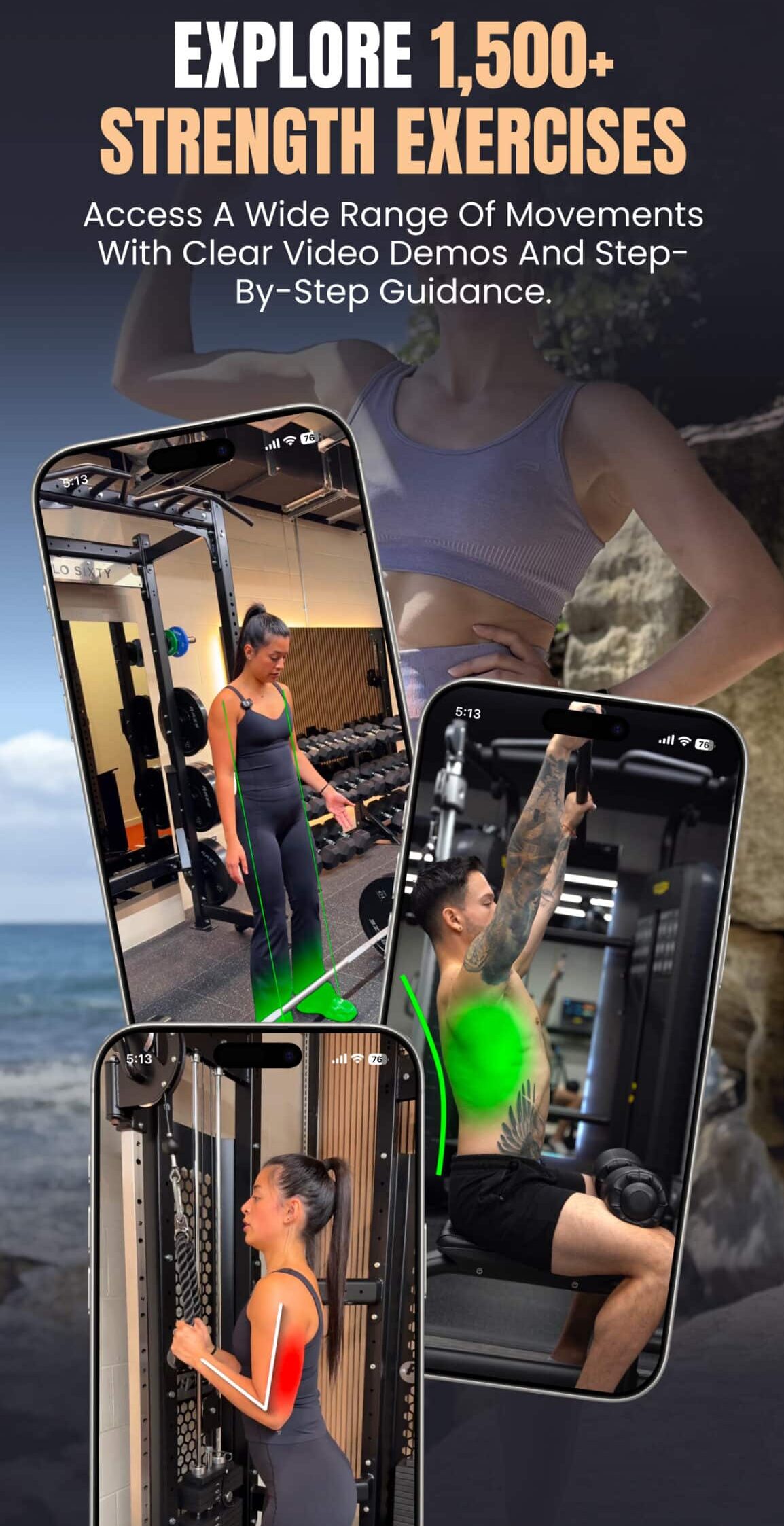
The exercise library contains 1,500+ exercises with video demonstrations. The app filters this library based on your equipment, showing only exercises you can actually perform.
3. Personalised progression
Every workout, you log your sets, reps, and weights. The app tracks your performance and automatically suggests when to increase weight:
- Complete all sets and reps with good form? App recommends adding weight next session.
- Struggling with current weight? App adjusts volume or suggests maintaining current load.
This is progressive overload managed automatically. No spreadsheets. No mental maths. The app tells you exactly what to do.
4. Adapts to your life
Can’t get to the gym this week? Switch to home workouts in seconds—the app rebuilds your programme using bodyweight and home equipment.
Travelling? The app adjusts to hotel gym equipment or creates a bodyweight routine.
This flexibility means you never have an excuse to skip training. Your programme adapts to your life rather than your life adapting to a rigid programme.
Why This Matters for Full Body vs Split Decision
Most women choose a training split, then immediately face these problems:
Problem 1: “I chose upper/lower but don’t know which exercises to include.”
12REPS solution: The app builds your complete upper and lower day workouts, including exercise selection, sets, reps, and progression scheme.
Problem 2: “I planned to train 4 days per week but can only manage 3 this week due to work.”
12REPS solution: Temporarily adjust your training frequency in the app. It restructures your programme to maintain effectiveness with fewer sessions.
Problem 3: “I’m doing full body 3 days per week but don’t know when I should switch to a split.”
12REPS solution: When you’re ready for increased volume or training frequency, simply update your training days in the app. It automatically transitions you to an appropriate split.
Problem 4: “I don’t know if I’m progressing appropriately.”
12REPS solution: Complete progress tracking. See strength gains over weeks and months. Visual graphs show your progression in every exercise.
Real-World Example
Sarah trains 3 days per week. She inputs this into 12REPS along with her goal (muscle growth) and available equipment (full gym).
The app builds a complete 3-day full body programme:
- Specific exercises for each day
- Exact sets and reps
- Suggested starting weights based on her experience level
- Video demonstrations for every exercise
She follows the programme for 6 months, consistently progressing. Now she wants to train 4 days per week.
She updates her training frequency to 4 days in the app. 12REPS automatically restructures her programme into an upper/lower split, maintaining all her progression whilst distributing volume across 4 days instead of 3.
No hiring a new trainer. No buying a different programme. The app adapts.
The Bottom Line on 12REPS
You don’t need to become an expert in programme design to train effectively. 12REPS applies the same principles outlined in this article—choosing appropriate training frequency, selecting suitable exercises, progressing systematically—and handles all the implementation for you.
Whether you choose full body or split training, the app ensures you’re following an evidence-based programme tailored to your specific circumstances.
Try 12REPS free for 7 days. No credit card required. See how much simpler training becomes when the programme adapts to you.
The Bottom Line
Full body vs splits isn’t about which is “better”—it’s about which suits your circumstances.
Choose full body training if:
✅ You train 2-3 days weekly
✅ You’re a beginner (0-12 months)
✅ Your schedule is unpredictable
✅ You prioritise fat loss
✅ You prefer simplicity
Choose split training if:
✅ You train 4+ days weekly
✅ You’re intermediate/advanced (12+ months)
✅ You can commit to a consistent schedule
✅ You prioritise muscle growth
✅ You want to emphasise specific muscles
Both produce similar results when volume is matched.
Stop overthinking which routine is theoretically optimal.
Choose based on:
- How many days per week can you realistically train
- Your training experience
- Your schedule consistency
- Your personal preferences
The “best” programme is the one you’ll actually follow consistently for months and years. That’s what produces results—not the theoretical superiority of one split over another.
References
- Zaroni, R.S., Brigatto, F.A., Schoenfeld, B.J., Braz, T.V., Camargo, J.B., Scramim, L.F., Chavarro, J.E.R., Marchetti, P.H. and Nunes, J.P. (2022). A Randomized Trial on the Efficacy of Split-Body Versus Full-Body Resistance Training in Non-Resistance Trained Women. BMC Sports Science, Medicine and Rehabilitation, 14(1), 87. https://doi.org/10.1186/s13102-022-00481-7
- Ramos-Campo, D.J., Benito-Peinado, P.J., Caravaca, L.A., Rojo-Tirado, M.A. and Rubio-Arias, J.Á. (2024). Efficacy of Split Versus Full-Body Resistance Training on Strength and Muscle Growth: A Systematic Review With Meta-Analysis. Journal of Strength and Conditioning Research, 38(7), pp.1330-1340. https://doi.org/10.1519/JSC.0000000000004781
- Schoenfeld, B.J., Ogborn, D. and Krieger, J.W. (2016). Effects of Resistance Training Frequency on Measures of Muscle Hypertrophy: A Systematic Review and Meta-Analysis. Sports Medicine, 46(11), pp.1689-1697. https://doi.org/10.1007/s40279-016-0543-8
- Brigatto, F.A., Braz, T.V., Zanini, T.C., Germano, M.D., Aoki, M.S., Schoenfeld, B.J., Marchetti, P.H. and Lopes, C.R. (2019). Effect of Resistance Training Frequency on Neuromuscular Performance and Muscle Morphology After 8 Weeks in Trained Men. Journal of Strength and Conditioning Research, 33(8), pp.2104-2116. https://doi.org/10.1519/JSC.0000000000002563
- Grgic, J., Schoenfeld, B.J., Davies, T.B., Lazinica, B., Krieger, J.W. and Pedisic, Z. (2018). Effect of Resistance Training Frequency on Gains in Muscular Strength: A Systematic Review and Meta-Analysis. Sports Medicine, 48(5), pp.1207-1220. https://doi.org/10.1007/s40279-018-0872-x