


By Will Duru, BSc (Hons) Sport and Exercise Science, Award-winning Personal Trainer with over 10 years of experience in strength training and optimising recovery.
Yes, you can combine strength training and cardio without losing muscle or strength. A 2022 meta-analysis found that adding cardio did not reduce muscle growth or maximal strength on average. Explosive power gains were a little lower, mostly when both were done in the same session.
These are the questions I hear most from people who lift:
- Should I do cardio before or after weights?
- Will cardio kill my gains?
- Can I build muscle and improve my fitness at the same time?
The short answers: lift first or separate the sessions, keep hard cardio sensible, and yes. This guide shows how to fit cardio around 12-rep strength training, with two sample weeks.

What the research says about the interference effect
Concurrent training means doing strength and endurance training in the same program. The interference effect is the idea that cardio can blunt strength and muscle gains.
Early studies raised this concern. Newer research shows it is smaller than many people fear, and it depends on how you set things up.
- Muscle and maximal strength: a 2022 meta-analysis found no average loss when cardio was added to strength training. Explosive strength was slightly reduced, more so in same-session training.
- Type, amount and frequency of cardio: a 2012 meta-analysis found that interference depended on the mode, frequency and duration of the cardio. Running, but not cycling, was linked to smaller strength and muscle gains in that analysis.
- Intervals: a 2018 meta-analysis found that high-intensity intervals did not reduce muscle growth or upper-body strength. Lower-body strength gains were slightly smaller.
The evidence on running versus cycling is mixed. The safest takeaway is simple: the more cardio you add, especially hard leg work, the more it can affect your lower-body lifts.
Why combine them at all?
The WHO physical activity guidelines recommend both for adults. That means 150 to 300 minutes of moderate aerobic activity a week, or 75 to 150 minutes of vigorous activity. It also means muscle-strengthening work on 2 or more days.
Combining them can also bring broader benefits. In one 8-week trial of 69 adults with raised blood pressure, combined training improved fitness, strength, lean mass and diastolic blood pressure. That was a single small study, but it fits the guidelines.

Should you lift or do cardio first?
If strength is your priority, lift first. A 2018 meta-analysis found that doing resistance training before endurance exercise led to better lower-body strength gains. Order made no difference to muscle growth, aerobic fitness or body fat.
- Same session: lift first, then do your cardio.
- Same day, two sessions: leave a few hours between them if you can. In the 2022 meta-analysis, the drop in explosive strength was no longer significant when sessions were at least 3 hours apart.
- Cardio is your main goal: do it first, and accept that your lifting may be a little weaker that day.
For more detail, read cardio or weights first? and cardio and weights on the same day.

Which type of cardio fits best
Easy steady cardio
This is cardio at a steady, comfortable pace, such as brisk walking, easy cycling or rowing. The CDC’s talk test is a simple guide: at moderate intensity you can talk, but not sing. It is easy to recover from and suits rest days. Our guide to zone 2 cardio explains this type in more depth.
Intervals
Intervals alternate short hard efforts with easy recovery. At vigorous intensity you cannot say more than a few words without pausing for breath. Intervals take less time, but they are more tiring. Keep them short when you are training hard in the gym.
Video: Airbike. The air bike is a simple way to do intervals that is low on impact for your legs. Watch this to see how it is used before you try the interval session below.
Choosing the mode
- Cycling, rowing and air bikes are low impact and often easier to fit around leg days.
- Running is useful and convenient, but the impact adds leg fatigue. Keep long or hard runs away from heavy leg sessions.
- Walking is the simplest way to add easy activity on any day.
If you have a heart condition, high blood pressure or another health condition, check with your doctor before starting hard intervals.

How much cardio should you add?
Start with what you can recover from, then build up. Wilson’s meta-analysis linked more frequent and longer cardio sessions to more interference.
- Start with 2 cardio sessions a week alongside your strength training.
- Add a few minutes at a time, not a whole new session.
- Track your main lifts. If your weights or reps drop for two or three weeks, cut back the cardio or move it further from leg days.
How 12-rep strength training fits
Sets of around 12 reps use moderate weights, which many people find easier to recover from than very heavy sessions. That leaves room for some cardio. Muscle can also grow with a range of rep schemes when sets are hard, so you do not need to change your rep range to add cardio. For the research, see the science behind 12-rep training.
Plan the week so that hard leg sessions and hard cardio are not back to back. That one rule removes most of the conflict.
Video: Hyrox training with the 12REPS app. Hyrox combines running with strength work, so it is a useful example of mixing both. Watch this to see how strength sessions can support a race that also needs fitness. Our hybrid athlete training guide goes further.

Two sample weeks
Week A: 4 strength days and 2 cardio days
This plan keeps strength and cardio on separate days for recovery.
Monday: upper body
- Pull-ups or lat pulldown: 3 sets of 12 reps.
- Bench press: 3 sets of 12 reps.
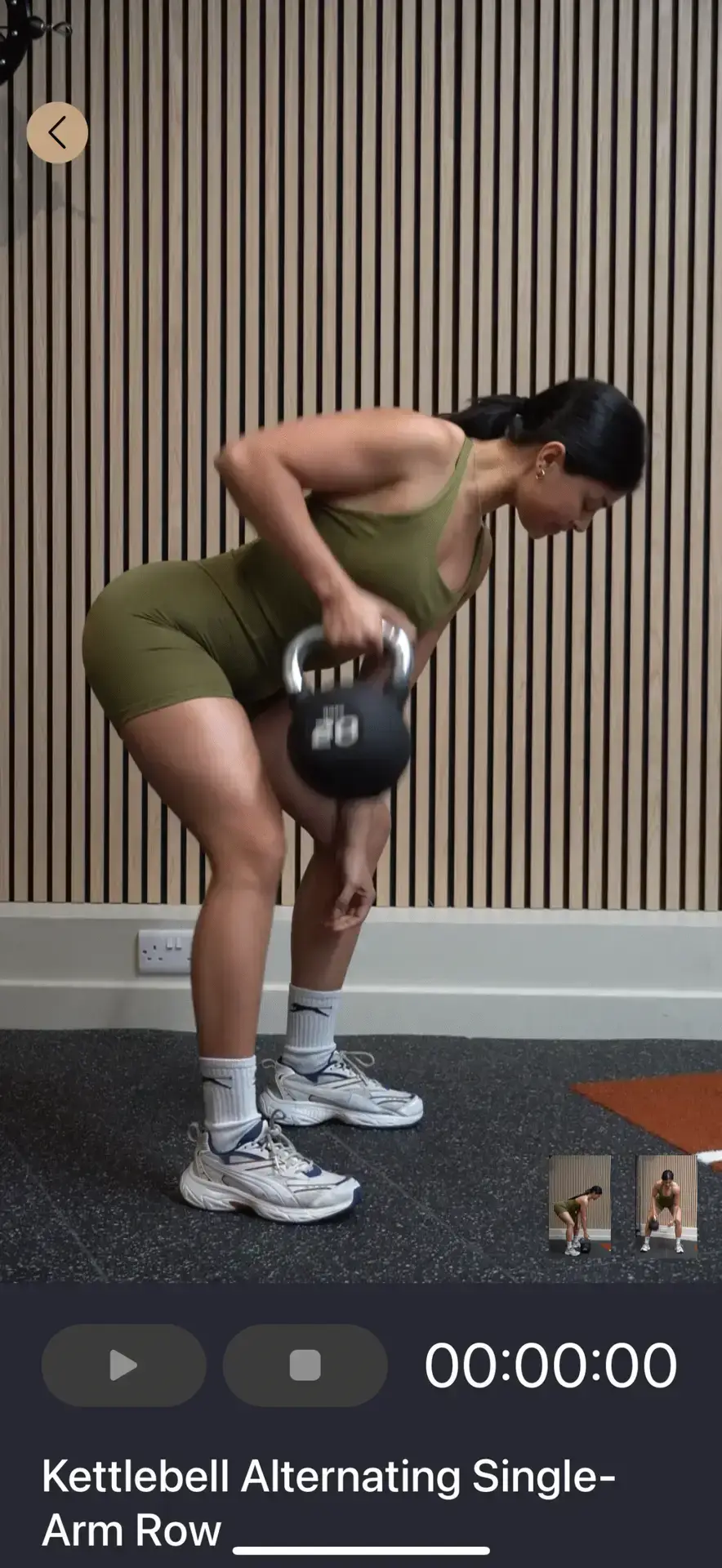
- Bent-over row: 3 sets of 12 reps.
- Overhead press: 3 sets of 12 reps.
- Biceps curl: 2 sets of 12 reps.
- Triceps extension: 2 sets of 12 reps.
Tuesday: intervals
- 5-minute easy warm-up.
- 8 rounds of 30 seconds hard and 90 seconds easy.
- 5-minute easy cool-down. About 25 minutes in total.
Wednesday: lower body
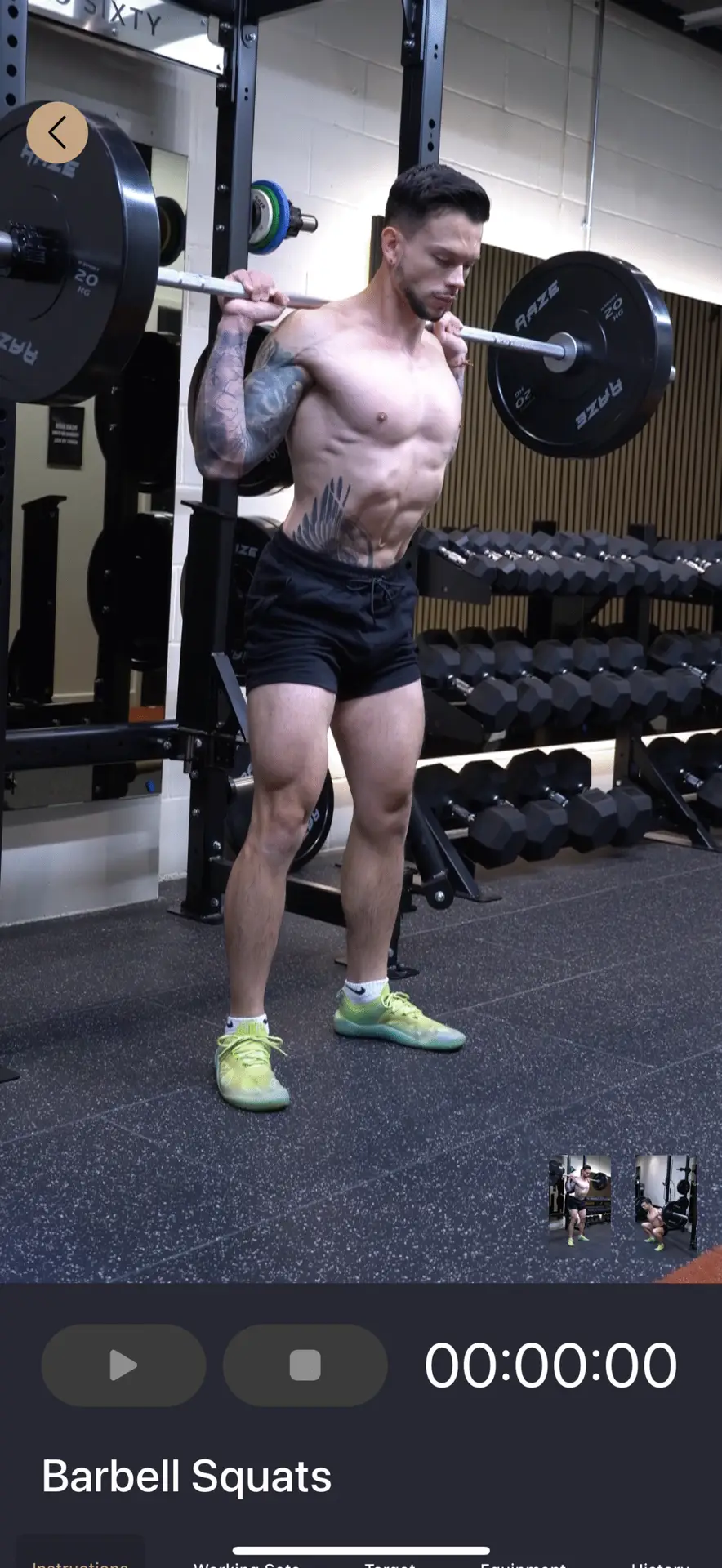
- Squat: 4 sets of 12 reps.
- Deadlift: 3 sets of 12 reps, with a weight you can control for every rep.
- Lunges: 3 sets of 12 reps per leg.
- Calf raises: 3 sets of 15 reps.
- Plank: 2 sets of 45 seconds.
Thursday: upper body
- Chin-ups or assisted chin-ups: 3 sets of 12 reps.
- Incline press: 3 sets of 12 reps.
- Cable row: 3 sets of 12 reps.
- Lateral raises: 3 sets of 12 reps.
- Face pulls: 2 sets of 15 reps.
Friday: lower body
- Romanian deadlift: 3 sets of 12 reps.
- Bulgarian split squat: 3 sets of 12 reps per leg.
- Hip thrust: 3 sets of 12 reps.
- Walking lunges: 2 sets of 20 steps in total.
- Russian twists: 2 sets of 20 in total.
Saturday: steady cardio. 30 to 45 minutes of cycling, walking or swimming at a pace where you can talk but not sing.
Sunday: rest or light activity.
Week B: 3 strength days and 2 cardio days
- Monday: lower-body strength, then 10 to 12 minutes of intervals on a bike.
- Wednesday: upper-body strength, plus 20 to 30 minutes of optional easy cardio.
- Friday: lower-body strength.
- Saturday: intervals, such as hill sprints or bike sprints, for 12 to 15 minutes.
- Sunday: 20 to 30 minutes of easy cardio or a long walk.
New to lifting? Build the strength habit first with our beginner 12-rep workout program, then add cardio.
Fuel and recovery
- Protein: muscle gains from training leveled off at about 1.6 g of protein per kg of body weight per day in a large meta-analysis.
- Carbohydrates: eat some before training and after longer or harder cardio, so you have energy for your next session.
- Sleep: the CDC states that adults should sleep at least 7 hours a night.
- Fluids: drink through the day, and more on hot or sweaty days.
Want your strength days planned for you? 12REPS builds each session around your goal, your equipment and your time, with a trainer demonstration for every exercise. Logging your reps and weight shows whether your lifts keep moving up as you add cardio.

Key takeaways
- Adding cardio does not, on average, reduce muscle growth or maximal strength.
- Lift first if both are in one session, or separate them by a few hours.
- Keep hard cardio and hard leg days apart, and add cardio gradually.
- Watch your main lifts. If they drop for a few weeks, cut back the cardio.
Sources
- Compatibility of Concurrent Aerobic and Strength Training for Skeletal Muscle Size and Function: An Updated Systematic Review and Meta-Analysis. Schumann M, Feuerbacher JF, Sünkeler M, et al. Sports Medicine, 2022. https://pubmed.ncbi.nlm.nih.gov/34757594/
- Concurrent training: a meta-analysis examining interference of aerobic and resistance exercises. Wilson JM, Marin PJ, Rhea MR, et al. Journal of Strength and Conditioning Research, 2012. https://pubmed.ncbi.nlm.nih.gov/22002517/
- The compatibility of concurrent high intensity interval training and resistance training for muscular strength and hypertrophy: a systematic review and meta-analysis. Sabag A, Najafi A, Michael S, et al. Journal of Sports Sciences, 2018. https://doi.org/10.1080/02640414.2018.1464636
- WHO guidelines on physical activity and sedentary behaviour. World Health Organization, 2020. https://www.who.int/publications/i/item/9789240015128
- Comparative effectiveness of aerobic, resistance, and combined training on cardiovascular disease risk factors: A randomized controlled trial. Schroeder EC, Franke WD, Sharp RL, Lee DC. PLOS ONE, 2019. https://doi.org/10.1371/journal.pone.0210292
- The Role of Intra-Session Exercise Sequence in the Interference Effect: A Systematic Review with Meta-Analysis. Eddens L, van Someren K, Howatson G. Sports Medicine, 2018. https://doi.org/10.1007/s40279-017-0784-1
- How to Measure Physical Activity Intensity. Centers for Disease Control and Prevention (CDC), 2025. https://www.cdc.gov/physical-activity-basics/measuring/
- A systematic review, meta-analysis and meta-regression of the effect of protein supplementation on resistance training-induced gains in muscle mass and strength in healthy adults. Morton RW, Murphy KT, McKellar SR, et al. British Journal of Sports Medicine, 2018. https://doi.org/10.1136/bjsports-2017-097608
- 1 in 3 adults don’t get enough sleep. Centers for Disease Control and Prevention (CDC), 2016. https://archive.cdc.gov/www_cdc_gov/media/releases/2016/p0215-enough-sleep.html