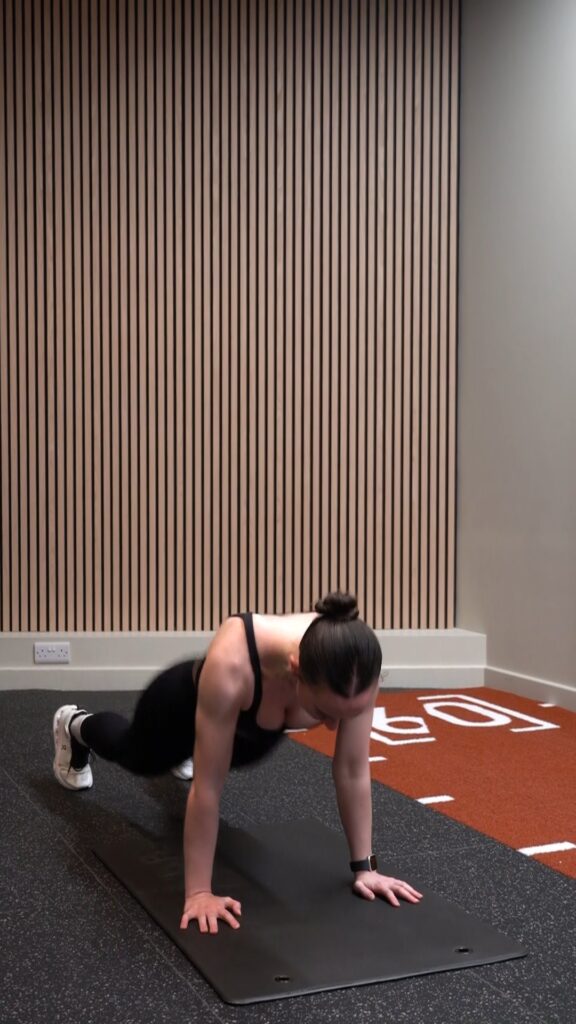
Short answer: A burpee is a squat, a kick back to a plank and a jump, done in one smooth rep. To do one, squat down, put your hands on the floor, step or jump your feet back into a plank, bring your feet back in, stand up and jump. If you are new to them, start with a step-back burpee with no jump and add the harder parts as you get fitter. Most people do burpees in short, timed intervals rather than chasing big numbers.
This guide is for anyone who wants to learn burpees properly, scale them to their level and fit them into a workout. I cover form, easier and harder versions, what the research shows and how many to do.
What is a burpee?
A burpee is a full-body bodyweight exercise. You move from standing to the floor and back up again, which makes it hard work for your heart and lungs. It needs no equipment and very little space.
Your legs and glutes do the squat and the jump. Your chest, shoulders and triceps support you in the plank, and they work harder if you add a push-up. Your core keeps your body straight while you are on the floor.
In my view, the burpee is mainly a conditioning exercise. It gets your heart rate up quickly. It is not the best tool for building muscle or maximal strength, so I use it alongside strength training rather than in place of it.
How to do a burpee
The demo above shows the chest-to-floor version. The steps below are for a standard burpee. I explain how to make it easier or harder further down.
- Stand tall. Set your feet about hip-width apart, with your arms by your sides.
- Squat down. Bend your knees and hips and place your hands flat on the floor, just in front of your feet and about shoulder-width apart.
- Kick or step back. Jump your feet back, or step them back one at a time, so you land in a plank. Your hands should be under your shoulders, with your body in a straight line from head to heels.
- Push-up (optional). Lower your chest toward the floor and press back up. Leave this out until the rest of the move feels easy.
- Bring your feet in. Jump or step your feet back toward your hands, landing with your feet flat.
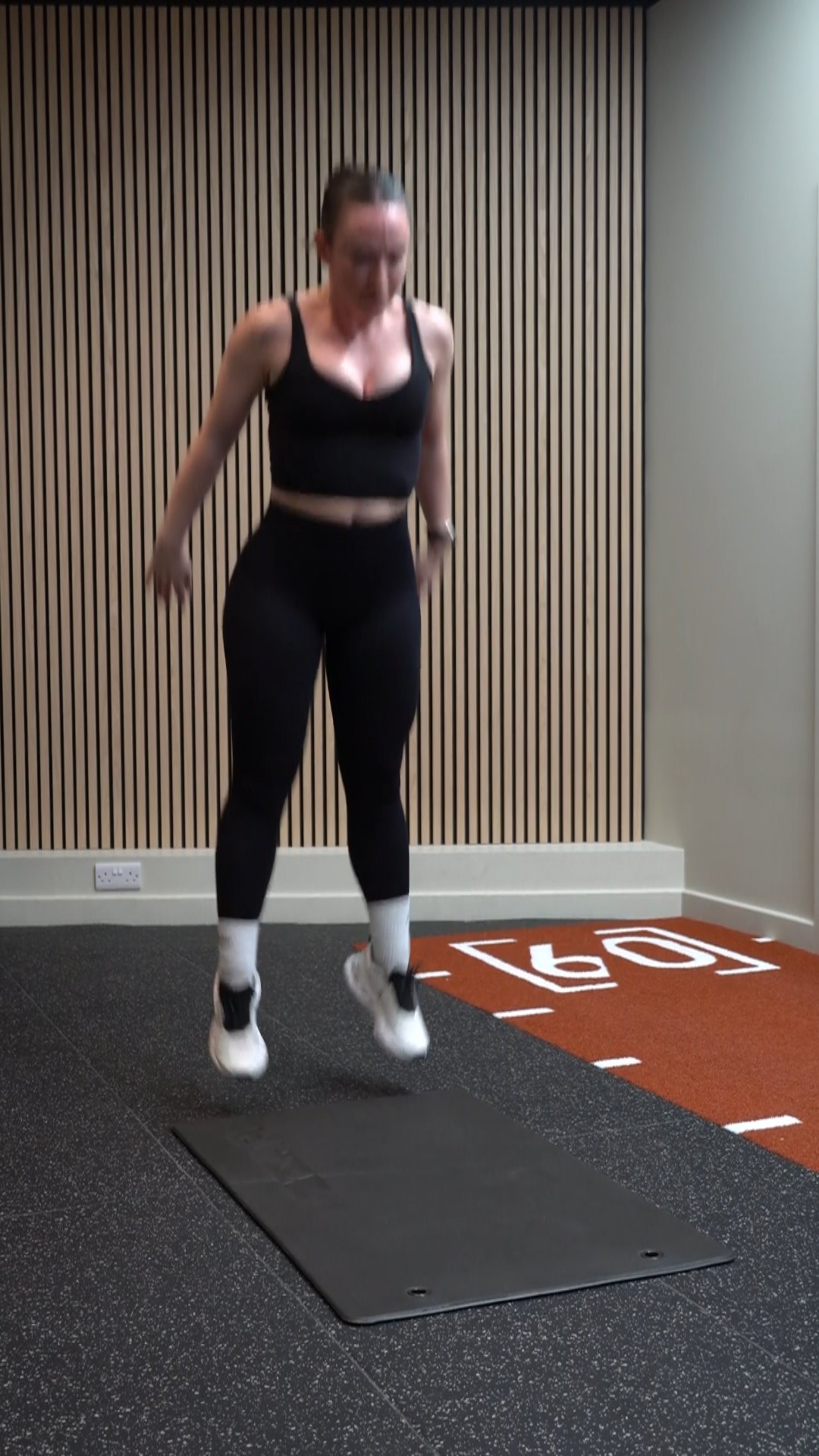
- Stand and jump. Drive through your feet, stand up and jump straight up. Reach your arms overhead if you like.
- Land softly. Land on the balls of your feet, let your heels come down and bend your knees. Go straight into the next rep.
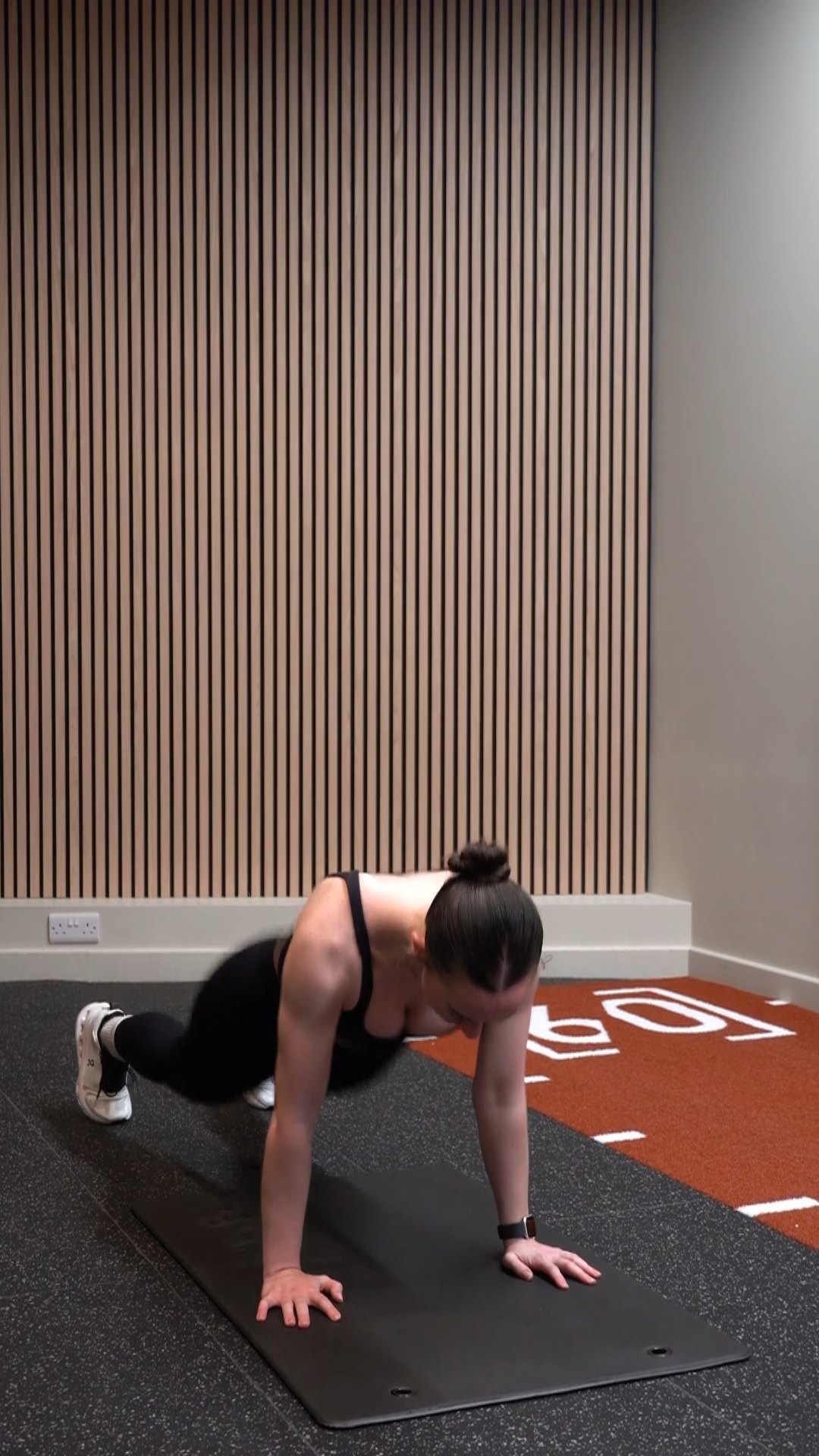
Coaching cues I use
- “Hands flat, under your shoulders.” This keeps your wrists and shoulders in a stronger position when you land in the plank.
- “Brace before you kick back.” Tighten your stomach as if you are about to be poked. This stops your hips from dropping when your feet land.
- “Feet land flat when they come in.” Landing on your toes with your heels high makes standing up harder and less stable.
- “Quiet landings.” If your jump lands loudly, you are probably landing stiff-legged. Bend your knees and absorb it.
- “Smooth, not frantic.” A steady rhythm usually lets you do more good reps than rushing and losing form.
Common burpee mistakes
| Mistake | What it looks like | The fix |
|---|---|---|
| Sagging hips | Your lower back arches and your hips drop toward the floor in the plank | Brace your core before your feet land. Step back instead of jumping if you cannot hold the plank yet. |
| Hands too far forward | Your hands land well ahead of your shoulders | Place your hands just in front of your feet, so they end up under your shoulders in the plank. |
| Feet landing too far from your hands | You land in a wide, shallow squat and struggle to stand | Bring your feet close to your hands, flat on the floor, before you stand. |
| Stiff landings | A loud landing with straight knees | Land on the balls of your feet and bend your knees. |
| Rounding to reach the floor | Your back rounds a lot to get your hands down | Bend your knees more, or use the elevated version below. |
| Rushing until form breaks | Reps get faster but sloppier | Slow down, rest when form slips, or switch to an easier version. |
Easier and harder burpee variations
You do not need to do the full version on day one. Pick the version you can do with good form for the whole set, then move up the table when it feels comfortable.
| Version | How it changes the move | Best for |
|---|---|---|
| Elevated burpee | Hands go on a bench or box instead of the floor | Beginners, or anyone who finds the floor hard to reach |
| Step-back burpee | Step your feet back and forward one at a time, then stand up without a jump | Beginners, and lower-impact days |
| Burpee without a push-up | Kick back to a plank, jump in and jump up, with no push-up | The standard starting point for most people |
| Standard burpee with a push-up | Add one push-up in the plank | People who can already do good push-ups |
| Chest-to-floor burpee | Lower your whole chest to the floor, then push back up | More advanced trainees; it is harder on the upper body |
| BOSU ball burpee | Hold a BOSU ball, place it on the floor and do the plank on it | Experienced trainees who want a balance challenge |
If you are working on the push-up part, my push-up variations guide runs from the easiest version to the hardest.
BOSU ball burpee
This version adds a balance challenge in the plank. Only use it once the standard burpee feels solid. For more ways to use the ball, see my BOSU ball exercises guide.
What the research says about burpees
There is not a large body of research on burpees. The studies below are small and mostly in young, active adults, so treat them as a guide rather than a final answer.
- Burpee intervals raise heart rate a lot. In a study of 11 moderately trained college-aged adults, four 30-second all-out bouts of modified burpees (with 4 minutes of active recovery between them) produced average heart rates of about 85% of peak. That was not significantly different from all-out sprint cycling, although it was slightly lower on average (Gist et al., 2014).
- They can maintain fitness in a short program. In Army ROTC cadets, 4 weeks of 30-second all-out burpee intervals, done 3 days a week, kept fitness at a similar level to about 60 minutes of usual physical training. Neither group improved aerobic capacity over the 4 weeks, so the result was maintenance rather than gains (Gist et al., 2015).
- People may enjoy them more than you would expect. In 18 moderately active young adults, a short burpee interval session (10 five-second efforts with 35 seconds of rest) was rated as more enjoyable than a 6-minute continuous run, and less unpleasant than sprint intervals. It did cause more muscle soreness 48 hours later than the run (Mayr Ojeda et al., 2022).
- Very short sessions can improve jumping. In active adults, sessions of ten 4-second all-out burpee efforts with 30 seconds of rest (about 8 minutes) improved countermovement jump height. A matched sprint interval group improved shuttle run performance instead. Neither program changed body composition or blood pressure over the study (Pérez-Ifrán et al., 2024).
My take: burpees are a useful, equipment-free way to do hard intervals. The research does not show that they beat other conditioning options, and short studies do not tell us much about long-term fat loss.
Are burpees good for building muscle?
Not on their own, in my experience. Burpees use your body weight, and you cannot easily add load the way you can with a squat or a press. Once you can do many reps, they become more of a conditioning challenge than a strength one.
If you want to build muscle and strength, I would make resistance training the main part of your week and use burpees as a short finisher or interval block. My guide to the best workout for fat loss explains how strength work and conditioning fit together.
How many burpees should you do?
There is no single right number. It depends on your fitness, the version you use and the rest of your training. I prefer timed intervals to big rep targets, because they let you stop before your form breaks down.
Here is how I would start, depending on your level. These are my coaching suggestions, not research-based targets.
| Level | Version | Workout | How often |
|---|---|---|---|
| Beginner | Elevated or step-back burpee | 5 rounds of 20 seconds of work and 40 seconds of rest | Once or twice a week, at the end of a workout |
| Intermediate | Burpee without a push-up | EMOM for 8 minutes: 5 to 8 burpees at the start of each minute, then rest for the rest of that minute | Once or twice a week |
| Advanced | Standard or chest-to-floor burpee | 8 rounds of 20 seconds of work and 40 seconds of rest, aiming to keep your rep count steady from round to round | Once or twice a week, not before heavy leg sessions |
EMOM stands for “every minute on the minute.” I explain the format, with more workouts, in my EMOM workout guide.
To progress, add one round, one rep per round, or move up one version in the variations table. Change one thing at a time.
Who should take care with burpees?
Burpees involve jumping and putting weight through your hands. If you have a wrist, shoulder, knee, hip or back injury, use the step-back or elevated version, or check with a doctor or physical therapist first. The same applies if you have a heart condition, high blood pressure or you are pregnant, because burpees push your heart rate up quickly.
Burpee alternatives
If burpees do not suit you, these give a similar challenge with less impact on one area:
- Mountain climbers keep you in the plank position with no jump or squat.
- Jump squats give you the lower-body jump without the trip to the floor.
- Battle ropes are hard conditioning work with no impact on your joints.
Summary
- A burpee is a squat, a plank, a return to standing and a jump, done as one movement.
- Keep your hands under your shoulders, brace before your feet land and land softly.
- Start with the elevated or step-back version and add the jump, the plank kick-back and the push-up as you get fitter.
- Small studies show burpee intervals raise heart rate a lot and can maintain fitness, but the evidence is limited.
- Use short, timed intervals once or twice a week, alongside strength training.
Plan your burpees around the rest of your training
Burpees work best as one part of a balanced week. The hard part is knowing how much conditioning to add without wearing yourself out for your strength sessions.
That is what I built 12REPS to help with. You set your goal, your available time and your equipment, and the app builds your workouts. Every exercise comes with a trainer demonstration, and you can log your sets and reps to see your progress over time.
Download 12REPS and see what you’ll get:
Sources
- Gist NH, Freese EC, Cureton KJ. Comparison of responses to two high-intensity intermittent exercise protocols. J Strength Cond Res. 2014;28(11):3033–3040.
- Gist NH, Freese EC, Ryan TE, Cureton KJ. Effects of low-volume, high-intensity whole-body calisthenics on Army ROTC cadets. Mil Med. 2015;180(5):492–498.
- Mayr Ojeda E, et al. Burpee interval training is associated with a more favorable affective valence and psychological response than traditional high intensity exercise. Percept Mot Skills. 2022;129(3):767–786.
- Pérez-Ifrán P, et al. Extremely low-volume burpee interval training equivalent to 8 minutes per session improves vertical jump compared with sprint interval training in real-world circumstances. J Strength Cond Res. 2024;38(1):10–20.
Related reading
- Mountain Climbers: How to Do Them, Muscles Worked and 3 Variations
- Jump Squats: How to Do Them and Are They Worth It?
- Push-Up Variations: 7 Types From Easiest to Hardest
- How to Do a Plank Properly: Form, Hold Times and Variations
- Box Jumps: Benefits, How High to Go and How to Do Them Safely
- Full-Body HIIT Workout: 5 Gym Moves to Build Fitness
I’m Will Duru, a personal trainer and the founder of 12REPS. I hold a BSc (Hons) in Sport and Exercise Science and have more than a decade of experience coaching people in strength training.
This article is for general education and isn’t medical advice.