

Quick answer: To grow your calves, do standing calf raises with straight knees, lower all the way into a deep stretch at the bottom, and pause there. Do about 9 to 12 hard sets a week, spread over 2 or 3 sessions, using 10 to 20 reps per set. Add weight or reps over time. Seated calf raises are a useful extra, but standing raises built far more calf muscle in research.
Calves have a reputation for being stubborn. Often the problem isn’t your genes. It’s quick, bouncy half reps done at the end of leg day. This guide is for you if your calves aren’t growing, or if you’re not sure whether to stand or sit. You’ll learn which muscles make up your calves, what the research says, how to do each calf raise properly and a simple calf workout you can start this week.
Your calf muscles
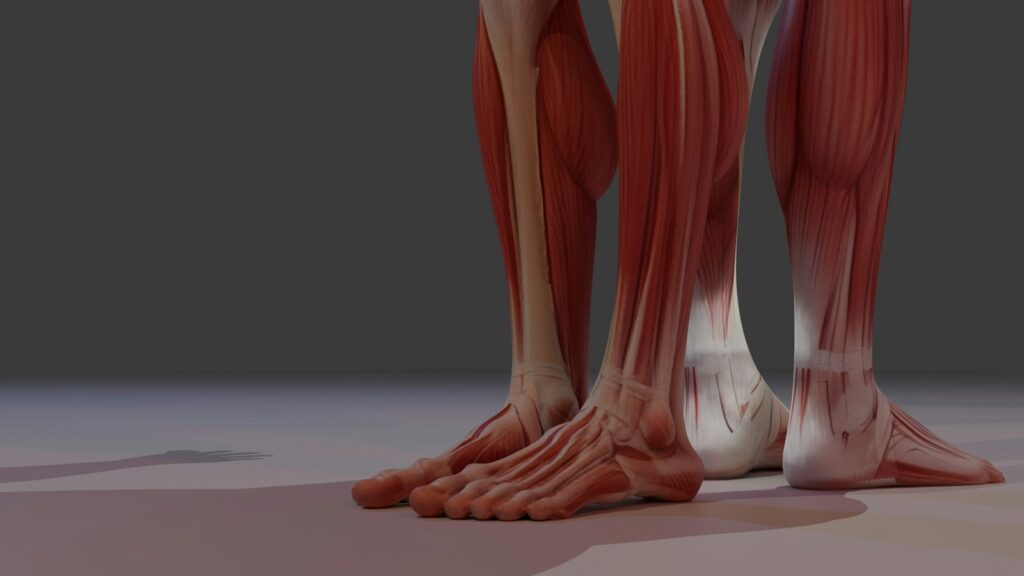
Your calf has two main muscles:
- Gastrocnemius: the large, diamond-shaped muscle you can see. It crosses both your ankle and your knee, so it works hardest when your knee is straight.
- Soleus: a flatter muscle underneath. It only crosses your ankle, so it works whether your knee is straight or bent.
That’s the reason the standing vs seated question matters. Bend your knee, and the gastrocnemius goes slack and can’t do as much.
Standing vs seated calf raises: what the research says
In a 12-week study, 14 adults trained one leg with standing calf raises and the other with seated calf raises. Both legs did 5 sets of 10 reps, twice a week (Kinoshita et al., 2023).
| Muscle | Standing calf raise | Seated calf raise |
|---|---|---|
| Inner gastrocnemius | +9.2% | +0.6% |
| Outer gastrocnemius | +12.4% | +1.7% |
| Soleus | +2.1% | +2.9% |
| Whole calf | +5.6% | +2.1% |
The standing leg grew much more. The soleus grew about the same in both. The authors concluded that standing calf raises were “by far more effective” (Kinoshita et al., 2023).
The study used untrained adults, so the gap might be smaller for experienced lifters. Even so, standing calf raises should be the base of your calf training. Seated raises are an extra, not a replacement.
The stretch at the bottom matters most
The bottom of a calf raise, with your heels below the step, is where your calves are stretched. Training in that position seems to build the most muscle.
- In an 8-week trial with 42 young women, partial reps in the bottom half of the movement grew the inner gastrocnemius by 15.2%, compared with 6.7% for full reps and 3.4% for top-half partials (Kassiano et al., 2023).
- In 23 trained lifters, bottom-half partials and partials done past failure at the top both grew the calves well. Bottom-half partials had a small, uncertain edge (Larsen et al., 2025).
My takeaway: don’t skip the stretch. Lower your heels as far as is comfortable, pause there for a second, then push up. When you can’t do any more full reps, add a few partial reps from the bottom.
How many sets do you need?
In a 6-week study, 61 untrained women did 6, 9 or 12 sets of calf raises a week. The 12-set group grew their calves significantly more than the 6-set group. The 9-set group was close behind the 12-set group (Int J Sports Med, 2024; StrengthLog summary).
That’s 3 to 4 sets per session if you train calves 3 times a week, or 5 to 6 sets per session if you train them twice a week.
How to do a standing calf raise
Setup
- Stand on a step, plate or calf raise machine with the balls of your feet on the edge and your heels hanging off. You can also use the machine standing calf raise.
- Keep your knees straight but not locked.
- Hold a rail, the machine handles or a dumbbell for balance.
The movement
- Lower your heels as far as is comfortable until you feel a stretch in your calves.
- Pause for 1 to 2 seconds at the bottom.
- Push through the balls of your feet and rise as high as you can.
- Squeeze for a second at the top, then lower slowly.
Coaching cues: “Heels down, pause, then up.” “Push through your big toe.” “No bouncing.”
How to do a seated calf raise
- Sit on the machine with the pad resting on your lower thighs, just above your knees.
- Place the balls of your feet on the platform, heels hanging off.
- Lower your heels into a deep stretch and pause.
- Push up as high as you can, squeeze, then lower slowly.
With your knees bent, this mainly works your soleus. Use it after standing calf raises, not instead of them.
Common mistakes
- Bouncing. Using the spring in your Achilles tendon instead of your calf muscles. Pause at the bottom of every rep.
- Half reps at the top. Skipping the stretch, which is the part that seems to build the most muscle.
- Too much weight. If you can’t get a full stretch and a full squeeze, go lighter.
- Bending your knees on standing raises. That shifts the work away from the gastrocnemius. Keep your knees straight.
- Rushing. Take about 2 seconds up, a 1-second squeeze, 2 seconds down and a 1- to 2-second pause.
- Only training calves once in a while. Two or three sessions a week work better than one rushed set at the end of leg day.
A simple calf workout
| Exercise | Sets | Reps | Notes |
|---|---|---|---|
| Standing calf raise | 3 to 4 | 10 to 15 | Pause 1 to 2 seconds at the bottom |
| Seated calf raise | 2 | 15 to 20 | Optional, for the soleus |
| Bottom-half partials | 1 finisher | To failure | After your last standing set |
Do this 2 to 3 times a week, for about 9 to 12 standing sets in total. Take each set close to failure (see training to failure). When you hit the top of the rep range on every set, add weight. That’s progressive overload.
Summary
- Your calves are the gastrocnemius and the soleus. Standing raises work both, and seated raises mainly work the soleus.
- Standing calf raises built far more calf muscle than seated raises in a 12-week study.
- Lower into a deep stretch and pause at the bottom of every rep.
- Aim for about 9 to 12 hard sets a week, over 2 or 3 sessions.
- Use 10 to 20 slow, full reps, then add weight over time.
Stop guessing on leg day
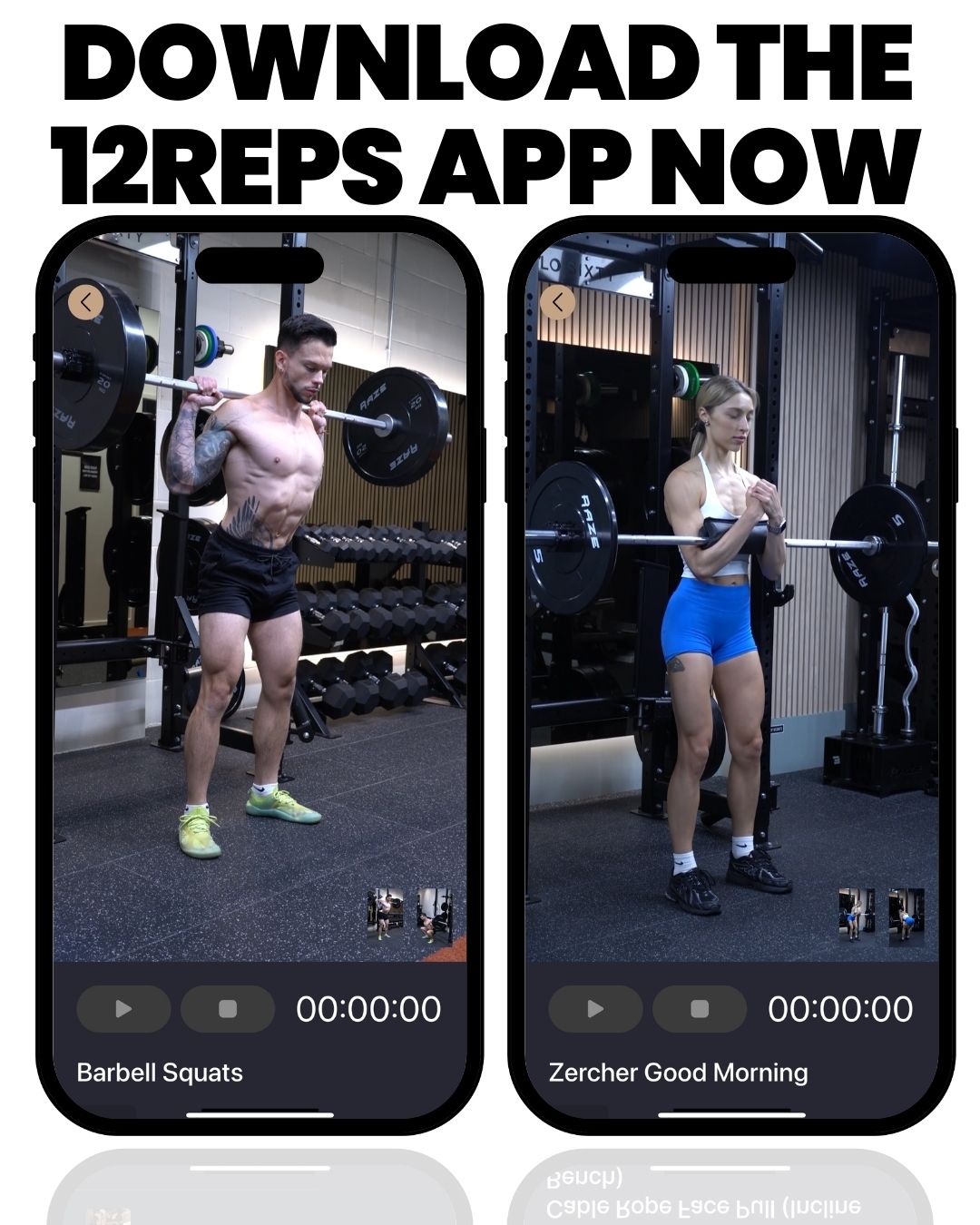
Calves grow with steady, progressive training, not random sets at the end of a workout. 12REPS gives you trainer-built programs with two demo videos for every exercise, and a gym log that shows what you lifted last time. You’ll know exactly when to add weight. New users get a 7-day free trial.
Download 12REPS and see what you’ll get:
Sources
- Kinoshita M et al. Triceps surae muscle hypertrophy is greater after standing versus seated calf-raise training. Front Physiol, 2023
- Kassiano W et al. Greater gastrocnemius muscle hypertrophy after partial range of motion training performed at long muscle lengths. J Strength Cond Res, 2023
- Larsen S et al. Resistance training beyond momentary failure: past-failure partials versus initial partials on calf muscle hypertrophy. Eur J Sport Sci, 2025
- Bigger calves from doing higher resistance training volume? Int J Sports Med, 2024
- StrengthLog. New study: grow stubborn calves with high-volume training
Related reading
- 5 leg exercises that actually grow your legs
- Dumbbell leg day: 4 simple moves
- Get stronger legs with gym machines
- Why training your legs could add years to your life
- The beginner’s guide to progressive overload
I’m Will Duru, a personal trainer and the founder of 12REPS. I hold a BSc (Hons) in Sport and Exercise Science and have more than a decade of experience coaching people in strength training.