



By Will Duru, personal trainer and founder of 12REPS.
The Short Answer
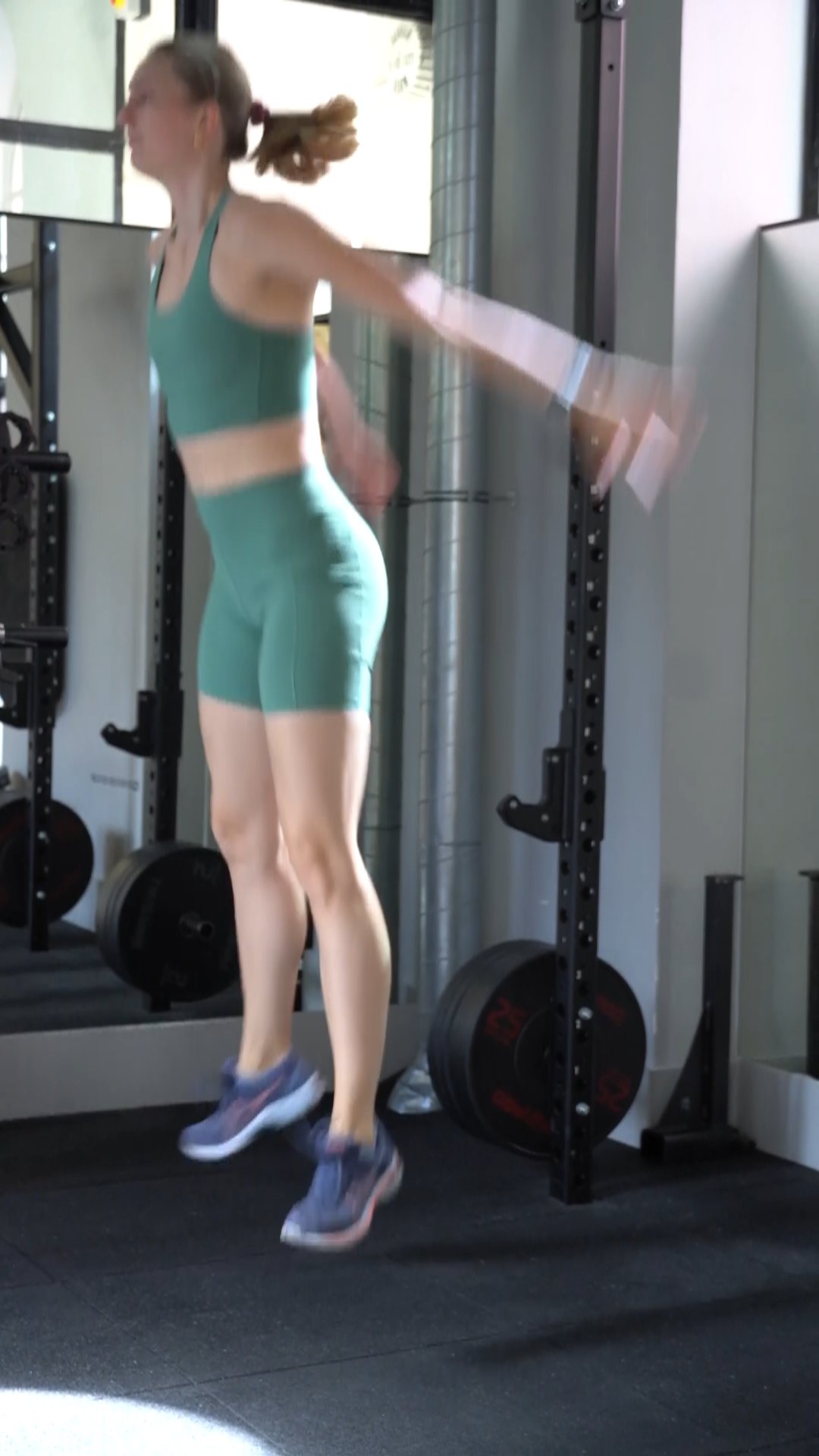
A jump squat is a squat where you drive up fast enough to leave the floor, then land softly and repeat. It trains power, the ability to produce strength quickly, which matters for sprinting, jumping and many sports.
Jump squats are worth adding if your goal is power or athleticism. For building muscle and maximum strength, regular squats with heavier weights still do most of the work.

What the Research Says
- Jump training improves jump height. A 2007 meta-analysis by Markovic in the British Journal of Sports Medicine found plyometric training improved squat jump height by about 4.7% and countermovement jump height by about 8.7%.
- Jump squats can build strength too. In a 6-week study by Lake and Lauder, young men trained twice a week with either jump squats or kettlebell swings. Across both groups, half squat strength improved by about 9.8% and jump height by about 19.8%, with no significant difference between the two training types.
These studies mostly used young, healthy people. If you’re older or new to exercise, the same idea applies, but start with lower jumps and fewer reps. See strength training after 60.
How to Do a Jump Squat
- Stand with your feet about shoulder-width apart, toes turned out slightly.
- Push your hips back and bend your knees into a quarter or half squat, swinging your arms back.
- Drive through your whole foot and jump straight up, swinging your arms forward and up.
- Land softly on the balls of your feet, then let your heels come down as you bend your knees and hips.
- Pause, reset your position, then jump again.

Coaching cues I use:
- “Land quietly.” Loud landings usually mean stiff knees.
- “Knees over toes.” Keep your knees in line with your feet when you land, not caving in.
- “Jump for height, not for reps.” Every jump should be fast and high.
Jump Squat Variations
| Variation | Level | Why use it |
|---|---|---|
| TRX jump squat | Beginner | Straps help with balance and landing |
| Bodyweight jump squat | Beginner to intermediate | The standard version |
| Dumbbell jump squat | Intermediate | Adds load for more strength and power |
| Box jump | Intermediate | Softer landing on the box |
TRX Jump Squat
Holding the straps takes some of your weight and helps you control the landing. A good place to start. See TRX workout for beginners.
Dumbbell Jump Squat
Hold light dumbbells at your sides. Keep the weight light, around 10–20% of what you’d use for a normal squat, so you can still jump fast.
Want an easier landing? Try box jumps, where you land on a box instead of the floor.
How to Program Jump Squats
These are my coaching recommendations, not rules from the research:
- For power: 3–5 sets of 3–6 reps with full rest (about 1–2 minutes). Do them at the start of a leg workout.
- For conditioning: Short intervals, like 20 seconds on and 40 seconds off. See this HIIT workout.
- Frequency: 1–2 times a week is plenty for most people.
- Stop the set when your jumps get noticeably lower or your landings get loud.
Who Should Be Careful?
- People with current knee, ankle or back pain. Get it checked first.
- Beginners who can’t yet do a controlled bodyweight squat. Build that first with a goblet squat.
- Anyone who is very deconditioned. Start with small jumps or step-ups.
Common Mistakes
- Landing with straight legs. Always land with bent knees and hips.
- Knees caving in on landing. Push your knees out in line with your toes.
- Doing too many reps. Tired jumps are slow jumps. Keep sets short.
- Going too heavy with weights. If you can’t jump fast, the load is too heavy.
- Skipping the warm-up. Do a few sets of squats and small jumps first.
Summary
- Jump squats train power by squatting and jumping as high as you can.
- Research shows jump training improves jump height, and jump squats can improve strength too.
- Land softly, keep your knees in line with your toes and keep sets short.
- Start with TRX or bodyweight versions, then add light dumbbells.
- Use 3–5 sets of 3–6 reps at the start of a workout, once or twice a week.
Add Power to Your Training With 12REPS
In 12REPS, pick your workout time and the equipment you have, and the app builds a session that fits, including power moves like jump squats when they suit your goal.
Every exercise has a demo and a coach tutorial from me, and your log shows what you did last time, so you know when to progress.
Download 12REPS and see what you’ll get:
Sources
- Markovic G. Does plyometric training improve vertical jump height? A meta-analytical review. Br J Sports Med. 2007;41(6):349–355.
- Lake JP, Lauder MA. Kettlebell swing training improves maximal and explosive strength. J Strength Cond Res. 2012;26(8):2228–2233.
Related Reading
- Box jumps
- How to do a kettlebell swing
- Knees past toes when squatting
- Equipment-free lower body workouts
- Strength training after 60
I’m Will Duru, a personal trainer and the founder of 12REPS. I hold a BSc (Hons) in Sport and Exercise Science and have more than a decade of experience coaching people in strength training. This article is for general education and isn’t medical advice.
