
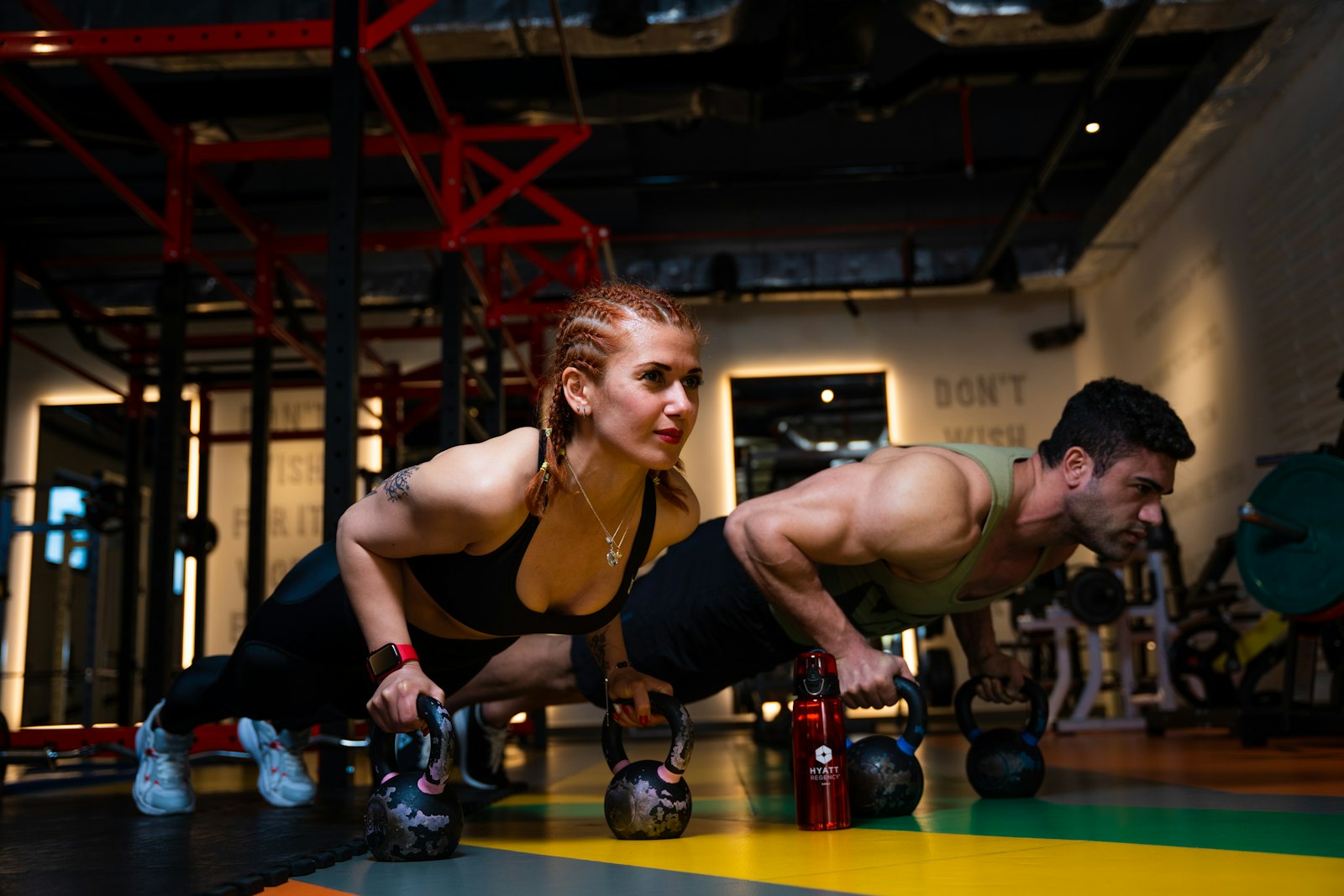



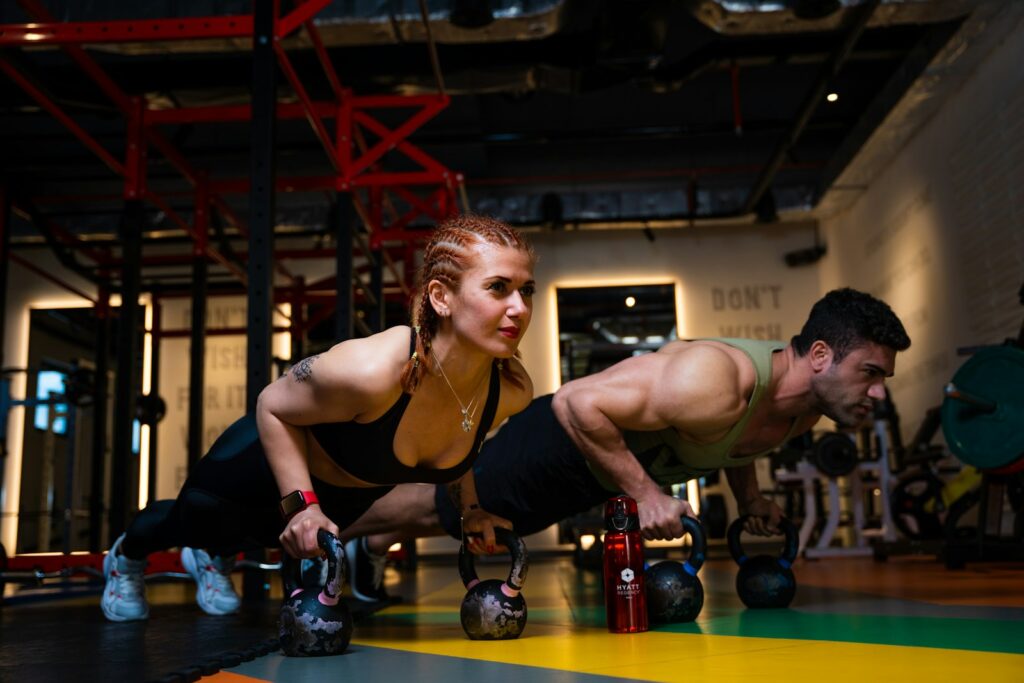
The short answer: a renegade row is a one-arm row done from a high plank, with your hands on a pair of kettlebells or dumbbells. It works your upper back, lats and biceps, and it makes your core work hard to stop your body twisting as you lift one hand. It’s best thought of as a core exercise with a row attached. It’s great for core strength and full-body control, but it isn’t the best way to build a bigger back, because the plank limits how much weight you can row. Use a wide stance, flat-sided weights and a weight you can row without your hips rotating.
This guide is for anyone who has tried renegade rows and felt wobbly, or anyone wondering if they’re worth adding to a program. I’ll cover what they work, what the research suggests, how to do them, common mistakes, easier and harder versions, and where they fit.
What muscles do renegade rows work?
| Area | What it does |
|---|---|
| Lats and upper back | Pull the weight up toward your hip |
| Rear delts and biceps | Help with the row |
| Obliques and deep core | Stop your body rotating when one hand leaves the floor |
| Abs and glutes | Hold a straight plank from head to heels |
| Chest, front shoulders and triceps | Support your body weight through the hand on the floor |
What the research says
I couldn’t find any study on the renegade row itself. But research on one-arm exercises helps explain why it challenges your core.
- One-arm loads make your core work harder. A 2012 study of 15 healthy men compared one-arm and two-arm dumbbell shoulder presses, seated and standing, at 80% of max. Standing one-arm presses produced far more external oblique activity than two-arm presses, with the two-arm version about 68% lower. The authors recommended standing and one-arm exercises to work the core muscles more.
That study used presses, not rows. But the idea is the same: when the weight is on one side, your core has to work to keep you square. The renegade row takes that further because you’re also holding a plank on one hand. The rest of this guide is based on my coaching experience.
How to do a renegade row
Setup
- Place two kettlebells or hex dumbbells on the floor about shoulder width apart. Use weights with flat sides that won’t roll.
- Grip the handles and set up in a high plank, wrists straight and stacked under your shoulders.
- Spread your feet wider than hip width. A wider stance makes it much easier to stay square.
- Squeeze your glutes and brace your stomach so your body forms a straight line from your head to your heels.
The row
- Shift a little weight onto your left hand without letting your hips move.
- Row the right weight up toward your hip, keeping your elbow close to your body.
- Pause briefly at the top, then lower the weight under control to the floor.
- Repeat on the other side. One rep on each side counts as one rep.
Coaching cues I use: “hips stay square to the floor,” “push the floor away with the support hand” and “row to your hip, not your chest.” Imagine a glass of water balanced on your lower back. If it would spill, the weight is too heavy or your feet are too close together.

Common mistakes and how to fix them
| Mistake | Why it matters | Fix |
|---|---|---|
| Hips rotating toward the rowing arm | The core work disappears and the row becomes a twist | Widen your feet and use a lighter weight |
| Feet too close together | Very hard to stay balanced | Set your feet wider than hip width |
| Hips sagging or piking up | Puts stress on your lower back or turns off your core | Squeeze your glutes and hold a straight plank |
| Using round dumbbells | They can roll and twist your wrist | Use kettlebells or hex dumbbells |
| Going too heavy | You can row more than you can stabilize | Pick a weight you can row with no hip movement |
| Rushing the reps | You use momentum and lose control | Pause at the top and lower slowly |
Easier and harder versions
| Level | Version | How it helps |
|---|---|---|
| Easiest | Plank shoulder taps | Teaches you to stay square with one hand off the floor, no weight needed |
| Easier | Renegade row from your knees | Reduces how much you need to stabilize |
| Easier | Hands on a bench | An incline takes some load off your arms and core |
| Standard | Renegade row with a wide stance | The main version |
| Harder | Narrower stance | Less base of support, so more core work |
| Harder | Renegade row with a push-up | One push-up between each pair of rows |
Here’s a demo of plank shoulder taps if you’re working up to the full exercise. My plank guide covers the basic plank position in more detail.
Are renegade rows good for building your back?
Not on their own. In a renegade row, the weight you can lift is limited by how well you can hold the plank, not by how strong your back is. Most people can row much more weight in a dumbbell row or a T-bar row. Use those for back size and strength, and use renegade rows for core strength and full-body control.
Sets, reps and where they fit
These are starting points I use with most people.
| Goal | Sets | Reps | Rest |
|---|---|---|---|
| Core strength | 3 | 6–8 per side | 60–90 seconds |
| Conditioning circuit | 2–4 | 8–10 per side | As part of a circuit |
I like renegade rows near the end of an upper-body or full-body session, or as part of a circuit. Do your main heavy lifts first while you’re fresh.
If you have wrist or shoulder pain in a plank, try the version with your hands on a bench, or swap in a one-arm dumbbell row with your other hand on a bench.
Summary
- A renegade row is a one-arm row from a high plank, with your hands on kettlebells or dumbbells.
- It works your upper back, lats and biceps, and challenges your core to stop you twisting.
- No study has looked at the renegade row directly, but one-arm loads are known to work the obliques harder.
- Use a wide stance, flat-sided weights and a weight you can row without your hips moving.
- Treat it as a core exercise. Use regular rows to build a bigger back.
Put renegade rows into a complete plan
Renegade rows are a great addition, but they work best alongside heavier rows and core work in a balanced program. That’s where 12REPS helps.
12REPS gives you trainer-built programs with two demo videos for every exercise, so you can check your setup and form. Build Your Routine lets you add renegade rows to your own week, the gym log shows what you used last time, and the built-in timer keeps your circuits and rest periods on track. Every new account starts with a 7-day free trial.
Download 12REPS and see what you’ll get:
Sources
Related reading
- How to Do a Plank Properly: Form, Hold Times and Variations
- How to Do a Dead Bug: A Beginner’s Guide to Core Stability
- Are Russian Twists Bad for Your Back?
- T-Bar Row vs Landmine Row
- Full Body Kettlebell Workout: 5 Moves
I’m Will Duru, a personal trainer and the founder of 12REPS. I hold a BSc (Hons) in Sport and Exercise Science and have more than a decade of experience coaching people in strength training.
