


Quick answer: The difference is your grip. A pull-up uses an overhand grip, with your palms facing away from you. A chin-up uses an underhand grip, with your palms facing you. Both work your lats (the big muscles down the sides of your back) about equally. Chin-ups work your biceps and chest a bit more, and pull-ups work your lower traps a bit more. Most people find chin-ups slightly easier. The best choice is the one you can do with good form, and over time it’s worth doing both.
This guide is for you if you’re working toward your first rep, or if you can already do a few and want to know which version to train. You’ll see how they compare, what the research says, how to do each one, the mistakes I see most and how to build up if you can’t do one yet.

Chin-ups vs pull-ups: what’s the difference?
| Pull-up | Chin-up | |
|---|---|---|
| Grip | Overhand, palms facing away | Underhand, palms facing you |
| Hand width | Usually just wider than your shoulders | Usually about shoulder-width |
| Lats | Worked hard | Worked hard |
| Biceps | Worked | Worked more |
| Chest (pecs) | Worked less | Worked more |
| Lower traps | Worked more | Worked less |
| Difficulty | Usually harder | Usually a little easier |
What the research says
- Lats work about the same. In a study of 25 people, lat activity didn’t differ between pull-ups and chin-ups. Chin-ups produced more biceps and chest activity. Pull-ups produced more lower-trap activity (Youdas et al., 2010).
- Grip changes small details. In 19 strength-trained men, an overhand grip worked the middle traps harder than a neutral grip (palms facing each other). Otherwise, muscle activity was similar across grips (Dickie et al., 2016).
- Chin-ups vs lat pulldowns. Chin-ups produced more biceps and lower-back activity than lat pulldowns during the pulling phase (Doma et al., 2013).
These studies measured muscle activity with sensors on the skin (EMG). That shows which muscles work harder during the movement. It doesn’t prove which exercise builds more muscle over months.
Which is easier?
For most people, chin-ups feel easier. Your biceps can help more with your palms facing you, which fits the higher biceps activity in the research above. No study I found directly compared how many reps people can do of each, so treat this as a common pattern, not a rule.
My advice: if you can’t do either yet, start with chin-ups. Your first rep usually comes sooner, and the strength carries over to pull-ups.
How to do a pull-up
Setup
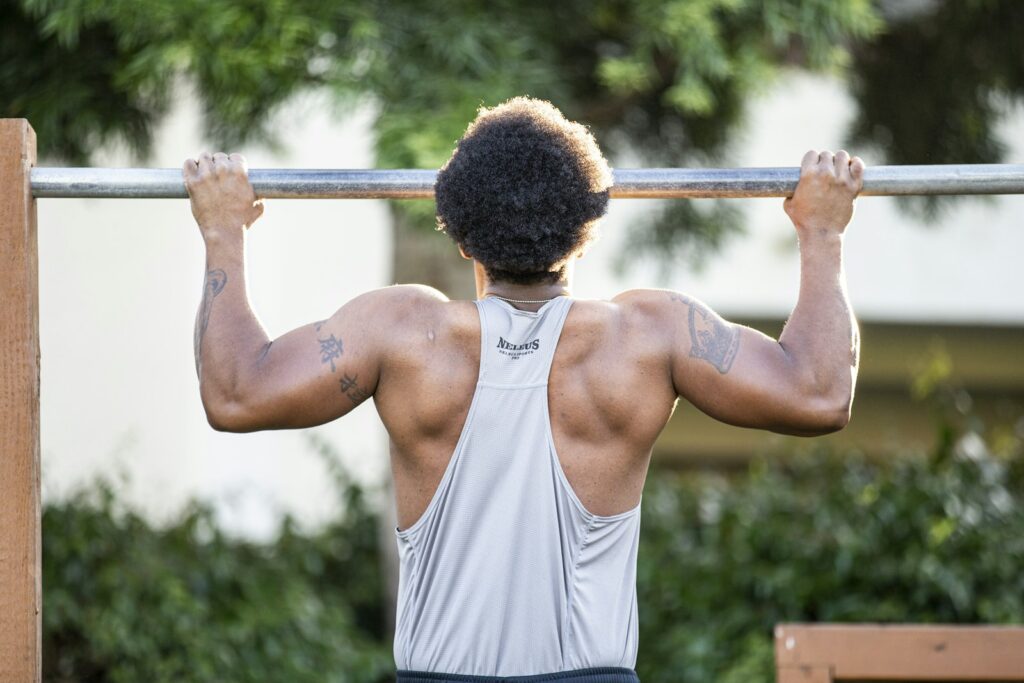
- Grab the bar with an overhand grip, hands just wider than your shoulders.
- Hang with your arms straight. Squeeze your glutes and brace your stomach so your body doesn’t swing.
- Pull your shoulders down and away from your ears before you start.
The movement
- Pull your elbows down toward your back pockets.
- Keep pulling until your chin clears the bar.
- Lower yourself slowly, about 2 to 3 seconds, until your arms are straight again.
Coaching cues: “Elbows to your pockets.” “Chest up to the bar.” “Control the way down.”
Want more back focus? Try the wide-grip pull-up. Your hands go further out, and the range of motion is a little shorter.
How to do a chin-up
- Grab the bar with an underhand grip, hands about shoulder-width apart.
- Hang with your arms straight, glutes and stomach tight.
- Pull your shoulders down, then drive your elbows down and in toward your ribs.
- Pull until your chin clears the bar.
- Lower slowly until your arms are straight.
Coaching cues: “Elbows into your ribs.” “Lead with your chest.” “Full hang at the bottom.”
Common mistakes
- Half reps. Stopping short at the bottom or top. Start each rep from a full hang and finish with your chin over the bar.
- Swinging or kicking. Using momentum takes work away from your back. Squeeze your glutes and keep your legs still.
- Shrugging. Letting your shoulders creep up to your ears. Pull them down before each rep.
- Dropping fast. The lowering phase builds strength too. Take 2 to 3 seconds on the way down.
- Reaching with your chin. Craning your neck to get over the bar. Pull your chest toward the bar instead.
Can’t do one yet? Build up to it
Most people need to build up to their first pull-up or chin-up. These steps help:
- Lat pulldown. Builds the same pulling pattern with a weight you can choose. See the lat pulldown demo.
- Assisted chin-up machine or band. Takes some of your body weight so you can practice the full movement.
- Inverted rows. Pull your chest to a bar or rings with your feet on the floor. See the ring row demo.
- Negatives. Jump or step up so your chin is over the bar, then lower yourself as slowly as you can. Do 3 to 5 reps.
- Dead hangs. Hang from the bar for 20 to 30 seconds to build grip strength.
For a full step-by-step plan, read my guide on how to do your first pull-up, from zero to 10 reps.
Which should you do?
| Your goal | My pick |
|---|---|
| Your first rep | Chin-ups |
| Bigger arms | Chin-ups, for the extra biceps work |
| Wider back | Both. Lats work about equally in each |
| Upper-back posture | Pull-ups, for the extra trap work |
| Balanced strength | Alternate them, or do both in the same week |
Sets and reps
| Your level | How to train it |
|---|---|
| Can’t do one yet | 3 sets of 6 to 10 assisted reps or lat pulldowns, plus 3 slow negatives |
| 1 to 5 reps | 4 to 5 sets of 1 to 3 reps, stopping 1 or 2 reps before failure |
| 6 to 12 reps | 3 sets of 6 to 10 reps |
| More than 12 reps | Add weight with a belt or a dumbbell between your feet |
Train them 2 to 3 times a week, with at least a day in between. Rest 2 to 3 minutes between sets, so each set gets your best effort (see how long to rest between sets). When you hit the top of your rep range on every set, add a rep or a little weight next time. That’s progressive overload.
Summary
- Pull-ups use an overhand grip. Chin-ups use an underhand grip.
- Both work your lats about equally.
- Chin-ups work your biceps and chest more and are usually a little easier.
- Pull-ups work your lower traps more.
- Start with chin-ups if you can’t do either yet, and build up with pulldowns, assisted reps and negatives.
- Use full reps and a slow lowering phase, and add reps or weight over time.
Get your first pull-up with a plan
Pull-ups come from steady progress, week after week. 12REPS gives you trainer-built programs with pull-ups, chin-ups, pulldowns and rows. Every exercise has two demo videos, and the gym log shows what you did last time, so you know when to add a rep or move to the next step. New users get a 7-day free trial.
Download 12REPS and see what you’ll get:
Sources
- Youdas JW et al. Surface electromyographic activation patterns and elbow joint motion during a pull-up, chin-up, or Perfect-Pullup rotational exercise. J Strength Cond Res, 2010
- Dickie JA et al. Electromyographic analysis of muscle activation during pull-up variations. J Electromyogr Kinesiol, 2016
- Doma K, Deakin GB, Ness KF. Kinematic and electromyographic comparisons between chin-ups and lat-pull down exercises. Sports Biomech, 2013
Related reading
- How to do your first pull-up: from zero to 10 reps
- Lat pulldowns and pull-ups for women: technique guide
- Pull day workout: building a stronger back
- How to do face pulls
- How to build bigger arms
- The beginner’s guide to progressive overload
I’m Will Duru, a personal trainer and the founder of 12REPS. I hold a BSc (Hons) in Sport and Exercise Science and have more than a decade of experience coaching people in strength training.