

Quick answer: After 50, strength training is one of the most useful things you can do for your health. Research links it with a lower risk of early death, better blood sugar control, sharper thinking and fewer falls. Falls are the leading cause of injury death in adults 65 and older. Aim for two or more strength sessions a week that work your whole body, plus balance work. Start light, and add weight slowly.
This article is for you if you’re 50 or older, or you’re helping a parent stay strong. You don’t need gym experience.
I’ll explain what happens to your muscles as you age, and why that matters for your heart, metabolism, brain and balance. I’ll show you what the research says, and where it’s less certain. Then I’ll give you a simple two-day plan to start with.
Here’s the big idea. Muscle isn’t just for looks. It’s the tissue that lets you climb stairs, carry groceries, get up off the floor, and catch yourself when you trip. How long do you want to keep doing those things on your own?
What happens to your muscles as you age
The slow loss of muscle with age is called sarcopenia. Loss of strength is sometimes called dynapenia. They’re related, but they don’t move at the same speed.
A review of the research found that older adults lose muscle mass at a median of about 0.47% a year in men and 0.37% in women. By age 75, the rate rises to about 0.6% to 1% a year. Strength drops much faster, at about 2.5% to 4% a year at 75. Studies that measured both found strength fell 2 to 5 times faster than muscle size (Mitchell et al., 2012).
The same review found that losing strength was a more consistent risk for disability and death than losing muscle size.
That’s why I care more about what you can lift than how big your arms look. The good news? Muscle responds to training at any age. You won’t stop aging, but you can slow down what it takes from you.
Strength training and living longer
Can lifting weights help you live longer? The research points that way, with one important limit.
- Less risk of early death. A 2022 review pooled 16 large studies. People who did muscle-strengthening activities had a 10% to 17% lower risk of dying from any cause. They also had lower risk of heart disease, cancer and diabetes (Momma et al., 2022).
- You don’t need hours. The biggest benefit showed up at about 30 to 60 minutes of strength work a week. That’s two short sessions.
- Strength matters on its own. A study of almost 140,000 adults in 17 countries measured grip strength. Every 5 kg (11 lb) drop in grip strength was linked with a 16% higher risk of death from any cause. Grip strength predicted death better than blood pressure did (Leong et al., 2015).
The limit: these are observational studies. They show that strong, active people tend to live longer. They can’t prove that lifting alone caused it. People who lift may also eat better, sleep more or smoke less. The same review also found that more wasn’t always better. Benefits leveled off, and the effect of very high amounts of strength training was unclear.
So I won’t tell you strength training will add a set number of years. I’ll tell you this: being strong is one of the clearest signs of good health we can measure, and training is how you build it.
Muscle and metabolic health
Metabolic health is how well your body handles blood sugar, fat and blood pressure. Muscle plays a big part.
Muscle soaks up blood sugar. After a meal, your muscles handle most of the sugar that leaves your blood. Researchers estimate skeletal muscle is responsible for 70% to 80% of glucose clearance after eating (Hoolachan et al., 2025). Less muscle means less room to store that sugar.
Training improves blood sugar control. A 2025 review looked at 13 trials of women, average age 45 or older, who had type 2 diabetes and overweight. Resistance training lowered their fasting blood sugar by about 21 mg/dL. It lowered HbA1c, a three-month average of blood sugar, by 0.66 percentage points. It also improved cholesterol, diastolic blood pressure and body fat (Liu et al., 2025).
It’s linked with less diabetes. In the 2022 review above, muscle-strengthening activities were linked with a lower risk of developing type 2 diabetes (Momma et al., 2022).
If you already have diabetes or take blood sugar medicine, talk to your doctor before you start. Training can lower blood sugar, so your medicine may need adjusting.
Muscle and brain health
Can lifting weights help your memory and thinking? There’s good evidence that exercise helps, and strength training is part of it.
- Exercise improves thinking after 50. A review of 39 trials in adults over 50 found that exercise improved cognitive function. Aerobic exercise, resistance training, tai chi and mixed programs all helped. Sessions of 45 to 60 minutes at moderate intensity or higher worked best (Northey et al., 2018).
- Strength training helped people with memory problems. The SMART trial followed 100 adults, average age 70, with mild cognitive impairment. That’s a stage of memory and thinking problems that raises the risk of dementia. Six months of high-intensity strength training, 2 to 3 days a week, improved overall cognitive scores. The benefits to planning and decision-making lasted 18 months (Fiatarone Singh et al., 2014).
A fair caveat: the effects in these studies were modest, and the SMART trial was small. Strength training isn’t a cure for dementia. But it’s a low-risk habit with real upside for your brain, and it helps the rest of your body at the same time.
The review authors suggested doing both aerobic and resistance exercise, at least at moderate effort, on as many days as you can manage.
Why falls are so dangerous after 65
Falls are the leading cause of injury, and of injury-related death, in adults 65 and older in the U.S. Heart disease and cancer still cause more deaths overall. But no other injury kills as many older adults as a fall.
The CDC’s numbers (CDC):
- More than 14 million older adults, about 1 in 4, report a fall every year.
- The fall death rate was 78.4 per 100,000 older adults in 2024.
- That’s 21% higher than in 2018, when it was 64.7 per 100,000.
Why does a fall hit harder at 75 than at 35? Weaker legs make it harder to catch yourself when you trip. Slower reactions give you less time to step out of it. Weaker bones break more easily when you land. And after a bad fall, many people move less because they’re afraid of falling again. That makes them weaker, which makes the next fall more likely.
Can exercise prevent falls?
Yes, and this is some of the strongest evidence in this article. A Cochrane review of 108 trials in adults 60 and older living at home found (Sherrington et al., 2019):
| Type of exercise | Drop in the rate of falls | Certainty of evidence |
|---|---|---|
| Any exercise | 23% fewer falls | High |
| Balance and functional exercise | 24% fewer falls | High |
| Several types combined, usually balance plus strength | 34% fewer falls | Moderate |
| Strength training on its own | Unclear | Not enough trials |
Notice the last two rows. Strength training on its own wasn’t clearly shown to cut falls. Strength plus balance did best. So the plan below includes both.
If bone health is a worry for you, read my guide on improving bone density after menopause.
What type of training should you do after 50?
What the guidelines say. U.S. guidelines ask adults to do muscle-strengthening activities on 2 or more days a week, plus at least 150 minutes of moderate aerobic activity, like brisk walking. For older adults, they recommend multicomponent activity that includes balance training (Piercy et al., 2018). A 2025 global expert consensus also recommends a mix of aerobic, resistance, balance and flexibility training. It calls progressive resistance training “indispensable” for older adults (Izquierdo et al., 2025).
“Progressive” means the work gets a little harder over time. That’s the part most people skip.
How I’d put that into a week:
| What | How often | Examples |
|---|---|---|
| Strength training | 2 to 3 days a week | Squats, hinges, pushes, pulls, carries |
| Balance work | Most days, a few minutes | Single-leg stands, step-ups, heel-to-toe walking |
| Aerobic activity | 150 minutes a week in total | Brisk walking, cycling, swimming |
A simple two-day strength plan
Do each session on a different day, with at least one rest day between them. Do 2 sets of each exercise for the first few weeks, then 3. Stop each set when you could still do 2 or 3 more good reps. Rest 60 to 90 seconds between sets.
Day A
| Exercise | Reps |
|---|---|
| Dumbbell goblet squat | 8 to 10 |
| Elevated press-up | 6 to 10 |
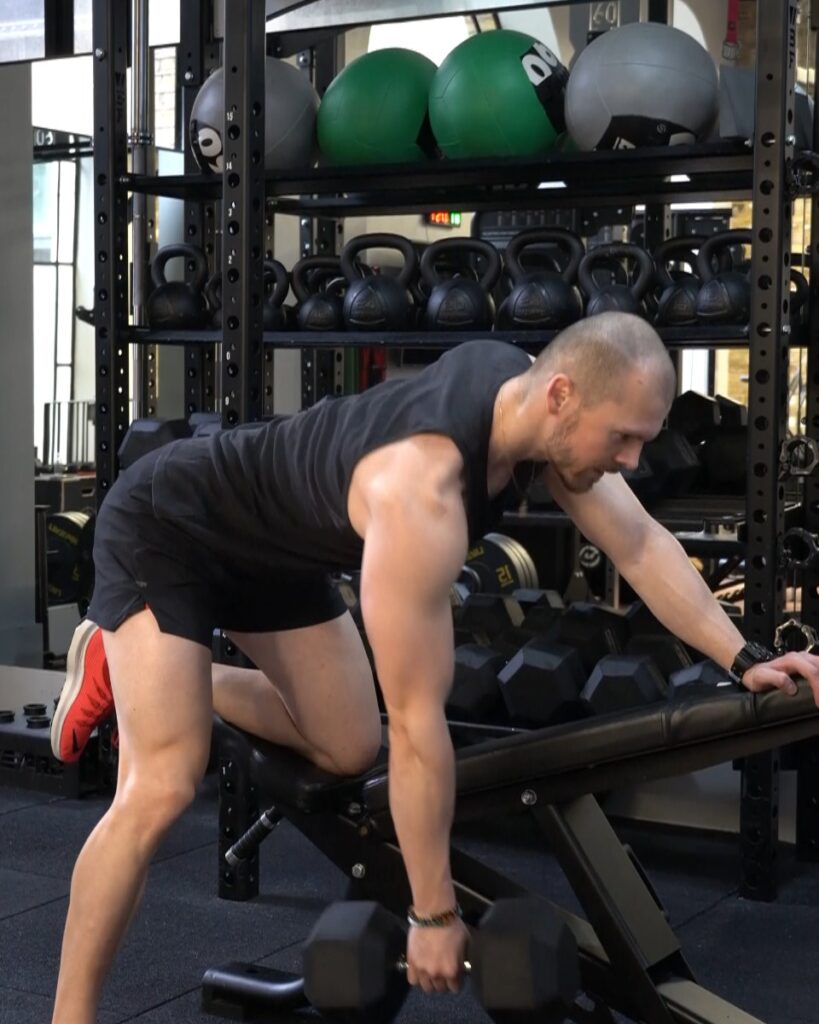
| Dumbbell single-arm row | 8 to 10 each side |
| Bodyweight step-up | 6 to 8 each leg |
| Dumbbell farmer’s carry | 20 to 30 seconds |
Dumbbell goblet squat
Elevated press-up
Dumbbell single-arm row
Bodyweight step-up
Dumbbell farmer’s carry
Day B
| Exercise | Reps |
|---|---|
| Dumbbell Romanian deadlift | 8 to 10 |
| Seated dumbbell shoulder press | 8 to 10 |
| Dumbbell bent-over row | 8 to 10 |
| Glute bridge | 10 to 12 |
| Side plank from the knees | 15 to 30 seconds each side |
Dumbbell Romanian deadlift
Seated dumbbell shoulder press
Dumbbell bent-over row
Glute bridge
Side plank
Finish both days with 3 minutes of balance work. The side plank video shows the full version, so drop to your knees until that feels easy. Then stand on one leg for 20 to 30 seconds per side, near a counter you can hold. Then walk heel-to-toe in a straight line for 10 steps, there and back. When that’s easy, try it with your eyes closed, still near the counter.

Why these exercises? Each one matches something you do in daily life. Squats help you get out of a chair. Step-ups help with stairs. Deadlifts help you pick things up off the floor. Carries help with groceries. Rows and presses help you lift things onto a shelf. I’d rather you get strong at those than at any one gym lift.
How to start safely
- Check with your doctor first if you have heart disease, high blood pressure, diabetes, osteoporosis, a recent surgery or joint replacement, or you’ve had a fall in the past year.
- Start lighter than you think. For the first two weeks, pick weights that feel easy. You’re learning the movements and letting your joints and tendons catch up.
- Add weight slowly. When you can do every rep of every set with good form, go up one dumbbell size next time. Small steps, often.
- Train near support. Do balance work beside a counter or wall. Use a sturdy bench for step-ups.
- Expect some muscle soreness. Mild soreness for a day or two is normal. Sharp pain, chest pain, dizziness or shortness of breath is not. Stop and get checked.
- Be consistent. Two sessions a week, every week, will do more than five sessions one week and none the next.
What if you’ve never lifted before? That’s fine. Most people I see in their 50s and 60s start with bodyweight squats to a chair and press-ups against a counter. You can too.
Summary
- After 50, you lose strength faster than you lose muscle size. Strength is what keeps you independent.
- Muscle-strengthening activity is linked with a 10% to 17% lower risk of early death, with the biggest benefit at 30 to 60 minutes a week.
- Muscle handles most of the blood sugar from your meals. Resistance training improves blood sugar control.
- Exercise, including strength training, improves thinking and memory in adults over 50.
- Falls are the leading cause of injury death in adults 65 and older. Exercise that combines balance and strength cut falls by about a third in trials.
- Train your whole body 2 to 3 days a week, add a few minutes of balance work, and walk on most days.
Start your plan with 12REPS
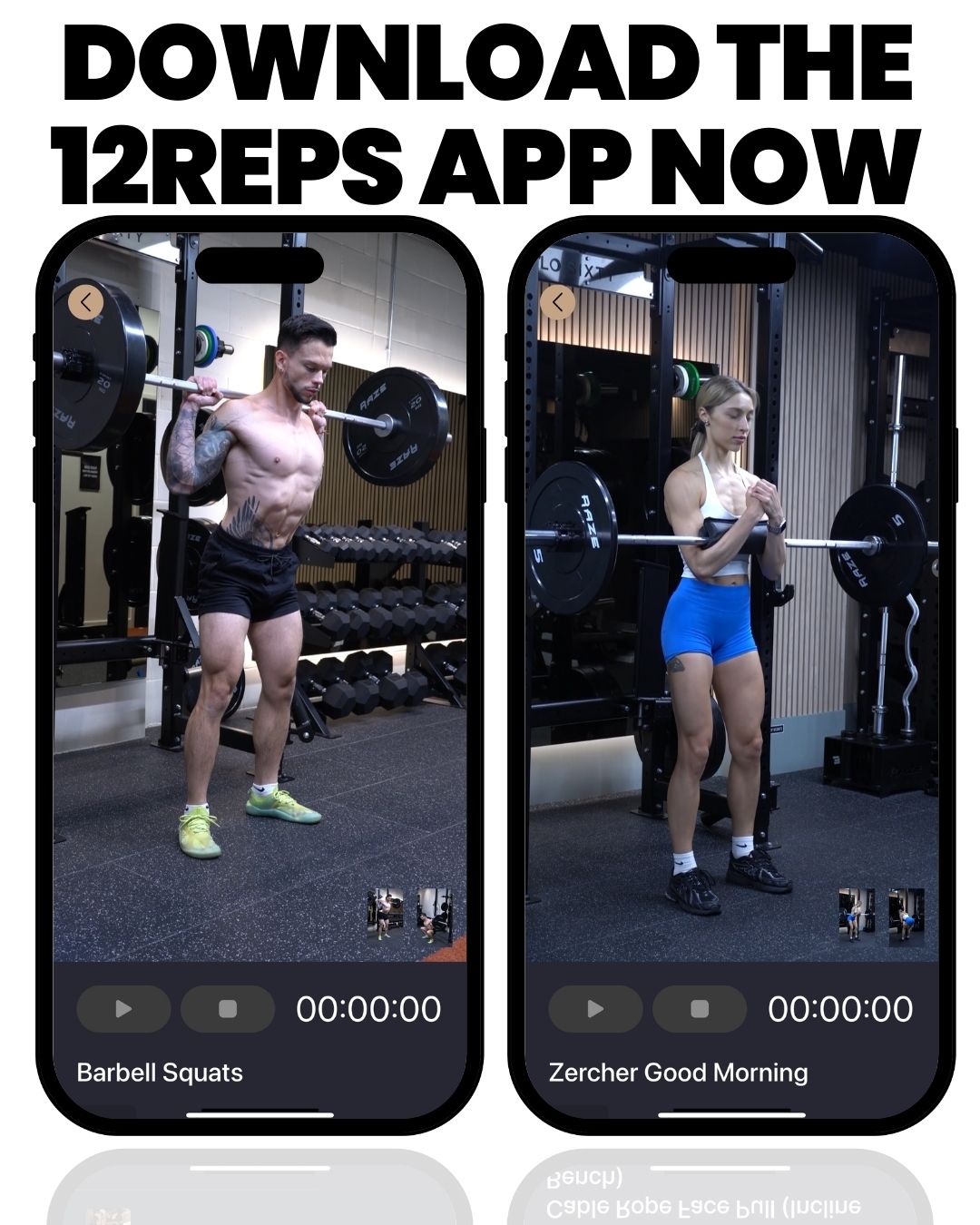
Knowing what to do is the easy part. Doing it every week is harder. In the 12REPS app, every exercise has two demo videos, so you can check your form. Your gym log shows what you lifted last time, and the app tells you when it’s time to add weight. You can set up the two days above in Build Your Routine, or follow a trainer-built 6 to 12 week program. New users get a 7-day free trial.
Download 12REPS and see what you’ll get:
Sources
- Mitchell WK et al. Sarcopenia, dynapenia, and the impact of advancing age on human skeletal muscle size and strength; a quantitative review. Front Physiol, 2012
- Momma H et al. Muscle-strengthening activities are associated with lower risk and mortality in major non-communicable diseases: a systematic review and meta-analysis. Br J Sports Med, 2022
- Leong DP et al. Prognostic value of grip strength: findings from the Prospective Urban Rural Epidemiology (PURE) study. Lancet, 2015
- Hoolachan JM et al. TAS1R3 regulates GTPase signaling in human skeletal muscle cells for glucose uptake. Int J Mol Sci, 2025
- Liu R et al. The effects of resistance training on glycemic control, cardiometabolic health, and body composition in middle-aged and older women with type 2 diabetes. Maturitas, 2025
- Northey JM et al. Exercise interventions for cognitive function in adults older than 50: a systematic review with meta-analysis. Br J Sports Med, 2018
- Fiatarone Singh MA et al. The Study of Mental and Resistance Training (SMART) study. J Am Med Dir Assoc, 2014
- CDC. Older Adult Falls Data
- Sherrington C et al. Exercise for preventing falls in older people living in the community. Cochrane Database Syst Rev, 2019
- Piercy KL et al. The Physical Activity Guidelines for Americans. JAMA, 2018
- Izquierdo M et al. Global consensus on optimal exercise recommendations for enhancing healthy longevity in older adults (ICFSR). J Nutr Health Aging, 2025
Related reading
- Lifting weights at 50: the complete guide
- Strength training after 60: a safe guide for beginners
- Can you really improve bone density after menopause?
- How to do a goblet squat
- How to do a farmer’s carry
I’m Will Duru, a personal trainer and the founder of 12REPS. I hold a BSc (Hons) in Sport and Exercise Science and have more than a decade of experience coaching people in strength training.