


To track your workouts, write down the exercise, the weight, and the reps for every working set, with the date, in the same place each session. Before you train, check last session’s numbers and aim to beat one of them. Once a week, review your log to decide what to change.
Without a log, most people guess. Was it 50 kg or 52.5 kg last week? Guessing often means lifting roughly the same weights for months.
I’m Will Duru, a personal trainer with more than 10 years of experience in London. This is a step-by-step method for keeping a simple training log and using it to progress. If you want the reasons first, read why a workout tracker helps you progress.
Step 1: Choose where you will log
All three options work if you use them every session. Pick the one you will actually keep.
| Method | Good for | Watch out for |
|---|---|---|
| Notebook | No battery, no setup, quick to flip back a week | Hard to spot trends over months, can get damaged |
| Spreadsheet | Charts, easy to copy for a new training block, easy to share with a coach | Fiddly to fill in on a phone between sets |
| Workout app | Shows last session’s numbers while you train, backs up your data | Notifications can distract you; pick one built for strength training |
A notebook is the simplest option, and it works well. The method matters less than the habit.
Step 2: Log the essentials
Record these four things for every exercise, every session.
1. Exercise name
Be specific so you compare like with like. Write “barbell back squat,” not “squat.” Note the variation and the machine if your gym has more than one, for example “incline dumbbell bench press” or “45-degree leg press.”
2. Weight
- Barbell: the total weight, including the bar, for example 60 kg.
- Dumbbells: the weight of each dumbbell, for example 12 kg dumbbells.
- Machines and cables: the weight on the stack and any seat or pin setting.
- Bodyweight: write “BW,” plus any added load such as a weight vest.
Be exact. Write 52.5 kg, not “about 50.”
3. Sets and reps
Write the reps for each set, not just the best one. “60 kg: 8, 8, 7” means three sets at 60 kg, with 8, 8 and 7 reps. A drop on the last set shows fatigue, which helps you plan the next session.
4. Date
The date shows how often you train each lift and how long it has been since you last trained a muscle group.
Step 3: Add effort if it helps
Once the basics are a habit, you can add one number for how hard a set felt. Reps in reserve (RIR) is how many more reps you could have done before failing. Zero RIR means you could not do another rep.
RIR comes from a resistance training effort scale based on reps in reserve. It is an estimate, not an exact score. A 2022 review on predicting reps to failure found people underestimated how many reps they had left by about one rep on average. Predictions got slightly more accurate closer to failure.
You do not need RIR for every exercise. Logging it for your main lifts is enough. Our guide to RPE versus RIR explains both scales.

A sample training log
Here is what four sessions of a lower body day might look like in a simple log. Each cell shows the weight, then the reps for each set.
| Exercise | Session 1 | Session 2 | Session 3 | Session 4 |
|---|---|---|---|---|
| Barbell back squat | 60 kg: 8, 8, 7 | 60 kg: 8, 8, 8 | 62.5 kg: 8, 7, 6 | 62.5 kg: 8, 8, 7 |
| Romanian deadlift | 50 kg: 10, 10, 9 | 50 kg: 10, 10, 10 | 52.5 kg: 10, 9, 8 | 52.5 kg: 10, 10, 9 |
In session 2 every squat set reached 8 reps, so the weight went up in session 3. The reps dropped at first, then started to climb again. That is progress, even though the reps went down for a week.
What you can skip
Some numbers take time to record but rarely change what you do next. Keep these optional.
- Exact rest times: a rough guide is enough for most people. See how long to rest between sets.
- Heart rate during lifting: useful for cardio, but not a good guide to how hard a set of squats was.
- Session length: it changes with how busy the gym is. What matters is whether you did the planned work.
- Soreness: it is not a reliable sign of a good session. Read what is normal when you feel sore after workouts.
- Mood and energy scores: these vary with sleep, stress and caffeine. A short note is enough if you feel unusually tired for several sessions, for example “stressed at work all week.”
Keep it simple: exercise, weight, sets and reps, date.
Step 4: Use your log to progress
Muscles adapt when you gradually ask more of them. This is called progressive overload. Your log tells you when it is time to step up.
A simple rule is double progression:
- Pick a rep range for the exercise, for example 8 to 10 reps.
- Keep the same weight until you reach the top of the range on every set.
- Then add the smallest step your equipment allows, and work back up the range.
The American College of Sports Medicine position stand on progression suggests adding about 2 to 10% load once you can do one or two reps beyond your target. Adding reps also counts. A 2022 study comparing load and rep progression found similar muscle growth, with adding load slightly better for maximal strength.
Not sure where to start? See how much weight you should lift, and our complete guide to progressive overload.
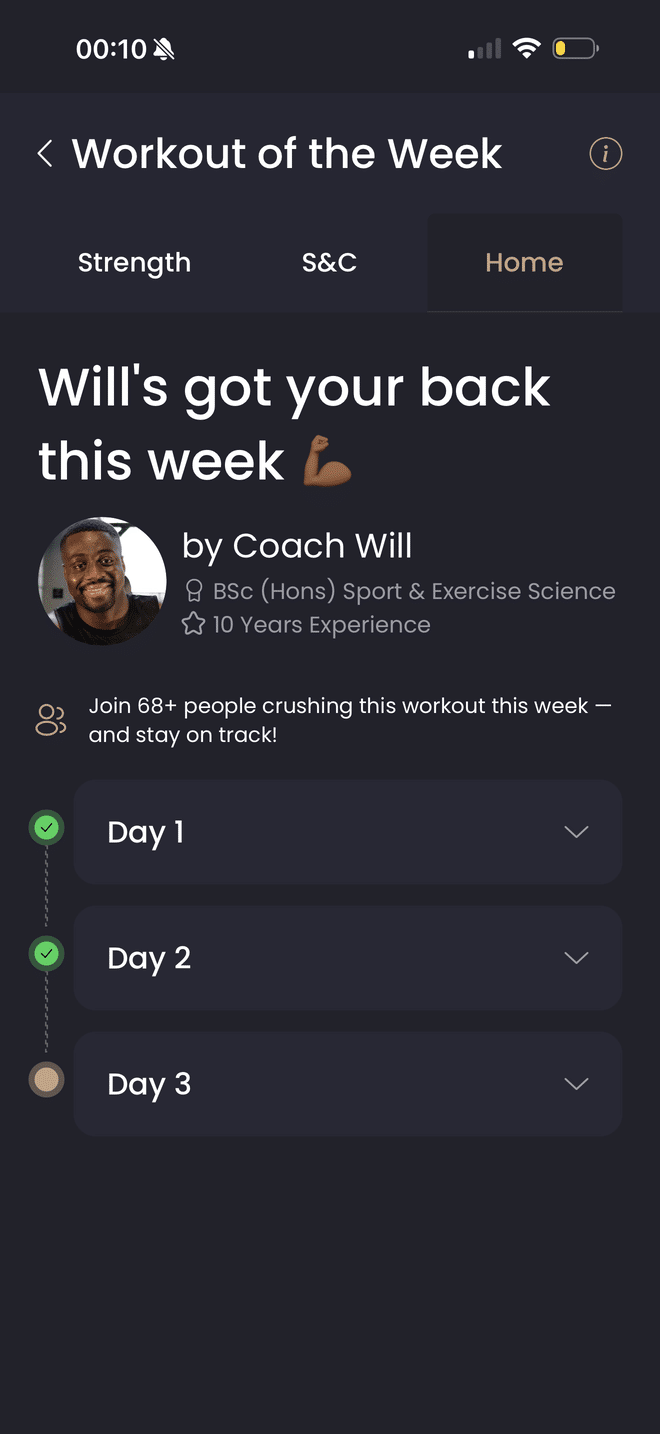
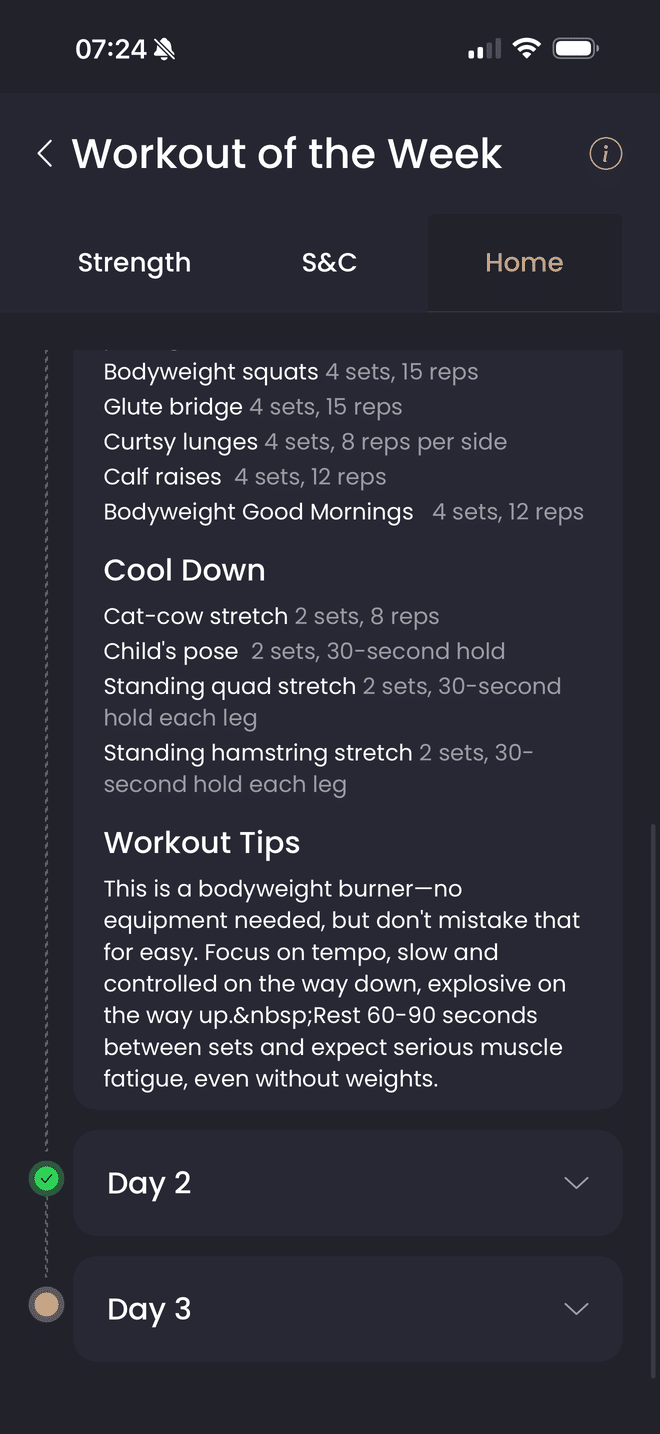
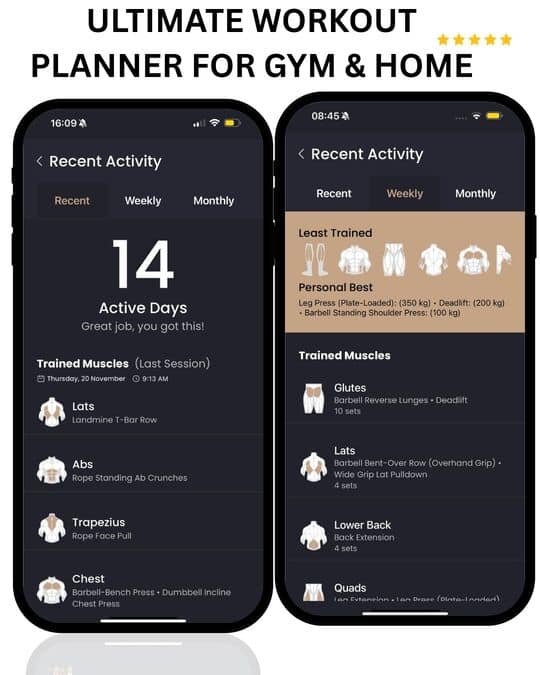
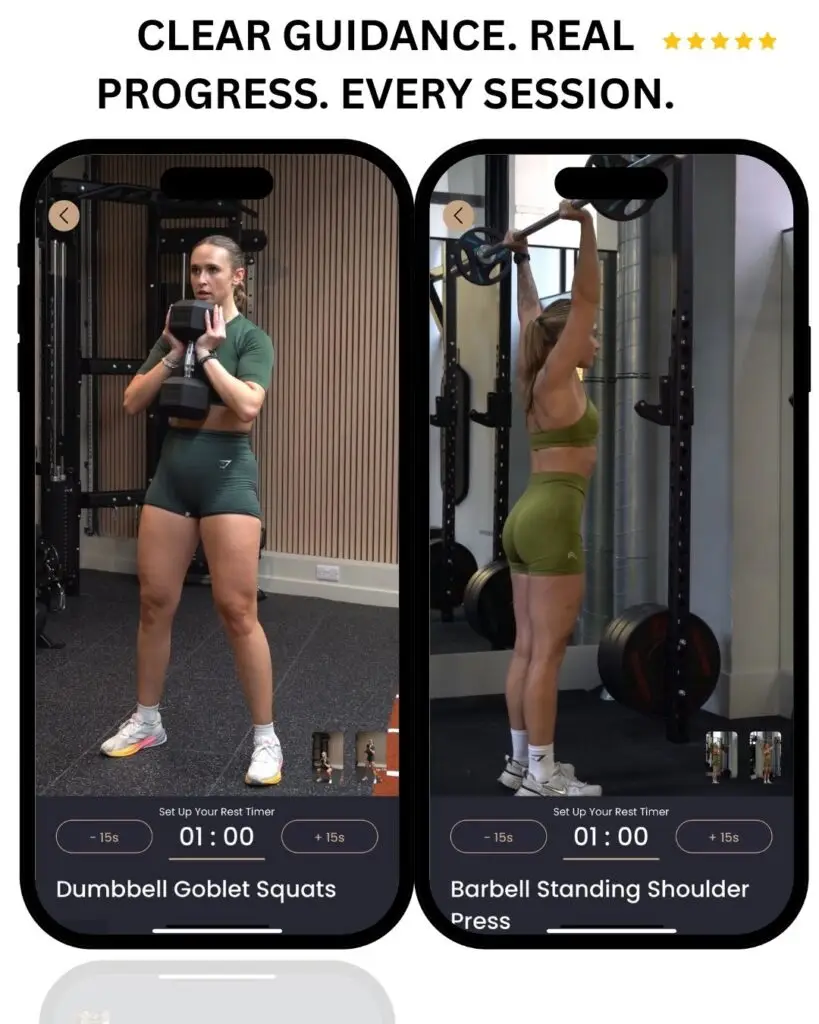
If you train with 12REPS, your planned session and your logged numbers sit in the same app. The screens below show planned workouts in 12REPS.
Step 5: Review once a week
Pick a regular time, such as Sunday evening, and look back over the week.
- Did the weight or reps go up on your main lifts?
- Has any lift stayed the same for three weeks or more?
- Did you complete all your planned sessions?
- Did any set drop off sharply compared with last week?
Then write one target per main lift for the next session. For example, if last week’s squat was 60 kg for 8, 8, 7, this week’s target is 60 kg for 8, 8, 8.
Reviewing your record is part of why logging works. In a meta-regression of healthy eating and physical activity programs, self-monitoring explained more of the difference between programs than any other technique. Programs that combined it with goal setting or reviewing progress did better.
When your numbers stall
Every lifter hits a flat spot. Your log helps you find the cause. Check these first:
- Effort: are your sets still hard? If your RIR keeps creeping up, the work may be too easy.
- Consistency: missed sessions show up clearly in a log.
- Recovery: poor sleep, stress or extra activity can flatten your numbers for a while.
- Technique: a change in form can make a lift feel harder or easier.
- Program: if one lift has stalled for several weeks while others improve, try a different rep range or variation.
If performance drops across several lifts and weeks, you may need a lighter week. Read about the deload week and what to do when you stop seeing progress.
Tracking body changes too
Your lifting log shows strength. If your goal includes changing your body, two extra records help:
- Body weight: weigh yourself under the same conditions, for example in the morning, and look at the trend over weeks rather than single days.
- Progress photos: same light, same pose, same time of day, every few weeks.
Our guide on how strength training changes body composition explains how to read these numbers.
Video: How women should track progress, scale or photos. This short 12REPS video compares the two methods. Watch it to decide which one to add to your log.
Tracking workouts in 12REPS
12REPS is a strength training app that plans your workout and tracks it in the same place:
- Open the app. Your workout is ready, built around your goal, your equipment and the time you have.
- Tap Start Workout and watch the trainer demonstration.
- Enter the reps and weight for each set.
- Next time, the app shows what you lifted, so you have a number to beat.
12REPS also tracks your workouts, sets, reps, weights and streaks, with a weekly goal, challenges and awards. You can log body weight to see your start, current and change, and keep private progress photos to compare stages.
Video: 12REPS, strength training for gym and home. This short video shows the app in use. Watch it to see how logging fits into a session.
Quick checklist
- Choose one place to log and use it every session.
- Record exercise, weight, reps for each set, and date.
- Add RIR for your main lifts if it helps.
- Check last session’s numbers before you start.
- Use double progression: reach the top of the range, then add weight.
- Review once a week and set one target per main lift.
Want a plan and a log in one place? 12REPS sets out each session for your goal, equipment and time. It remembers what you lifted, so every workout has a number to beat.
Related reading
Sources
- American College of Sports Medicine position stand: Progression models in resistance training for healthy adults. American College of Sports Medicine, 2009. https://pubmed.ncbi.nlm.nih.gov/19204579/
- Progressive overload without progressing load? The effects of load or repetition progression on muscular adaptations. Plotkin D, et al., PeerJ, 2022. https://doi.org/10.7717/peerj.14142
- Novel resistance training-specific rating of perceived exertion scale measuring repetitions in reserve. Zourdos MC, et al., Journal of Strength and Conditioning Research, 2016. https://doi.org/10.1519/JSC.0000000000001049
- Accuracy in predicting repetitions to task failure in resistance exercise: a scoping review and exploratory meta-analysis. Halperin I, et al., Sports Medicine, 2022. https://doi.org/10.1007/s40279-021-01559-x
- Effective techniques in healthy eating and physical activity interventions: a meta-regression. Michie S, et al., Health Psychology, 2009. https://pubmed.ncbi.nlm.nih.gov/19916637/