By Will Duru, BSc (Hons) Sport and Exercise Science, Award-winning Personal Trainer
This dumbbell and machine leg workout is a beginner-friendly gym session with five exercises. You start on two machines, the leg extension and the hip abductor. Then you move to dumbbell reverse lunges, Romanian deadlifts and glute bridges. Every exercise gets 4 sets, with a 60-second rest after each set.
One lesson I keep coming back to as a personal trainer: a strong body is built from the ground up. This session gives you a simple structure for your first months of leg training in any gym that has a leg extension and an abductor machine.
Different setup? Choose the version that fits:
- Only dumbbells at home: a leg workout with just a pair of dumbbells.
- Dumbbells and a suspension trainer at home or on the road: the dumbbell and suspension trainer workout.
- A full gym where you want legs and abs in one session: the full-gym legs and core routine.
- Ready for barbells and kettlebells: the mixed-equipment leg day.

Why combine machines and dumbbells?
Each type of equipment does a different job in this workout.
Machines give you a guided path. The leg extension and hip abductor move along a fixed track. You do not have to balance anything, so you can focus on slow, controlled reps. The leg extension targets the quadriceps, the muscles on the front of your thigh. The abductor works the muscles on the outside of your hips.
Dumbbells train how you move. Reverse lunges work one leg at a time, so each side has to do its own share. Romanian deadlifts teach the hip hinge, the movement you use to pick something up with a flat back. Glute bridges load your glutes directly.
Is one type better? A meta-analysis of 13 studies compared free weights and machines directly and found no clear difference in strength or muscle growth. Strength gains were partly specific to the equipment people trained on (Haugen and colleagues, 2023). Using both gives you practice with each. Read more in free weights vs machines.

The dumbbell and machine leg workout
This workout trains your quads, hamstrings, glutes and outer hips, while your core keeps you steady on the dumbbell moves. If you are a beginner, do it twice a week on non-consecutive days, such as Monday and Thursday, to give your legs time to recover.
| Exercise | Sets | Reps | Rest |
|---|---|---|---|
| Leg extension | 4 | 12 | 60 seconds |
| Hip abductor machine or mini band crawl | 4 | 12 | 60 seconds |
| Dumbbell reverse lunge | 4 | 16 (8 per leg) | 60 seconds |
| Dumbbell Romanian deadlift (RDL) | 4 | 12 | 60 seconds |
| Dumbbell glute bridge | 4 | 15 | 60 seconds |
Write down the weight and reps for every set. Next session, you will know exactly what to beat.
Step-by-step technique for beginners
1. Leg extension
- Adjust the seat so your knees line up with the machine’s pivot point.
- Sit back with the pad resting just above your ankles.
- Straighten your legs to lift the weight, then squeeze your quads at the top.
- Lower slowly with control.
2. Hip abductor machine or mini band crawl
Machine:
- Sit with your back against the pad and the pads on the outside of your thighs.
- Push your knees apart against the resistance.
- Pause, then let your legs come back together slowly.
Mini band crawl: if the machine is busy, place a mini band around your ankles. Stay in a half-squat and take slow, controlled steps to the side. Do the same number of steps each way.
3. Dumbbell reverse lunge
- Start with light dumbbells, arms long by your sides.
- Step back about one stride and bend both knees until each forms roughly a right angle.
- Keep your front heel down. That leg does most of the work.
- Press up through the front leg, bring your feet together, then repeat on the other side.
The lunge technique guide shows forward, reverse and walking versions.
4. Dumbbell Romanian deadlift (RDL)
- Stand with a light dumbbell in each hand and a small bend in your knees.
- Hinge: push your hips back as if closing a car door with your backside.
- Keep your back flat and let the dumbbells slide down the front of your legs.
- Stop when the backs of your thighs feel stretched, then bring your hips forward to stand up.
New to the hinge? The Romanian deadlift form guide breaks it down.
5. Dumbbell glute bridge
- Lie on a mat with your knees bent and your heels a short distance from your glutes.
- Hold a dumbbell on your hip bones with both hands.
- Tighten your glutes first, then press through your heels to raise your hips.
- Pause for a second at the top, then lower slowly.
Why do the machines come first?
This workout starts with two machine exercises, then moves to the dumbbells. One common reason for this order is pre-exhaustion: tiring a muscle with a single-joint exercise before a multi-joint one. Research has not found an extra benefit from that. In one study of 39 trained adults, pre-exhaustion gave no greater strength gains than other exercise orders (Fisher and colleagues, 2014).
For a beginner, the order is still practical. The machines let you warm up your knees and hips with simple, guided reps before you balance dumbbells. The American College of Sports Medicine usually advises multi-joint exercises before single-joint ones (ACSM, 2009). So once your main goal is lifting heavier on lunges and RDLs, move them to the start of the session.
Easier and harder options
Video: Static lunges. An easier start than the reverse lunge. Your feet stay in place, so you can focus on balance and depth before you add the step back.
Video: Elevated glute bridge. A harder version of the glute bridge for when 15 reps feel easy. Raising your feet or shoulders increases the range your hips travel.
There is no direct ab exercise in this session. To add one, learn the plank or the dead bug first. If you would rather train mostly on machines, this machine leg day guide is a good next read. After a few months, move on to a leg session built for strength and size or this lower body gym guide for women.
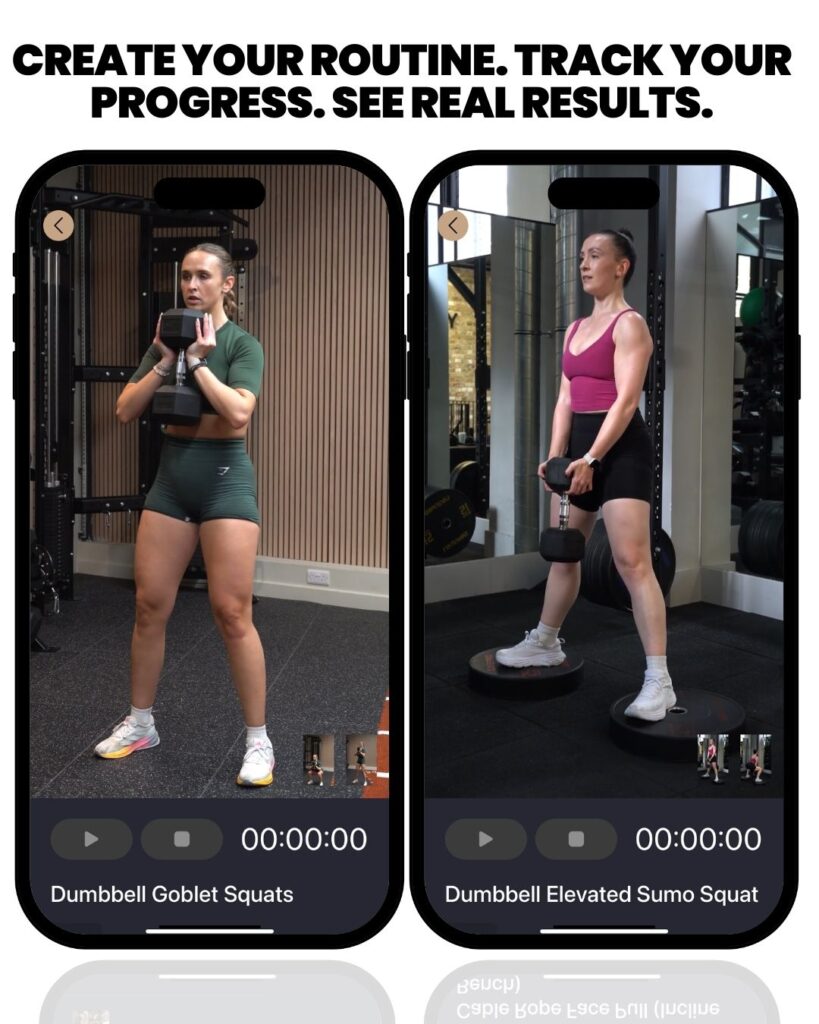
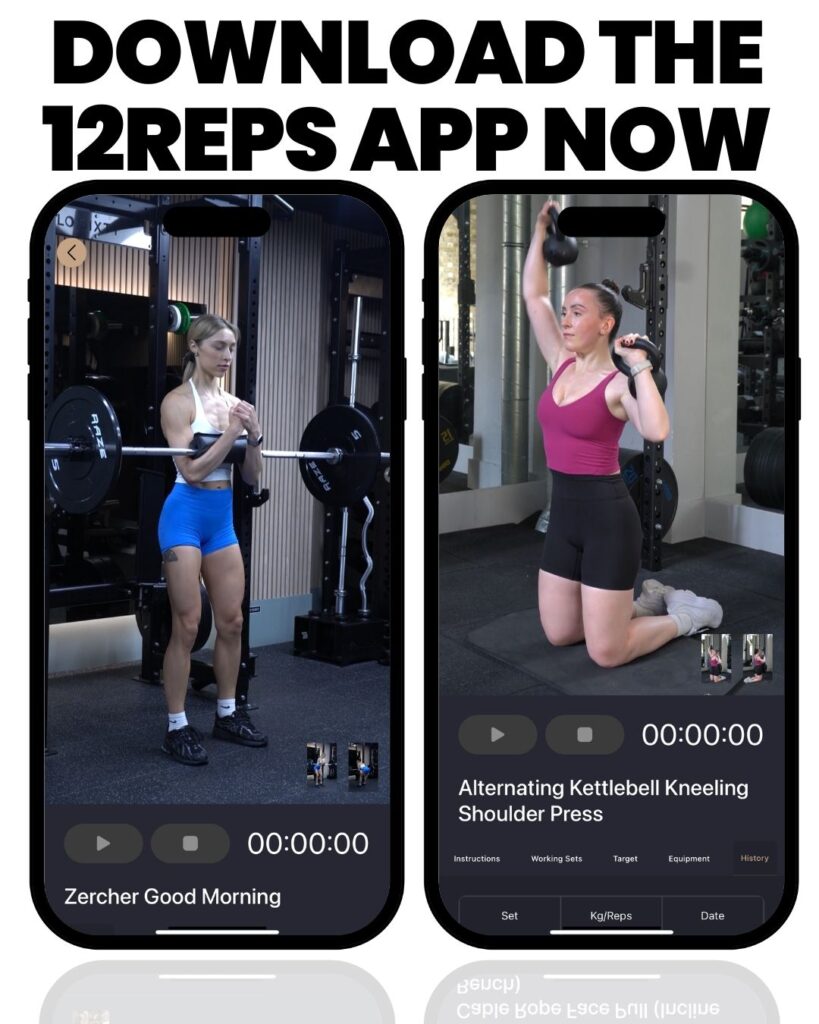
If you want each gym session planned for you, 12REPS builds workouts around your goal, equipment and time. You watch a trainer demonstration before each exercise and log every set, so the next session always has a clear target.
Sources
- Effect of free-weight vs. machine-based strength training on maximal strength, hypertrophy and jump performance: a systematic review and meta-analysis. Haugen ME, Vårvik FT, Larsen S, Haugen AS, van den Tillaar R, Bjørnsen T. BMC Sports Science, Medicine and Rehabilitation, 2023. https://doi.org/10.1186/s13102-023-00713-4
- The effects of pre-exhaustion, exercise order, and rest intervals in a full-body resistance training intervention. Fisher JP, Carlson L, Smith D, Steele J. Applied Physiology, Nutrition, and Metabolism, 2014. https://pubmed.ncbi.nlm.nih.gov/25092528/
- American College of Sports Medicine position stand. Progression models in resistance training for healthy adults. American College of Sports Medicine. Medicine and Science in Sports and Exercise, 2009. https://pubmed.ncbi.nlm.nih.gov/19204579/