




By Will Duru, BSc (Hons) Sport and Exercise Science, Award-winning Personal Trainer
This full-body bodyweight workout uses seven moves: press-ups (push-ups), squats, reverse lunges, sit-ups or leg raises, back extensions, mountain climbers and jump squats. Do it twice a week to build a base of strength, or use it to hold on to your strength when you cannot get to the gym. You need no equipment, just a little floor space.
After more than a decade in the fitness industry, I have seen plenty of trends come and go. Bodyweight training, also called calisthenics, has lasted because it works with almost no kit. You use your own body as the resistance.
This article gives you one complete routine with sets, reps and rest. If you want to learn the best individual moves and how to progress each one, read our guide to bodyweight strength training at home.
Can a bodyweight workout build strength?
Yes, especially for the upper body. One 8-week study of 18 men compared push-ups with bench presses at a similar load, about 40% of each man’s one-rep max (1RM). Both groups gained similar chest muscle and strength. Your 1RM is the most you can lift for a single rep.
A 2021 review on strength training when you are short of time found a small number of upper-body bodyweight exercises can be effective strength training alternatives. Push-ups and pull-ups have the best support. The authors noted that little research exists on bodyweight exercise for the legs.
Load still matters for maximal strength. A 2017 meta-analysis found heavier loads gave bigger 1RM strength gains, while muscle growth was similar across light and heavy loads. So bodyweight work builds muscle and general strength well. If you want a bigger max lift, you will need heavier loads at some point.
The NHS lists exercises that use your own body weight, such as push-ups and sit-ups, as muscle-strengthening activities. It recommends these on at least 2 days a week.

Why bodyweight training suits beginners
A gym can feel daunting when you are new. Bodyweight exercise removes that barrier. You can learn the basic movement patterns at home, at your own pace.
Squats, press-ups and lunges are compound exercises. That means they work several muscles and joints at once. They build the kind of strength that helps with everyday tasks such as carrying shopping or climbing stairs.
Using this workout to maintain strength
Bodyweight training is not just for beginners. It is also useful when work, travel or family life cut your gym time.
You need less training to keep strength than to build it. A 2021 review on the minimal dose of exercise looked at how little training keeps strength. In younger people, strength and muscle size were kept for up to 32 weeks with as little as 1 session a week and 1 set per exercise. The key was keeping the intensity, meaning how heavy the load is compared with your max. Older adults may need up to 2 sessions a week and 2 to 3 sets per exercise to keep muscle size.
Bodyweight moves are often lighter than your usual gym loads, so they may not fully hold on to your maximal strength. To keep the work hard, take your sets close to failure or use harder variations. Failure means the point where you cannot complete another rep with good form.

Stretching is optional. The 2021 review suggests not prioritizing it unless improving mobility is an important goal for you. If you enjoy simple standing stretches like the ones shown, do them after your session.
The full-body bodyweight workout
Do this workout twice a week on non-consecutive days, for example Monday and Thursday, so you have time to recover. Warm up for a few minutes first with light movement such as marching on the spot or easy squats.
| Exercise | Sets | Reps | Rest |
|---|---|---|---|
| Press-ups or knee press-ups | 4 | 12 | 60 seconds |
| Bodyweight squats or bench squats | 4 | 12 | 60 seconds |
| Reverse lunges | 4 | 16 (8 per leg) | 60 seconds |
| Sit-ups or leg raises | 4 | 10 | 60 seconds |
| Back extensions | 3 | 10 | 60 seconds |
| Mountain climbers | 3 | 30 seconds | 60 seconds |
| Jump squats | 4 | 15 | 60 seconds |
How to do each exercise
Each exercise below has a short 12REPS video demonstration.
1. Press-ups or knee press-ups
- Start in a plank position with your hands slightly wider than your shoulders.
- Keep your body in a straight line from head to heels.
- Lower your chest until it nearly touches the floor.
- Push back up to the start.
To make it easier, do the move with your knees on the floor. See the bodyweight press-up exercise page for more detail.
2. Bodyweight squats or bench squats
- Stand with your feet about shoulder-width apart.
- Push your hips back and bend your knees, as if sitting into a chair. Keep your chest up.
- Go as low as you comfortably can with good form.
- Push through your whole foot to stand back up.
To make it easier, squat down to a bench or chair, touch it lightly, then stand.
3. Reverse lunges
- Stand tall with your feet hip-width apart.
- Step one foot back and lower your hips until both knees are bent. Your back knee should hover just above the floor.
- Keep your front knee in line with your toes.
- Push through your front foot to return to the start. Alternate legs.
See the bodyweight reverse lunge page, or our full lunge guide for forward and walking lunges.
4. Sit-ups or leg raises
Sit-ups:
- Lie on your back with your knees bent and your feet flat on the floor.
- Cross your hands over your chest or rest your fingertips by your head.
- Brace your core and lift your upper body toward your knees.
- Lower back down with control.
Leg raises: lie on your back with your legs straight. Keep your lower back pressed into the floor, lift your legs toward the ceiling, then lower them slowly.
Video: Leg raises. The video above shows sit-ups. Watch this one to see the leg raise option before you try it.
5. Back extensions
- Lie on your front with your arms stretched out in front of you.
- Squeeze your glutes and lift your chest and arms a little off the floor.
- Hold for a moment, then lower back down with control.
Keep the lift small and smooth. Look at the floor to keep your neck in line.
6. Mountain climbers
- Start in a high plank position with your hands under your shoulders.
- Drive one knee toward your chest.
- Switch legs, driving the other knee in as the first leg goes back.
- Keep alternating at a steady running pace for 30 seconds.
Keep your hips level with your shoulders. See the bodyweight mountain climbers page for more cues, and our plank guide for the starting position.
7. Jump squats
- Squat down as in exercise 2.
- Drive up hard and jump straight up.
- Land softly through your feet, with your knees bent.
- Go straight into the next squat.
Jump squats add power and raise your heart rate. If jumping does not suit you, do regular squats at a faster pace instead. See the bodyweight jump squat page for more detail.
How to progress this bodyweight workout
To keep getting stronger, make the workout a little harder over time. This is called progressive overload. Our beginner’s guide to progressive overload explains it in full. With bodyweight training, you can:
- Add reps when you can complete every set with good form.
- Slow down the lowering phase of each rep.
- Move to harder variations. For example, go from knee press-ups to full press-ups, then to decline press-ups with your feet raised. You can also progress from reverse lunges to a deficit reverse lunge or a Bulgarian split squat.
The 2021 review notes that when you use light loads for more than 15 reps, you should train at or close to failure to build muscle. If 12 press-ups feel easy, choose a harder version rather than just adding more reps forever.
Video: How long it takes to build muscle. Watch this to set realistic expectations before you judge your progress.
Want a longer plan? Our home workout plan builds on this routine. On gym days, try our full-body HIIT workout. Nutrition matters too; see whether a keto diet helps build muscle.
Track your progress
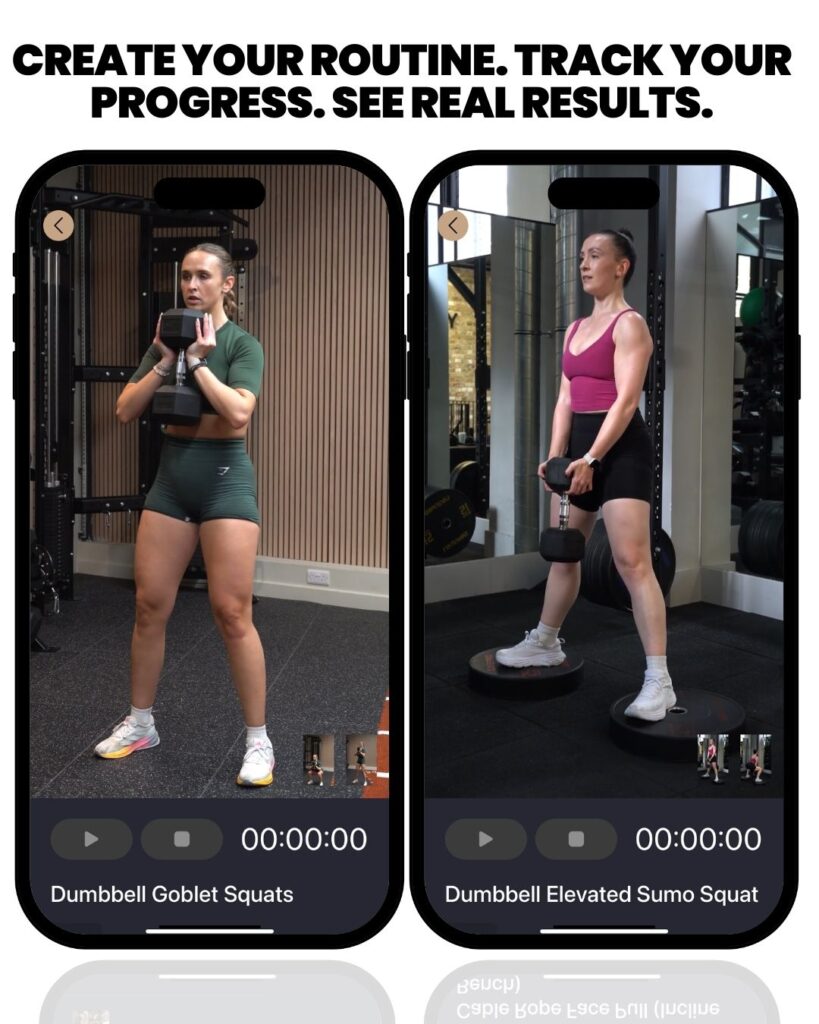
Consistency is what makes this work. If you want each session set out for you, 12REPS builds workouts around your goal, the equipment you have and your time. Every exercise has a trainer demo, and you log reps for each set so you know what to beat next time.
Sources
- Low-load bench press and push-up induce similar muscle hypertrophy and strength gain. Kikuchi N, Nakazato K, Journal of Exercise Science & Fitness, 2017. https://doi.org/10.1016/j.jesf.2017.06.003
- No Time to Lift? Designing Time-Efficient Training Programs for Strength and Hypertrophy: A Narrative Review. Iversen VM, Norum M, Schoenfeld BJ, Fimland MS, Sports Medicine, 2021. https://doi.org/10.1007/s40279-021-01490-1
- Strength and hypertrophy adaptations between low- vs. high-load resistance training: a systematic review and meta-analysis. Schoenfeld BJ, Grgic J, Ogborn D, Krieger JW, Journal of Strength and Conditioning Research, 2017. https://pubmed.ncbi.nlm.nih.gov/28834797/
- Maintaining physical performance: the minimal dose of exercise needed to preserve endurance and strength over time. Spiering BA, Mujika I, Sharp MA, Foulis SA, Journal of Strength and Conditioning Research, 2021. https://pubmed.ncbi.nlm.nih.gov/33629972/
- Physical activity guidelines for adults aged 19 to 64. NHS, accessed 2026. https://www.nhs.uk/live-well/exercise/physical-activity-guidelines-for-adults-aged-19-to-64/

