

Strength training and weight loss work together, but not in the way many people expect. Research shows that lifting weights on its own leads to modest fat loss. Its bigger role is helping you keep muscle while a calorie deficit does most of the work on the scale.
This article sets out what the studies actually found, with a link to each one. That way you can see where the evidence is strong and where it is limited.
What does strength training do for weight loss?
Strength training (also called resistance training) means working your muscles against a load. That load can be dumbbells, barbells, machines, bands or your own body weight. Here is a short summary of the evidence.
| Question | What the research found | Source |
|---|---|---|
| Does lifting alone reduce body fat? | Yes, modestly: about 1.5 percentage points less body fat and about 0.5 kg less fat mass than not training. | Wewege et al., 2022. |
| Does it add to weight loss? | Not much on its own, but it may increase fat-free mass and fat loss. | ACSM, 2009. |
| How does it compare with cardio? | Aerobic training reduced body mass and fat mass more; strength training increased lean mass. | Willis et al., 2012. |
| Does it help keep muscle while dieting? | Adding strength training to calorie restriction prevented most lean mass loss in older adults with obesity. | Sardeli et al., 2018. |
Strength training on its own: modest fat loss
A meta-analysis pools the results of many trials to get a clearer answer. A 2022 meta-analysis of 58 studies looked at healthy adults who were new to lifting.
Compared with not training, strength training reduced body fat percentage by about 1.46% and fat mass by about 0.55 kg. It also reduced visceral fat, the fat stored around your organs.
That is a real effect, but it is small. It also explains why the scale can move slowly when you start lifting. You may lose some fat and gain some muscle at the same time.
If that sounds familiar, read why strength training without losing weight can still be progress.
Strength training vs cardio for weight loss
In one 8-month trial, 119 overweight or obese adults did aerobic training, strength training, or both. Aerobic and combined training led to more weight loss and fat loss than strength training. Strength and combined training increased lean body mass more than aerobic training alone.
The combined group did not lose significantly more fat than the aerobic group, even though it trained for longer. In short, cardio tends to use more energy per session. Strength training is what builds and keeps muscle.
For most people, the practical answer is to do both. If you plan to train them together, see how to do cardio and weights on the same day.
Why keeping muscle matters when you diet
A calorie deficit means eating fewer calories than your body uses. In a deficit, some of the weight you lose can be muscle. Strength training gives your body a reason to keep it.
A 2018 meta-analysis of six trials studied older adults with obesity. Adding strength training to calorie restriction prevented about 93.5% of the lean mass loss seen with calorie restriction alone. Fat loss was similar in both groups.
The analysis was small, so treat the exact figure with care. The direction of the finding is clear, though: lifting while you diet helps protect muscle.
Metabolism and the afterburn effect
Some older articles claim each kilogram of muscle burns 30 to 50 extra calories a day. The research does not support that. Skeletal muscle uses about 13 kcal per kg per day at rest, compared with about 4.5 kcal per kg for fat tissue.
Strength training can still raise your daily energy use a little. In a 26-week study of 15 adults aged 61 to 77, strength training raised resting energy expenditure by 6.8% and total daily energy expenditure by 12%. The body also used slightly more fat for fuel at rest. This was a small study in older adults, so your results may differ.
The afterburn effect is called EPOC (excess post-exercise oxygen consumption). It is the extra energy your body uses to recover after a workout. One study of seven young men found oxygen use stayed raised for up to 38 hours after a hard 31-minute resistance circuit.
A review of the research describes EPOC as a supplemental part of weight management, not the main driver. For the full numbers, read strength training and metabolism: what muscle really burns.
How to use strength training for weight loss
- Train all major muscle groups at least two days a week. This matches the NHS physical activity guidelines, which also recommend at least 150 minutes of moderate activity a week.
- Build sessions around compound exercises. These use several joints and muscle groups at once, such as squats, deadlifts, presses and rows.
- Use progressive overload. This means adding a little weight, reps or sets over time. Our beginner’s guide to progressive overload shows how.
- Add cardio you can stick with. The ACSM position stand notes that 150 to 250 minutes of moderate activity a week gives only modest weight loss on its own. It works better alongside a moderate diet.
- Use a moderate calorie deficit. The NHS suggests aiming to lose 0.5 to 1 kg a week.
Want a structured example? Our 10-week plan for working toward 5kg sets out a training week and nutrition steps. For safe weekly rates and the reasons behind them, read how to lose 5kg safely.
If you have a medical condition or take medication, check with your doctor before you change your diet or start a new exercise routine.
The bottom line
Strength training will not replace a calorie deficit. It does help you lose some fat, keep muscle and get stronger while you lose weight. Pair it with cardio and sensible eating for a balanced approach.
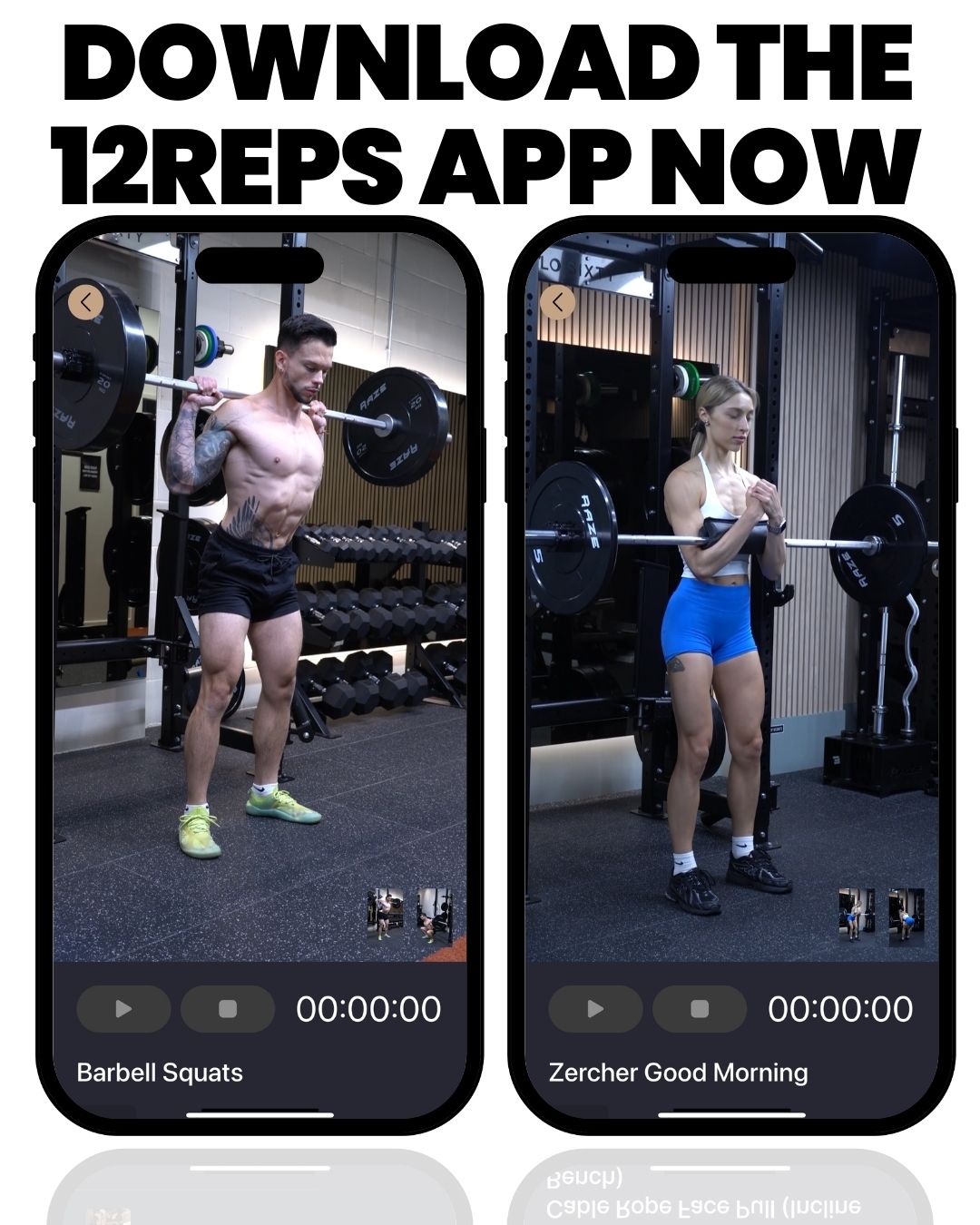
If you want a plan built around your goal, the equipment you have and the time you’ve got, 12REPS sets out each session for you. It shows a trainer demonstration for every exercise and remembers what you lifted, so you always have a number to beat.
Sources
- The effect of resistance training in healthy adults on body fat percentage, fat mass and visceral fat: a systematic review and meta-analysis. Sports Medicine, 2022. https://www.pubmed.gov/34536199/
- ACSM Position Stand: Appropriate Physical Activity Intervention Strategies for Weight Loss and Prevention of Weight Regain for Adults. American College of Sports Medicine, Medicine & Science in Sports & Exercise, 2009. https://www.sportgeneeskunde.com/files/bestanden/VSG/VSG6671.pdf
- Effects of aerobic and/or resistance training on body mass and fat mass in overweight or obese adults. Journal of Applied Physiology (PEDro record), 2012. https://search.pedro.org.au/search-results/record-detail/34655
- Resistance Training Prevents Muscle Loss Induced by Caloric Restriction in Obese Elderly Individuals: A Systematic Review and Meta-Analysis. Nutrients, 2018. https://www.mdpi.com/2072-6643/10/4/423
- Specific metabolic rates of major organs and tissues across adulthood: evaluation by mechanistic model of resting energy expenditure. The American Journal of Clinical Nutrition, 2010. https://pmc.ncbi.nlm.nih.gov/articles/PMC2980962
- Resistance training increases total energy expenditure and free-living physical activity in older adults. Journal of Applied Physiology, 2000. https://www.bisp-surf.de/Record/PU199912408417
- Effect of an acute period of resistance exercise on excess post-exercise oxygen consumption: implications for body mass management. European Journal of Applied Physiology, 2002. https://link.springer.com/doi/10.1007/s00421-001-0568-y
- Resistance Training and EPOC. Reynolds and Kravitz, University of New Mexico, n.d.. https://www.unm.edu/~lkravitz/Article%20folder/epoc.html
- Physical activity guidelines for adults aged 19 to 64. NHS, accessed 2026. https://www.nhs.uk/live-well/exercise/physical-activity-guidelines-for-adults-aged-19-to-64/
- Tips to help you lose weight. NHS, accessed 2026. https://www.nhs.uk/live-well/healthy-weight/managing-your-weight/12-tips-to-help-you-lose-weight/