



By Will Duru, BSc (Hons) Sport and Exercise Science, Award winning Personal Trainer with over 10 years of experience in strength training
Strength training in your 40s still works. What changes is the margin for error. Muscle declines slowly, hormones begin to shift, and old aches show up more. Most people keep progressing by adding recovery, choosing joint-friendly exercises and eating enough protein.
Maybe you are doing what you always did, but your body is not responding the same way. Your body has changed a little, so your training needs to change with it.
This guide explains what really changes in this decade, for men and women, and how to adjust your training. If you want a ready-made program, go to the 4-day plan for building muscle after 40.
If you have a health condition or joint problem, or you take regular medication, check with your doctor before you change your training.

What actually changes in your 40s
Muscle mass declines slowly
Muscle loss with age is gradual. A 2012 review compared young adults with people over 65. It found a median loss of about 0.47% of muscle mass a year in men and 0.37% in women (Mitchell et al., 2012).
The same review found strength falls faster than muscle size in later life. That is why lifting matters more with age, not less.
Hormones shift, differently for men and women
Men: testosterone falls steadily, by about 1% a year from around the age of 30 to 40. The NHS says this decline is unlikely to cause problems in itself, and calls the idea of a sudden “male menopause” misleading (NHS).
Women: menopause usually happens between the ages of 45 and 55 and is caused by a fall in hormone levels (NHS). Symptoms can include muscle aches and joint pains, sleep problems, weight gain around the middle and loss of bone density (NHS).
A Finnish study followed 234 women aged 47 to 55 through the menopause transition. Lean mass fell during that time, and women who were more physically active kept more of it (Juppi et al., 2020). This was an observational study, so it shows a link, not cause and effect. For more, read perimenopause strength training for beginners.
Your metabolism probably has not slowed much
Many people blame a slower metabolism for weight gain in their 40s. A large 2021 study of daily energy use found that, after adjusting for body size, it stayed stable from about age 20 to 60. It only began to decline after about 60 (Pontzer et al., 2021).
So weight gain in your 40s usually has more to do with moving less, eating more or, for women, the menopause transition. See losing weight in your 40s for the fat-loss side.
Recovery can feel slower
Many people say they need more time between hard sessions in their 40s. The research is less clear. A 2023 scoping review of recovery studies in adults aged 65 and over found the results inconsistent, with too little data for clear advice (Hayes et al., 2023).
In practice, work stress, family life and poor sleep often add up. Planning rest days is a sensible response, whatever the cause.
Joints carry more history
Osteoarthritis becomes more likely with age and most often affects the knees, hips and hands (NHS). The NHS osteoarthritis page still recommends strength exercises on 2 or more days a week. Exercise choice and technique matter more than before.
Protein needs per meal rise a little
In a lab study, healthy older men needed more protein in a single meal than younger men to get the same muscle-building response. They needed about 0.40 g per kg of body weight, compared with 0.24 g/kg for younger men (Moore et al., 2015). Spreading protein across your meals helps you reach that.

How to adapt your training in your 40s
1. Plan your recovery
- Frequency: three or four sessions a week suits most people in their 40s. It gives enough training to progress, with rest days in between.
- Sleep: the CDC recommends 7 or more hours a night for adults aged 18 to 60 (CDC). Keep regular bed and wake times.
- Easier weeks: a common approach is to cut your training volume and load by about 40 to 50% for one week every 4 to 6 weeks. Read how to take a deload week.
- Listen to your body: sharp pain, unusual tiredness or soreness that lasts are signs to back off.
2. Warm up for longer
Spend 10 to 15 minutes warming up. Start with light cardio to raise your body temperature. Then do mobility drills for the joints you will use, and a few easy reps of the muscles you are about to train.
Before a lower-body session, try 5 minutes on the bike, then leg swings, hip circles and bodyweight squats. Before an upper-body session, use arm circles, band pull-aparts and light push-ups. For a full routine, see how to warm up before lifting weights.
3. Choose joint-friendly exercises
Some lifts that felt fine at 25 may not feel good at 45. You do not need to avoid hard training. You may just need a different version of the movement.
| Instead of | Try |
|---|---|
| Barbell back squat | Goblet squat, front squat or leg press |
| Flat barbell bench press | Incline dumbbell press or floor press |
| Conventional deadlift | Trap bar deadlift or Romanian deadlift |
| Behind-the-neck press | Dumbbell shoulder press |
| Upright row | Face pull or lateral raise |
These swaps train the same movement patterns. The trap bar deadlift, for example, lets you stand inside the bar, which many people find more comfortable for the lower back.
There is nothing wrong with barbell squats, bench presses or deadlifts if you can do them without pain and with good technique. The key is to notice how your body responds and adjust when needed.
Video: Trap bar deadlift. Watch this if you are swapping the conventional deadlift. It shows the setup inside the bar and how to stand up with it.
Video: Dumbbell incline chest press. This is the swap for the flat barbell bench press. Use it to check the bench angle and the path of the dumbbells.
4. Control every rep
Lifting weights you cannot control puts extra stress on your joints. Use a steady tempo: about 2 to 3 seconds to lower the weight, a brief pause, then 1 to 2 seconds to lift it.
If you cannot control a weight through the full range of motion, it is too heavy. Lower it and focus on quality reps.
5. Make time for mobility
Hips, upper back and shoulders often feel tight, especially if you sit at a desk. Add mobility work to your warm-up, on rest days or as a short session once a week. Ten minutes of stretching or yoga can make a real difference to how you move.

A sample 3-day training week for your 40s
This three-day week suits people in their 40s who want to build muscle and strength with plenty of recovery. Each session starts with a 10-minute warm-up (5 minutes of cardio, 5 minutes of mobility) and ends with 5 minutes of stretching. If you can train four days, use the 4-day upper/lower plan instead.
Day 1: Push (chest, shoulders, triceps)
| Exercise | Sets | Reps | Rest | Notes |
|---|---|---|---|---|
| Incline dumbbell press | 4 | 8 to 10 | 90 sec | Controlled tempo |
| Flat dumbbell press | 3 | 10 to 12 | 90 sec | Full range of motion |
| Seated dumbbell shoulder press | 3 | 10 to 12 | 90 sec | Neutral grip option |
| Cable fly | 3 | 12 to 15 | 60 sec | Squeeze at the end |
| Lateral raise | 3 | 12 to 15 | 60 sec | Light weight, strict form |
| Triceps pushdown | 3 | 12 to 15 | 60 sec | – |
Day 2: Pull (back, biceps, rear shoulders)
| Exercise | Sets | Reps | Rest | Notes |
|---|---|---|---|---|
| Lat pulldown | 4 | 8 to 10 | 90 sec | Full stretch at the top |
| Seated cable row | 4 | 10 to 12 | 90 sec | Squeeze your shoulder blades |
| Single-arm dumbbell row | 3 | 10 to 12 each | 60 sec | Support with your other hand |
| Face pull | 3 | 15 to 20 | 60 sec | Rotate your hands back at the end |
| Dumbbell biceps curl | 3 | 10 to 12 | 60 sec | No swinging |
| Hammer curl | 2 | 12 to 15 | 60 sec | – |
Day 3: Legs and core
| Exercise | Sets | Reps | Rest | Notes |
|---|---|---|---|---|
| Goblet squat or leg press | 4 | 10 to 12 | 2 min | Full depth if comfortable |
| Romanian deadlift | 4 | 10 to 12 | 90 sec | Feel the hamstring stretch |
| Walking lunge | 3 | 10 each leg | 90 sec | Controlled steps |
| Leg curl | 3 | 12 to 15 | 60 sec | – |
| Calf raise | 3 | 15 to 20 | 60 sec | Full range of motion |
| Plank | 3 | 30 to 45 sec | 45 sec | Brace your trunk |
| Dead bug | 3 | 10 each side | 45 sec | Slow and controlled |
Weekly schedule
| Day | Session |
|---|---|
| Monday | Push |
| Tuesday | Rest or light cardio |
| Wednesday | Pull |
| Thursday | Rest or mobility work |
| Friday | Legs and core |
| Saturday | Active recovery, such as walking or swimming |
| Sunday | Rest |
Add reps first, then weight, as you get stronger. For a full explanation, read progressive overload: how to get stronger.
Nutrition in your 40s
- Protein: in a large meta-analysis, muscle gains from training leveled off at about 1.6 g of protein per kg of body weight a day. The authors suggested up to 2.2 g/kg to be safe (Morton et al., 2018). The same analysis found that the benefit of extra protein got smaller with age. Spread it across three or four meals.
- Calories: because daily energy use stays fairly stable until about 60, your intake still matters most. Eat to match your goal: a small deficit to lose fat, or around maintenance to build muscle.
- Whole foods: build meals around protein, vegetables, fruit, whole grains, and healthy fats such as oily fish and olive oil.
- Water: drink regularly through the day, especially around training.
- Creatine: creatine monohydrate is one of the most studied supplements for strength. Read creatine for older adults before you try it.
If you have kidney disease or another health condition, or you take medication, check with your doctor or pharmacist before you raise your protein intake or take a supplement.
Common mistakes in your 40s
1. Training like you are still 25
The most common mistake I see is keeping the same exercises, effort and volume as a decade ago, then getting stuck or sore. Your body has changed a little, so your training should too.
2. Ignoring pain
Training through pain usually makes it worse. Sharp pain is a signal to stop. A dull ache that keeps coming back needs attention. See a doctor or physical therapist if it does not settle.
3. Skipping warm-ups and cool-downs
It is tempting to cut them when time is short. A good warm-up makes your first sets feel better, and stretching afterward helps you keep the mobility you need.
4. Cutting sleep
Sleep is often the first thing to go when life gets busy. Treat it as part of your training, not something to trade away.
5. Expecting a straight line
In your 20s you might have added weight every week. In your 40s, progress is slower and less even. Good and bad weeks are normal. If you are stronger than you were six months ago, you are progressing.

How to get started
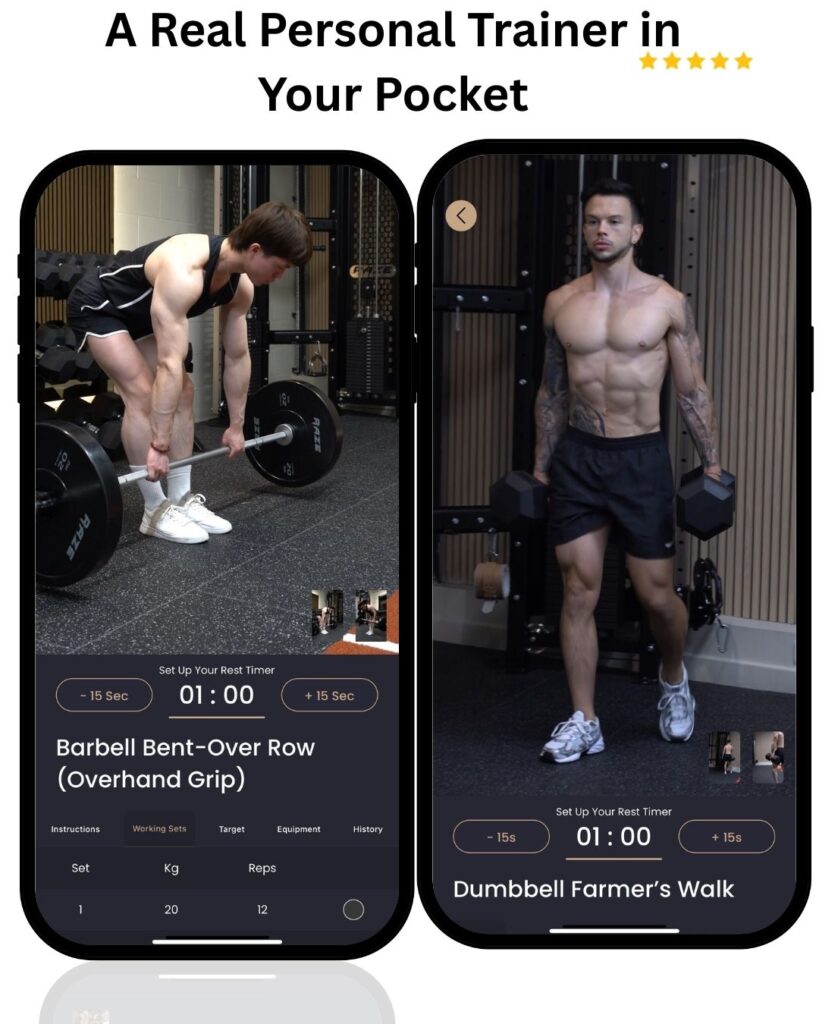
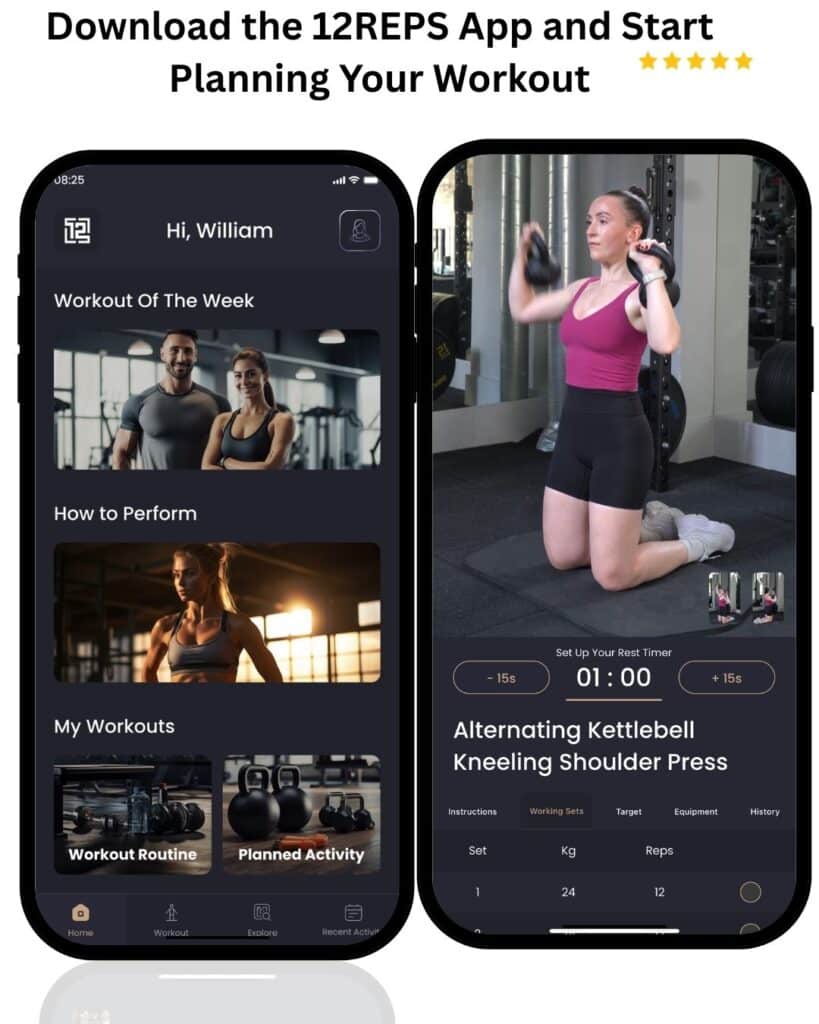
If you want sessions built around your goal, your equipment and the time you have, the 12REPS app sets them out for you. Every exercise comes with a trainer demonstration, and the app tracks your sets, reps and weights so you can see your progress. See how 12REPS works.
Final thoughts
Your 40s are not the end of progress. They are a decade that rewards a smarter approach.
Plan your recovery. Warm up properly. Choose exercises that suit your joints. Eat enough protein. Do that consistently, and you can keep getting stronger for decades.
Keep reading
Sources
- Sarcopenia, Dynapenia, and the Impact of Advancing Age on Human Skeletal Muscle Size and Strength; a Quantitative Review. Mitchell WK, Williams J, Atherton P, Larvin M, Lund J, Narici M. Frontiers in Physiology, 2012. https://doi.org/10.3389/fphys.2012.00260
- The ‘male menopause’. NHS, accessed 2026. https://www.nhs.uk/conditions/male-menopause/
- What are menopause and perimenopause?. NHS, accessed 2026. https://www.nhs.uk/conditions/menopause-and-perimenopause/what-are-menopause-and-perimenopause/
- Symptoms of menopause and perimenopause. NHS, accessed 2026. https://www.nhs.uk/conditions/menopause-and-perimenopause/symptoms/
- Role of Menopausal Transition and Physical Activity in Loss of Lean and Muscle Mass: A Follow-Up Study in Middle-Aged Finnish Women. Juppi HK, Sipila S, Cronin NJ et al. Journal of Clinical Medicine, 2020. https://doi.org/10.3390/jcm9051588
- Daily energy expenditure through the human life course. Pontzer H, Yamada Y, Sagayama H et al. Science, 2021. https://doi.org/10.1126/science.abe5017
- Recovery from Resistance Exercise in Older Adults: A Systematic Scoping Review. Hayes EJ, Stevenson E, Sayer AA, Granic A, Hurst C. Sports Medicine – Open, 2023. https://doi.org/10.1186/s40798-023-00597-1
- Osteoarthritis. NHS, accessed 2026. https://www.nhs.uk/conditions/osteoarthritis/
- Protein ingestion to stimulate myofibrillar protein synthesis requires greater relative protein intakes in healthy older versus younger men. Moore DR, Churchward-Venne TA, Witard O et al. Journals of Gerontology Series A, 2015. https://doi.org/10.1093/gerona/glu103
- About Sleep. Centers for Disease Control and Prevention (CDC), accessed 2026. https://www.cdc.gov/sleep/about/
- A systematic review, meta-analysis and meta-regression of the effect of protein supplementation on resistance training-induced gains in muscle mass and strength in healthy adults. Morton RW, Murphy KT, McKellar SR et al. British Journal of Sports Medicine, 2018. https://doi.org/10.1136/bjsports-2017-097608