




Strength training for marathon runners can help you run faster by improving running economy, which is the energy you use to hold a given pace. In controlled studies, runners who added heavy or explosive strength work improved their economy and race performance without gaining body weight. You still need your miles, but lifting can make each mile cost you less.
Many runners worry that weight training will slow them down. When strength work is planned around your running, the research points the other way. It can also help your body handle training load and keep you strong late in a race.
This article covers what the evidence says, then gives you a two-phase gym plan to run alongside your marathon training. Think of strength as the base that supports your speed, power and endurance, not a replacement for running.

Why Strength Training Matters
The research backs this up. In a 2008 study, well-trained distance runners added heavy half squats three times a week for 8 weeks. Their running economy improved by 5%, and their time to exhaustion at maximal aerobic speed improved by 21.3% (Støren et al., 2008).
In the same study, body weight and VO2max did not change. VO2max is the most oxygen your body can use during hard exercise. The authors put the gains down mainly to changes in the nervous system, not bigger muscles.
An earlier study replaced about a third of endurance athletes’ training with explosive strength work, such as jumps and fast lifts, for 9 weeks. Their 5 km time and running economy improved, while the control group’s did not (Paavolainen et al., 1999).
A systematic review of 24 studies found that strength training generally improved running economy by 2% to 8%. Time-trial performance over 1.5 to 10 km also tended to improve, and body composition was not harmed (Blagrove et al., 2018).
Strength work may also help with injury risk, but the evidence in runners is mixed. A meta-analysis across several sports found strength training programs cut injuries to less than a third, based on only four studies (Lauersen et al., 2014). A 2024 review of prevention programs in endurance runners found no clear drop in injury risk overall (Wu et al., 2024).
So lifting weights does not make you slower. Done well, it helps you run more economically and with more power.
Strength Periodization for Marathon Runners
Periodization means splitting your training into phases, each with its own goal. At 12REPS, we recommend a two-phase structure for endurance athletes. Each phase lasts about 5 weeks and is built to fit around your running volume, not clash with it.
Before each session, warm up with light cardio and active stretches, which are stretches you move through rather than hold. Cool down afterward. Rest about 45 seconds between sets, and listen to your body. If a session leaves your legs heavy for your next key run, reduce the load.
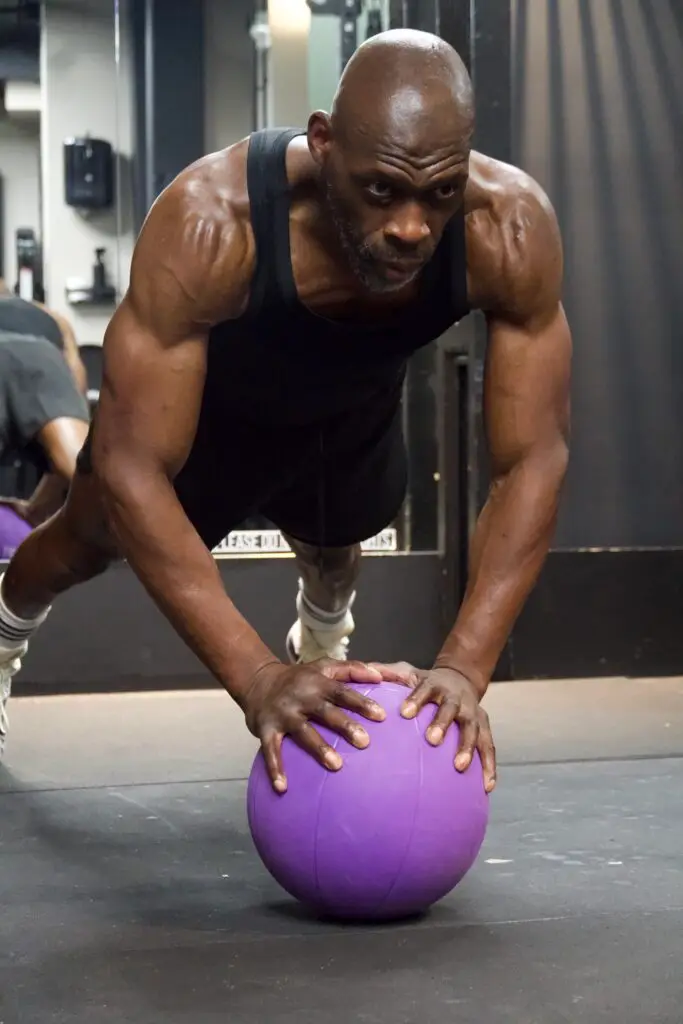
Phase 1: Foundation (Weeks 1 to 5)
Goal: Build joint stability, core strength and movement control.
Frequency: 2 sessions per week, using bodyweight, dumbbell and kettlebell exercises.
Session 1
- Kettlebell goblet squats: 4 sets of 12 reps
- Kettlebell swings: 4 sets of 12 reps
- Kettlebell single-leg RDL: 4 sets of 16 reps (8 each leg)
- Kettlebell lateral lunges: 4 sets of 16 reps (8 each leg)
- Single-leg box jumps: 4 sets of 16 reps (8 each leg)
Session 2
- Skipping (jump rope): 6 sets of 1 minute
- Hop skips: 6 sets of 20 seconds
- Dumbbell single-arm row: 4 sets of 20 reps (10 each arm)
- Dumbbell farmer’s carry: 4 sets of 40 meters (heavy weight)
- Dumbbell snatch: 4 sets of 20 reps (10 each arm)
- Dumbbell walking lunges: 4 sets of 20 reps (10 each leg)
Phase 2: Strength (Weeks 6 to 10)
Goal: Build maximal strength and power. Stronger legs can produce more force with each stride, which helps when you run up hills or pick up the pace late in a race.
Frequency: 2 to 3 sessions per week. Use heavier weights, lift with a fast but controlled tempo and keep the reps lower.

Session 1
- Box squats: 4 sets of 6 to 8 reps
- Barbell RDL: 4 sets of 6 to 8 reps
- Dumbbell Bulgarian split squats: 4 sets of 6 to 8 reps each leg
- Barbell power cleans: 4 sets of 2 to 3 reps
- Sled push: 4 sets of 40 meters
- Cable wood chops: 4 sets of 10 reps
Session 2
- Box jumps: 4 sets of 8 reps
- Lateral skips: 4 sets of 12 reps (6 each side)
- Skipping (jump rope): 5 sets of 1 minute
- Battle ropes: 4 sets of 30 seconds
- Bodyweight calf raises: 5 sets of 20 reps
- Kettlebell hip flexor drive: 4 sets of 20 reps (10 each leg)
Session 3
- Plank: 4 sets of 45 seconds
- Bear crawl: 4 sets of 40 meters
- Kettlebell farmer’s walk: 4 sets of 40 meters
- Side plank: 4 sets of 20 seconds each side
- Push-ups: 4 sets of 12 reps (or knee push-ups)
- Medicine ball slams: 4 sets of 12 reps
The 12REPS app includes trainer demonstrations for exercises like these. It also logs your reps and weights for each set, so you have a number to beat next time.
Fitting Strength Work Around Your Runs
Try to keep heavy leg sessions away from your long run and your hardest interval day. If you lift and run on the same day, leave a few hours between them where you can. A 2022 meta-analysis found that doing both in one session can blunt gains in explosive strength. When sessions were at least 3 hours apart, that effect was not significant (Schumann et al., 2022).
Tracking Your Runs Alongside Your Strength Training
Running apps such as Runna and Strava can plan your runs or log your pace, distance and elevation. That data helps you spot fatigue before it builds up. These are separate apps from 12REPS. Use your running app for your miles and 12REPS for your gym sessions, and you have structure on both sides: your muscles and your miles.
For more ideas, see our guides to the best strength training exercises for runners and hybrid athlete training.

Key Takeaways
- Strength training can improve running economy and time-trial performance without adding body weight.
- Heavy lifts and explosive work both have evidence behind them.
- Plan your gym sessions around your key runs, and leave a few hours between them on shared days.
- Start with a foundation phase, then move to heavier, faster strength work.
You can’t run your best marathon by running alone. If you want the gym side set out for you, 12REPS builds each session around your goal, your equipment and your time, with a trainer demonstration for every exercise.
Will Duru
Personal Trainer | Founder of 12REPS
Sources
- Maximal strength training improves running economy in distance runners. Medicine & Science in Sports & Exercise, 2008. https://doi.org/10.1249/MSS.0b013e318168da2f
- Explosive-strength training improves 5-km running time by improving running economy and muscle power. Journal of Applied Physiology, 1999. https://pubmed.ncbi.nlm.nih.gov/10233114/
- Effects of strength training on the physiological determinants of middle- and long-distance running performance: a systematic review. Sports Medicine, 2018. https://repository.lboro.ac.uk/articles/journal_contribution/Effects_of_strength_training_on_the_physiological_determinants_of_middle-_and_long-distance_running_performance_a_systematic_review/9619553
- The effectiveness of exercise interventions to prevent sports injuries: a systematic review and meta-analysis of randomised controlled trials. British Journal of Sports Medicine, 2014. https://bjsm.bmj.com/content/48/11/871
- Compatibility of Concurrent Aerobic and Strength Training for Skeletal Muscle Size and Function: An Updated Systematic Review and Meta-Analysis. Sports Medicine, 2022. https://pmc.ncbi.nlm.nih.gov/articles/PMC8891239/
- Do Exercise-Based Prevention Programs Reduce Injury in Endurance Runners? A Systematic Review and Meta-Analysis (Wu et al.). Sports Medicine, 2024. https://lida.sport-iat.de/ta/Record/4086976
