



You want to build muscle. You also want to lose fat. And you’re wondering: how many calories do I actually need to eat?
Here’s what usually happens: you read one article saying “eat in a surplus to build muscle.” Then you read another saying “eat in a deficit to lose fat.” You’re confused because you want both.
So you either eat too little (lose weight but also lose muscle), eat too much (gain muscle but also gain fat), or yo-yo between the two approaches without making real progress on either goal.
I’m Will Duru, a personal trainer with over 10 years’ experience in London. I’ve guided hundreds of women through this exact confusion around calories, macros, and body composition.
This guide explains exactly how many calories you need based on your specific goal, why “building muscle and losing fat simultaneously” is more complicated than it sounds, and how to structure your nutrition for actual progress.

The Inconvenient Truth About Building Muscle and Losing Fat
Let’s address the elephant in the room first: can you simultaneously build muscle and lose fat?
The short answer: Sometimes, but probably not as much as you want.
The nuanced answer: It depends on your training history, current body composition, and how much patience you have.
When Simultaneous Muscle Gain and Fat Loss Works
Body recomposition (gaining muscle whilst losing fat) is most effective for:
1. Complete beginners (0-12 months training)
Untrained individuals experience rapid strength and muscle gains initially. Your body is so responsive to the training stimulus that it can build muscle even in a modest calorie deficit.
Research on untrained women shows they can gain 1-2kg of muscle whilst losing 2-4kg of fat over 12-16 weeks when following a structured strength programme with adequate protein.
2. People returning after a layoff
If you’ve trained before, stopped for 6+ months, and are returning, “muscle memory” accelerates regains. You can rebuild lost muscle faster than building new muscle, even in a deficit.
3. Individuals carrying significant body fat (30%+ body fat)
When you have substantial fat stores, your body can more readily use stored fat as energy to fuel muscle growth whilst in a calorie deficit.
4. Those using pharmaceutical assistance
Enhanced athletes have dramatically increased capacity for building muscle and losing fat simultaneously. If you’re natural, don’t compare your results to theirs.
When Simultaneous Muscle Gain and Fat Loss Is Difficult
Body recomposition becomes increasingly difficult for:
- Intermediate and advanced trainees (18+ months consistent training)
- Women already relatively lean (20-25% body fat or lower)
- Those trying to achieve results quickly (wanting 5kg muscle gain in 3 months)
Why? Building muscle requires energy. Your body is reluctant to build muscle—an energetically expensive tissue—when calories are restricted. The leaner and more trained you are, the more your body prioritises survival over muscle growth during a deficit.

The Research on Body Recomposition
A 2021 meta-analysis of 59 fat loss studies examined at what calorie deficit muscle growth becomes impossible.
Key findings:
- Small deficit (200-300 calories): Many participants built muscle whilst losing fat
- Moderate deficit (300-500 calories): Muscle growth possible but less common
- Large deficit (500+ calories): Muscle growth rare; muscle loss becomes likely
Takeaway: If attempting body recomposition, keep your deficit small (200-300 calories maximum).
The Three Calorie Approaches: Cut, Bulk, or Recomp
Rather than trying to achieve everything simultaneously, most women benefit from choosing one primary goal for 12-16 week blocks.
Approach 1: Cutting (Fat Loss Priority)
Goal: Lose fat whilst preserving as much muscle as possible
Calorie intake: 300-500 calorie deficit
Expected results:
- Fat loss: 0.5-0.75% of bodyweight weekly (0.3-0.5kg for 65kg woman)
- Muscle gain: Minimal to none (beginners may gain small amounts)
- Strength: Maintenance or small gains possible
Who this suits:
- Women wanting to lose noticeable body fat
- Those prioritising clothing size reduction over scale weight
- People comfortable with slower muscle building
Practical example (65kg woman):
- Maintenance calories: 2,000
- Cutting calories: 1,600-1,700
- Weekly weight loss target: 0.3-0.5kg
Approach 2: Bulking (Muscle Building Priority)
Goal: Maximise muscle growth, accepting some fat gain
Calorie intake: 200-300 calorie surplus
Expected results:
- Muscle gain: 1-2kg per month (beginners), 0.5-1kg per month (intermediates)
- Fat gain: Some inevitable (aim to minimise)
- Strength: Consistent progress
Who this suits:
- Women wanting to build muscle as quickly as possible
- Those comfortable with temporary fat gain
- Individuals already relatively lean (20-25% body fat)
Practical example (65kg woman):
- Maintenance calories: 2,000
- Bulking calories: 2,200-2,300
- Monthly weight gain target: 1-2kg (first 6 months), 0.5-1kg (thereafter)
Approach 3: Body Recomposition (Equal Priority)
Goal: Build muscle and lose fat simultaneously, accepting slower progress on both
Calorie intake: Maintenance or slight deficit (100-200 calories)
Expected results:
- Fat loss: Slow (0.25-0.5kg per month)
- Muscle gain: Slow (0.25-0.5kg per month)
- Strength: Moderate progress
- Timeline: 6-12 months to see significant changes
Who this suits:
- Complete beginners
- Those returning after layoff
- Women uncomfortable with deliberate fat or muscle gain
- People prioritising long-term sustainability over speed
Practical example (65kg woman):
- Maintenance calories: 2,000
- Recomp calories: 1,900-2,000
- Expected change: -0.25kg fat, +0.25kg muscle monthly (very slow scale weight change)
How to Calculate Your Calorie Needs
Step 1: Calculate Maintenance Calories (TDEE)
Your Total Daily Energy Expenditure (TDEE) is the calories you burn daily, including:
- Basal Metabolic Rate (BMR): Energy for basic bodily functions
- Activity: Exercise and daily movement
- Thermic Effect of Food: Energy used digesting food
Quick estimation formula:
Sedentary (desk job, minimal exercise): Bodyweight (kg) × 26-28
Lightly active (3 training sessions weekly): Bodyweight (kg) × 28-30
Moderately active (4-5 training sessions weekly): Bodyweight (kg) × 30-32
Very active (6+ sessions weekly, active job): Bodyweight (kg) × 32-35
Example calculation for 65kg woman training 4x weekly: 65kg × 30 = 1,950 calories (round to 2,000)
Important: This is an estimate. Your actual maintenance calories may differ by 10-15% based on genetics, metabolism, and activity level. You’ll refine this through tracking.
Step 2: Adjust for Your Goal
For fat loss (cutting): Maintenance – 300 to 500 calories
For muscle gain (bulking): Maintenance + 200 to 300 calories
For body recomposition: Maintenance – 100 to 200 calories (or stay at maintenance)
Step 3: Track and Adjust
Week 1-2: Eat your calculated calories, track weight daily, calculate weekly average.
Week 3-4: Compare week 2 average to week 4 average.
Adjustments:
If cutting:
- Lost 0.3-0.5kg weekly? Perfect, continue.
- Lost more than 0.75kg weekly? Increase calories by 100-150 (losing too fast risks muscle loss).
- Lost less than 0.2kg weekly? Decrease calories by 100-150.
If bulking:
- Gained 0.5-1kg in first month? Perfect, continue.
- Gained more than 2kg in first month? Reduce calories by 150-200 (gaining too fast means excessive fat gain).
- Gained less than 0.3kg in first month? Increase calories by 150-200.
If recomping:
- Weight stable or changing slowly (0.2-0.5kg per month)? Perfect, continue.
- Losing weight faster than 0.5kg monthly? Increase calories by 100.
- Gaining weight faster than 0.5kg monthly? Decrease calories by 100.
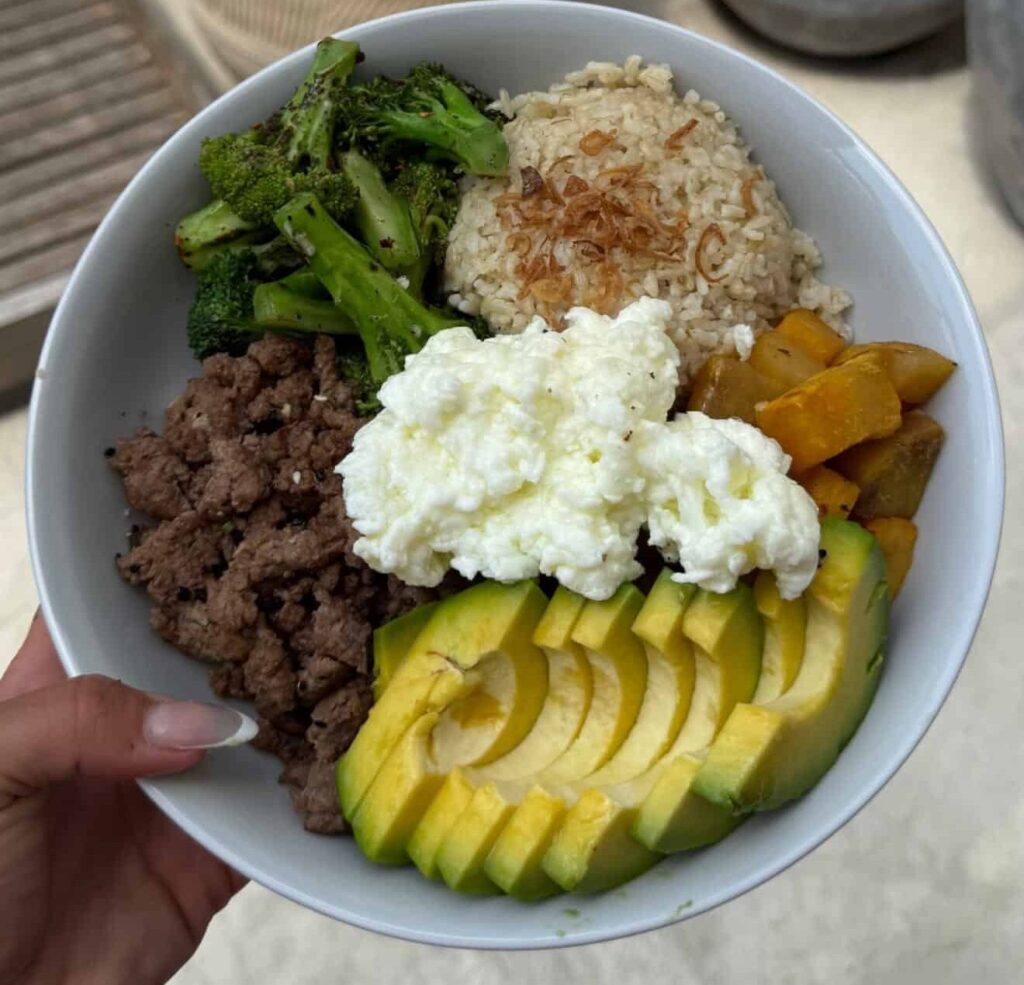
Protein: The Non-Negotiable Factor
Regardless of whether you’re cutting, bulking, or recomping, protein intake is critical.
How Much Protein Do You Need?
Research-backed recommendations:
Minimum effective dose: 1.6g per kg bodyweight
Optimal range: 1.8-2.2g per kg bodyweight
Upper beneficial limit: 2.4g per kg bodyweight
For a 65kg woman:
- Minimum: 105g daily
- Optimal: 115-145g daily
- Upper limit: 155g daily
Why so much? Protein provides amino acids for muscle repair and growth. When calories are restricted (cutting or recomping), high protein intake prevents muscle loss. When calories are surplus (bulking), adequate protein maximises muscle gains.
Does More Protein Help?
Research shows benefits plateau around 2.2-2.4g per kg. Eating 3g per kg doesn’t provide additional muscle-building benefits for natural trainees.
Exception: Very aggressive cuts (500+ calorie deficit) may benefit from higher protein (2.4-2.6g per kg) to preserve muscle.
Protein Distribution
Does timing matter? Less than you think, but distributing protein across 3-4 meals is slightly better than one or two large meals.
Practical approach: Aim for 25-40g protein per meal if eating 3-4 times daily.
Example day (130g protein target):
- Breakfast: 30g (Greek yoghourt with protein powder)
- Lunch: 35g (chicken breast salad)
- Afternoon snack: 25g (protein bar)
- Dinner: 40g (salmon with vegetables)

Carbs and Fats: How to Split Remaining Calories
After determining protein, you allocate remaining calories between carbohydrates and fats.
Minimum Fat Intake
Never go below: 0.5g per kg bodyweight
For a 65kg woman: minimum 32g fat daily
Why? Fat is essential for hormone production, vitamin absorption, and cell function. Very low fat intake (below 0.5g/kg) can disrupt menstrual cycles and reduce testosterone (yes, women produce testosterone—it’s important for muscle growth).
Minimum Carbohydrate Intake
Recommendation: At least 100-150g daily if training with weights 3+ times weekly
Why? Carbohydrates fuel high-intensity training. Extremely low carb intake reduces training performance, making muscle growth difficult.
The Split Between Carbs and Fats
After meeting minimum protein and fat, allocate remaining calories between carbs and fats based on preference and training volume.
Higher carb approach (250-300g): Suits women training 4-6 days weekly, preferring feeling “full” and energised.
Moderate carb approach (150-200g): Suits women training 3-4 days weekly, no strong preference.
Lower carb approach (100-150g): Suits women training 2-3 days weekly or those who feel better on lower carbs.
Sample macros for 65kg woman eating 2,000 calories:
Higher carb version:
- Protein: 130g (520 cal)
- Carbs: 240g (960 cal)
- Fat: 58g (520 cal)
Moderate carb version:
- Protein: 130g (520 cal)
- Carbs: 190g (760 cal)
- Fat: 80g (720 cal)
Lower carb version:
- Protein: 130g (520 cal)
- Carbs: 140g (560 cal)
- Fat: 100g (900 cal)
All three approaches work. Choose based on what you’ll actually stick to.
Special Considerations for Women
Menstrual Cycle Effects
Your maintenance calories may fluctuate by 100-200 throughout your cycle, typically slightly higher during the luteal phase (post-ovulation).
Practical approach: Don’t stress about this. If you notice you’re hungrier during certain weeks, eating an extra 100-150 calories is fine. Your monthly average matters more than daily precision.
Age and Metabolism
Women under 30: Use standard calculations
Women 30-40: May need to reduce estimated maintenance by 50-100 calories
Women 40+: May need to reduce estimated maintenance by 100-150 calories
These adjustments reflect typical metabolic slowdown with age, though individual variation is large. Always adjust based on your actual results.
Training Experience Level
Beginners (0-12 months): Can build muscle in a deficit. Consider body recomposition approach.
Intermediate (12-36 months): May still recomp successfully but slower. Consider dedicated cut or bulk phases.
Advanced (36+ months): Body recomposition very difficult. Dedicate 12-16 weeks to either cutting or bulking for optimal results.

Common Questions
“Can I eat more on training days and less on rest days?”
Yes, this is called calorie cycling or carb cycling.
Example:
- Training days: +200-300 calories (mostly from carbs)
- Rest days: -200-300 calories (reduce carbs, maintain protein/fat)
- Weekly average: Still hits your target
Some research suggests minor benefits, but the primary advantage is psychological—eating more around training can improve performance and motivation.
Practical implementation:
- Maintenance: 2,000 calories weekly average
- Training days (4x weekly): 2,200 calories
- Rest days (3x weekly): 1,750 calories
- Weekly total: 14,025 (average 2,004 daily)
“What if I’m not losing weight despite eating in a deficit?”
Reasons weight loss stalls:
- Inaccurate tracking: Most people underestimate food intake by 20-30%. Weigh food with a scale.
- Insufficient time: Weight fluctuates 1-2kg daily due to water, food volume, and hormones. Track for 3-4 weeks before concluding progress has stopped.
- Metabolic adaptation: After weeks of dieting, metabolism slows slightly. Solution: Diet break (eat at maintenance for 1-2 weeks), then resume deficit.
- You’re building muscle whilst losing fat: If strength is increasing and clothes fit better despite stable scale weight, you’re recomping successfully. Trust the process.
- Maintenance calories were overestimated: Reduce calories by 100-150 and track for another 3-4 weeks.

"Should I eat back calories burned during exercise?"
Short answer: Activity is already factored into your TDEE calculation.
Don’t log exercise in MyFitnessPal and eat back those calories—this leads to overestimating expenditure and overeating.
Exception: If you add significant new activity (start training for a half-marathon whilst already lifting 4x weekly), increase total calories by 150-250 to account for additional energy expenditure.
“Can I have one ‘cheat day’ per week?”
The problem: A single excessive day can negate your entire weekly deficit.
Example:
- Monday-Saturday: 1,700 calories daily (300 deficit)
- Total deficit: 1,800 calories
- Sunday cheat day: 3,500 calories (+1,500 surplus)
- Net weekly deficit: only 300 calories
You’d lose 0.05kg that week instead of 0.3kg.
Better approach: Build foods you enjoy into your daily calories. Want pizza? Have 2-3 slices and a side salad that fits your calories. No food is forbidden.
“Should I track calories forever?”
Ideal progression:
Months 1-3: Track everything diligently. Learn portion sizes and calorie content.
Months 4-6: Track most days, estimate occasionally. You’re developing intuition.
Months 6+: Track periodically (one week monthly) to ensure you’re roughly on target. Many people successfully maintain without daily tracking after building this foundation.
However: If you stop tracking and your weight starts drifting in an undesired direction, resume tracking.
“What about flexible dieting / IIFYM (If It Fits Your Macros)?”
Concept: As long as food fits your calorie and macro targets, eat anything.
Reality: This works but requires nuance. 80-90% of calories from whole, nutrient-dense foods, 10-20% from whatever you want ensures adequate micronutrition whilst maintaining adherence.
Poor IIFYM execution:
- Breakfast: Pop-Tarts (fits macros!)
- Lunch: McDonald’s (fits macros!)
- Dinner: Pizza (fits macros!)
You’ll hit calorie/macro targets but feel terrible, lack micronutrients, and struggle with hunger.
Better IIFYM execution:
- Breakfast: Eggs, toast, fruit
- Lunch: Chicken, rice, vegetables
- Afternoon snack: Biscuit with tea (fits macros!)
- Dinner: Fish, potatoes, salad
- Evening: Small chocolate bar (fits macros!)

Sample Daily Meal Plans
Cutting Example (1,700 Calories)
65kg woman, 130g protein, 180g carbs, 50g fat
Breakfast (400 cal):
- 2 eggs
- 2 slices wholemeal toast
- 1 medium banana
Lunch (500 cal):
- 150g chicken breast
- 200g cooked rice
- Large mixed salad
- 10g olive oil dressing
Afternoon Snack (250 cal):
- Protein bar (20g protein)
Dinner (500 cal):
- 150g salmon
- 250g potatoes
- 200g broccoli
Evening (50 cal):
- 10g dark chocolate
Bulking Example (2,300 Calories)
65kg woman, 135g protein, 290g carbs, 65g fat
Breakfast (550 cal):
- 80g porridge oats
- 30g protein powder
- 1 banana
- 200ml semi-skimmed milk
Lunch (650 cal):
- 150g chicken breast
- 300g cooked rice
- Mixed vegetables
- 15g olive oil
Afternoon Snack (350 cal):
- Greek yoghourt (200g)
- 40g granola
Dinner (650 cal):
- 150g lean beef mince
- 250g pasta
- Tomato-based sauce
- Side salad
Evening (100 cal):
- 2 biscuits with tea
Recomp Example (2,000 Calories)
65kg woman, 130g protein, 230g carbs, 60g fat
Breakfast (450 cal):
- 3 eggs scrambled
- 2 slices wholemeal toast
- 80g mushrooms
Lunch (550 cal):
- Chicken wrap (150g chicken, large tortilla, salad)
- Apple
Afternoon Snack (300 cal):
- Protein shake (30g powder, 300ml semi-skimmed milk, 1 banana)
Dinner (600 cal):
- 150g salmon
- 300g sweet potato
- 150g green beans
- Small portion rice
Evening (100 cal):
- Small handful nuts (15g)
How 12REPS Helps With Nutrition
Understanding how many calories you need is step one. Actually eating those calories consistently whilst following a structured training programme is step two—and that’s where most people fail.
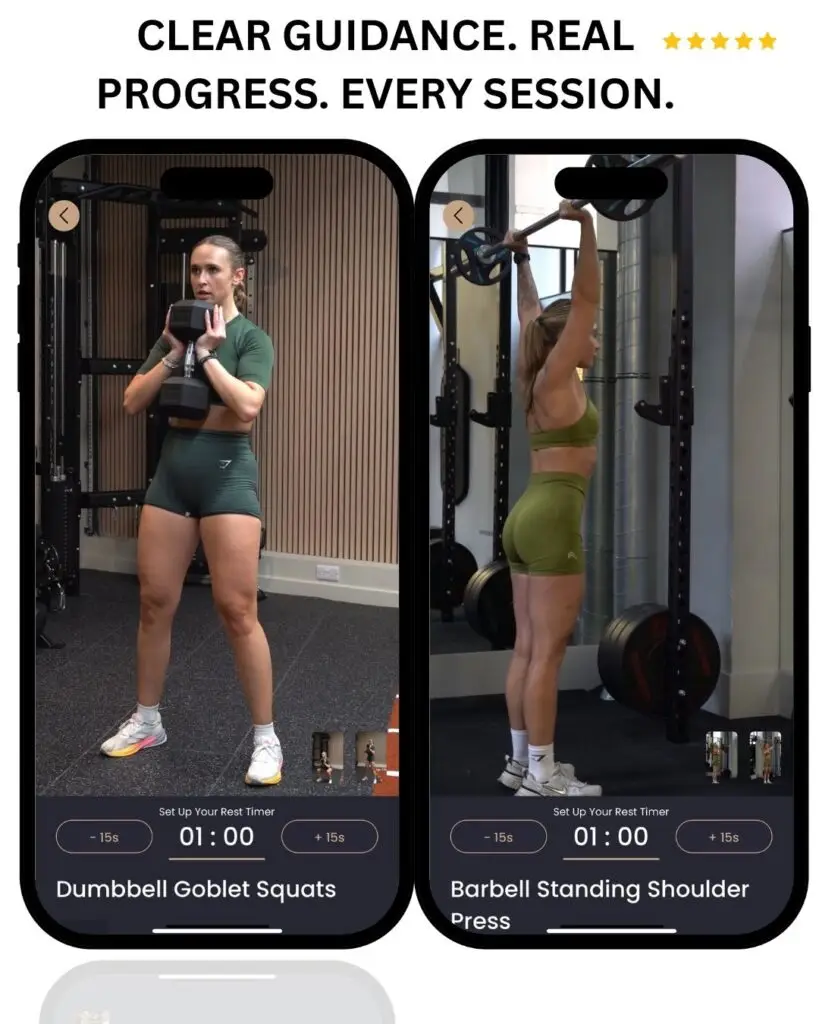
12REPS doesn’t just provide training programmes—it helps structure your entire approach:
1. Training programme matches your calorie approach
Tell the app your goal (fat loss, muscle gain, or body recomposition) and it structures your training accordingly:
- Cutting: Emphasises strength maintenance with appropriate volume
- Bulking: Higher volume to maximise muscle growth stimulus
- Recomping: Balanced approach suitable for slower progress
2. Progress tracking shows if your calorie intake is working
Log your workouts. If strength is increasing whilst bodyweight drops, your cut is working (preserving muscle whilst losing fat). If strength stalls despite eating in a surplus, you may need more calories.
The app’s progress tracking makes these adjustments obvious.
3. Equipment flexibility supports nutrition goals
Can’t get to the gym today because you’re exhausted from under-eating? The app adapts your workout to home/bodyweight options so you still train, maintaining muscle and adherence.
4. Consistency over perfection
The hardest part about hitting calorie and macro targets is maintaining consistency for months. 12REPS handles the training consistency, making nutrition adherence easier because you’re following a clear plan rather than guessing.
Try 12REPS free for 7 days. See how much easier training consistently becomes when you’re following a programme designed around your specific goals.
The Bottom Line
How many calories should you eat? It depends on your primary goal.
For fat loss (cutting):
✅ Calculate maintenance calories
✅ Subtract 300-500 calories
✅ Target 0.5-0.75% bodyweight loss weekly
✅ Minimum 1.8g protein per kg bodyweight
✅ Duration: 12-16 weeks, then diet break or reverse
For muscle gain (bulking):
✅ Calculate maintenance calories
✅ Add 200-300 calories
✅ Target 0.5-1kg gain monthly (after initial 2-3 months)
✅ Minimum 1.8g protein per kg bodyweight
✅ Duration: 16-24 weeks, then cut if desired
For body recomposition:
✅ Calculate maintenance calories
✅ Subtract 0-200 calories
✅ Target very slow changes (0.25-0.5kg monthly)
✅ Minimum 2.0g protein per kg bodyweight
✅ Duration: 6-12 months minimum
Most important: consistency.
Perfect macros calculated to the gram don’t matter if you only follow them 3 days per week. Roughly correct numbers followed consistently for months will always beat perfectly calculated numbers followed sporadically.
Start with the calculations in this guide. Track for 3-4 weeks. Adjust based on actual results. Repeat.
That’s how you actually build muscle and lose fat—not by finding the “perfect” calorie number, but by picking a reasonable starting point and consistently working the process.
References
- Barakat, C., Pearson, J., Escalante, G., Campbell, B. and De Souza, E.O. (2020). Body Recomposition: Can Trained Individuals Build Muscle and Lose Fat at the Same Time? Strength and Conditioning Journal, 42(5), pp.7-21. https://doi.org/10.1519/SSC.0000000000000584
- Hector, A.J. and Phillips, S.M. (2018). Protein Recommendations for Weight Loss in Elite Athletes: A Focus on Body Composition and Performance. International Journal of Sport Nutrition and Exercise Metabolism, 28(2), pp.170-177. https://doi.org/10.1123/ijsnem.2017-0273
- Morton, R.W., Murphy, K.T., McKellar, S.R., Schoenfeld, B.J., Henselmans, M., Helms, E., Aragon, A.A., Devries, M.C., Banfield, L., Krieger, J.W. and Phillips, S.M. (2018). A Systematic Review, Meta-Analysis and Meta-Regression of the Effect of Protein Supplementation on Resistance Training-Induced Gains in Muscle Mass and Strength in Healthy Adults. British Journal of Sports Medicine, 52(6), pp.376-384. https://doi.org/10.1136/bjsports-2017-097608
- Ribeiro, A.S., Pereira, L.C., Schoenfeld, B.J., Nunes, J.P., Kassiano, W., Nabuco, H.C., Fernandes, R.R., Junior, P.S., Venturini, D. and Cyrino, E.S. (2022). Moderate and Higher Protein Intakes Promote Superior Body Recomposition in Older Women Performing Resistance Training. Medicine & Science in Sports & Exercise, 54(8), pp.1296-1306. https://doi.org/10.1249/MSS.0000000000002917
- Longland, T.M., Oikawa, S.Y., Mitchell, C.J., Devries, M.C. and Phillips, S.M. (2016). Higher Compared with Lower Dietary Protein During an Energy Deficit Combined with Intense Exercise Promotes Greater Lean Mass Gain and Fat Mass Loss: A Randomized Trial. American Journal of Clinical Nutrition, 103(3), pp.738-746. https://doi.org/10.3945/ajcn.115.119339