

Written by Will Duru, BSc (Hons) Sport and Exercise Science, Level 3 Personal Trainer
A barbell full-body workout trains your legs, hips, back, shoulders and arms in one session, using just a barbell and plates. This plan comes from the 12REPS app and uses five compound lifts, with five sets of each.
A compound lift is an exercise that moves more than one joint and trains several muscle groups at once, such as a squat or a row. You can do this workout in a gym or a home setup with a rack, a bar and plates.
The plan is built on progressive overload. That means you add a little weight or a rep or two over time, so your muscles keep getting a new challenge.
Why This Barbell Workout Works
Every lift in this session is a compound lift. That gives you a few clear advantages:
- You train more muscle groups in each exercise.
- You need fewer exercises to cover the whole body.
- You can load them heavily, which suits strength goals.
Research backs this up. In a 2017 study of untrained young men, a program of only multi-joint exercises led to bigger strength gains than single-joint exercises at the same total load. Both groups had similar changes in body composition.
Full-body sessions also work as well as split routines for most people. A 2024 meta-analysis found no meaningful difference in strength or muscle growth between split and full-body training when total volume was equal. So you can pick the style that suits your week.
Log your weight, reps and sets after each session, then try to beat them next time.
The 12REPS Full-Body Barbell Workout
| Exercise | Sets x reps | Main muscles |
|---|---|---|
| Deadlift | 5 x 5 | Glutes, hamstrings, back |
| Bent-over row | 5 x 8-10 | Upper back, lats, rear shoulders |
| Clean and press | 5 x 8-10 | Hips, legs, traps, shoulders, arms |
| Reverse lunge | 5 x 10 (5 each leg) | Quads, glutes |
| Barbell squat | 5 x 8-10 | Quads, glutes, core |
1. Deadlift: 5 sets of 5 reps
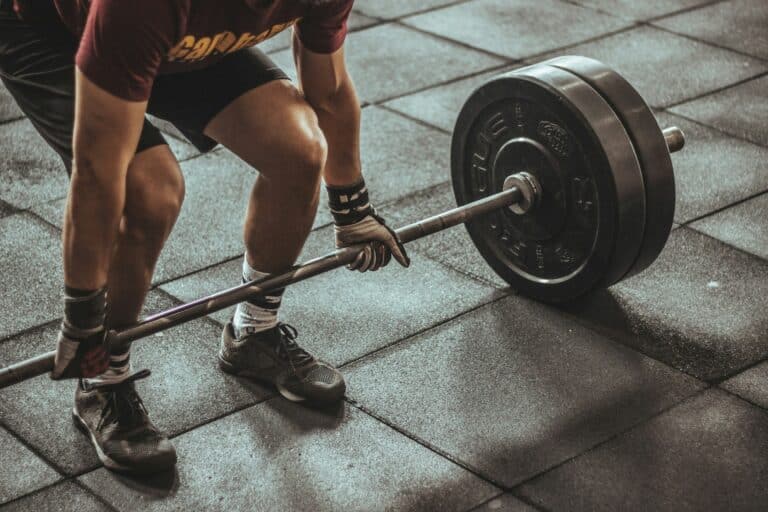
The deadlift trains your posterior chain, the muscles along the back of your body: glutes, hamstrings and back.
- Push the floor away with your feet.
- Keep the bar close to your legs the whole way up.
- Add weight only when your form stays tight on every rep.
New to the lift? Read our step-by-step deadlift technique guide first.
2. Bent-Over Row: 5 sets of 8-10 reps
The bent-over row trains your upper back, lats and rear shoulders.
- Hinge forward with a flat back.
- Pull the bar to your lower chest or upper stomach.
- Control each rep. Do not bounce the bar or jerk your body.
See the trainer demo on the barbell bent-over row exercise page.
3. Clean and Press: 5 sets of 8-10 reps
The clean and press combines power and control in one lift. The clean, where you pull the bar from the floor to your shoulders, works your hips, legs and traps. The press then trains your shoulders and arms.
- This is the most technical lift in the session. Start light.
- Keep the bar close to your body as you pull it up.
- Brace your core before you press overhead.
If you are new to overhead pressing, learn the strict barbell military press before you add the clean.
4. Reverse Lunges: 5 sets of 10 reps (5 each leg)
Reverse lunges train one leg at a time, which challenges your legs, glutes and balance. Each leg has to do its own share of the work.
- Step back far enough that both knees bend to about 90 degrees.
- Keep most of your weight on your front foot.
- Push through your front heel to stand back up.
Use a barbell across your back, or hold dumbbells if that feels steadier at home.
5. Barbell Squat: 5 sets of 8-10 reps
The barbell squat is a foundation lift for leg strength. It mainly trains your quads and glutes, while your core works to keep you upright.
- Squat only as deep as you can with good form.
- Brace your core before each rep.
- Track your numbers over time so you can see your progress.
See the full demo on the barbell squat exercise page.
Short on Time?
Do a three-exercise version: squat, deadlift and clean and press. Those three lifts still train your whole body.
In the 12REPS app, you can also set the time you have, and the app builds your session around it.
How Often to Do This Workout
The NHS advises adults to do strengthening activities that work all the major muscle groups on at least two days a week. Doing this full-body session twice a week covers that.
Leave at least one rest day between sessions. If you train three times a week, lower the number of sets so you can recover.
Not sure whether full-body or a split suits you best? Read our workout split guide.
How to Progress
Use a weight that lets you finish every set with good form and one or two reps to spare. When you can do the top of the rep range on all five sets, add a small amount of weight next time.
If you cannot add weight yet, add a rep instead. A 2022 study found that adding reps and adding load both built muscle and strength.
The 2026 ACSM resistance training position stand says to build gradually, and that you do not need to train to failure to make progress. For more on this, see our guide to progressive overload for beginners.
Safety Tips
- Warm up with an empty bar or light sets before your working sets.
- Learn each lift with a light weight before you go heavy.
- Use safety bars or a spotter for heavy squats.
- Stop if you feel sharp pain, and get advice from a qualified professional.
To learn more about why these lifts matter, read the power of compound lifts. If you also want a dedicated back day, try our pull day workout.
Train With a Plan
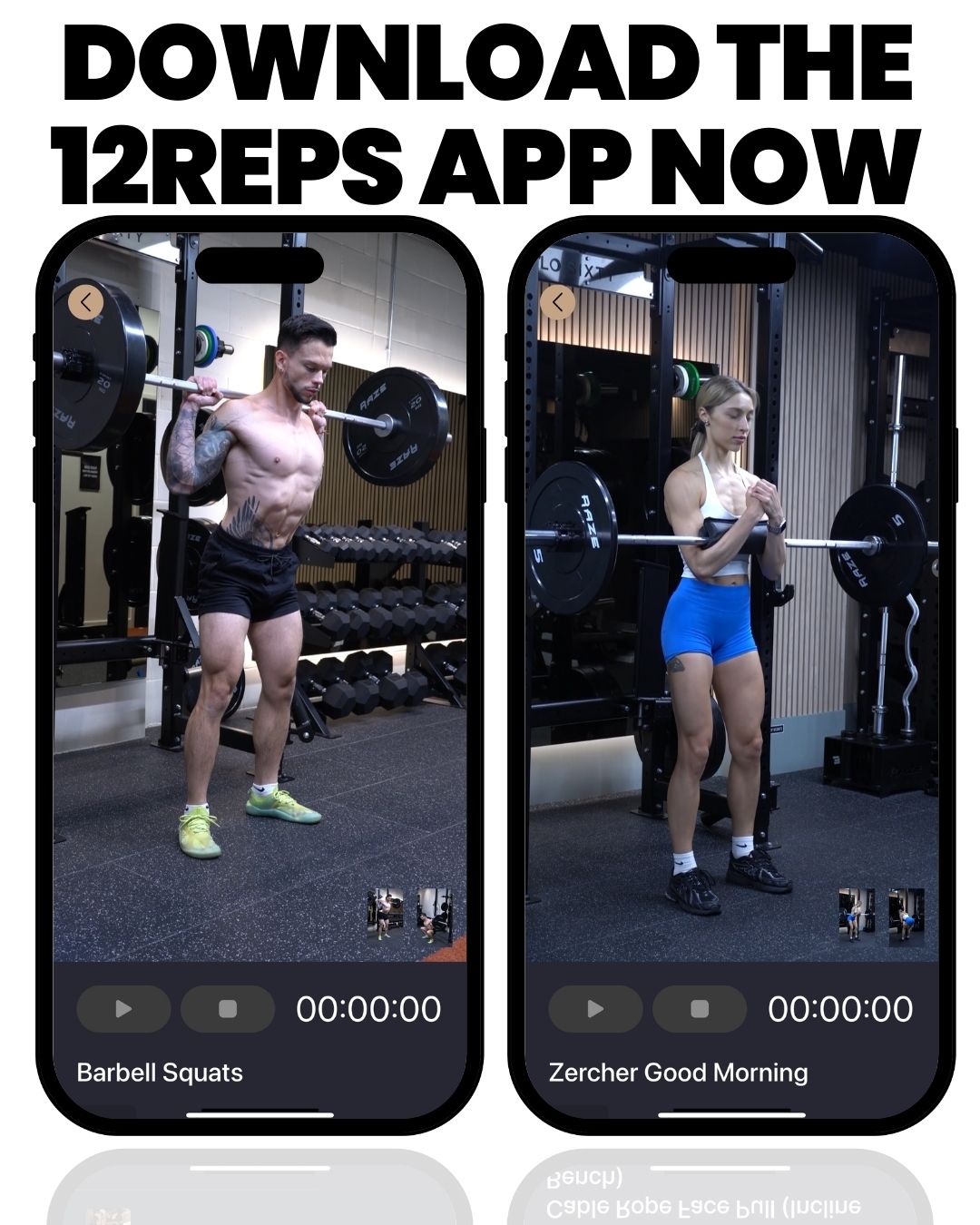
This workout came from the 12REPS app. If you want a plan like it built around your goal, your equipment and the time you’ve got, try 12REPS. You’ll see a trainer demo for every lift and log every set, so you know what to beat next session.
Sources
- Resistance Training with Single vs. Multi-joint Exercises at Equal Total Load Volume: Effects on Body Composition, Cardiorespiratory Fitness, and Muscle Strength. Frontiers in Physiology, 2017. https://www.frontiersin.org/articles/10.3389/fphys.2017.01105/full
- Efficacy of Split Versus Full-Body Resistance Training on Strength and Muscle Growth: A Systematic Review With Meta-Analysis. Journal of Strength and Conditioning Research, 2024. https://pubmed.ncbi.nlm.nih.gov/38595233/
- Physical activity guidelines for adults aged 19 to 64. NHS, 2024. https://www.nhs.uk/live-well/exercise/physical-activity-guidelines-for-adults-aged-19-to-64/
- Progressive overload without progressing load? The effects of load or repetition progression on muscular adaptations. PeerJ, 2022. https://peerj.com/articles/14142
- Resistance Training Prescription for Muscle Function, Hypertrophy, and Physical Performance in Healthy Adults (position stand infographic). American College of Sports Medicine, 2026. https://acsm.org/wp-content/uploads/2026/03/Resistance-Training-Position-Stand-infographic.pdf