Written by Will Duru, BSc (Hons) Sport and Exercise Science, Level 3 Personal Trainer.
Tracking macros means logging how many grams of protein, carbohydrate and fat you eat each day. To start, set a calorie target for your goal, set protein first, then split the rest between fat and carbs. Pair it with strength training so your body has a reason to keep or build muscle while you change your weight.
This guide explains what macros are, why muscle matters for fat loss, how to set and track your macros step by step, and where the 12REPS app fits in.
What Are Macros?
Macros, short for macronutrients, are the three nutrients that provide most of your energy. Each one gives a set amount of energy per gram, according to the British Nutrition Foundation.
| Macro | Energy per gram | Main job | Common foods |
|---|---|---|---|
| Protein | 4 kcal | Repairing and building muscle and other tissues | Meat, fish, eggs, dairy, beans, lentils, tofu |
| Carbohydrate | 4 kcal | Main fuel for your muscles during exercise | Oats, rice, potatoes, bread, pasta, fruit |
| Fat | 9 kcal | Essential fatty acids and absorbing some vitamins | Oils, nuts, seeds, avocado, oily fish |
Because fat has more than twice the energy per gram, small amounts of oil, butter or nuts add up fast. That is one reason tracking can be eye-opening.

Why Muscle Matters When You Want to Lose Fat
Strength training and good nutrition work together. Food provides the energy and protein. Training tells your body to use them to keep or build muscle. Here is how muscle helps when your goal is fat loss.
1. Muscle uses energy, even at rest
Muscle tissue uses some energy just to maintain itself. So keeping or adding muscle raises your daily energy use a little. The effect is smaller than many people claim, though. It helps over time, but it does not replace a sensible calorie intake.
2. The afterburn effect is real but small
After a hard session, your body uses slightly more energy for a while as it recovers. This is called excess post-exercise oxygen consumption (EPOC), or the “afterburn effect”. The extra energy used is usually modest, so treat it as a small bonus, not the main reason to lift.
3. You can change your body shape: lose fat and gain muscle
Weight loss is not only about the number on the scale. Body recomposition means losing fat while gaining or keeping muscle. Your weight may change only a little, but your clothes can fit differently.
It is most likely when you are new to lifting or returning after a break. It needs consistent training and enough protein. Read more in our body recomposition guide.
4. Muscle helps you keep what you have worked for
When you eat less to lose fat, some of the weight you lose can come from muscle. Strength training and a high protein intake help you hold on to muscle. The International Society of Sports Nutrition (ISSN) notes that higher protein intakes may help resistance-trained people keep lean mass while eating fewer calories.
5. Strength for everyday life
Beyond fat loss, getting stronger makes daily tasks such as carrying groceries, climbing stairs and lifting children feel easier. That benefit stays with you whatever the scale says.

How to Start Tracking Macros in 5 Steps
You do not need to be perfect. The aim is a rough, consistent picture of what you eat, so you can adjust it.
Step 1: Set your calorie target
Your goal decides your calories.
- Fat loss: eat a little less than you burn. This is a calorie deficit, which means your body draws on stored energy.
- Muscle gain: eat a little more than you burn, so your body has spare energy to build muscle.
- Body recomposition: eat close to the amount you burn.
Our guide to how many calories to eat to build muscle and lose fat shows how to estimate this.
Step 2: Set your protein
Protein comes first because it supports muscle repair and growth. The ISSN suggests 1.4 to 2.0 g per kg of body weight per day for most people who exercise. It notes that resistance-trained people eating fewer calories may benefit from higher intakes, around 2.3 to 3.1 g per kg.
Spread it across the day. The ISSN suggests 20 to 40 g per meal, about every 3 to 4 hours. Our high-protein breakfast ideas make the first meal simple.
Step 3: Set your fat
Fat is essential, so do not cut it too low. EFSA suggests fat should provide 20 to 35% of your total energy. A 2016 joint position statement on nutrition and athletic performance advises against eating less than 20% from fat over the long term.
Step 4: Fill the rest with carbohydrates
Take your protein and fat calories away from your total. Divide what is left by 4 to get your carbs in grams. Carbs fuel your training, so they often make up the largest share.
A worked example
Say you weigh 70 kg and your calorie target is 2,200 kcal a day.
| Macro | How it is set | Grams | Calories |
|---|---|---|---|
| Protein | 2.0 g per kg x 70 kg | 140 g | 560 kcal |
| Fat | 25% of 2,200 kcal, divided by 9 | About 61 g | 550 kcal |
| Carbohydrate | Remaining 1,090 kcal, divided by 4 | About 270 g | 1,090 kcal |
That carbohydrate amount works out at about 3.9 g per kg. It sits within the 3 to 5 g per kg range the joint position statement gives for light training loads. Your own numbers will differ. Treat them as a starting point.
Step 5: Log, review and adjust
- Use a food-tracking app and a kitchen scale. Weighing food is more accurate than guessing portions.
- Log as you go. It is easier than trying to remember at the end of the day.
- Count the small things. Cooking oil, sauces, milk in coffee and drinks all add up.
- Watch your weekly trend. Weigh yourself under the same conditions and look at the average over a few weeks, not single days.
- Adjust slowly. If your weight is not moving the way you want after a few weeks, make a small change to your calories and review again.
If tracking makes you anxious or starts to affect your relationship with food, stop and speak to your doctor or a registered dietitian. You can still eat well using a simple plate method. See our guide to healthy eating for strength training.
Common Myths About Muscle and Fat Loss
Some outdated ideas can stop people from starting. Here are two of the most common.
Myth 1: Cardio is the only way to lose weight
The myth: “I need to run for hours every day to lose weight. Lifting weights is just for getting big.”
The reality: Fat loss comes from a calorie deficit over time. Cardio and strength training both use energy and both have health benefits. Strength training adds something cardio does not: it gives your body a strong reason to keep muscle while you eat less. Many people do best with a mix of both. Compare them in our guide to running vs strength training for weight loss.
Myth 2: Lifting weights will make women bulky
The myth: “I don’t want to lift weights because I’ll get too big.”
The reality: Building a large amount of muscle takes years of focused training and eating, for anyone. Women generally have much lower testosterone levels than men, which makes large muscle gains slower. For most women, regular lifting builds strength and a more athletic shape. Read more in will lifting weights make me bulky?
Your Training Plan for Muscle Building and Weight Loss with 12REPS
Macro tracking covers the food side. For the training side, you need a clear, step-by-step plan. This is where the 12REPS app comes in.
How 12REPS Helps You Train for Fat Loss and Muscle Gain
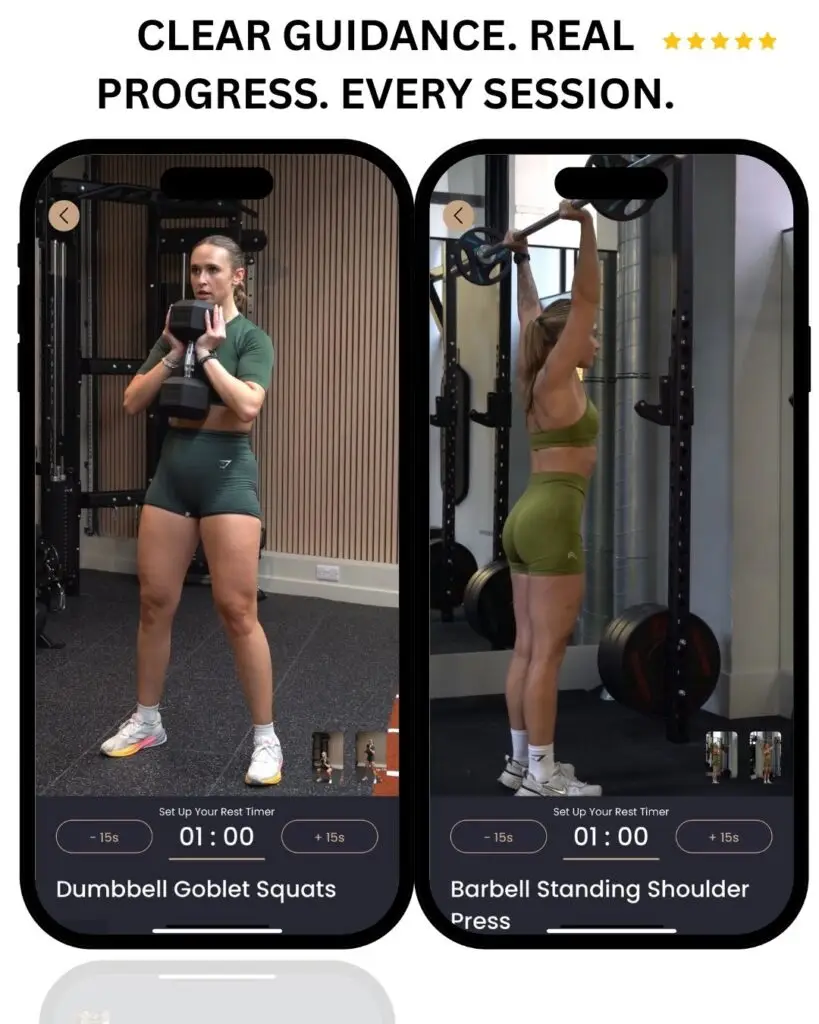
- A plan built for you: 12REPS builds your training around your goal, the equipment you have and the time you’ve got. Open the app and your workout is ready.
- Trainer demonstrations: every exercise comes with a demonstration and technique breakdown from qualified personal trainers, including big multi-joint lifts such as squats, deadlifts, presses and rows.
- Progressive overload made simple: progressive overload means gradually asking more of your muscles over time, for example by adding a rep or a little weight. You enter your reps and weight for each set, and the app remembers what you lifted, so you always have a number to beat.
- Accountability: 12REPS tracks your workouts, sets, reps, weights and streaks. You can set a weekly goal, join challenges and log your body weight to see your trend over time.
What 12REPS Does (and Doesn’t) Do for Food
12REPS is a training app. It gives you structured workouts, exercise demonstrations and ways to track your training. It does not give meal plans or track your food. For that, use a separate food-tracking app alongside the guidance in this article.
For more help with the food side, read the 12REPS nutrition guide and our guide to how much protein you need to build muscle. Training gives your body the reason to change. Good food gives it what it needs to make that change.
Conclusion: Track Your Macros, Train Consistently
Tracking macros gives you a clear picture of what you eat. Set your calories for your goal, put protein first, keep fat at a healthy level and let carbs fill the rest. Then review your trend and adjust slowly.
Food is only half the picture. Strength training tells your body to keep and build muscle while you change your weight. Both cardio and lifting have a place, and lifting will not make you bulky by accident.
If you want a training plan to go with your nutrition, 12REPS builds each session around your goal, your equipment and your time. It also remembers what you lifted, so every workout gives you a number to beat.
If you have a medical condition, are pregnant or take medication, check with your doctor before changing your diet or starting a weight-loss plan.
Sources
- Fat (nutrition information). British Nutrition Foundation, 2023. https://www.nutrition.org.uk/nutritional-information/fat/
- International Society of Sports Nutrition Position Stand: Protein and Exercise. Journal of the International Society of Sports Nutrition (Jäger et al.), 2017. https://cdr.lib.unc.edu/concern/articles/gh93h184p
- EFSA sets European dietary reference values for nutrient intakes. European Food Safety Authority (EFSA), 2010. https://www.efsa.europa.eu/en/press/news/nda100326
- Nutrition and Athletic Performance: Position of Dietitians of Canada, the Academy of Nutrition and Dietetics and the American College of Sports Medicine. Dietitians of Canada, 2016. https://www.dietitians.ca/DietitiansOfCanada/media/Documents/Resources/noap-position-paper.pdf