




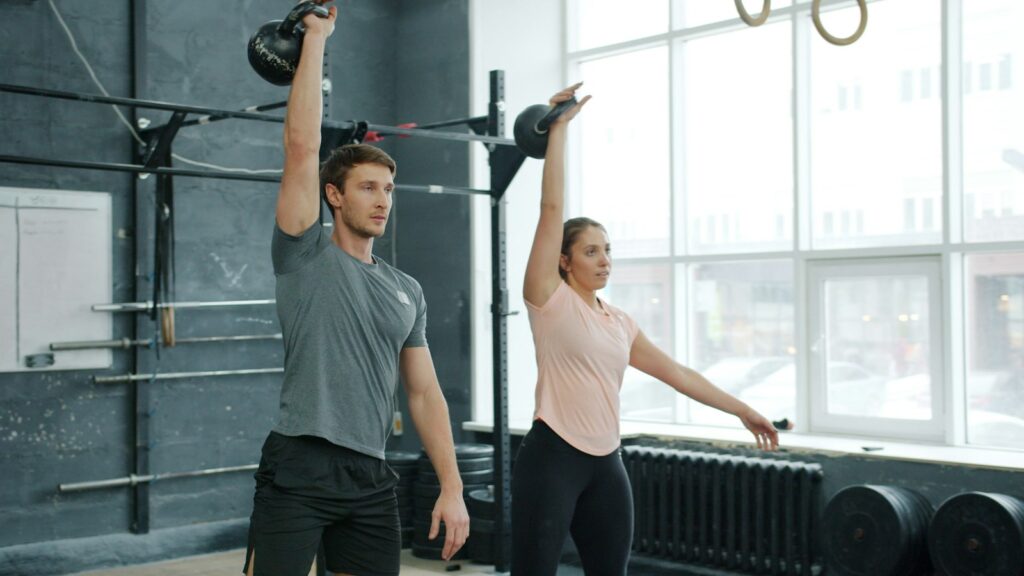
The short answer: the kettlebell clean and press is a two-part exercise. First you “clean” the bell from between your legs to the rack position, where it rests on your forearm at chest height. Then you press it overhead with one arm. It works your hips, glutes, hamstrings, shoulders, triceps, upper back, core and grip in one movement. The key to doing it well is simple: drive the clean with your hips, not your arm, and let the bell roll around your wrist instead of flipping over and hitting your forearm.
This guide is for anyone who wants a full-body exercise they can do with a single kettlebell. I’ll explain how the movement works, what the research does and doesn’t show, how to do it step by step, the mistakes I see most and how to fit it into your training.
What is a kettlebell clean and press?
The movement has two parts that flow together.
- The clean: a short, hip-driven swing that brings the bell up to the rack position. It uses the same hip hinge as a kettlebell swing, but the bell travels close to your body and finishes at your chest instead of out in front.
- The press: a strict, single-arm overhead press from the rack position to a locked-out arm overhead.
Because you work one arm at a time, your core has to stop your body from leaning or twisting. That makes it more than a shoulder exercise.
Kettlebell clean and press muscles worked
| Phase | Main muscles | What they do |
|---|---|---|
| Clean | Glutes, hamstrings, lower back | Snap your hips forward to drive the bell up |
| Clean | Lats, upper back, forearms | Keep the bell close and guide it into the rack |
| Rack | Core, upper back | Hold the bell steady at your chest |
| Press | Shoulders, triceps, upper chest | Push the bell overhead |
| Press | Core, obliques, glutes | Stop you leaning sideways or arching your back |
| Whole movement | Grip and forearms | Hold the handle for every rep |
What the research says
There is very little research on the kettlebell clean and press itself. Most kettlebell studies look at the swing. Here’s what the evidence does show, and where it’s thin.
- Kettlebell research is still limited overall. A 2019 scoping review found 99 publications on kettlebell training. Most studies were small and of low quality, effects were usually trivial to small, and the authors rated confidence in the results as low to very low.
- Kettlebells change how a press feels. A 2018 study of 21 people compared overhead presses with a dumbbell and a kettlebell. Front shoulder (anterior deltoid) activity was a little higher with the dumbbell, at about 63% of maximum compared with 58% for the kettlebell. The authors linked this to the kettlebell’s weight sitting behind your hand rather than in line with it, which changes the balance of the press.
- Kettlebell intervals raise your heart rate. In a 2012 study of 13 moderately trained people, 10 minutes of two-handed swings (35 seconds on, 25 seconds off) kept heart rate above 85% of age-predicted maximum. That matched a treadmill run at the same perceived effort, although the run used more oxygen and energy.
- Hip-driven kettlebell work can build strength. A 2012 study found that kettlebell swing training improved both maximal and explosive strength. The clean uses the same hip drive, but it hasn’t been studied in the same way.
So the research supports kettlebells as a useful training tool, but it doesn’t prove the clean and press is better than other options. My advice on technique and programming below comes from coaching experience.
How to do a kettlebell clean and press
Setup
- Place the kettlebell on the floor about a foot in front of you, between your feet.
- Stand with your feet about hip to shoulder width apart.
- Push your hips back, keep your back flat and grab the handle with one hand. Your thumb should point toward you.
- Hike the bell back between your legs, as you would at the start of a swing.
The clean
- Snap your hips forward and stand up tall. Let that hip drive move the bell, not your arm.
- Keep your elbow close to your side so the bell travels up close to your body, like you’re zipping up a jacket.
- As the bell reaches chest height, turn your hand around the handle and “punch” it through so the bell rolls softly onto the back of your forearm.
- Finish in the rack position: bell resting on your forearm, wrist straight, elbow tucked in close to your ribs, fist near your chin.
The press
- Squeeze your glutes, brace your stomach and squeeze the handle.
- Press the bell straight up. Let your forearm stay vertical under the bell as it rises.
- Lock your elbow at the top with your biceps near your ear. The bell should sit over your shoulder, not out in front.
- Lower the bell under control back to the rack position.
- Let the bell drop back down between your legs with a hinge, then clean it again for the next rep.
Coaching cues I use: “hips, not arms” for the clean, “zip up the jacket” to keep the bell close and “ribs down, glutes tight” for the press. If the bell is banging your forearm, the clean is too loose and too far from your body.

Common mistakes and how to fix them
| Mistake | Why it matters | Fix |
|---|---|---|
| Curling the bell up with your arm | Tires your arm and misses the hip drive | Snap your hips and let the bell float up |
| Bell slamming onto your forearm | Bruises your arm and loses control | Keep the bell close and rotate your hand around it early |
| Wrist bent back in the rack | Strains your wrist | Grip the handle deep in your palm and keep your wrist straight |
| Squatting instead of hinging | Takes power away from the hips | Push your hips back with only a slight knee bend |
| Leaning sideways on the press | Shifts load onto your lower back | Brace your core and use a lighter bell |
| Pressing the bell out in front | Makes the lift harder on your shoulder | Finish with the bell over your shoulder and your arm by your ear |
| Rushing every rep | Technique falls apart as you tire | Pause in the rack for a second before each press |
How heavy should your kettlebell be?
The press is almost always the limit, not the clean. Choose a bell you can press overhead for about 5–8 controlled reps on your weaker arm. For most people, that’s lighter than the bell they use for swings.
If you can clean the bell easily but the press is a grind, stay with that weight and build your press first. If the press feels easy but your forearm gets bruised, work on the clean before going heavier.
Sets, reps and a simple workout
These are starting points I use with most lifters. Adjust them to your goal and the rest of your program.
| Goal | Sets | Reps per arm | Rest |
|---|---|---|---|
| Strength | 4–5 | 3–5 | 90 seconds–2 minutes |
| Muscle and strength endurance | 3–4 | 6–10 | 60–90 seconds |
| Conditioning | 10-minute EMOM | 3–5, alternating arms each minute | Rest of the minute |
EMOM stands for “every minute on the minute.” You start a set at the top of each minute and rest for whatever time is left.
Ladder option: do 1 rep on your left arm and 1 on your right, then 2 per arm, then 3, up to 5. Rest 1–2 minutes and repeat the ladder 2–3 times. It’s a simple way to build volume without rushing.
Variations to try
- Half-kneeling press: takes your legs out of it and makes your core work harder to stay upright. See the kettlebell kneeling shoulder press demo.
- Split stance press: one foot forward, one back, for more balance challenge. See the kettlebell split stance shoulder press demo.
- Clean and push press: add a short knee dip and leg drive to get a heavier bell overhead.
- Double kettlebell clean and press: one bell in each hand. Harder on your whole body and better once you’ve mastered the single-arm version.
If you have shoulder pain or a past shoulder injury, start light or check with a physical therapist or doctor before pressing overhead.
Summary
- The kettlebell clean and press combines a hip-driven clean with a single-arm overhead press.
- It works your hips, shoulders, triceps, upper back, core and grip in one movement.
- Research on this exact exercise is limited, and kettlebell studies overall are small, so treat it as a useful tool rather than a magic one.
- Clean with your hips, keep the bell close and press from a strong rack position.
- Pick a bell you can press 5–8 times on your weaker arm.
Build a full-body kettlebell plan
One good exercise doesn’t make a program. You also need to know how it fits with your other lifts and when to move up a bell. That’s where 12REPS helps.
12REPS gives you trainer-built programs with two demo videos for every exercise, so you can check the clean and the press before you try them. The gym log shows which bell you used last time, the built-in timer runs your EMOMs and rest periods, and Build Your Routine lets you add the clean and press to your own week. Every new account starts with a 7-day free trial.
Download 12REPS and see what you’ll get:
Sources
- Meigh NJ, Keogh JWL, Schram B, Hing WA. Kettlebell training in clinical practice: a scoping review. BMC Sports Science, Medicine and Rehabilitation. 2019;11:19.
- Dicus JR, Holmstrup ME, Shuler KT, Rice TT, Raybuck SD, Siddons CA. Stability of resistance training implement alters EMG activity during the overhead press. International Journal of Exercise Science. 2018;11(1):708–716.
- Hulsey CR, et al. Comparison of kettlebell swings and treadmill running at equivalent rating of perceived exertion values. Journal of Strength and Conditioning Research. 2012;26(5):1203–1207. Summary via IDEA Health and Fitness Association.
- Lake JP, Lauder MA. Kettlebell swing training improves maximal and explosive strength. Journal of Strength and Conditioning Research. 2012;26(8):2228–2233.
Related reading
- How to Do a Kettlebell Swing: Form, Cues and Common Mistakes
- Total Body Kettlebell Strength: One Kettlebell. Six Exercises. Your Entire Body.
- The Ultimate Time-Saver: A Full-Body Kettlebell Workout for Busy People
- Women’s Kettlebell Training: Full Body Strength Program
I’m Will Duru, a personal trainer and the founder of 12REPS. I hold a BSc (Hons) in Sport and Exercise Science and have more than a decade of experience coaching people in strength training.
