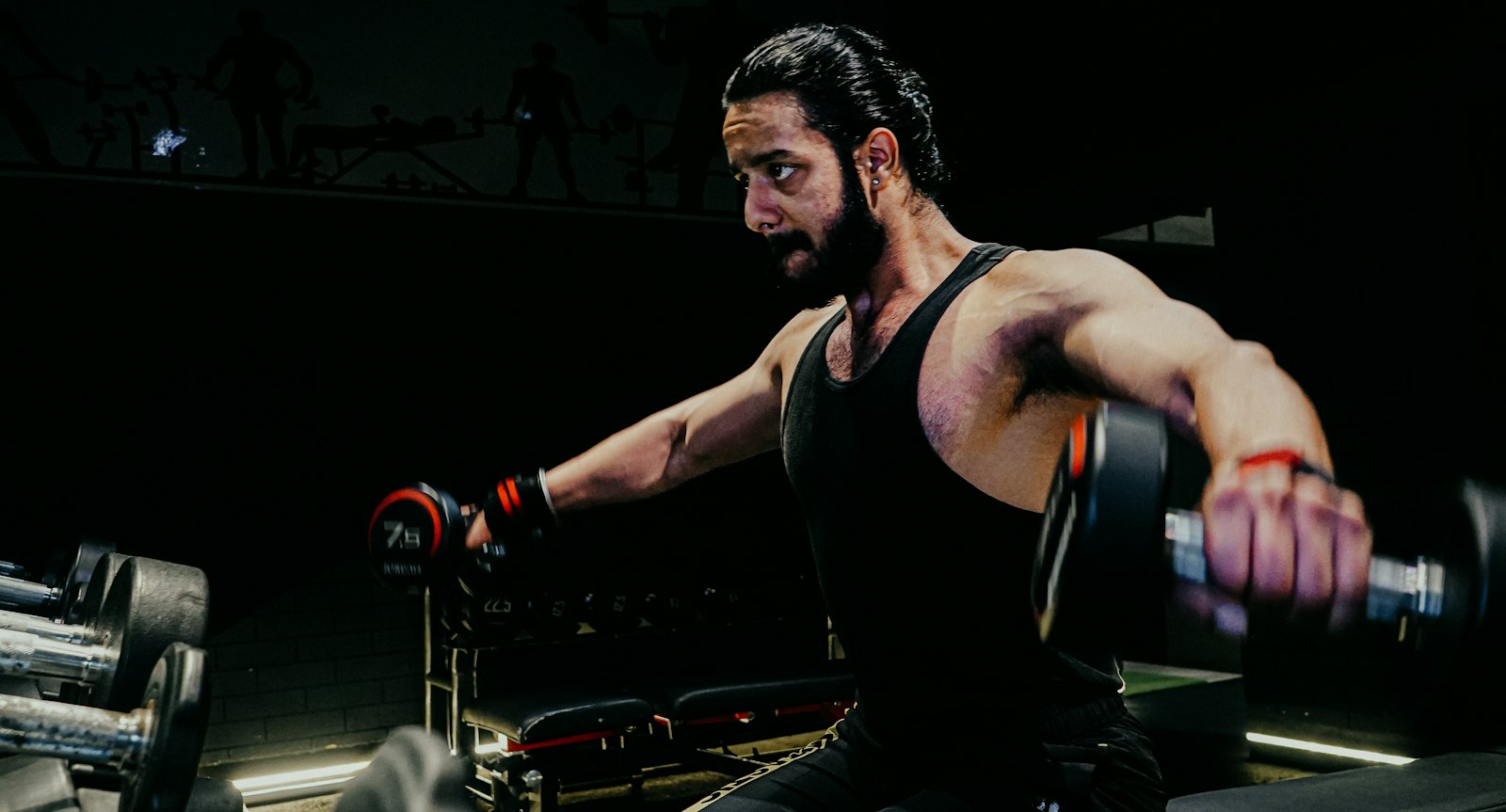


Quick answer: To do a lateral raise, hold a light dumbbell in each hand by your sides with a slight bend in your elbows. Lift your arms out to the sides until your hands reach about shoulder height, leading with your elbows. Pause for a moment, then lower slowly. Keep your shoulders down and away from your ears, and keep your hands roughly level with your elbows. Use a weight you can lift for 12 to 20 controlled reps.
Lateral raises build the side of your shoulders, the part that makes them look wider. They’re simple, but they’re easy to get wrong. Most people go too heavy, swing the weight and end up feeling it in their neck instead of their shoulders.
This guide is for you if your lateral raises don’t seem to work your shoulders, or if you’re new to them. You’ll learn which muscles they train, how to do them with dumbbells and cables, what the research says, the mistakes I see most and how to program them.
What muscles do lateral raises work?
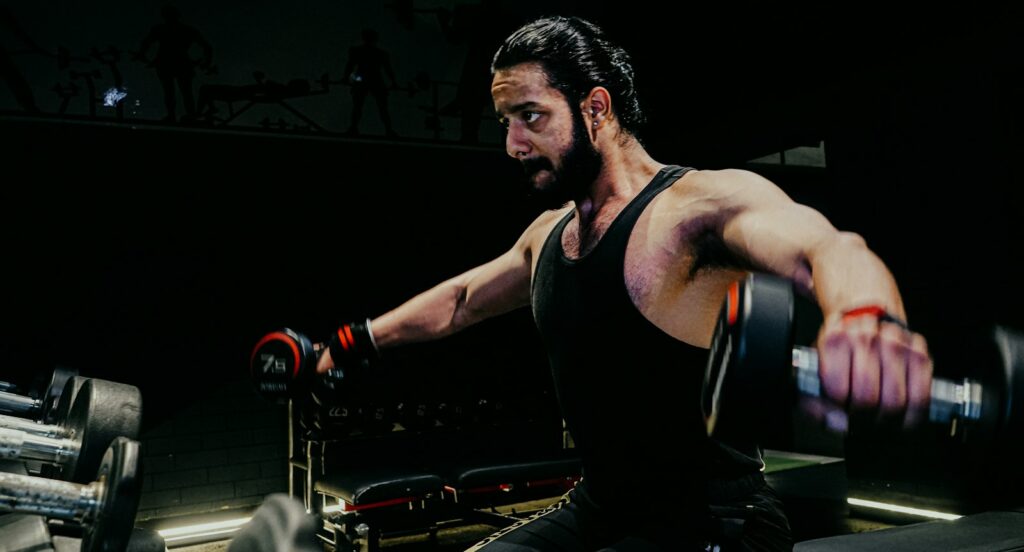
Your shoulder muscle (the deltoid) has three parts: front, side and rear. Lateral raises mainly work the side delts, which add width to your shoulders. The front delts, rear delts and upper traps (the muscles between your neck and shoulders) also help.
Pressing exercises like the overhead press work your front delts hard but your side delts less. That’s why lateral raises are a common addition to a shoulder workout.
How to do a dumbbell lateral raise
Setup
- Stand with your feet about hip-width apart and a dumbbell in each hand.
- Let the dumbbells hang by your sides or slightly in front of your thighs, palms facing in.
- Bend your elbows slightly and keep that bend through the whole set.
- Brace your stomach and pull your shoulders down, away from your ears.
The movement
- Lift your arms out to the sides, leading with your elbows.
- Stop when your hands reach about shoulder height.
- Pause for a second at the top.
- Lower slowly, taking about 2 to 3 seconds.
Coaching cues: “Push the dumbbells out to the walls, not up to the ceiling.” “Elbows lead, hands follow.” “Shoulders down.”
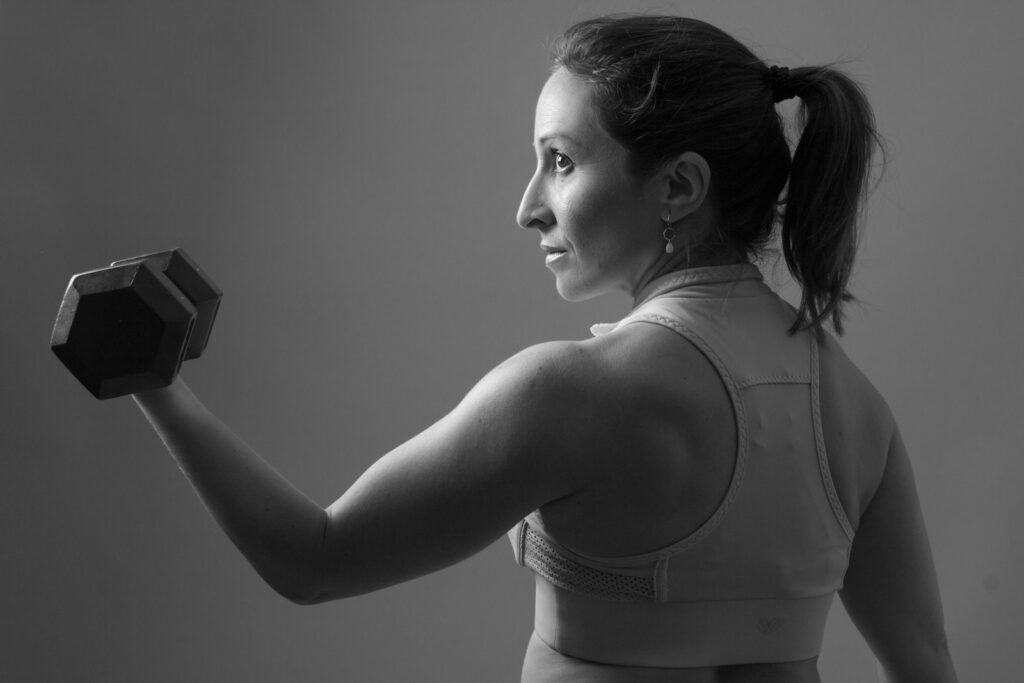
Cable lateral raise
With a cable, you stand side-on to a low pulley and raise one arm at a time. A dumbbell is heaviest at the top of the movement and easy at the bottom. A cable keeps tension on your shoulder for more of the range, including the bottom.
So is the cable version better? Not according to the best study so far. In an 8-week trial, 24 experienced lifters (16 men, 8 women) did cable raises with one arm and dumbbell raises with the other. Side delt growth was about the same: 3.3% to 4.6% thicker muscle with both. The authors concluded both are “similarly effective” (Larsen et al., 2025).
My advice: use whichever you have and enjoy. If you have both, doing one of each in the same week is a simple way to add variety.
Thumbs up, thumbs down or neutral?
You may have heard the tip to tip your thumbs down, like pouring a jug of water. The research doesn’t support it for your side delts.
- Neutral works the side delt best. In 10 competitive bodybuilders, a neutral arm position produced the most side delt activity. Turning the arm inward (thumbs down) shifted more work to the rear delts and upper traps (Coratella et al., 2020).
- Thumbs down may be less comfortable. In a study of 28 people with shoulder impingement and 28 without, the thumbs-down (“empty can”) position caused more shoulder pain than the thumbs-up (“full can”) position (study via CORE).
So keep your palms facing down or slightly forward, with your hands about level with your elbows. Don’t roll your thumbs down.
Common mistakes
- Going too heavy. The side delt is a small muscle. Heavy dumbbells turn the lift into a swing and shift the work to your traps.
- Swinging or bouncing. Leaning back and using your legs to start the rep. Stand still and lift with control.
- Shrugging. Lifting your shoulders toward your ears. Keep them down so your traps don’t take over.
- Lifting too high. Raising well above shoulder height adds little for your side delts and lets your traps take over. Stop around shoulder height.
- Dropping the weight. Lowering fast skips half the work. Take 2 to 3 seconds on the way down.
- Locking or over-bending your elbows. Keep a slight, fixed bend. Bending more as you lift turns it into a different exercise.
How heavy should you go?
Lighter than you think. Pick a weight you can lift for 12 to 20 controlled reps, finishing each set close to failure (when you can’t do another good rep). In the trial above, lifters used a weight they could manage for 12 to 16 reps and took each set to failure (Larsen et al., 2025).
For many people that’s somewhere around 5 to 15 lb per hand. If you can’t pause at the top, or you have to swing to finish the set, the weight is too heavy. For more on this, read how much weight should I lift?
Sets, reps and how often
| Your level | Sets and reps | How often |
|---|---|---|
| Beginner | 2 to 3 sets of 12 to 15 | 1 to 2 times a week |
| Intermediate | 3 to 4 sets of 12 to 20 | 2 times a week |
| Advanced | 4 to 5 sets of 12 to 20, close to failure | 2 times a week |
Rest about 60 to 90 seconds between sets. When you can do the top of your rep range on every set with good form, move up to the next dumbbell or add a rep. That’s progressive overload.
Variations to try
- Seated lateral raise: sitting removes the temptation to swing. The Swiss ball lateral raise works the same way and adds a little balance work.
- Single-arm cable lateral raise: lets you focus on one side at a time.
- Leaning lateral raise: hold a sturdy post with one hand and lean away, then raise the dumbbell with the other arm. It makes the bottom of the movement harder.
- Partial reps at the end of a set: when you can’t do any more full reps, finish with a few half reps from the bottom.
Summary
- Lateral raises mainly work your side delts, which make your shoulders look wider.
- Lift out to the sides to about shoulder height, leading with your elbows, and lower slowly.
- Keep your shoulders down and your thumbs neutral, not pointing down.
- Dumbbell and cable raises built muscle equally in research. Use either.
- Go lighter than you think: 12 to 20 controlled reps.
- Do 2 to 5 sets, twice a week, and add weight or reps over time.
Build wider shoulders with a plan
Lateral raises work best as part of a program that also includes presses, rows and pulls. 12REPS gives you trainer-built programs with two demo videos for every exercise, plus a gym log that shows what you lifted last time, so you know when to move up a dumbbell. New users get a 7-day free trial.
Download 12REPS and see what you’ll get:
Sources
- Larsen S et al. Dumbbell versus cable lateral raises for lateral deltoid hypertrophy: an experimental study. Front Physiol, 2025
- Coratella G et al. An electromyographic analysis of lateral raise variations and frontal raise in competitive bodybuilders. Int J Environ Res Public Health, 2020
- Differences in scapular orientation, subacromial space and shoulder pain between the full can and empty can tests (via CORE)
Related reading
- Building broad shoulders: the complete guide
- How to overhead press properly
- How to do face pulls
- Dumbbell upper body workout: 6 moves for chest, shoulders and back
- Training to failure: should you push every set?
- The beginner’s guide to progressive overload
I’m Will Duru, a personal trainer and the founder of 12REPS. I hold a BSc (Hons) in Sport and Exercise Science and have more than a decade of experience coaching people in strength training.