



By Will Duru, BSc (Hons) Sport and Exercise Science, Award winning Personal Trainer with over 10 years of experience in strength training
David had been going to the gym for two years. He trained regularly, three times per week without fail. Yet when I asked him how much he was lifting compared to when he started, he had no idea. He did not track his weights. He grabbed whatever dumbbells felt comfortable and did his usual routine.
His body looked almost identical to when he began.
David was making the most common mistake in fitness: he was exercising without progressing. He showed up, he worked hard, he sweated. But he never gave his body a reason to change.
This is where progressive overload comes in. It is the single most important principle in strength training, yet most gym goers have never heard of it. Understanding and applying this concept is the difference between years of wasted effort and genuine, visible transformation.

What Is Progressive Overload
Progressive overload is a simple concept: to get stronger or build muscle, you must gradually increase the demands you place on your body over time.
Your body is remarkably adaptable. When you challenge it with a new stress, like lifting a heavy weight, it responds by getting stronger to handle that stress more easily. But once it has adapted, that same stress no longer triggers further change. You need to increase the challenge to continue progressing.
Think of it like this. If you walked one kilometre every day, your body would quickly adapt to that demand. After a few weeks, it would no longer be challenging. To continue improving your fitness, you would need to walk further, faster or uphill. The same principle applies to strength training.
Without progressive overload, your body has no reason to change. It has already adapted to your current training demands. You can exercise for years without getting any stronger or building any muscle if the challenge never increases.

Why Your Body Needs Increasing Challenge
When you lift weights, you create microscopic stress in your muscle fibres. During recovery, your body repairs this stress and makes the muscle slightly stronger and larger to better handle similar stress in the future. This is called adaptation.
The key word is “similar.” Your body prepares for what it has experienced. If you bench press 60 kilograms today, your body adapts to handle 60 kilograms more easily. It does not prepare for 70 kilograms unless you actually attempt 70 kilograms.
This means that repeating the exact same workout indefinitely produces diminishing returns. The first time you do it, there is a strong adaptation signal. The tenth time, a weaker signal. The hundredth time, almost none.
Progressive overload keeps the adaptation signal strong by continuously presenting new challenges. Your body never fully “catches up” because the target keeps moving forward.
The Five Ways to Apply Progressive Overload
Most people think progressive overload only means adding more weight to the bar. While that is one method, there are actually several ways to increase training demands:
Method 1: Increase the Weight
The most straightforward approach. If you squatted 80 kilograms last week, try 82.5 kilograms this week. Even small increases, when accumulated over months, produce significant strength gains.
This method works best for compound exercises like squats, deadlifts, bench press and rows where you can handle heavier loads and make regular increases.
Method 2: Increase the Repetitions
Keep the weight the same but do more reps. If you did 8 reps with 50 kilograms last week, try for 9 or 10 reps this week. Once you reach the top of your target rep range, increase the weight and drop the reps back down.
This method is excellent for isolation exercises and accessory movements where adding weight is more difficult or less practical.
Method 3: Increase the Sets
Add more total volume by performing additional sets. If you did 3 sets of squats last week, try 4 sets this week. More sets mean more total work, which can drive continued adaptation.
Use this method sparingly as it increases workout duration. It works well when other methods have stalled temporarily.
Method 4: Increase the Frequency
Train each muscle group more often during the week. If you trained chest once per week, try twice per week. Greater frequency provides more opportunities to stimulate adaptation.
This requires careful programming to avoid overtraining, but can be effective for breaking through plateaus.
Method 5: Decrease Rest Periods
Do the same work in less time by shortening rest between sets. If you rested 3 minutes between sets last week, try 2 minutes 30 seconds this week. This increases the metabolic demand of your training.
This method is less effective for pure strength development but useful for building muscular endurance and work capacity.

Realistic Rates of Progression
How quickly can you expect to progress? This depends on your training experience:
Complete Beginners (0 to 6 months of training)
Beginners can often add weight every single session for compound lifts. This is sometimes called “newbie gains.” Your nervous system is learning to recruit muscle fibres efficiently, and your muscles have tremendous untapped potential.
Typical progression rates:
- Squat and deadlift: 2.5 to 5 kg per week
- Bench press and rows: 1.25 to 2.5 kg per week
- Overhead press: 1.25 kg per week or every other week
Intermediate Lifters (6 months to 2 years)
Progress slows as you exhaust initial adaptations. Weekly increases become biweekly or monthly. You may need to use rep progression before adding weight.
Typical progression rates:
- Squat and deadlift: 2.5 to 5 kg per month
- Bench press and rows: 1.25 to 2.5 kg per month
- Overhead press: 1.25 kg per month or less
Advanced Lifters (2+ years)
Progress becomes slow and hard earned. You may only add a few kilograms to your lifts over an entire year. Programming becomes more complex, using periodisation and varied training blocks.
At this level, maintaining strength is itself an achievement. Small gains require significant dedication.
A Simple Progressive Overload System
Here is a practical system for applying progressive overload to any exercise:
Step 1: Choose a rep range, such as 8 to 12 reps.
Step 2: Select a weight that allows you to complete at least the minimum reps (8) with good form but not more than the maximum (12).
Step 3: Each session, attempt to do more reps than last time with the same weight.
Step 4: Once you can complete the maximum reps (12) for all prescribed sets, increase the weight by the smallest increment available (usually 1.25 to 2.5 kg for upper body, 2.5 to 5 kg for lower body).
Step 5: With the new weight, your reps will drop back toward the minimum (8). Repeat the process.
This system is called double progression because you progress in reps first, then in weight. It works for virtually any exercise and any rep range.
Example in Practice
Week 1: Bench Press, 60 kg, 3 sets of 8, 8, 7 reps Week 2: Bench Press, 60 kg, 3 sets of 9, 8, 8 reps Week 3: Bench Press, 60 kg, 3 sets of 10, 9, 9 reps Week 4: Bench Press, 60 kg, 3 sets of 11, 10, 10 reps Week 5: Bench Press, 60 kg, 3 sets of 12, 11, 11 reps Week 6: Bench Press, 60 kg, 3 sets of 12, 12, 12 reps (hit target) Week 7: Bench Press, 62.5 kg, 3 sets of 8, 8, 7 reps (weight increased, reps reset)
The cycle continues indefinitely. Over months and years, the weights climb steadily higher.
Common Progressive Overload Mistakes
Mistake 1: Progressing Too Quickly
Enthusiasm leads many people to add weight before they are ready. They sacrifice form to hit bigger numbers, which increases injury risk and actually reduces muscle stimulation.
Only progress when you can complete your current target with good technique. Sloppy reps do not count.
Mistake 2: Progressing Too Slowly
The opposite problem. Some people stay with comfortable weights for months because heavier feels hard. Discomfort is part of the process. If you are not regularly attempting weights that challenge you, progress stalls.
Use your training log to hold yourself accountable. If the numbers are not increasing over weeks and months, something needs to change.
Mistake 3: Ignoring Smaller Increments
Many gyms have plates that jump from 1.25 kg to 2.5 kg to 5 kg. For upper body exercises especially, 2.5 kg jumps can be too large. A 2.5 kg increase on a 40 kg bench press is over 6%, which is substantial.
Invest in fractional plates (0.5 kg or 1 kg) to allow smaller jumps. These small investments pay enormous dividends in long term progress.
Mistake 4: Changing Exercises Too Often
You cannot track progress on an exercise you only do occasionally. If you constantly rotate movements, you never build the skill and strength in any single one.
Keep your main compound lifts consistent for extended periods, at least 8 to 12 weeks. Save variety for accessory exercises where progression matters less.
Mistake 5: Expecting Linear Progress Forever
No one adds weight every session indefinitely. Progress eventually stalls, sometimes for weeks. This is normal and does not mean failure.
When progress stalls, try a different overload method (more reps, more sets), take a deload week, or simply be patient. Breakthroughs often follow periods of apparent stagnation.
What to Do When Progress Stalls
Even with perfect application, progress will eventually slow or stop temporarily. Here are strategies for breaking through plateaus:
Strategy 1: Deload
Reduce training intensity and volume for one week. This allows accumulated fatigue to dissipate. Often, strength jumps immediately after a deload as your body supercompensates.
A simple deload: use 50 to 60% of your normal weights and reduce sets by half.
Strategy 2: Change the Rep Range
If you have been training in the 8 to 12 range, try 5 to 8 for a few weeks. The different stimulus can reignite adaptation. Then return to your original range, often with renewed progress.
Strategy 3: Add a Variation
If your bench press has stalled, try close grip bench or incline bench as your main movement for a month. Build strength in the variation, then return to regular bench press. The carryover often pushes past the plateau.
Strategy 4: Improve Technique
Sometimes the issue is not strength but inefficiency. Video your lifts and compare to proper form. Small technique improvements can unlock significant strength gains without any physiological change.
Strategy 5: Address Recovery
Are you sleeping enough? Eating enough protein? Managing stress? Recovery limitations can cap progress regardless of training quality. Sometimes the solution is outside the gym.
Progressive Overload for Different Goals
The principle applies to all training goals, but implementation varies:
For Strength
Focus on weight increases in the 1 to 6 rep range. Progress by adding kilograms to the bar. Heavy weights with low reps build maximum force production.
For Muscle Growth
Use moderate rep ranges (6 to 12) and progress through both weight and reps. Volume (total sets and reps) matters more than maximum weight. Increase total work over time.
For Endurance
Higher rep ranges (12 to 20+) with progression through reps, sets and reduced rest. The goal is increased work capacity rather than maximum strength.
For Fat Loss
Progressive overload matters here too. Maintaining or increasing strength while in a caloric deficit preserves muscle mass. If your strength drops significantly during a diet, you are likely losing muscle along with fat.
David’s Transformation
Remember David from the beginning? After I explained progressive overload and set up a tracking system, everything changed.
We started him with weights he could handle comfortably and applied the double progression system. Every session, he knew exactly what he needed to beat. The app showed his previous numbers, and his only job was to do slightly better.
In six months, his bench press went from 50 kilograms for 8 reps to 72.5 kilograms for 8 reps. His squat jumped from 60 kilograms to 95 kilograms. For the first time in his training life, he could see clear, measurable progress.
More importantly, his body finally started to change. The muscles he had been trying to build for years began to appear. His clothes fit differently. People noticed.
“I cannot believe I wasted two years doing the same thing over and over,” he told me. “If I had understood this from the start, I would be so much further along.”
The frustrating truth is that David’s situation is common. Millions of people exercise without progressing, wondering why their bodies refuse to change. The answer is almost always the same: they never gave their bodies a reason to adapt.

Getting Started with Progressive Overload
If you are new to this concept, here is how to begin:
This week: Write down every exercise you do, along with the weight, sets and reps. This is your baseline.
Next week: Look at your records and attempt to beat at least one number on each exercise. One more rep, a slightly heavier weight, an extra set.
Ongoing: Continue tracking and attempting to progress each session. Celebrate small wins. Be patient with the process.
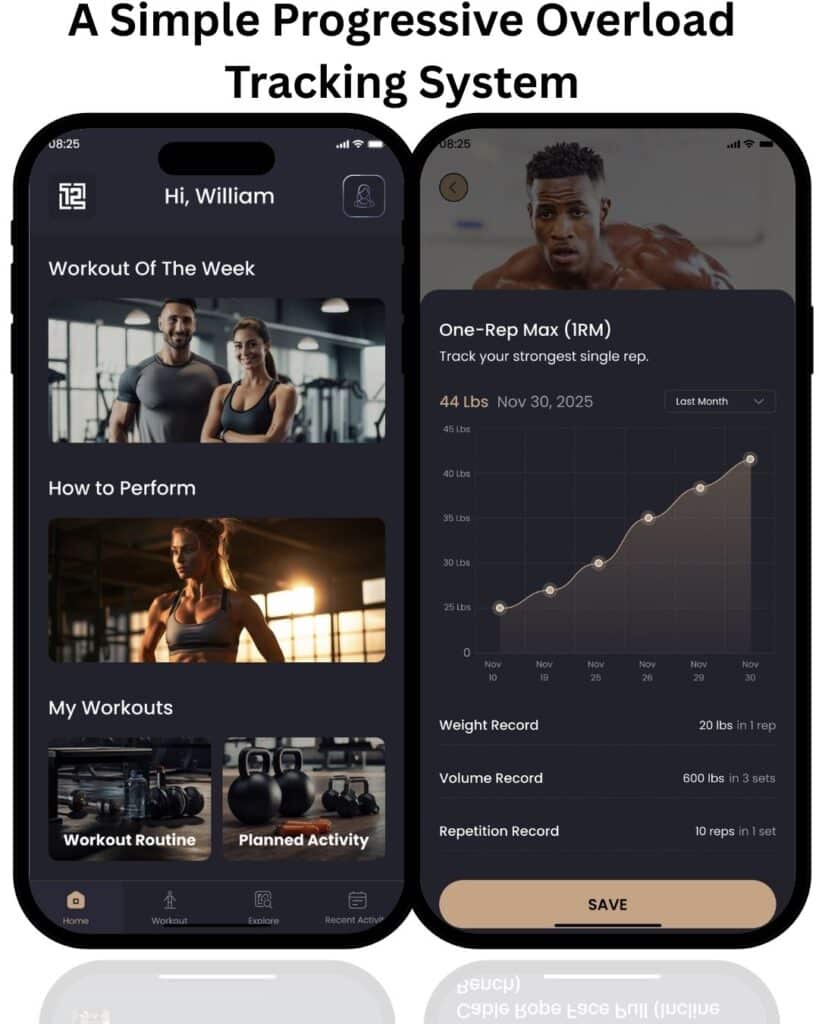
The 12REPS app automates this entire process. It tracks your history, shows what you did last time, suggests appropriate progressions and celebrates your personal records. Having this information at your fingertips during workouts removes guesswork and keeps you focused on what matters: doing slightly more than before.
Progressive overload is not complicated. It is simply the commitment to continuous, incremental improvement. Applied consistently over months and years, it transforms bodies that seemed stuck forever.
Your potential is far greater than your current performance suggests. Give your body a reason to grow, and watch what happens.
Related Articles on just12reps.com
| Article | Description | Link |
|---|---|---|
| Ultimate Guide to Workout Planners and Trackers | Why tracking is essential for progress and how to do it effectively. | Read Article |
| Complete Beginner’s Guide to Strength Training | A 12 week programme that applies progressive overload principles. | Read Article |
| Science Behind 12 Rep Training | Understanding rep ranges and their effects on muscle growth. | Read Article |
| Ultimate 12 Week Push Pull Legs | A structured programme with built in progression. | Read Article |
| Best Workout Planner and Tracker | How the right tools make progressive overload easier to implement. | Read Article |
[1] Schoenfeld, B.J. et al. (2017). Dose-response relationship between weekly resistance training volume and increases in muscle mass. Journal of Sports Sciences. https://www.tandfonline.com/toc/rjsp20/current
[2] Peterson, M.D. et al. (2011). Progression of volume load and muscular adaptation during resistance exercise. European Journal of Applied Physiology. https://link.springer.com/journal/421
[3] Kraemer, W.J. & Ratamess, N.A. (2004). Fundamentals of resistance training: progression and exercise prescription. Medicine and Science in Sports and Exercise. https://journals.lww.com/acsm-msse/pages/default.aspx
[4] Rhea, M.R. et al. (2003). A meta-analysis to determine the dose response for strength development. Medicine and Science in Sports and Exercise. https://journals.lww.com/acsm-msse/pages/default.aspx
[5] Fry, A.C. (2004). The role of resistance exercise intensity on muscle fibre adaptations. Sports Medicine. https://link.springer.com/journal/40279
About the Author: Will Duru holds a BSc (Hons) in Sport and Exercise Science and is an award winning personal trainer with over 10 years of experience helping clients achieve measurable, progressive results. He is the creator of the 12REPS app, designed to make tracking and progression simple for everyone.