




By Will Duru, BSc (Hons) Sport and Exercise Science, Award-winning Personal Trainer with over 10 years of experience in strength training and optimising recovery
Twelve reps is a good, practical choice for muscle growth, but it is not a magic number. Research shows that a wide range of rep ranges can build similar muscle, as long as each set ends close to failure. Effort, enough weekly sets and steady progress matter more than the exact rep count.
So why do so many plans use 12 reps? Sets of about 12 use a moderate weight. That makes it easier to keep good form, push close to failure and finish a session in a sensible time.
This article checks the common claims about 12-rep sets against the research, then shows you how to use them well. For a side-by-side look at other rep ranges, see our comparison of 12-rep workouts vs other rep ranges.

How Muscles Grow
Muscle growth, or hypertrophy, happens when your muscles adapt to repeated hard work. Over weeks and months, your body builds new muscle protein and the muscle fibers get larger.
Three drivers are usually named:
- Mechanical tension: the force your muscles produce against a challenging load. Every effective muscle-building program creates plenty of it.
- Metabolic stress: the “burn” you feel as byproducts build up during a hard set. It may add to growth, but how much is still debated.
- Muscle damage: the damage, and often soreness, that comes from new or very hard training.
The old idea that muscles grow because you “tear” them is not well supported. In a 2016 study in The Journal of Physiology, muscle damage was highest in the first week of training. Muscle growth was linked to protein building later on, once the damage had dropped. So you do not need to feel sore for a workout to work.

Is 12 Reps Best for Muscle Growth?
The classic “hypertrophy range” is about 8 to 12 reps per set. Newer research paints a broader picture.
- Load matters less than you might think: a 2021 network meta-analysis found that muscle growth appeared to be load independent. Light, moderate and heavy loads gave similar gains.
- One rep range per goal is too simple: a 2021 review of the “repetition continuum” concluded that muscle can be built across a wide range of loads.
- Effort matters: muscle growth tended to increase as sets were taken closer to failure, according to a 2024 series of meta-regressions. Going all the way to failure was not required, as a 2022 meta-analysis found.
So 12 reps does not build more muscle than lower or higher reps when the effort is similar. It is a useful middle ground, not a special zone.
Strength Is Different
If your main goal is maximal strength, heavier loads have an edge. In the same 2021 network meta-analysis, high and moderate loads gave larger strength gains than low loads. Read our guide to strength training vs hypertrophy to choose the right focus.
What About Time Under Tension?
Time under tension is how long a muscle works during a set. A set of 12 takes longer than a set of 5. But a 2015 meta-analysis found similar muscle growth with rep durations from 0.5 to 8 seconds. Very slow reps, over 10 seconds each, seemed less effective.
So you do not need to slow every rep right down. Control the weight, use a full range of motion and let the effort of the set do the work.
Why 12 Reps Is Still a Smart Default
Twelve reps is not special for growth, but it has real practical benefits:
- Manageable loads. A weight you can lift about 12 times is moderate. Many people find it easier to keep good form with it than with near-maximal weights.
- Easier to judge effort. People estimated their reps left more accurately in sets of 12 or fewer than in longer sets, according to a 2021 review. That helps you stop at the right point.
- Room for enough volume. Total weekly sets matter. A 2016 meta-analysis found that more weekly sets tended to mean more muscle growth. Sets of about 12 reps make it practical to do several hard sets per muscle in one session.
4. Consistency. The best rep range is one you can train with week after week. If moderate weights feel more comfortable for your joints and your confidence, that makes it easier to stay consistent. Heavy, low-rep work is still useful, especially for strength, so many plans use a mix of both.

How to Train for Muscle Growth With 12-Rep Sets
Doing 12 reps is not enough on its own. How you choose the weight, how you progress and how you recover matter more than the rep count.
1. Choose a Weight That Takes You Close to Failure
Pick a weight you can lift for 12 good reps with about 1 to 3 reps left in reserve. If you could do many more than 12, it is too light. If you cannot reach 8 reps, it is too heavy for this rep range.
Not sure how to judge reps left? Our guide to RPE vs RIR explains how to rate each set.
2. Use Progressive Overload
Progressive overload means slowly increasing the demand on your muscles over time. Once you can complete 12 good reps with a weight, raise the challenge. You can:
- Add a small amount of weight, then work back up to 12 reps.
- Add a rep or two with the same weight, such as 13 or 14.
- Add a set to the exercise.
For a step-by-step approach, read our complete guide to progressive overload.
3. Keep Your Form Consistent
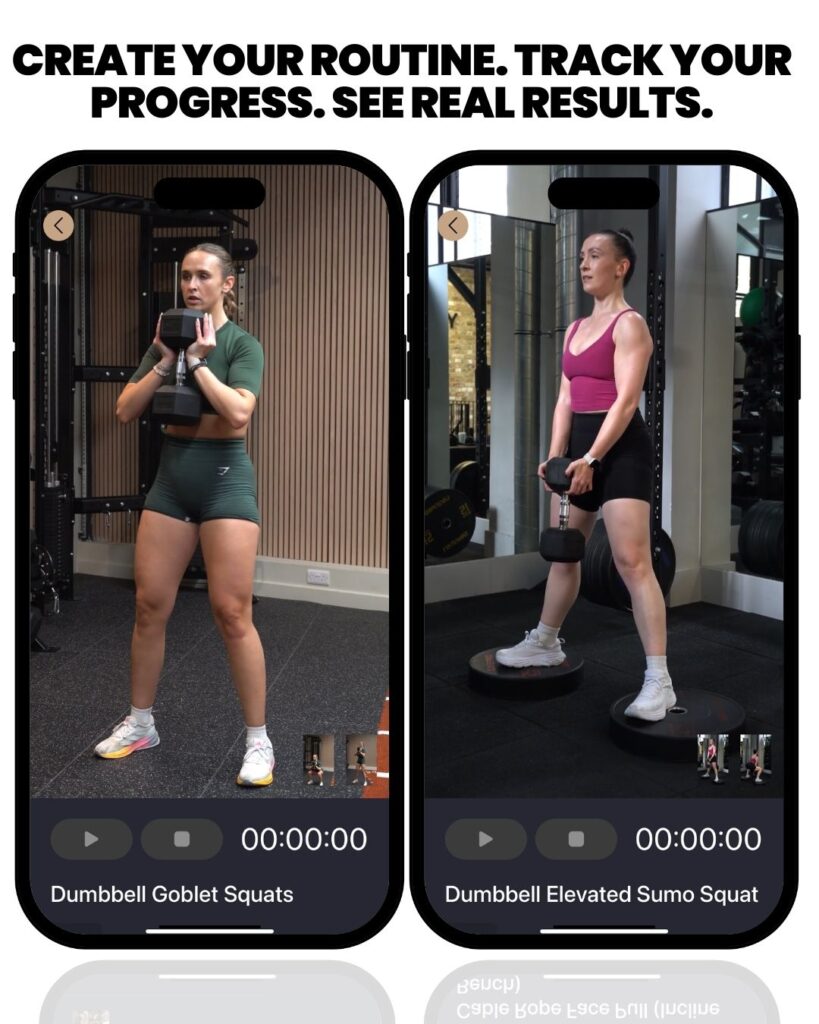
Move the weight with control through a full range of motion. Avoid swinging or bouncing it. The 12REPS exercise library has trainer demonstrations you can check your technique against.
4. Recover Well
Muscle grows as you recover between sessions. Adults aged 18 to 60 need at least 7 hours of sleep a night, according to the CDC. Eat enough protein, and give a muscle group time to recover before you train it hard again. Our guide on how often to lift covers training frequency.

Pick the Plan That Fits Your Week
Sample 12-Rep Workout Plans
Here are two sample plans that use 12-rep sets. Choose a weight that makes the last few reps of each set hard, with about 1 to 3 reps left in reserve. Do 3 sets of each exercise.
Full-Body Workout (3 Days a Week)
| Exercise | Sets | Reps |
|---|---|---|
| Barbell squat | 3 | 12 |
| Barbell bench press | 3 | 12 |
| Barbell bent-over row | 3 | 12 |
| Barbell overhead press | 3 | 12 |
| Biceps curl | 3 | 12 |
| Triceps pushdown | 3 | 12 |
| Plank | 3 | Hold 60 seconds |
Upper/Lower Split (4 Days a Week)
Upper Body Day 1
| Exercise | Sets | Reps |
|---|---|---|
| Incline dumbbell press | 3 | 12 |
| Lat pulldown | 3 | 12 |
| Seated dumbbell shoulder press | 3 | 12 |
| Seated cable row | 3 | 12 |
| Dumbbell lateral raise | 3 | 12 |
| EZ bar curl | 3 | 12 |
| Overhead triceps extension | 3 | 12 |
Lower Body Day 1
| Exercise | Sets | Reps |
|---|---|---|
| Leg press | 3 | 12 |
| Romanian deadlift | 3 | 12 |
| Leg extension | 3 | 12 |
| Hamstring curl | 3 | 12 |
| Calf raise | 3 | 15 to 20 |
| Ab crunch | 3 | 15 to 20 |
Upper Body Day 2
| Exercise | Sets | Reps |
|---|---|---|
| Flat barbell bench press | 3 | 12 |
| Pull-up (or assisted pull-up) | 3 | To failure (aim for 8 to 12) |
| Arnold press | 3 | 12 |
| T-bar row | 3 | 12 |
| Face pull | 3 | 15 |
| Hammer curl | 3 | 12 |
| Dip (or bench dip) | 3 | To failure (aim for 8 to 12) |
Lower Body Day 2
| Exercise | Sets | Reps |
|---|---|---|
| Barbell squat | 3 | 12 |
| Good morning | 3 | 12 |
| Lunge | 3 | 12 per leg |
| Glute bridge | 3 | 15 |
| Seated calf raise | 3 | 15 to 20 |
| Hanging leg raise | 3 | To failure |
These are examples, not a fixed program. Swap exercises to match your equipment and experience, and keep the effort high on every work set.

The Bottom Line on 12 Reps for Muscle Growth
Twelve reps is a solid, practical target for building muscle. It is not better than other rep ranges on its own. Muscle grows across a wide range of reps when you take sets close to failure, do enough weekly sets and progress over time.
Use 12-rep sets because they suit you: moderate weights, clear effort and workouts that fit your week. Add heavier sets if strength is a goal. To get more from each rep, try the tips in our guide to the mind-muscle connection.
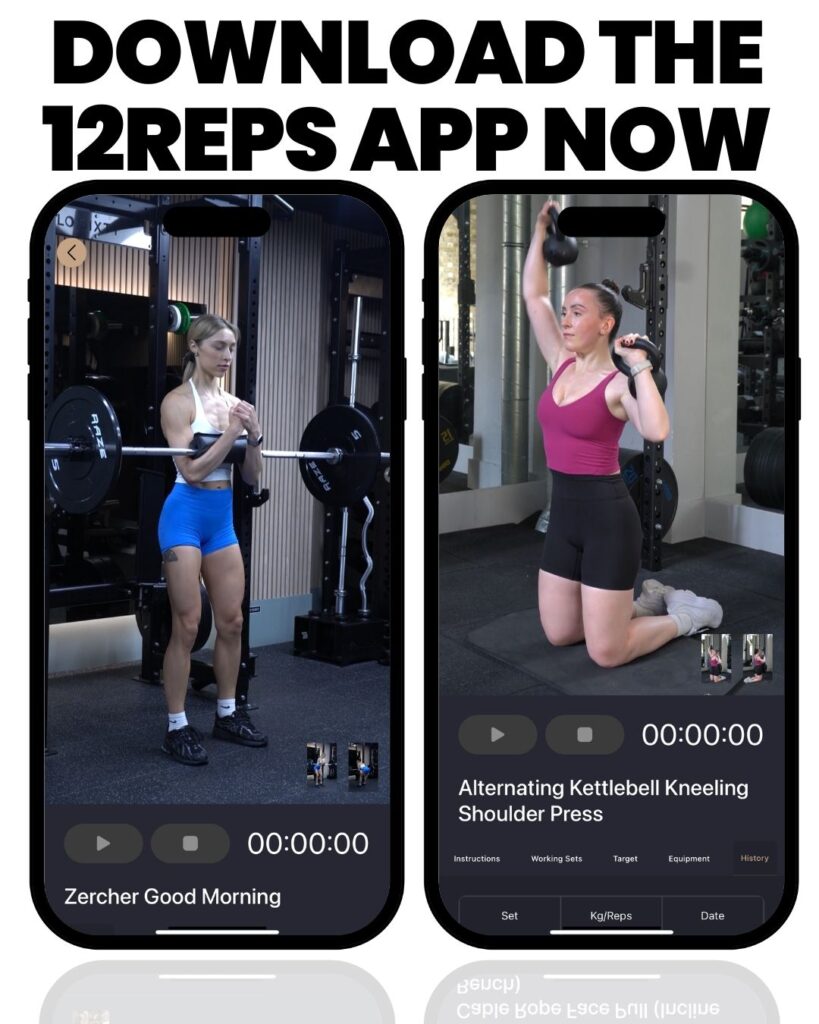
If you want a plan built around your goal, your equipment and your time, 12REPS sets out each session with a trainer demonstration for every exercise. It also remembers what you lifted, so you have a number to beat.
Want more detail? Read the science behind 12-rep training and our guide to understanding rep ranges.
Sources
- Resistance Training Load Effects on Muscle Hypertrophy and Strength Gain: Systematic Review and Network Meta-analysis (Lopez P et al.). Medicine and Science in Sports and Exercise, 2021. https://jyx.jyu.fi/handle/123456789/75929
- Loading Recommendations for Muscle Strength, Hypertrophy, and Local Endurance: A Re-Examination of the Repetition Continuum (Schoenfeld BJ et al.). Sports, 2021. https://doaj.org/article/6d51b905504d46f0873bb43d5d84bf21
- Exploring the dose-response relationship between estimated resistance training proximity to failure, strength gain, and muscle hypertrophy: a series of meta-regressions (Robinson ZP et al.). Sports Medicine, 2024. https://lida.sport-iat.de/ta/Record/4089104?lng=en
- Effects of resistance training performed to repetition failure or non-failure on muscular strength and hypertrophy: a systematic review and meta-analysis (Grgic J et al.). Journal of Sport and Health Science, 2022. https://doaj.org/article/dc36ba7ccd994798964f66b93bd8f662
- Resistance training-induced changes in integrated myofibrillar protein synthesis are related to hypertrophy only after attenuation of muscle damage (Damas F et al.). The Journal of Physiology, 2016. https://experts.mcmaster.ca/scholarly-works/61717
- Effect of Repetition Duration During Resistance Training on Muscle Hypertrophy: A Systematic Review and Meta-Analysis (Schoenfeld BJ, Ogborn DI, Krieger JW). Sports Medicine, 2015. https://vufind-test.katalog.k.utb.cz/SummonRecord/FETCH-LOGICAL-c541t-71978a7d24b170446a397e935773d903acfc02aad4f2e02dfc6d2a043f78c3353/Details
- Accuracy in predicting repetitions to task failure in resistance exercise: a scoping review and exploratory meta-analysis (Halperin I et al.). Sports Medicine, 2021. https://pure.solent.ac.uk/en/publications/accuracy-in-predicting-repetitions-to-task-failure-in-resistance-/
- Dose-response relationship between weekly resistance training volume and increases in muscle mass: a systematic review and meta-analysis (Schoenfeld BJ, Ogborn D, Krieger JW). Journal of Sports Sciences, 2016. https://paulogentil.com/pdf/Dose-response%20relationship%20between%20weekly%20resistance%20training%20volume%20and%20increases%20in%20muscle%20mass%20-%20A%20systematic%20review%20and%20metaanalysis.pdf
- 1 in 3 adults don’t get enough sleep. Centers for Disease Control and Prevention (CDC), 2016. https://archive.cdc.gov/www_cdc_gov/media/releases/2016/p0215-enough-sleep.html
