
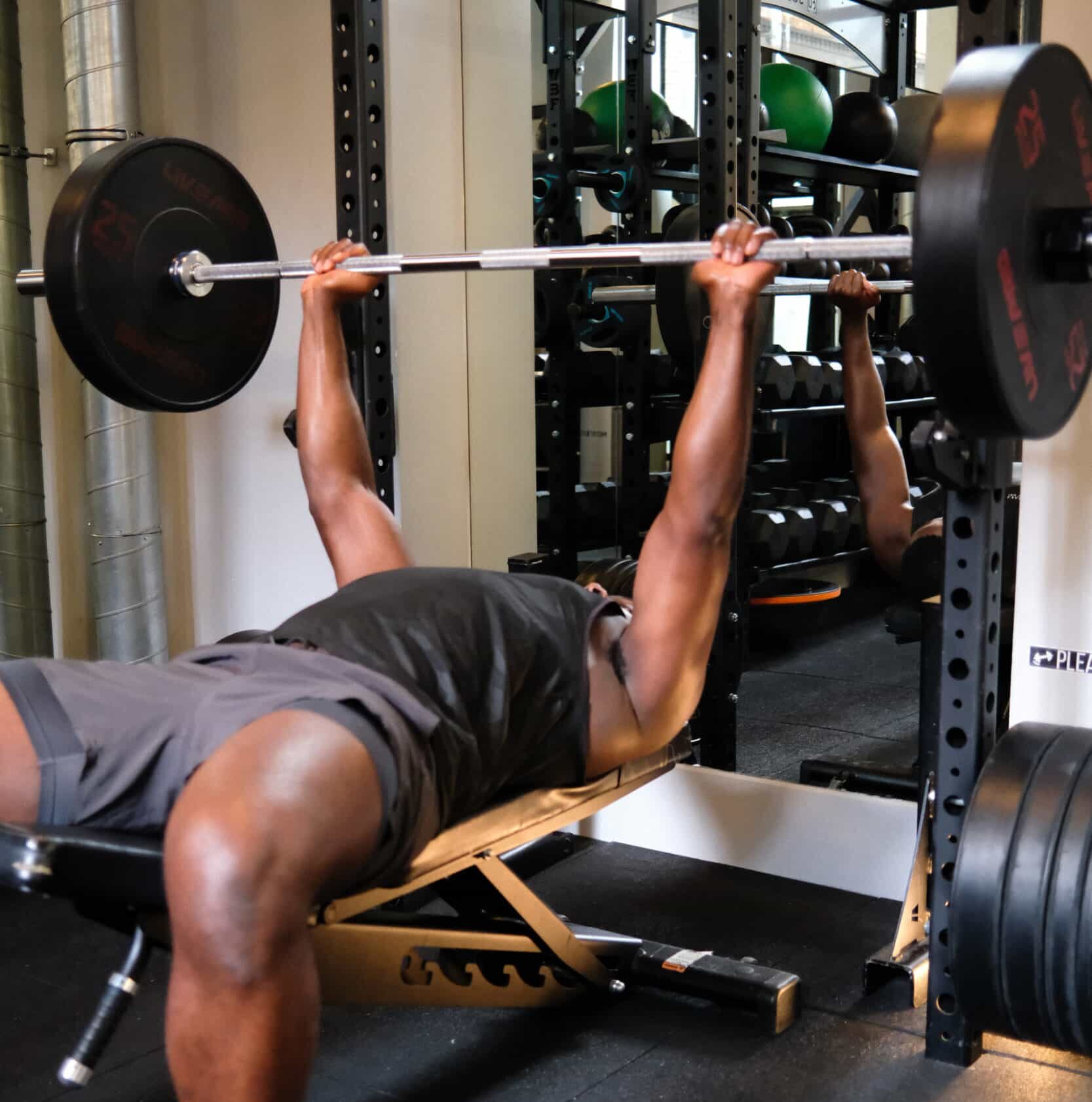



To increase your bench press when it has stalled, bench two or three times a week. Tighten your setup and train the part of the lift where the bar slows down. Then add weight in small steps and log every session, so you always know the number to beat. Most plateaus come from benching once a week, a setup that changes every session, and random heavy days.
You have been stuck at the same weight for months. Same sets, same reps, same frustration. This guide is about getting unstuck: finding why your bench has stalled and fixing it.
I’m Will Duru, a personal trainer in London with over 10 years of experience. Plateau, technique and weak-point problems are the bench press issues I see most in the gym.
If you are chasing a specific number, read your first 100 kg bench press roadmap next. It sets out the step-by-step plan to that milestone.
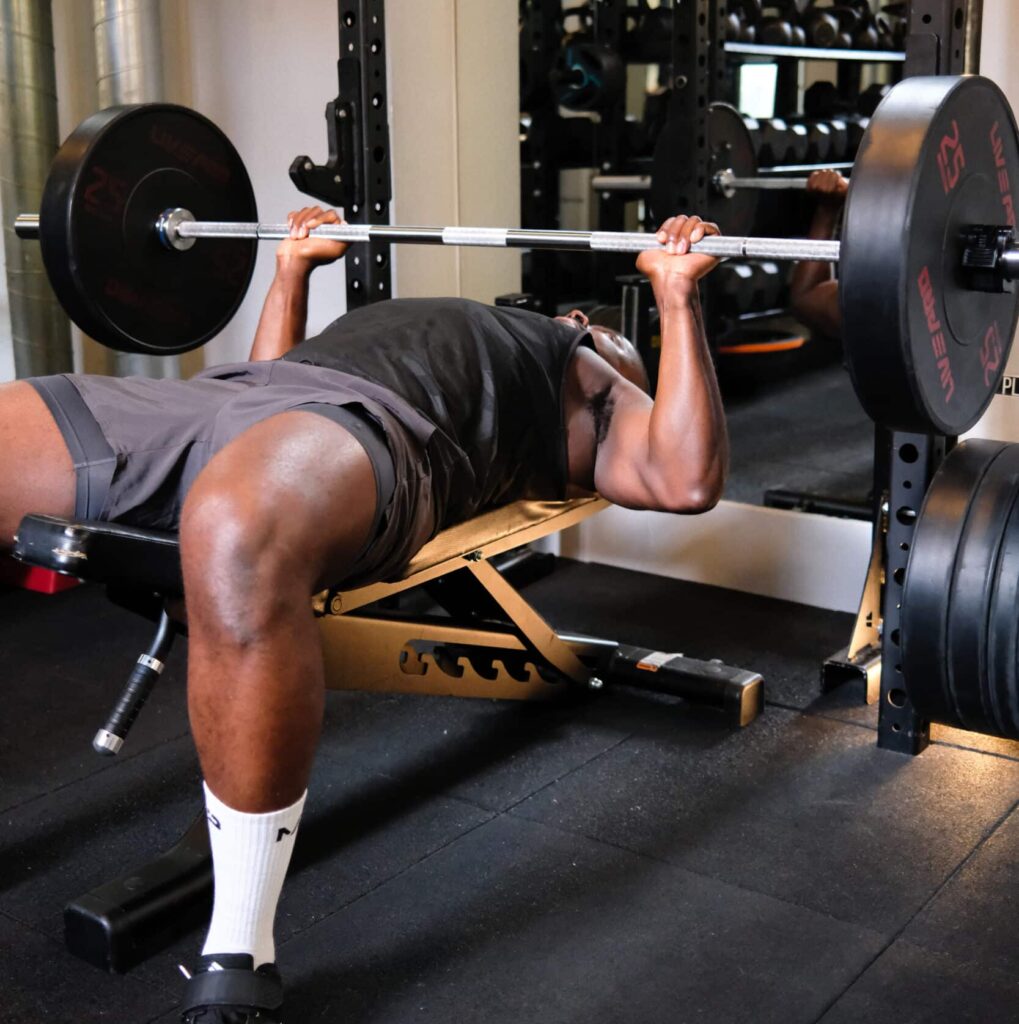
Why your bench press is stuck
A stalled bench usually has one of five causes. Check each one before you change your whole program.
1. You only bench once a week
Many lifters bench on “chest day” and nowhere else. That gives you one chance a week to practice the lift.
A 2018 meta-analysis found that training more often led to bigger strength gains in upper-body and multi-joint lifts like the bench press (Grgic et al., 2018). When weekly volume was matched, frequency made little difference. So the benefit seems to come from the extra quality sets you can fit in. Spreading your bench sets over two or three days makes that easier.
2. Your setup changes every session
If your feet, grip and touch point move from set to set, you are learning a new lift every week. A repeatable setup lets you put all your effort into pressing.
3. You have a weak point you never train
Most lifters have a part of the rep where the bar slows down, and where a failed rep usually stalls. Researchers call the point where a lift fails the sticking point (Kompf and Arandjelović, 2016). If you only ever do flat bench sets, that weak spot can stay weak.
4. Your training has no plan
Some days you do 70 kg for 8, other days 75 kg for 5. Without a plan and a log, you cannot tell if you are progressing. Progressive overload means doing a little more over time, and you can only do that if you know what you did last time.
5. You test instead of train
Grinding out a new max every week builds fatigue, not strength. Research shows you do not need to take every set to failure to gain strength (Grgic et al., 2022). Save heavy tests for the end of a training block. For more on effort, see how to know if you are training hard enough.
Video: Bench press. Watch the 12REPS demo to see the whole movement before you work through the technique checklist below.
Bench press technique checklist
Fix these points with a lighter weight first. A small drop in load for two or three weeks is worth it if your setup becomes repeatable. For a full walk-through, see the barbell bench press exercise guide.
Setup, before you unrack
- Eyes under the bar. Lie down so your eyes are roughly below the bar.
- Feet planted. Put your feet flat on the floor in a position they will not slide from. Push them into the floor through the whole set. Cue: “push the floor away.”
- Shoulder blades back and down. Squeeze them together and tuck them toward your back pockets. This gives you a stable base on the bench. Cue: “pinch a pencil between your shoulder blades.”
- Grip. Start with your hands about one and a half times shoulder width. When the bar touches your chest, your forearms should look close to vertical from the front.
- Natural arch. Keep a natural arch in your lower back. Your head, upper back and glutes stay on the bench.
The press
- Unrack with straight arms. Use a spotter or set the safety bars. Let the bar settle over your shoulders before you start.
- Lower with control. Take about two seconds to lower the bar to your lower chest. Touch the same point every rep, without bouncing.
- Press up and back. Drive the bar up and slightly back toward the rack, so it finishes over your shoulders. The path looks like a gentle curve, not a straight line.
- Stay tight. Keep your feet pushing and your shoulder blades pinched until the bar is back in the rack.
How grip width changes the lift
In studies of novice and trained men, medium and wide grips let lifters lift more than a narrow grip (Saeterbakken et al., 2021; Larsen et al., 2021). In trained lifters, a wide grip used the triceps less than medium or narrow grips. Chest activity was similar across grips.
Grip width does not remove the sticking point. In one study, the bar slowed through a similar part of the press with every grip width (Larsen et al., 2021). A review also warns that a wide grip may raise the risk of shoulder injury, so make any change gradually (Kompf and Arandjelović, 2016).
Find your sticking point and train it
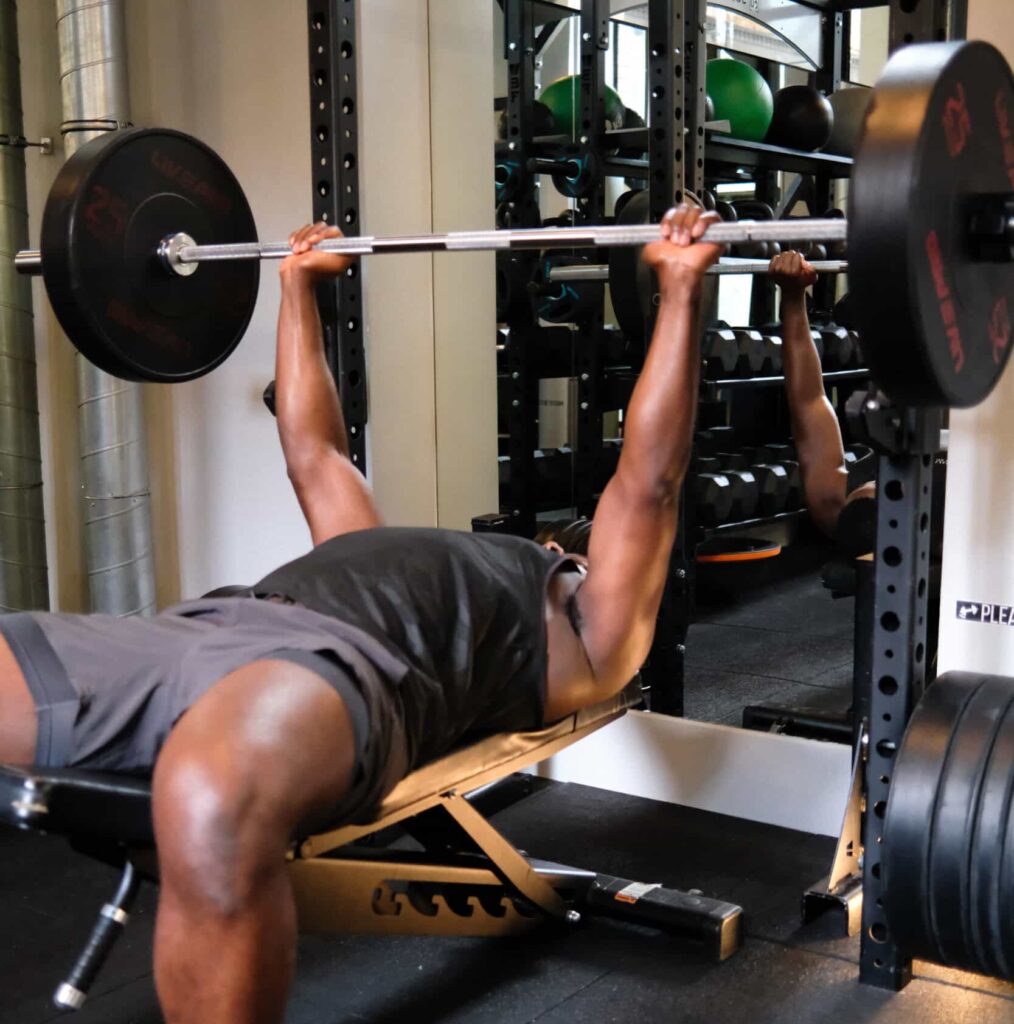
Film a heavy set from the side, or ask someone to watch. Note where the bar slows down. Then add one or two exercises that train that range. There is little direct research on matching accessories to sticking points, so treat these as starting points and track whether they help.
| Where the bar slows | Common cause | Exercises to try |
|---|---|---|
| Just off the chest | Chest strength and losing tightness at the bottom | Paused bench press, dumbbell incline press |
| Halfway up | Overall pressing strength | More weekly bench sets, floor press |
| Near lockout | Triceps strength | Close-grip bench, triceps dips, overhead triceps extensions |
For lockout problems, the dumbbell close-grip chest press is a useful option if the barbell version bothers your wrists. For more triceps work, see how to build bigger arms.
Video: Triceps dips. Dips train the triceps hard near lockout. Watch the demo to see how far to lower and how to keep your shoulders down.
Video: Dumbbell incline chest press. This is the incline accessory in the plan below. The demo shows the bench angle and how to control the dumbbells at the bottom.
A 12-week plan to break a bench press plateau
This plan has you bench three times a week. Each day has a different job.
- Monday, heavy day: 3 to 6 reps to build top-end strength.
- Wednesday, volume day: 8 to 10 reps to add quality practice and build muscle.
- Friday, technique day: paused reps with a 3-second pause on the chest.
The weights below are an example for a lifter whose heavy sets start at 65 kg for 5 reps. Use your own numbers. Start each day with a weight you can lift for every target rep with good form and a rep or two to spare.
Rule for adding weight: when you hit every target rep with good form, add the smallest jump available next week (usually 2.5 kg on a barbell). If you miss reps, keep the weight and try to beat your reps. The American College of Sports Medicine gives a similar rule. Raise the load by about 2 to 10% once you beat your target by one or two reps in two sessions in a row (ACSM, 2009).
| Week | Monday (heavy) | Wednesday (volume) | Friday (technique, 3-second pause) |
|---|---|---|---|
| 1 | 65 kg × 5, 5, 5, 5 | 55 kg × 10, 10, 10 | 52.5 kg × 5, 5, 5 |
| 2 | 67.5 kg × 5, 5, 5, 4 | 57.5 kg × 10, 10, 9 | 55 kg × 5, 5, 5 |
| 3 | 67.5 kg × 5, 5, 5, 5 | 57.5 kg × 10, 10, 10 | 55 kg × 6, 6, 6 |
| 4 | 70 kg × 5, 5, 5, 4 | 60 kg × 10, 10, 9 | 57.5 kg × 5, 5, 5 |
| 5 | 70 kg × 5, 5, 5, 5 | 60 kg × 10, 10, 10 | 57.5 kg × 6, 6, 6 |
| 6 | 72.5 kg × 4, 4, 4, 3 | 62.5 kg × 9, 9, 8 | 60 kg × 5, 5, 5 |
| 7 | 72.5 kg × 5, 5, 4, 4 | 62.5 kg × 10, 10, 9 | 60 kg × 6, 6, 5 |
| 8 | 75 kg × 4, 4, 3, 3 | 65 kg × 9, 8, 8 | 62.5 kg × 5, 5, 4 |
| 9 | 75 kg × 5, 4, 4, 4 | 65 kg × 10, 9, 9 | 62.5 kg × 5, 5, 5 |
| 10 | 77.5 kg × 3, 3, 3, 3 | 67.5 kg × 8, 8, 7 | 65 kg × 5, 4, 4 |
| 11 | 77.5 kg × 4, 4, 3, 3 | 67.5 kg × 9, 9, 8 | 65 kg × 5, 5, 5 |
| 12 | 80 kg × 3, 3, 2, 2 | 70 kg × 8, 8, 7 | 67.5 kg × 5, 4, 4 |
Rest between sets: 3 to 4 minutes on the heavy day, 2 to 3 minutes on the volume day and 2 minutes on the technique day. For more on rest, read how long to rest between sets.
Accessory exercises
Do these after your main bench work.
| Day | Exercise | Sets × reps | Why |
|---|---|---|---|
| Monday | Close-grip bench press | 3 × 8 to 10 | Triceps strength for lockout |
| Monday | Dumbbell single-arm row | 3 × 10 to 12 | Upper-back strength for a stable base |
| Wednesday | Incline dumbbell press | 3 × 10 to 12 | Extra chest and shoulder pressing |
| Wednesday | Weighted dips | 3 × 8 to 12 | Triceps and chest pressing strength |
| Friday | Overhead triceps extension | 3 × 12 to 15 | Triceps size |
| Friday | Face pulls | 3 × 15 to 20 | Upper back and rear shoulders |
After week 12
Take a lighter week with about half your usual sets. Then start a new block from your new numbers. Our guide to the deload week explains how to set one up.
Be patient. In my coaching, going from a 60 kg bench to 100 kg usually takes more than a year of steady training, not 12 weeks.
Common bench press mistakes
- Benching once a week. Spread your bench sets over two or three days so you get more practice.
- Feet that float. Plant your feet and keep pushing them into the floor for the whole set.
- Bouncing the bar off your chest. Lower under control and touch lightly. The bounce hides weakness at the bottom.
- Losing your shoulder blades mid-set. Reset them between reps if you need to, or end the set.
- Ignoring triceps and upper back. Your triceps finish the press. Your upper back gives you a firm base.
- Testing your max every week. Train for weeks, then test at the end of a block.
Bench press FAQs
How often should I bench to increase my bench press?
Two or three times a week works well for most lifters. One day can be heavy and another lighter or focused on technique. What matters most is the total number of quality sets you do each week.
Should I train to failure to break a plateau?
No. Failure is not needed for strength gains, and it adds fatigue. End most sets with one or two good reps left in the tank.
Does a wider grip help me bench more?
A medium or wide grip usually lets you lift more than a narrow grip. A very wide grip is not always better and can stress your shoulders. Find the width that keeps your forearms close to vertical at the bottom.
The bottom line
To increase your bench press, bench two or three times a week, make your setup repeatable and train the part of the rep where you stall. Add weight in small steps, rest between blocks and log every set. If you want to work toward a specific number, follow the first 100 kg bench press roadmap. For the wider muscle-building side of chest training, read how to build a bigger chest.
A plan like this only works if you know what you lifted last time. 12REPS logs every set, rep and weight and shows your last numbers in the session, so you always have a weight to beat. It also has a trainer demonstration for each exercise.
Sources
- Effect of Resistance Training Frequency on Gains in Muscular Strength: A Systematic Review and Meta-Analysis. Grgic J, Schoenfeld BJ, Davies TB, Lazinica B, Krieger JW, Pedisic Z. Sports Medicine, 2018. https://pubmed.ncbi.nlm.nih.gov/29470825/
- The Effect of Grip Width on Muscle Strength and Electromyographic Activity in Bench Press among Novice- and Resistance-Trained Men. Saeterbakken AH, Stien N, Pedersen H, Solstad TEJ, Cumming KT, Andersen V. International Journal of Environmental Research and Public Health, 2021. https://www.mdpi.com/1660-4601/18/12/6444
- A Biomechanical Analysis of Wide, Medium, and Narrow Grip Width Effects on Kinematics, Horizontal Kinetics, and Muscle Activity on the Sticking Region in Recreationally Trained Males During 1-RM Bench Pressing. Larsen S, Gomo O, van den Tillaar R. Frontiers in Sports and Active Living, 2021. https://doi.org/10.3389/fspor.2020.637066
- Understanding and Overcoming the Sticking Point in Resistance Exercise. Kompf J, Arandjelović O. Sports Medicine, 2016. https://link.springer.com/doi/10.1007/s40279-015-0460-2
- Effects of resistance training performed to repetition failure or non-failure on muscular strength and hypertrophy: A systematic review and meta-analysis. Grgic J, Schoenfeld BJ, Orazem J, Sabol F. Journal of Sport and Health Science, 2022. https://pubmed.ncbi.nlm.nih.gov/33497853/
- American College of Sports Medicine position stand. Progression models in resistance training for healthy adults. American College of Sports Medicine. Medicine & Science in Sports & Exercise, 2009. https://pubmed.ncbi.nlm.nih.gov/19204579/
